

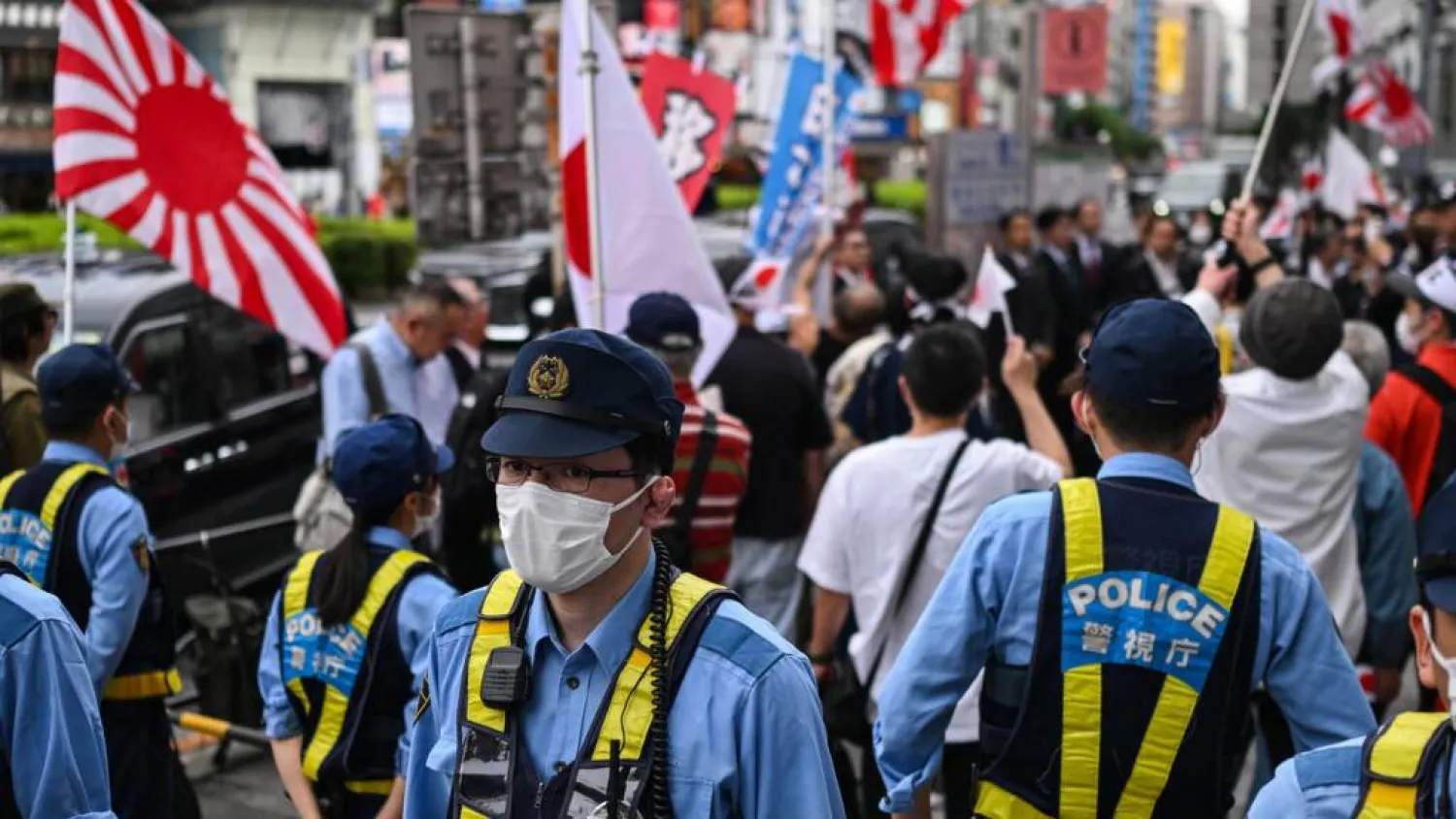

Japan Tightens Rules for Foreigners Wanting Permanent Residency

Foreign residents wishing to stay in Japan permanently will have to prove their annual income is above average. Andrew CABALLERO-REYNOLDS / AFP
TT

Japan Tightens Rules for Foreigners Wanting Permanent Residency

Foreign residents wishing to stay in Japan permanently will have to prove their annual income is above average. Andrew CABALLERO-REYNOLDS / AFP

Japan toughened on Thursday requirements for foreigners wanting to obtain permanent residency, as part of Prime Minister Sanae Takaichi's push to tighten immigration controls.

Under new rules that will come into effect in stages, foreign residents wishing to stay in Japan permanently will have to prove their annual income is above average and they can carry casual conversations in Japanese.

Application fees will also rise 20-fold from Thursday and at one immigration office in central Tokyo visited by AFP this week hundreds of people queued, hoping to wrap up procedures before the price spike.

"I understand that over-accepting foreigners... might dilute Japan's unique culture. But at the same time, given its low birth rate and aging population, Japan has to accept foreigners," said American-born university student Yujie Chono, who was among those waiting.

The 22-year-old told AFP, in fluent Japanese, that he had been waiting for five hours to file his paperwork.

Previous guidelines did not lay out specific thresholds for income, pension or language skills.

Even though Japan has a rapidly aging population and is suffering labor shortages in many sectors, opposition to immigration is growing, prompting a push by Takaichi for tighter regulations on foreign nationals.

"As the number of foreign residents in Japan increases, the government is facing the fact that some citizens feel anxiety and a sense of unfairness," Takaichi said in an extended post on X on Sunday, adding that she was pushing for "orderly coexistence" with foreign nationals.

Programs to attract international workers have fueled public worry.

Anti-immigration sentiment has spread across social media and false claims have circulated widely, including that a significant portion of welfare payments in Japan go to foreigners and that they are making Japanese streets less safe.

Experts and many business leaders warn however that Japan must welcome more foreign workers to sustain itself.

Japan needs to open its doors to more foreigners, the Nikkei business daily said in a recent editorial.

"Japan should stop viewing foreigners merely as a temporary labor force and instead promote their long-term settlement by expanding Japanese-language education and improving their treatment," it said.

- Anti-immigration sentiment -

Foreigners were a major issue in last year's upper house election which saw the sharp rise of the "Japanese-first" Sanseito party, which describes immigration as a "silent invasion".

The new rules for permanent residency come after the ruling Liberal Democratic Party last year pushed to tighten regulations for business manager visas, meaning entrepreneurs will be forced to leave Japan if they don't meet the new conditions.

Some foreign residents seek permanent residency to secure long-term stability, employment freedom and to earn trust within Japanese society. Those without permanent residency often have a difficult time seeking mortgages, for example.

Thursday's changes may prevent some people from applying for permanent residency but should not immediately push anyone out of the country.

Under the regulations, the application fee for permanent residency will soar to 200,000 yen ($1,275) from the current 10,000 yen.

Candidates must also show "understanding" of social rules and demonstrate expected pension benefits equivalent to someone who has paid pension insurance for 30 years.

Having lived in Japan for a decade, permanent residency applicant Chono said he saw both sides of the debate but that the country needed young people "to support its future".

"In recent years, I believe there had been a strong push to promote cultural diversity. The momentum has stalled, perhaps, and maybe it may never fully return," he said.


Türkiye Nabs Suspect in 2013 Attack by Syria Border

A Turkish flag with the Bosphorus Bridge in the background, flies on a passenger ferry in Istanbul, Türkiye, September 30, 2020. (Reuters)
TT

Türkiye Nabs Suspect in 2013 Attack by Syria Border

A Turkish flag with the Bosphorus Bridge in the background, flies on a passenger ferry in Istanbul, Türkiye, September 30, 2020. (Reuters)

Türkiye's intelligence agency has captured a key suspect from a deadly 2013 attack near the Syrian border while he was attempting to flee to Europe, state media said Thursday, citing a security source.

The twin bombings in the southern Reyhanli district, which killed 53 people, was the deadliest attack in Türkiye linked to fallout from Syria's civil war that began two years earlier, said AFP.

Omar al-Khatib, a Syrian who was the subject of an Interpol red notice, is believed to have coordinated between the attackers and intelligence officials loyal to Syria's then president Bashar al-Assad, Anadolu news agency reported.

Türkiye's National Intelligence Organization (MIT) detained al-Khatib as he prepared to leave for Europe by sea, Anadolu said, without saying exactly where or when he was caught.

Ankara blamed Turkish extremist groups allegedly backed by the Syrian government for the Reyhanli attack, accusations Damascus denied.

Türkiye was a strong supporter of Syrian rebels seeking to overthrow Assad and has hosted millions of Syrians who fled the conflict.

Since Assad's ouster nearly two years ago, Ankara has built close ties with Syria's new leadership under President Ahmed al-Sharaa.


Explosions Heard Overnight in Ethiopia's Capital

(FILES) Tigray People's Liberation Front (TPLF) fighters prepare to leave for another field at Tigray Martyr's Memorial Monument Center  in Mekele, the capital of Tigray region, Ethiopia, on June 30, 2021. (Photo by Yasuyoshi Chiba / AFP)
(FILES) Tigray People's Liberation Front (TPLF) fighters prepare to leave for another field at Tigray Martyr's Memorial Monument Center in Mekele, the capital of Tigray region, Ethiopia, on June 30, 2021. (Photo by Yasuyoshi Chiba / AFP)
TT

Explosions Heard Overnight in Ethiopia's Capital

(FILES) Tigray People's Liberation Front (TPLF) fighters prepare to leave for another field at Tigray Martyr's Memorial Monument Center  in Mekele, the capital of Tigray region, Ethiopia, on June 30, 2021. (Photo by Yasuyoshi Chiba / AFP)
(FILES) Tigray People's Liberation Front (TPLF) fighters prepare to leave for another field at Tigray Martyr's Memorial Monument Center in Mekele, the capital of Tigray region, Ethiopia, on June 30, 2021. (Photo by Yasuyoshi Chiba / AFP)

Explosions were heard overnight in Ethiopia's capital Addis Ababa, three diplomatic sources told Reuters.

A source linked to the opposition alliance that has been fighting federal forces in northern Ethiopia since last week said the alliance had carried out several drone strikes in Addis Ababa, including some targeting the military's headquarters there.

Reuters could ‌not independently ‌verify the claim.

If confirmed, ‌the ⁠strikes would mark ⁠the first known drone attack by anti-government forces on the Ethiopian capital.

Spokespeople for Prime Minister Abiy Ahmed's office, the federal government and the military did not immediately respond to requests for comment.

Last ⁠week's clashes in northern Ethiopia ‌were the biggest escalation ‌of violence in Ethiopia since the end ‌of a 2020-2022 civil war.

The national intelligence ‌service announced on Wednesday that it was banning for an indefinite period all drone flights over Addis Ababa and its surroundings for ‌security reasons.

Opposition alliance forces were not previously known to operate armed ⁠drones. ⁠However, there is growing evidence they may possess at least some drone capability.

On Tuesday, a pro-government militia in the northern region of Tigray said it had captured drone frames and batteries from forces linked to the Tigray People's Liberation Front (TPLF), one of the alliance's main members.

Reuters could not independently verify that claim.


Immigration Judge Rules US Can Deport President of Wisconsin's Largest Mosque

FILE - This photo provided by Yaseen Jajeeb shows Islamic Society of Milwaukee President Salah Sarsour on June 18, 2026, shortly after his release from Clay County Jail in Brazil, Indiana, where he was detained after his arrest by US Immigration and Customs Enforcement agents in March. (Yaseen Najeeb via AP, File)
TT

Immigration Judge Rules US Can Deport President of Wisconsin's Largest Mosque

FILE - This photo provided by Yaseen Jajeeb shows Islamic Society of Milwaukee President Salah Sarsour on June 18, 2026, shortly after his release from Clay County Jail in Brazil, Indiana, where he was detained after his arrest by US Immigration and Customs Enforcement agents in March. (Yaseen Najeeb via AP, File)

An immigration judge ruled that the US government can deport Palestinian American Salah Sarsour, who is the president of Wisconsin's largest mosque and a US permanent resident, under a Cold War-era law.
Sarsour, who grew up in the Israeli-occupied West Bank, was detained by the Immigration and Customs Enforcement agency in late March and released in mid-June after a federal judge said he had raised a substantial free speech retaliation claim that would render his detention unlawful, reported Reuters.
Chicago Immigration ‌Court Judge Jayme ‌Salinardi sided late on Tuesday with the government's argument that ‌Sarsour ⁠posed a security and ⁠foreign policy threat under the Cold War-era Immigration and Nationality Act, while rejecting the government's allegation that he lied on his green card application.
The US Department of Homeland Security welcomed the ruling, saying the judge "sustained multiple grounds of removability" in the case.
Sarsour said his legal team will appeal the ruling, which he called "deeply disappointing."
"I will not stop standing up for what's right and for justice in Palestine," he said in a statement. Sarsour cannot ⁠be deported until all legal avenues available to him are ‌exhausted. He says his life will be at risk ‌if deported to the West Bank.
Islamic Society of Milwaukee, Wisconsin's largest mosque, says Sarsour has ‌lived in the US for over three decades.
The mosque has said Sarsour ‌was "being targeted on the basis of his Palestinian and Muslim background, and his advocacy for Palestinian rights."
He has type 2 diabetes and lost more than 30 pounds in ICE detention, his legal team said.
Sarsour has no criminal record in the US and was convicted as a teenager ‌in Israeli military court before he came to the United States, which the Trump administration noted to cast him as a ⁠threat. Sarsour says ⁠the government has known that information for decades.
Israeli rights group B'Tselem says military courts in the West Bank, where Palestinians are tried for alleged crimes, have a 96% conviction rate and a history of extracting confessions through torture.
President Donald Trump's administration says Sarsour was convicted of throwing Molotov cocktails at the homes of Israeli armed forces.
Sarsour denies committing such crimes and says he was tortured and coerced into past confessions.
Trump has attempted to deport foreign pro-Palestinian protesters, threatened funding freezes for universities where protests were held, enforced a social media screening of immigrants and sanctioned Israel's critics.
Trump alleges pro-Palestinian voices are antisemitic and support extremists. Advocates, including some Jewish groups, say their criticism of Israeli attacks on Gaza and of Israel's occupation of Palestinian territories does not amount to antisemitism, and their advocacy for Palestinian rights should not be conflated with supporting extremism.
