What Does Activating the 7700, 7600 and 7500 Emergency Codes Mean in Aviation?

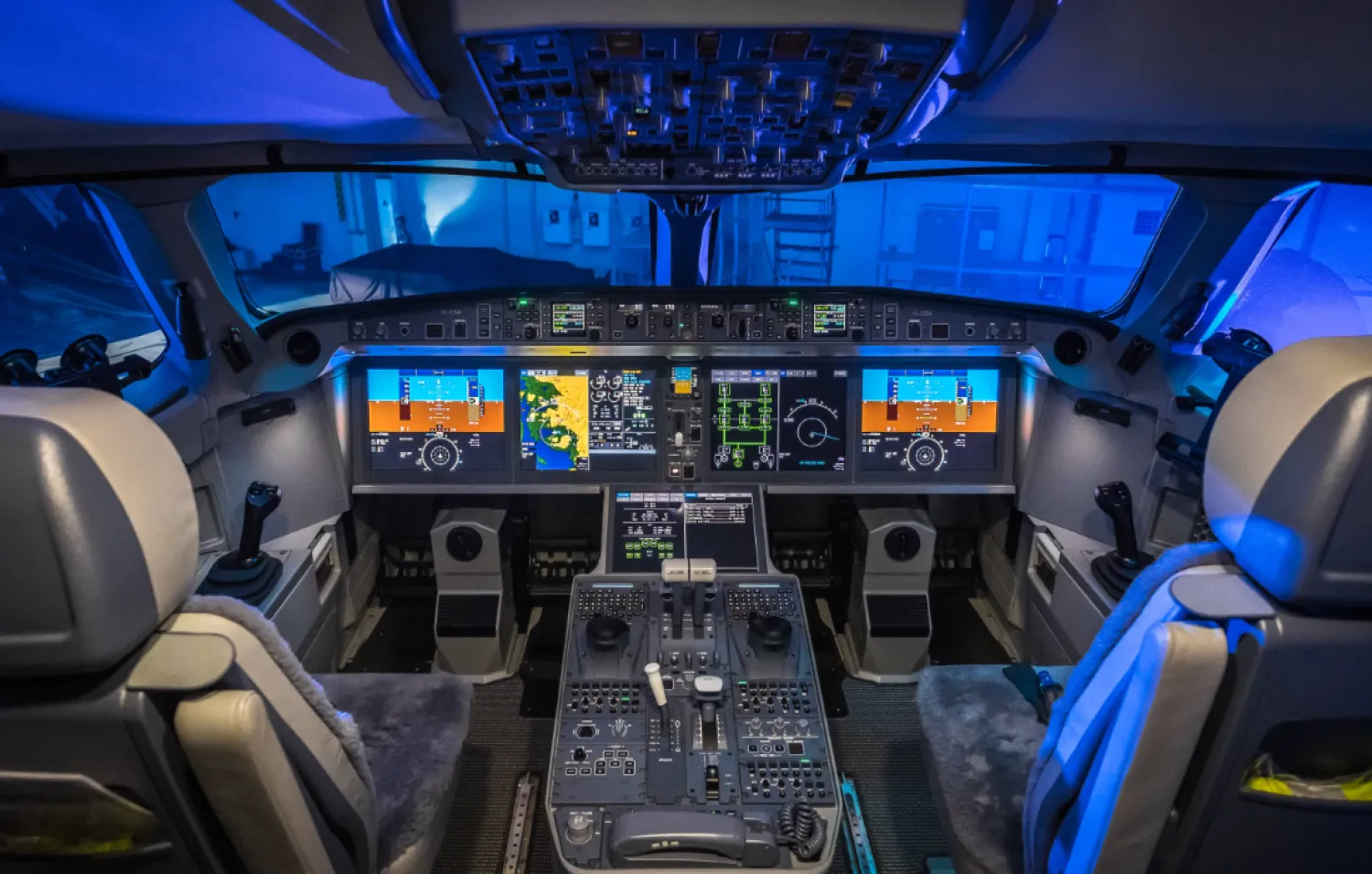
An illustration showing the layout of a modern glass cockpit, with advanced digital displays and the center pedestal located between the captain's and first officer's seats. The transponder used by pilots to enter the three-digit emergency codes 7700, 7600 and 7500 is located in this area. The codes are then displayed on air traffic controllers' radar screens. (Wikipedia)
TT

What Does Activating the 7700, 7600 and 7500 Emergency Codes Mean in Aviation?

An illustration showing the layout of a modern glass cockpit, with advanced digital displays and the center pedestal located between the captain's and first officer's seats. The transponder used by pilots to enter the three-digit emergency codes 7700, 7600 and 7500 is located in this area. The codes are then displayed on air traffic controllers' radar screens. (Wikipedia)

In aviation, flights operate according to carefully defined scenarios, but behind the apparent calm of the cockpit lies a coded digital language capable of changing the situation in the skies within seconds.

The recent incident involving a Flydubai flight, during which the emergency codes 7700 and then 7500 were activated, has again drawn attention to the strict and largely unseen protocols used by air traffic control centers to manage complex emergencies.

Between the emergency signal for a technical failure and the dramatic shift to the code indicating unlawful interference, how do the "shadow soldiers" on the ground manage a crisis involving an aircraft suspended between the sky and the ground until its wheels reach the safety of the runway?

The Silent Code and the Geography of Risk in Air Traffic Control Centers

Air traffic control centers monitor air traffic through continuous radio signals transmitted by the aircraft's transponder. When a cockpit crew faces a serious predicament, words can become a burden, and pressing buttons on the aircraft's equipment becomes the fastest means of signaling for help.

These distress signals appear on ground radar screens as flashing signals with distinctive colors that immediately draw the controller's attention. Internationally, they are known as "squawk codes," as designated by the International Civil Aviation Organization (ICAO).

Code 7700 represents the first technical and operational line of defense. It signals a major general emergency, which may range from critically low fuel or engine failure to serious medical emergencies, requiring an immediate response to secure a landing route.

But the danger takes on a different dimension when the code changes to 7500, the code for unlawful interference and hijacking. This alarming signal tells ground operations that the cockpit may have fallen under the control of an outside party, or that the safety of the aircraft and its passengers is under an imminent threat involving weapons or intimidation.
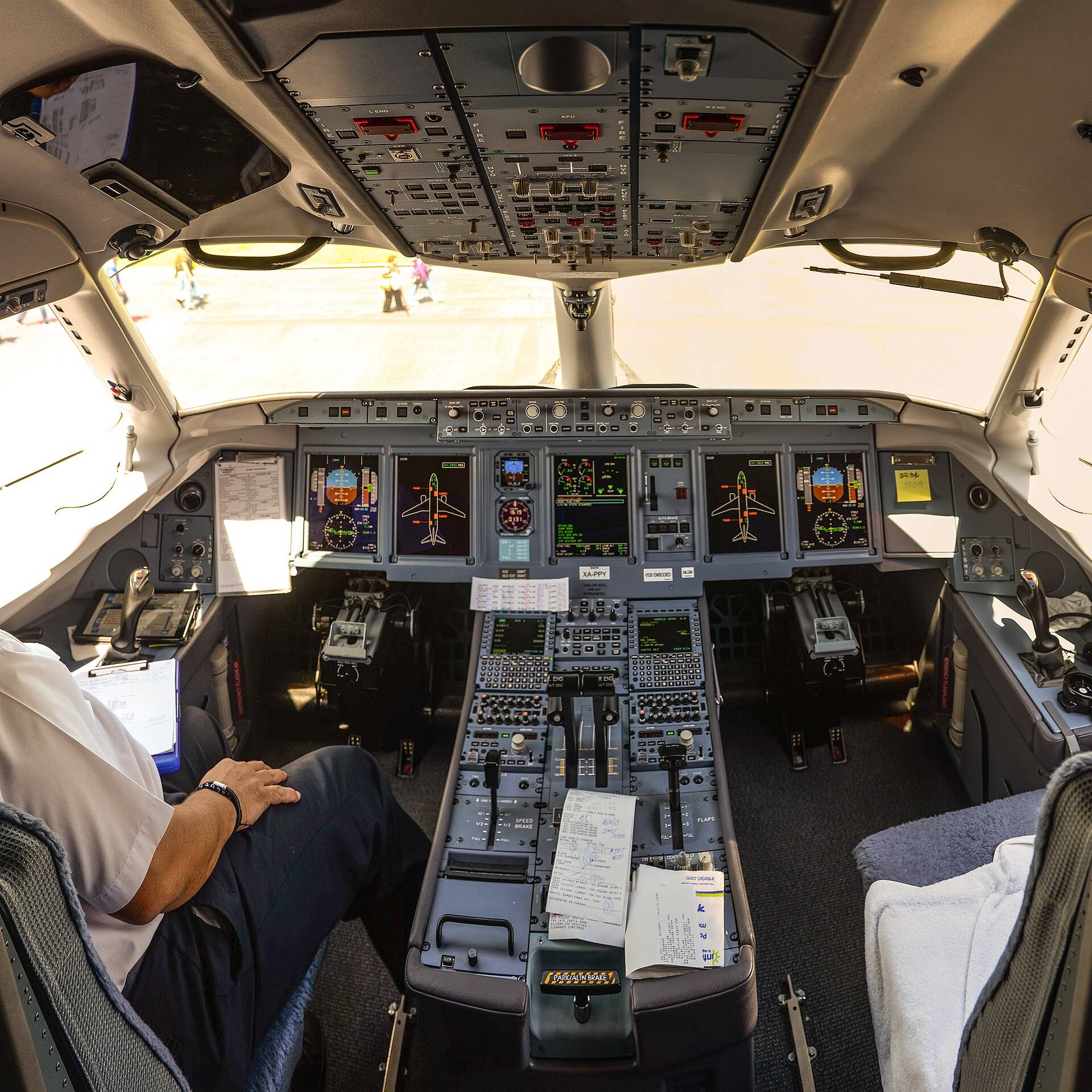
An image showing the layout of aircraft cockpits (Wikipedia)

The Mystery of Radio Silence and Decoding Code 7600

Between these two dangers is the other well-known code, 7600, which is used to indicate a complete failure of the aircraft's radio communications systems.

This code presents a unique challenge. The aircraft becomes "deaf and mute" in the sky, unable to receive instructions from the ground or transmit reports, while remaining visible on radar screens. Air traffic control handles code 7600 based on a clear assumption: controllers assume the pilot will follow the original flight plan precisely and begin clearing the airspace ahead of the aircraft based on its expected route.

The greatest danger lies in the overlap between these codes. Code 7600 may result from an innocent electrical failure, but in other scenarios it could be a deliberate maneuver by hijackers who have disconnected communications equipment to isolate the aircraft. This puts air traffic control centers on maximum alert as they work to resolve the ambiguity and determine that it has not developed into a 7500 situation.

Airspace Surgery and Securing Clear Routes

Once air traffic controllers detect the technical emergency code 7700, they begin what amounts to precise surgery in the surrounding airspace. Controllers immediately stop managing normal commercial traffic flow and focus their full attention on securing a route for the aircraft in distress.

All nearby aircraft receive decisive instructions to change altitude and move away from the affected aircraft's flight path, leaving the surrounding airspace completely clear and protected against any potential collision.

Ground authorities give the aircraft in distress absolute priority over all other flights and completely exempt it from the standard speeds and altitudes normally used in air navigation. Within minutes, control towers coordinate with ground authorities at the destination airport, positioning firefighting and rescue vehicles along the runway in preparation for a landing that may require urgent mechanical intervention.

Concealment Protocol and Management of Security Intervention

The situation inside operations centers changes completely if the alert becomes the hijacking code 7500. At that point, the crisis ceases to be a general aviation event and becomes a national security matter subject to the sovereign laws of the countries involved.

Strict international instructions require air traffic controllers to follow a protocol of radio silence and concealment. They are completely prohibited from using language over open radio frequencies that could indicate a hijacking or the presence of a security threat, in order to avoid provoking the perpetrators inside the cabin if they are listening to air traffic communications.

In such circumstances, the controller resorts to routine, coded messages, asking the pilot to reconfirm the aircraft's squawk code as a verification measure. If the pilot re-enters or confirms code 7500, or is unable to respond while the signal continues, the highest-level security plans are activated, and responsibility for managing the crisis immediately shifts from civilian authorities to air defense and armed forces leadership.

The Military Response and the Possibility of Extreme Measures

Fighter jets are deployed under what is known as an immediate scramble as soon as the 7500 security code is confirmed, to intercept and surround the civilian aircraft in the air.

Military pilots maintain carefully calculated safety distances that allow them to observe the cockpit visually, assess the situation inside, and verify the identity of those flying the aircraft amid the imposed radio silence or a communications failure indicated by code 7600.

This military escort is an extremely sensitive precautionary and sovereign measure intended to prevent the aircraft from approaching vital facilities or densely populated major cities.

Countries also take into account extreme scenarios. When conclusive evidence indicates that an aircraft has been turned into a flying bomb directed at destroying a strategic facility, a military shoot-down remains a last and painful option available to senior leaders to protect national security.

The Isolated Parking Area and the Transfer of Authority on the Ground

An aircraft facing a security threat indicated by code 7500 does not take the usual routes toward the airport's main gates. Instead, air traffic control directs it through completely isolated routes toward a remote area within the airport known as the isolated parking area.

This area is located at the far edges of the airfield, away from passenger terminals, critical infrastructure, and major fuel storage facilities, in order to minimize losses in the event of an explosion or act of sabotage.

Once the aircraft's wheels touch down on this isolated section of the airfield and it comes to a complete stop, the legal and operational authority of air traffic controllers ends.

The control tower closes its operational file, and law enforcement forces, counterterrorism units, and security negotiation teams take over on the ground. They begin dealing directly with the hijackers under tactical plans designed to save lives and take control of the cabin.

The Sequence of Codes: Between the Reality of the Threat and Human Error

The sequence and overlap of emergency codes during a single flight raises a state of heightened alert and deep analysis among aviation experts and investigators.

Under aviation conventions, this sequence has two possible explanations. The first points to a genuine escalation of the incident, in which the situation begins with a mechanical or technical failure indicated by code 7700 or a communications failure indicated by code 7600. A party then exploits the resulting chaos or sudden descent to seize control of the cockpit, forcing the crew to escalate the alert to code 7500.

The second explanation involves a technical human error under extreme pressure. Because the numbers on the control panel are close to one another, a pilot under intense fear and nervous stress could enter the hijacking code instead of the general emergency or communications failure code.

Despite the possibility of error, air traffic control protocols and aviation authorities worldwide require the sequence to be treated as a genuine security threat, and the military and security alert is not lifted until the aircraft has landed, been fully searched, and the safety of its passengers and crew has been confirmed.


2 Planes Collide on the Ground in Miami, Only Minor Injuries Reported

FILE - Vehicles drive past the entrance to Miami International Airport in Miami May 12, 2020, (AP Photo/Wilfredo Lee, File)
TT

2 Planes Collide on the Ground in Miami, Only Minor Injuries Reported

FILE - Vehicles drive past the entrance to Miami International Airport in Miami May 12, 2020, (AP Photo/Wilfredo Lee, File)

Federal aviation safety officials on Sunday were investigating a minor collision between two planes at a taxiway intersection at Miami International Airport, where one aircraft's wingtip struck the nose of another, authorities said. Two people reported minor injuries.

The accident happened at about 9 p.m. Saturday and involved a Copa Airlines Boeing 737 passenger aircraft with 172 people aboard and a UPS Boeing 767 cargo plane, according to the National Transportation Safety Board and Copa Airlines. The wing of the Copa flight and the nose of the UPS plane collided, the NTSB said.

Photos taken at the scene show the UPS plane nose with a horizontal gash on one side and a larger hole in the middle, The Associated Press reported.

On audio recorded by ATC.com, a pilot on the UPS plane told air traffic control that he went too far at the intersection and his plane was clipped by the Copa flight. Air traffic control told the UPS pilot that he was supposed to yield to the Copa aircraft.

The NTSB said it was gathering information and may provide an update on Sunday.

The Copa plane had just arrived from Panama City and the UPS plane was headed to Bogota, Colombia, officials said.

In a statement on social media, Copa called the collision minor and said two of its passengers were treated at the scene for minor injuries.

UPS said it was working with authorities to determine what happened.

“We cannot speculate on the details of the incident,” UPS said in a statement.

“The National Transportation Safety Board is responsible for investigating incidents like this and will control the flow of information.”

The mishap came two months after an Amazon cargo plane careened off a runway at Miami International and smashed into a van carrying workers for a company that cleans airplanes, killing five people.


Nearly 1,500 Migrants Arrive in Canary Islands in One Day

Rescued migrants disembark from a Spanish Maritime Rescue Service vessel with assistance from emergency workers and Civil Guard officers at the port of La Restinga in El Pinar on the island of El Hierro, Canary Islands, Spain, 14 November 2026. EPA/GELMERT FINOL
TT

Nearly 1,500 Migrants Arrive in Canary Islands in One Day

Rescued migrants disembark from a Spanish Maritime Rescue Service vessel with assistance from emergency workers and Civil Guard officers at the port of La Restinga in El Pinar on the island of El Hierro, Canary Islands, Spain, 14 November 2026. EPA/GELMERT FINOL

Almost 1,500 migrants arrived in Spain's Canary Islands on Saturday, the highest number in a single day since 2020, the EFE news agency reported on Sunday, citing the maritime rescue service.

A total of 1,488 people in 14 boats were rescued by the Spanish coastguard, EFE reported, continuing a surge of arrivals from West African countries to the Spanish archipelago since October.

The previous one-day record was the 1,461 people rescued in waters off the Canary Islands on November 7, 2020, maritime rescue services said ⁠on Sunday, according to Reuters.

While migrant ⁠arrivals have declined so far this year compared with the same period last year, the sharp increase last month placed additional pressure on reception and emergency services on some of the Canary Islands, particularly the smaller and less densely populated ones.

One boat on ⁠Saturday was carrying 240 people, including 12 women and 36 children, authorities said. The rescued migrants were taken to El Hierro, one of the smallest Canary Islands. Most of the people were from Senegal, Gambia and Guinea Conakry.

Twelve boats arrived in El Hierro, plus one in Gran Canaria and another in Tenerife.

Spain's Territorial Policy Minister Angel Victor Torres will visit El Hierro on Sunday to discuss the surge in migrant arrivals.

The Atlantic ⁠route ⁠from West Africa to the Canary Islands is one of the world's deadliest migration crossings. Thousands of migrants attempt the journey each year in overcrowded boats, seeking to reach Spanish territory despite rough seas, strong currents and long distances.

Arrivals tend to pick up in the autumn months, when sea conditions along the route are generally calmer and more favorable for crossings.

Migrant arrivals to the Canary Islands between January and October 31 were down 5.5% from the same period last year, government data show.


Iranian Lawmaker: A Nuclear Bomb is a ‘Public Demand’

Satellite imagery from Jun 9th, 2025 via Airbus/Bulletin, shows a truck at Iran’s Isfahan underground complex carrying 18 sealed containers (AP)
TT

Iranian Lawmaker: A Nuclear Bomb is a ‘Public Demand’

Satellite imagery from Jun 9th, 2025 via Airbus/Bulletin, shows a truck at Iran’s Isfahan underground complex carrying 18 sealed containers (AP)

Iranian lawmaker Hosseinali Haji Deligani said on Saturday that building a nuclear bomb has become a public demand, just days before a meeting of the International Atomic Energy Agency’s Board of Governors to discuss Iran.

“Today, one of the people's demands is that Iran, in addition to its faith and missiles, must build and possess a nuclear bomb,” said Haji Deligani, the deputy head of the Article 90 Commission in the Iranian Parliament, according to Fars news agency.

He argued that Tehran should possess nuclear weapons regardless of whether it intends to use them.

“We must have this capability. Whether it is used or not is a separate matter,” the lawmaker noted.

He said, “based on current assessments, the enemy would not launch a nuclear attack on Iran because of the country’s vast size and the significant repercussions of such an attack.”

The Article 90 Commission of Iran's parliament is mandated to receive, investigate, and respond to written complaints regarding the performance of the legislative, executive, and judicial branches.

Iran has made no official decision to change its nuclear doctrine despite growing calls from lawmakers and members of the public to reconsider its position if war resumes.

Iranian Foreign Ministry spokesperson Esmaeil Baghaei said on Monday that Tehran had not suspended its obligations under its safeguards agreement with the International Atomic Energy Agency (IAEA).

Speaking to reporters, Baghaei said Iran remained a party to the Treaty on the Non-Proliferation of Nuclear Weapons (NPT) and continued to uphold both the treaty and its safeguards agreement. He said the country had demonstrated its adherence to those commitments.

Grossi’s Report

Haji Deligani’s statements came one day after the UN’s nuclear watchdog said it cannot confirm that Tehran hasn’t diverted nuclear material away from peaceful purposes.

In a confidential report on Iran seen by media outlets on Friday, the UN’s nuclear watchdog said because of a lack of cooperation from Iran, it “is not able to conclude that there has been no diversion of declared nuclear material from peaceful nuclear activities in Iran.”

IAEA said it is “increasingly concerned” about a uranium-enrichment plant at Isfahan that Iran declared to it last year but has still not let the watchdog inspect.”

“It is more than a year since the Agency lost continuity of knowledge in relation to the previously declared inventories of LEU (low-enriched uranium) and HEU (highly enriched ⁠uranium) enriched up to 60% U-235 at the declared nuclear facilities affected by the attacks of June 2025,” IAEA Director General Rafael Grossi wrote in his last report on Iran.

He added that Iran needs to allow inspectors back in “with the utmost urgency.”

Inspectors have yet to return to nuclear sites the United States and Israel bombed in June 2025.

Until those attacks, the IAEA estimates Iran had 440.9 kg of uranium enriched to up to 60% purity, a short step from the roughly 90% of weapons-grade uranium. That is enough material, if enriched further, for 10 nuclear weapons, according to an IAEA yardstick, and Iran also had material enriched to lower levels.

“The director general encourages Iran to consider technical and gradual measures by which conditions are achieved that allow for the return of agency inspectors to Iran,” the report said.

But Iran told the IAEA that discussions on restarting inspections in the country cannot resume amid “a series of persistent, explicit, and public threats by the President of the United States of America.”

Criticizing legal and technical basis of IAEA’s reports, Iran Mission to UN Office in Vienna said normal execution of safeguards cannot resume under the abnormal condition created by attacks on Iran’s safeguarded nuclear sites.

In a message posted on its X account on Saturday, the Iranian mission also criticized Grossi’s reporting, arguing that the Board’s decisions have been adopted through an abuse of process and that the US-Israeli attacks on Iran have disrupted inspections and forced the withdrawal of the IAEA’s inspectors.

“The United States removed aggression from bias resolutions, but its consequences cannot be erased from reality,” the statement added.

An Unavoidable Necessity

Last Thursday, Iran’s Assembly of Experts called for considering the country’s withdrawal from the Nuclear Non-Proliferation Treaty (NPT), alongside a review of Iran’s defense doctrine and the establishment of what it described as necessary deterrence.

In a statement carried by Iranian media, the Assembly said that reviewing withdrawal from the NPT, revising the country’s defense doctrine and establishing the necessary deterrence had become an “unavoidable necessity” and a “public and national demand.”

Two weeks ago, Mohsen Araki, a member of the Assembly of Experts and the Expediency Discernment Council, said Iran should reconsider its membership in the Nuclear Non-Proliferation Treaty. He also noted that the country had suffered setbacks without gaining comparable benefits.

“The Islamic Republic has suffered considerable harm and setbacks over the years because of its membership in and continued adherence to this treaty, while gaining no commensurate benefit from that membership,” said Araki.