

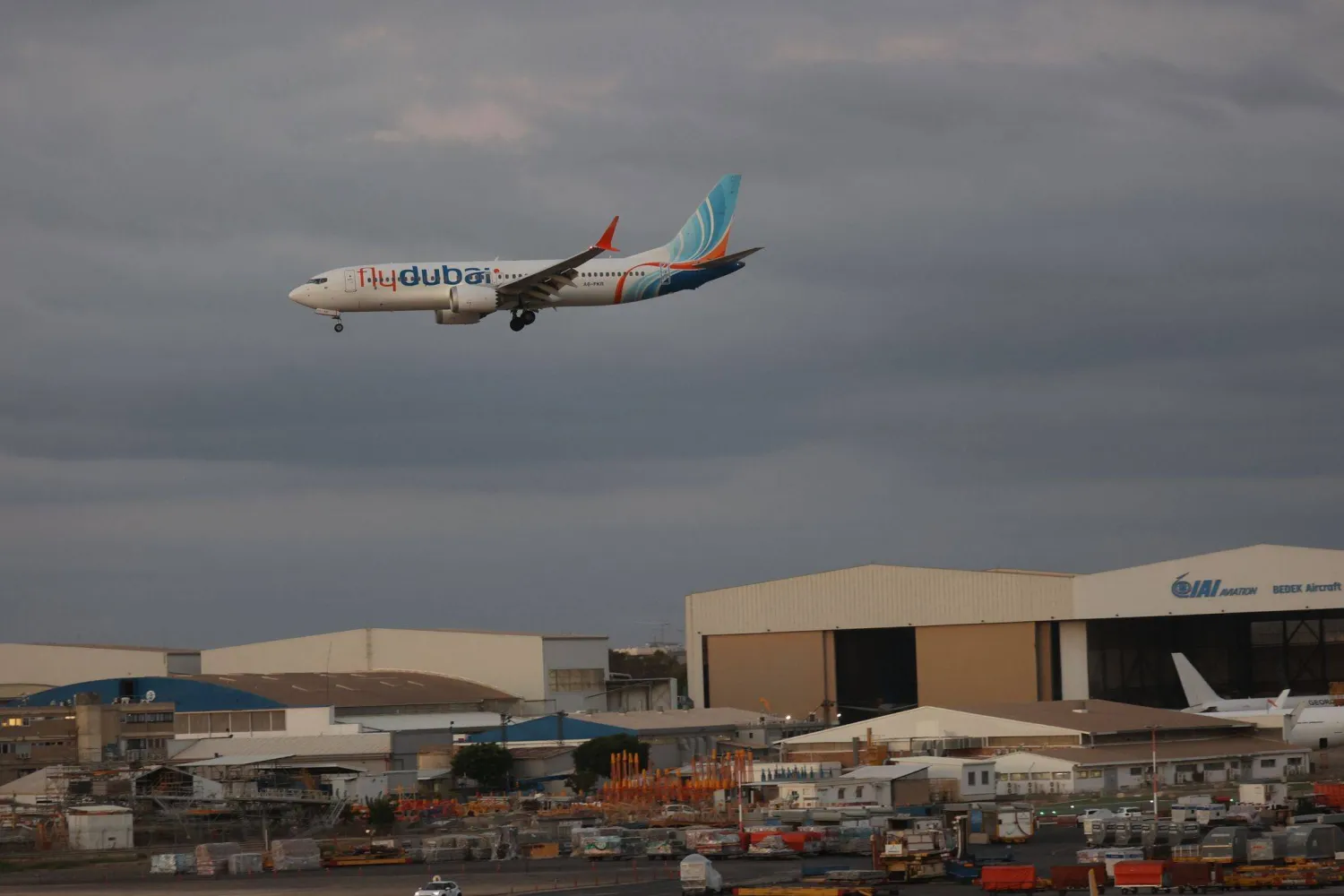

Trump Says Iran Will Be Hit ‘Very Hard’ if It Is Behind Co-Pilot Who Tried to Crash Flight to Israel

30 September 2026, Israel, Tel Aviv: A replacement Flydubai plane lands at Ben Gurion Airport. (dpa)
TT

Trump Says Iran Will Be Hit ‘Very Hard’ if It Is Behind Co-Pilot Who Tried to Crash Flight to Israel

30 September 2026, Israel, Tel Aviv: A replacement Flydubai plane lands at Ben Gurion Airport. (dpa)

US President Donald Trump said Thursday that if Tehran is linked to the co-pilot who tried to crash an Israel-bound flight, Iran would be struck “very hard” for the attempt on the lives of more than 180 people aboard the jet.

Trump issued the warning as investigators worked to determine why the co-pilot stabbed the flight's captain, causing the Flydubai plane to plummet before others on board stopped the attack and landed the airliner in Saudi Arabia.

The president was asked by reporters at the White House whether he had been briefed about any links between the pilot behind the attack and Tehran. He said, “We’re working on it right now.”

“I would say the answer, based on what I’m hearing, is yes, but we’re working on it right now,” Trump said. He did not elaborate about why he suspects Iran might be involved.

Asked if the US would retaliate against Tehran if it was behind the attack, Trump said, “Oh they’ll be hit, very hard, don’t worry.”

“You just ask them,” he added. “They know what happened. They’ll be hit very hard.”

His remarks came as diplomatic efforts to end the war appear to have stalled.

Iranian officials indicated Wednesday that they received an official US response to Tehran’s latest proposal to end the seven-month war, which Trump had publicly rejected just days earlier. The officials did not say what the response contained and whether it was a rejection.

Trump said in a Time magazine interview published Thursday that he will not accept proposals from Iran that “he wouldn’t have approved a year ago,” and left open the possibility of resuming bombing after the Nov. 3 election in the US.

Meanwhile, the American military has dispatched roughly 9,000 troops aboard a group of ships to the Middle East, a US official said Thursday. That could mean three carriers will be in the region as soon as late October, according to the official, who spoke to The Associated Press on condition of anonymity to discuss sensitive military operations.

Despite Trump’s public rebuff, mediators have continued working with Iran and the US to try to broker a deal to end the fighting and open the Strait of Hormuz, according to officials who were not authorized to comment publicly and spoke on condition of anonymity.

Passengers got into cockpit to take control of jet

Passengers on the plane, which was carrying 182 people, mostly Israelis, from the United Arab Emirates to Tel Aviv, have described how the bloodied Indian captain managed to open the cockpit door to let them in before they grappled with the co-pilot and stabilized a descent so sharp that the plane’s rudder was torn away.

“We felt helpless, suspended in midair, and I didn’t know who to turn to. But it was all instinct to survive,” Asaf Rajuan, who was among those who intervened, said in a statement shared by Israel’s presidency.

A regional official briefed on the investigation said the suspect was under arrest and confirmed that Saudi authorities were working with countries to try to determine a motive. He said the UAE, the United States and Oman also were involved. Saudi Arabia said the co-pilot had been handed over to the UAE.

“All possible scenarios, from terrorism to mental disorders, are being looked into. Nothing is ruled out for now,” said the official, speaking on condition of anonymity because they were not authorized to discuss an ongoing probe.

Israeli Prime Minister Benjamin Netanyahu, without giving details, claimed the attacker underwent extremist indoctrination. Asked who helped radicalize him, the prime minister told Fox News channel’s “Fox and Friends" he did not know.

When asked by AP how the prime minister knew the co-pilot underwent indoctrination, Netanyahu’s office said it would not comment.

Netanyahu told Fox that the suspect apparently got through a loophole in Israeli aviation rules that normally bar pilots from flying to Israel if they are from countries that do not have diplomatic relations with Israel.

The co-pilot has not been publicly identified.

Capt. Smit Machchhar, widely praised as one of the heroes of the flight, was recovering in the Emirati capital of Abu Dhabi, the Indian government said Thursday.

It was not clear what the co-pilot used as a weapon.

The UAE government said its own investigation team had begun looking into the attack and “whether it was linked to any terrorist purpose,” noting that Emirati authorities have jurisdiction because the plane is registered there and UAE law applies to crimes committed on board.

Asked if there is any indication of Iranian involvement, Netanyahu told Fox News it was “too early to say.”

Netanyahu earlier said he also spoke with the UAE’s president, Sheikh Mohamed bin Zayed Al Nahyan, who agreed that Israel would join the interrogation of the suspect.

On Wednesday, Trump told reporters at the White House that he and Netanyahu discussed the incident “at length” by phone. He said it seemed as though the co-pilot “was perhaps a terrorist or perhaps a whack job.”

Netanyahu had warned in recent days of heightened security threats, though he told CNN that Israel had received no specific warning. The country is a week away from the anniversary of the Hamas-led Oct. 7, 2023, attack on Israel, which has triggered the war in Gaza, and weeks away from an election.

The Israeli Foreign Ministry said most of the people aboard the flight were from Israel, along with others from India and the UAE. The US State Department said four passengers had American citizenship.



UN Says 5.8 mn Refugee Children Out of School

Syrian refugee children attend a class at a school in Mount Lebanon, October 7, 2016. REUTERS/Mohamed Azaki
TT

UN Says 5.8 mn Refugee Children Out of School

Syrian refugee children attend a class at a school in Mount Lebanon, October 7, 2016. REUTERS/Mohamed Azaki

Some 5.8 million refugee children were out of school in 2025, the United Nations said Friday, warning that funding cuts threatened to make the situation worse.

UNHCR, the UN refugee agency, said 44 percent of the world's 13.1 million school-age refugee children were out of school last year.

"Education is protection. But it is also a pathway to opportunity and self-reliance," said Barham Salih, the UN high commissioner for refugees, AFP reported.

"At a time of severe pressure on humanitarian and development financing, cuts to education risk reversing decades of collective investment and closing opportunities for a generation of young people."

The former Iraqi president, who was a refugee, said that looking back on his own life, "education gave me opportunities that displacement might otherwise have denied me".

"Displacement should not determine the limits of a child's life."

UNHCR said that while 65 percent of refugee children of primary school age were enrolled in education in 2025, only 32 percent were enrolled in secondary.

Refugee tertiary education enrolment reached a record 11 percent in 2025.

Earlier this week, UNHCR said its available funding had fallen from $5.2 billion in 2024 to $3.9 billion in 2025, while the number of people it is mandated to protect is hovering around historically high levels.

UNHCR said it needed $8.5 billion this year to protect refugees, but by the end of July had received only 32 percent of that amount ($2.7 billion).

UNHCR said nearly 8.3 million refugees and other forcibly displaced people faced losing vital assistance from the agency as protection services crumble due to the "severe" funding cuts.


Iran: Strait of Hormuz Will Not Reopen Until Conditions Are Met

Iran: Strait of Hormuz Will Not Reopen Until Conditions Are Met
TT

Iran: Strait of Hormuz Will Not Reopen Until Conditions Are Met

Iran: Strait of Hormuz Will Not Reopen Until Conditions Are Met

The Strait of Hormuz will not reopen until seven Iranian conditions set out in a June interim agreement with the US are met, Nournews reported Iran's parliament speaker Mohammad Baqer Qalibaf as saying on Sunday, a few days after Tehran received Washington's reply to its diplomatic proposal.

“The Americans, who say something different in the media, have recently put forward proposals through a mediator. ⁠But they must understand that ⁠the period of dragging out the process and dictating one-sided demands is over," Qalibaf was quoted as saying.

"The position of the Islamic Republic of Iran is completely clear and firm, and the Strait of Hormuz ⁠will not be opened until our seven conditions, based on the Islamabad Memorandum of Understanding, are met."

Meanwhile, army spokesperson Mohammad Akraminia told Fars news on Sunday that Iran will upgrade the range of its missiles following the war with the US as American forces are now ⁠positioned as much ⁠as 1,000 km (621 miles) away from the Iranian ⁠coast.

"During this war, we concluded that we absolutely must increase the ⁠range of ⁠our missiles, and we have now moved in that direction," he said.


Iran Tells US There is No Military Solution to Mideast War

(FILES) Vehicles drive past a giant billboard reading 'The Strait of Hormuz remains closed' at the Revolution Square in Tehran on April 28, 2026. (Photo by ATTA KENARE / AFP)
TT

Iran Tells US There is No Military Solution to Mideast War

(FILES) Vehicles drive past a giant billboard reading 'The Strait of Hormuz remains closed' at the Revolution Square in Tehran on April 28, 2026. (Photo by ATTA KENARE / AFP)

Iran's top diplomat insisted on Sunday that there would be no military solution to the United States' war against Iran, with talks on ending the conflict apparently at an impasse.

A campaign of heavy bombardment failed to bring a decisive close to the war launched by the US and Israel in late February, and Washington in recent weeks has dialed back military operations in favor of economic pressure.

The main point of contention remains Iran's attempt to blockade the Strait of Hormuz where a UK maritime agency reported on Sunday another tanker struck by an unknown projectile.

"If our enemies again choose the path of military confrontation, our response will be stronger than before, and we will defend ourselves with even more force," Iranian Foreign Minister Abbas Araghchi said at a gathering of foreign ambassadors.

"There is no military solution, nor any solution based on new sanctions," he continued, adding "only negotiations based on justice and fairness" could end the conflict.

The two sides agreed a memorandum of understanding in June that spelled out a framework for a permanent resolution, but Iranian attacks on vessels in the Hormuz prompted a return to US military operations.

On Sunday, the British maritime security agency UKMTO said a tanker in the Hormuz "reported being struck by an unknown projectile, causing damage to the engine room", though the crew were reported safe and no environmental impact was recorded.

The agency did not specify the date of the incident, the vessel's origin or destination, or whether it was an oil tanker or LNG carrier.

Iranian and US officials last week held indirect talks on the sidelines of the UN General Assembly, with Tehran saying it presented seven conditions for reopening the strait.

Iran has demanded, among other things, a ceasefire across the Middle East, the unfreezing of its assets abroad, the lifting of sanctions on its oil sector and an end to the US naval blockade.

Trump, however, rejected the proposal, while leaving the door open both to further talks or renewed military operations.

Iranian foreign ministry spokesman Esmaeil Baqaei on Sunday characterized the latest US counterproposal as being "in line with their previous proposals concerning nuclear issues".

"We have clearly indicated that we are focusing on the issue of the Strait of Hormuz," he said, adding that reopening the waterway required "an end to the disruptions to Iranian commercial maritime traffic and the lifting of sanctions".