Seoul Weighs Steps to Force North Korea Landmine Apology

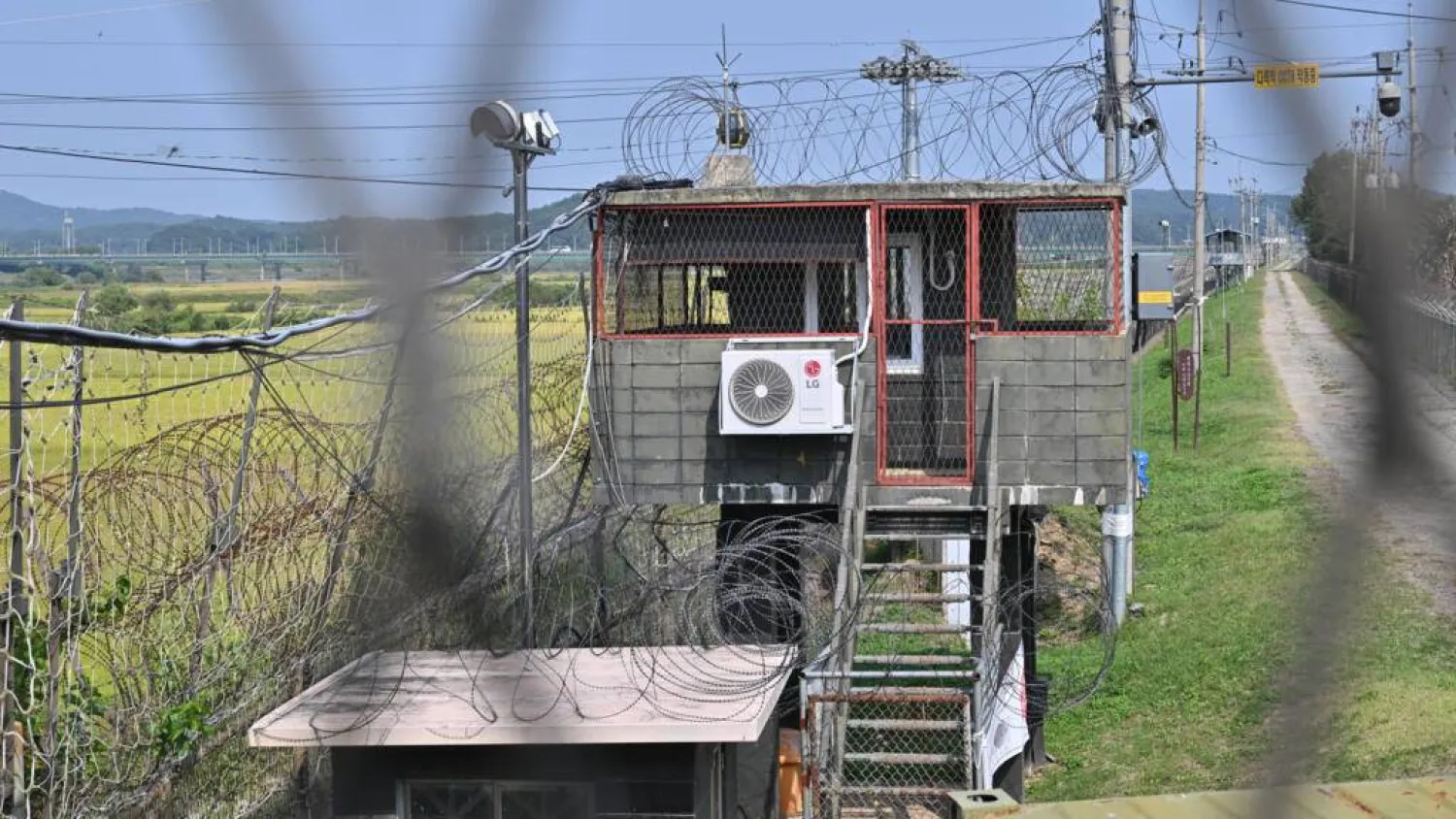
A South Korean military guard post is seen through a military fence at Imjingak peace park near the Demilitarized Zone (DMZ) dividing the two Koreas, in Paju on September 30, 2026. Jung Yeon-je / AFP
TT

Seoul Weighs Steps to Force North Korea Landmine Apology

A South Korean military guard post is seen through a military fence at Imjingak peace park near the Demilitarized Zone (DMZ) dividing the two Koreas, in Paju on September 30, 2026. Jung Yeon-je / AFP

South Korea is considering measures to force an apology from North Korea over a recent landmine blast that injured three soldiers inside the Demilitarized Zone, its defense ministry said Tuesday.

A joint South Korean-UN investigation concluded that two landmines that exploded in the DMZ last month were planted by North Korean forces about a year ago, prompting Seoul to demand an official apology, reported AFP.

It has also called on the nuclear-armed North to remove any other mines planted on the southern side of the Military Demarcation Line (MDL) that runs through the DMZ, the heavily fortified frontier that has divided the Korean Peninsula since the 1953 armistice.

Pyongyang has denied responsibility, with Kim Yo Jong, the powerful sister of North Korea's leader, slamming the call for an apology as "despicable".

"We are not ruling out any options or prejudging anything when it comes to additional measures," defense ministry spokeswoman Chung Bin-na told reporters Tuesday when asked if steps were being planned to force an apology from Pyongyang.

Bin-na did not offer specifics about what actions might be employed.

Landmine incidents in the DMZ have previously heightened tensions between the two Koreas, which remain technically at war.

In 2015, two South Korean soldiers were seriously wounded in a landmine blast on the southern side of the DMZ, with one losing both legs.

Seoul concluded at the time that North Korean troops had crossed the MDL to plant the mines, an accusation Pyongyang denied.

Since 2024, Pyongyang's military has laid mines and built anti-tank barriers along the frontier as part of efforts to permanently seal it off.

During the operation, North Korea also blew up the northern sections of inter-Korean roads no longer in use.


China’s Xi Backs Efforts to Ease Tensions with North Korea, South Korea Says

South Korean President Lee Jae Myung attends a meeting with Chinese President Xi Jinping at the APEC China 2026 Summit in Shenzhen, Guangdong province, China, 18 November 2026. (EPA)
TT

China’s Xi Backs Efforts to Ease Tensions with North Korea, South Korea Says

South Korean President Lee Jae Myung attends a meeting with Chinese President Xi Jinping at the APEC China 2026 Summit in Shenzhen, Guangdong province, China, 18 November 2026. (EPA)

China supports various efforts to ease tensions on the Korean peninsula including dialogue between US and North Korea, South Korea's presidential office said on Wednesday after a meeting between President Lee Jae Myung and Chinese counterpart Xi Jinping.

The two leaders met on the sidelines of the Asia-Pacific Economic Cooperation gathering.

US President Donald Trump has floated the possibility of meeting North Korean leader Kim Jong Un during his Asia trip, although no such encounter has been confirmed. China says it has no information about a possible meeting.

Trump's interest in renewed engagement with Kim ‌comes seven years ‌after their last summit ended without agreement over curtailing ‌North ⁠Korea's nuclear weapons ⁠and sanctions relief.

North Korea has repeatedly signaled it is unwilling to resume discussions unless denuclearization is off the agenda. Trump has referred to North Korea as a nuclear power, a status allies in the region and the West have refused to recognize.

US Secretary of State Marco Rubio said on Wednesday that Trump is "prepared" for dialogue with Pyongyang, although it does ⁠not mean a meeting will take place during ‌the visit.

Lee told Xi that ‌tensions on the peninsula were a matter of vital national interest for South ‌Korea, the presidential office said in a statement.

Xi briefed Lee on recent ‌developments in China's relations with North Korea and said China would continue to play a constructive role in issues on the Korean peninsula, Seoul said.

South Korea's Lee also said he hopes the two countries will further develop an ‌equal and mutually beneficial economic partnership.

"Above all, for the strategic partnership between Korea and China to mature and ⁠develop, peace and ⁠stability on the Korean Peninsula must be ensured," Lee said, according to a pool report.

Neither Xi nor Lee referred to denuclearization in their public opening remarks or in the South Korean account of the meeting.

China has increasingly framed its approach around stability and dialogue on North Korea issues rather than publicly stressing denuclearization.

Trump's new global security roadmap has dropped any reference to denuclearizing North Korea as a goal, fueling speculation that Washington wants to raise the chances of a diplomatic breakthrough with Pyongyang this year.

China is ready to strengthen communication and coordination with South Korea, maintain the stability and smooth operation of global industrial and supply chains, Xi said.


Report: CENTCOM Chief to Meet Military Officials in Israel

US Navy Admiral Brad Cooper, commander of US Central Command, makes an announcement aboard Nimitz-class aircraft carrier USS Abraham Lincoln in the Arabian Sea February 7, 2026. (US Navy/Mass Communication Specialist 2nd Class Sonny Escalante/Handout via Reuters)
TT

Report: CENTCOM Chief to Meet Military Officials in Israel

US Navy Admiral Brad Cooper, commander of US Central Command, makes an announcement aboard Nimitz-class aircraft carrier USS Abraham Lincoln in the Arabian Sea February 7, 2026. (US Navy/Mass Communication Specialist 2nd Class Sonny Escalante/Handout via Reuters)

US Central Command chief Admiral Brad Cooper is due to meet with Israeli military officials during a visit to the country on Wednesday, Israeli media reported, as hostilities flare between Washington and Tehran.

"CENTCOM commander will arrive to Israel tomorrow for talks with the Israeli army, and will also visit other countries in the region," a reporter for Israel's Kan public broadcaster wrote on X on Tuesday, citing sources.

News outlet Ynet reported that Cooper was expected to meet with Israeli military chief Lieutenant General Eyal Zamir.

It comes after Bahrain and Kuwait said Wednesday they had repelled aerial attacks launched against them by Iran following US strikes on an Iranian island.

Gulf countries have faced retaliatory bombardment from Iran throughout the Middle East war, which was triggered in late February by US-Israeli strikes on Iran.


Russia’s Putin Says He Expects ‘Big Potential Benefit’ from Meeting with Trump and Xi

President of Russia Vladimir Putin attends a meeting with Chinese President Xi Jinping (not pictured) at the APEC China 2026 Summit in Shenzhen, Guangdong province, China, 18 November 2026. (EPA)
TT

Russia’s Putin Says He Expects ‘Big Potential Benefit’ from Meeting with Trump and Xi

President of Russia Vladimir Putin attends a meeting with Chinese President Xi Jinping (not pictured) at the APEC China 2026 Summit in Shenzhen, Guangdong province, China, 18 November 2026. (EPA)

Russian President Vladimir Putin said on Wednesday he expected a "big potential benefit" from his trilateral meeting this week with US President Donald Trump and Chinese leader Xi Jinping.

Putin, who is due to hold talks with Trump and Xi on Thursday, was speaking at ‌the opening ‌ceremony of the Asia-Pacific Economic ‌Cooperation (APEC) ⁠CEO summit 2026 ⁠in China's southern city of Shenzhen.

Citing what he said was a fragmented global economy and military-political risks, Putin said partnership, rather than isolation, was necessary, and that APEC provided a ⁠chance for a constructive exchange of ‌views.

"I therefore ‌expect big potential benefit from the upcoming trilateral ‌meeting between the leaders of ‌Russia, China and the United States, which is scheduled to take place on the sidelines of the APEC summit," Putin told ‌the summit.

Putin held bilateral discussions with Xi on Wednesday, saying China ⁠and ⁠Russia's foreign policy partnership was working "steadily and positively on the international stage."

Xi, meanwhile, said that China and Russia should take more concrete measures to deepen all-round cooperation and "lead and advance the trend toward a multipolar world."

China-Russia relations have remained steadfast through storms, Xi said.