

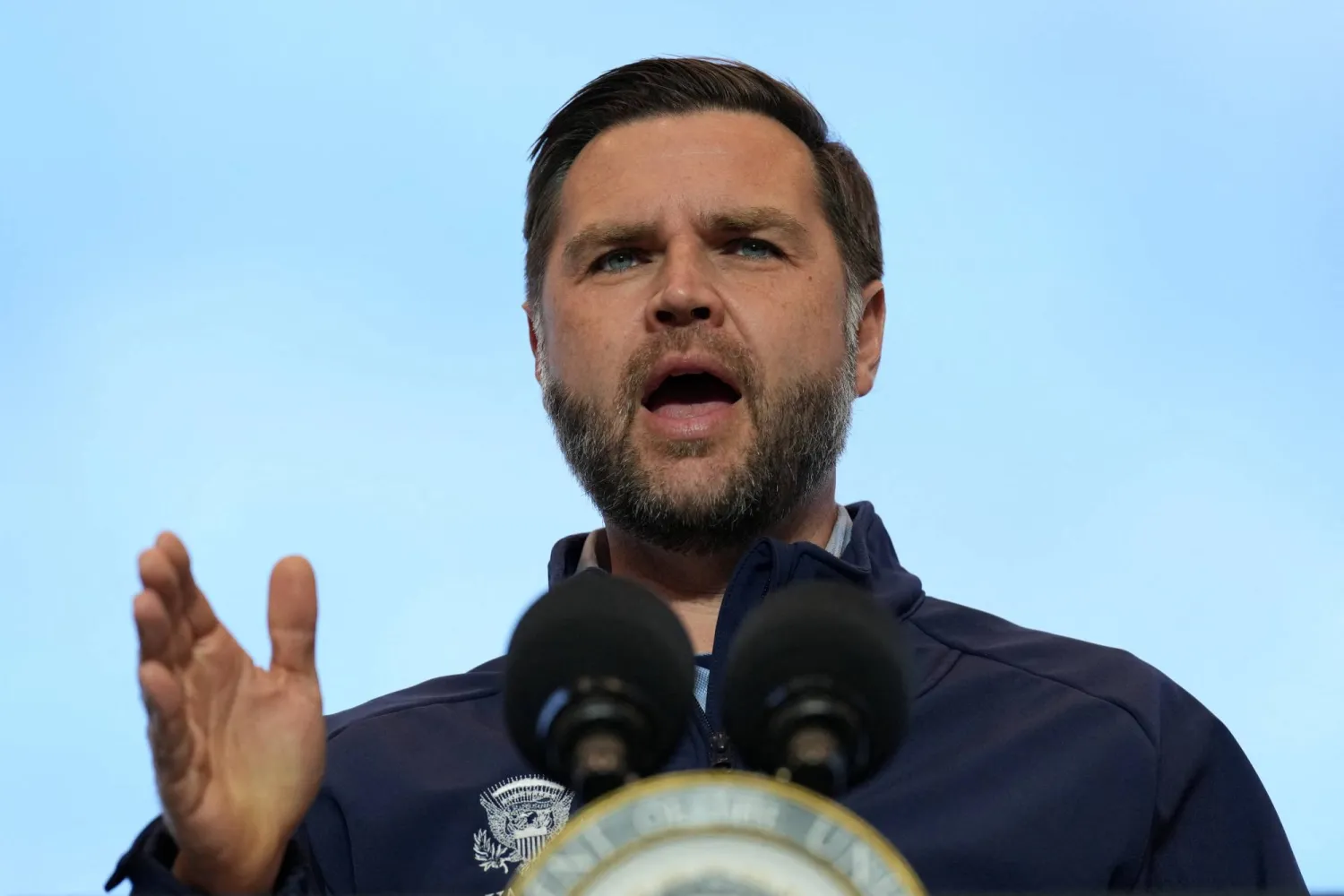

Vance Says Iran Must Cut Enrichment to End War

US Vice President JD Vance speaks at a campaign rally at Fairbanks International Airport in Fairbanks, Alaska, US, October 5, 2026. (Jacquelyn Martin/Pool via Reuters)
TT

Vance Says Iran Must Cut Enrichment to End War

US Vice President JD Vance speaks at a campaign rally at Fairbanks International Airport in Fairbanks, Alaska, US, October 5, 2026. (Jacquelyn Martin/Pool via Reuters)

US Vice President JD Vance said in an exclusive interview with Reuters that Iran must make a “meaningful” reduction in its nuclear enrichment capacity to satisfy US demands and end the countries’ seven-month war, even as Washington was unsure how Tehran makes decisions in negotiations.

Vance, a longtime skeptic of US involvement in foreign wars, has taken a leading role in negotiating a settlement to the conflict and brokered a provisional peace agreement in September that quickly fell apart. The war has jolted global energy markets and become a political liability for President Donald Trump and fellow Republicans ahead of November midterm elections.

Speaking on Monday after a campaign trip in Alaska, Vance said any agreement would require Iran to reduce its nuclear enrichment capacity, rather than offer assurances of future nuclear drawdowns.

"If you don't want a nuclear weapon, then why do you need 60% enriched ‌fuel? And if ‌you want to show commitment to not building a nuclear weapon, don't build highly ‌enriched ⁠fuel. That's a very ⁠basic threshold issue," Vance said.

"I think if they want to show a commitment to not building a nuclear weapon, they would do something meaningful on their enrichment capacity."

Iran and the US have exchanged proposals in recent weeks aimed at ending the war and reopening the Strait of Hormuz, a vital global energy shipping route. Trump rejected Tehran's latest offer and has warned that military operations could intensify after the midterms.

Vance said the US remained open to an agreement but would require concrete Iranian nuclear concessions.

"We're not going to trade words for actions," Vance said.

UNCLEAR HOW IRAN MAKES DECISIONS, SAYS VANCE

Complicating matters, Vance said Washington is uncertain ⁠who makes decisions in Tehran.

Vance said the US was in talks with Iranian President ‌Masoud Pezeshkian and Foreign Minister Abbas Araghchi. But it was unclear how much authority ‌they wield within Iran's power structure, he said, after joint US-Israeli strikes at the start of the war killed Supreme Leader ‌Ali Khamenei.

"One of the things we picked up on is it's not totally clear how their country makes decisions," ‌Vance said. Separately, Trump said on Tuesday his "biggest problem" is no one knows who is running Iran.

Iran's Foreign Ministry spokesperson said on Sunday that US officials are well aware of who their Iranian counterparts are and how Iran's decision-making system works.

"The problem is actually the opposite: it lies in the contradictory positions and mixed messaging from US officials," Esmaeil Baghaei told a weekly press conference.

Vance told Reuters he ‌has held personal conversations with field commanders to gauge battlefield conditions. He dismissed concerns over critical munitions shortages and added that while Iranian troops are periodically able to strike ⁠commercial ships in the Strait ⁠of Hormuz, they are largely unable to prevent energy exports through the waterway.

The war — and its $3 billion monthly price tag — has become a key issue on the campaign trail. Higher energy prices have put Trump and Republicans on the defensive in competitive states that will decide control of Congress.

Vance has sought to temper criticism of Trump’s handling of the conflict, telling voters they should not let that issue keep them from backing Republicans in next month's elections.

In Alaska, Vance rallied for Republican Senator Dan Sullivan, who is locked in a tight reelection battle with Democratic challenger Mary Peltola. Trump carried Alaska by 13 percentage points in 2024, but rising everyday costs have put the state in play.

Before speaking with Reuters, Vance focused much of his speech on affordability concerns, especially around energy. Alaska's remote locale makes consumer goods more expensive, and energy production is a key industry.

Rally attendees roared when Sullivan nearly introduced Vance as the president of the US, rather than the vice president. Vance is seen as a leading Republican contender to succeed Trump in the White House.

Vance told Reuters afterward that he had not decided whether to seek the presidency in 2028.

"I'm inherently a procrastinator," he said. "I really haven't thought about it much."


UN Chief Urges Drastic Emissions Cuts as COP31 Wrestles with Fossil Fuels

UN Secretary-General Antonio Guterres speaks at a press conference on the fifth day of the COP31 annual UN climate conference in Antalya, Türkiye, 13 November 2026. (EPA)
TT

UN Chief Urges Drastic Emissions Cuts as COP31 Wrestles with Fossil Fuels

UN Secretary-General Antonio Guterres speaks at a press conference on the fifth day of the COP31 annual UN climate conference in Antalya, Türkiye, 13 November 2026. (EPA)

UN Secretary-General Antonio Guterres on Friday called for an "immediate and drastic reduction" in greenhouse gas emissions, as divisions over fossil fuels dominated the first week of COP31 climate talks in Türkiye.

Big fossil fuel producers and consumers at the talks are resisting any deal that would specify firm new targets or a shift away from oil, gas and coal, observers said as the first week of talks drew to a close.

That poses a challenge for summit host Türkiye and lead negotiator Australia, which have another week to land the kind of ambitious agreement climate advocates such as Guterres say is needed.

"The central question is in the hands of member states, particularly the big emitters. They must recognize the need for an immediate and drastic reduction in emissions to keep the 1.5 goal still possible by the end of the century," he said, referring to the warming limit countries had agreed to ‌pursue under the 2015 ‌Paris Agreement.

A UN report last month found the world is on course to exceed ‌the 1.5 ⁠degrees Celsius (2.7 ⁠degrees Fahrenheit) warming threshold, a limit scientists say should prevent the worst effects of climate change.

As temperatures have risen, this year has been marked by extreme heatwaves across Western Europe and a glacier collapse in Nepal that triggered a flood that killed more than 1,450 people. Thousands more are still missing.

'DISPROPORTIONATE INFLUENCE'

Major oil producers have traditionally resisted language constraining fossil fuels, while large developing economies such as India have opposed measures they say could limit their development and energy choices, a dynamic that has compromised the outcomes of past deals.

The world’s biggest oil consumer, the United States, meanwhile, has skipped the talks for the second year ⁠in a row under President Donald Trump, who has called global warming a hoax and promoted ‌continued use of fossil fuels.

"We must confront the disproportionate influence of the fossil ‌fuel lobby. The future of our planet cannot be negotiated on the terms of those profiting from its destruction," said Guterres, who is leaving ‌his job at the end of December after two five-year terms.

"But I remain hopeful. I've also seen something extraordinary over ‌these 10 years. Renewable energy has moved from the margins to the mainstream. The economics have changed. The technology has advanced. A cleaner, safer, and more secure energy future is in our hands. The question is whether we have the courage and speed to reach for it."

ELECTRIFICATION AND NO FIRM TARGETS

COP31 host Türkiye is striving to place a proposal to expand global electrification at the center of an eventual deal, saying the ‌plan will lead to emissions cuts by speeding the shift away from fossil fuel-powered cars, boilers and other equipment.

The proposal does not require the increased electricity use to come ⁠from renewable sources, although some ⁠countries, including last year’s COP host Brazil, are advocating for progress on a plan to require countries to more clearly map out their transition away from fossil fuels.

Katrine Petersen, an observer for the non-governmental organization E3G, said whether those measures survive the talks depends on conversations in the days to come.

"We've also heard quite clearly from countries like India, the G77, that they don't want any firm targets. They don't want any kind of technology or fuel-specific language," she said. "(These are) the kind of consistent and ongoing divides that we've seen from those different parties before."

Diana Acconcia, head of the EU delegation, said Europe backed the electrification goal.

"Electrification is, in a way, an inclusive agenda because it is non-prescriptive in a way on how the electrification is achieved," she said. "Of course, for the European Union electrification is to be achieved by clean sources of energy."

The Australian team, which is leading negotiations under a split presidency arrangement, spent the first few days of the summit gathering views on what should be included in a political text agreed by consensus that will be followed by all the negotiated technical points.

Australia is taking further submissions from countries until Saturday night, with a view to formulating a draft text early next week.


Europe’s Security Cannot Be Part of Ukraine Peace Talks, EU Leaders Say

13 November 2026, Ireland, Dublin: German Chancellor Friedrich Merz speaks during a press conference on the sidelines of the EU summit at the Convention Centre in Dublin. (dpa)
TT

Europe’s Security Cannot Be Part of Ukraine Peace Talks, EU Leaders Say

13 November 2026, Ireland, Dublin: German Chancellor Friedrich Merz speaks during a press conference on the sidelines of the EU summit at the Convention Centre in Dublin. (dpa)

EU leaders said on Friday that Europe's security structure should not be a subject for Ukraine-Russia peace negotiations, but they did not answer the question of who should speak for Europe in any future talks.

The Kremlin said on Friday that Russia would be open to European countries taking part in Ukraine peace talks if it saw they were ready to contribute to the peace process.

German Chancellor Friedrich Merz described the Kremlin's comments as "the same old game" and said that Europe and the United States agreed on a clear message.

"There will be no discussions about ‌Ukraine without ‌Ukraine, and no discussions about Europe without Europe. Furthermore, there is no need ‌to ⁠talk about European ⁠security architecture. We have that already," Merz told reporters during a summit of European Union leaders in Dublin.

Russian officials have called for a broad agreement on Europe's security architecture to be reached before tackling the specifics of the war. Before its invasion of Ukraine in 2022, Russia demanded the withdrawal of NATO forces from countries that joined the alliance after 1997. NATO rejected the demand.

US negotiator Jared Kushner said in Moscow on Thursday that he had begun discussions with European partners on ⁠the continent's security architecture.

EUROPE PRIORITIZES CEASEFIRE IN RUSSIA-UKRAINE WAR

EU foreign policy chief ‌Kaja Kallas said Russian calls for discussions about Europe's ‌security architecture risked diverting attention from the need for a ceasefire. Latvian Prime Minister Andris Kulbergs called such ‌discussions "a trap".

During a meeting on Thursday, leaders from Poland, the Baltics and Nordic states warned ‌against brainstorming with the US or Russia about Europe’s security architecture, according to a European diplomat and a European official.

Forty European countries, meeting as a broader group in Dublin on Thursday, signed a declaration saying that any matter affecting European security should be decided with the involvement of Europeans.

EU leaders broadly agreed that Europe ‌needed to speak with one voice, but did not settle on a single individual to do so. Merz said discussions would continue.

"There are ⁠established institutional forms ⁠of (EU) representation — Kaja Kallas, for instance, is part of this — but the E3 format has also proven very effective," he said, in reference to an informal security grouping of France, Germany and Britain, which is no longer an EU member but a prominent NATO ally.

"Moreover, we always include Italy and Poland," Merz added.

Representatives from Britain, France, Germany, Italy and the EU attended Russia-Ukraine talks in Abu Dhabi earlier this week, where both Moscow and Kyiv cited some progress, though there was no sign of a breakthrough on key issues such as territory.

Swedish Prime Minister Ulf Kristersson said Britain, one of Europe's top three military powers, certainly had to be included in any future talks and that the five countries plus EU institutions would make sense.

"I'm quite flexible on that, so I think what we actually say is more important than the exact configuration of the people in the room," he said.


France Criticizes ‘Demagogic’ Move by Israel to Ban Hard-Left Leader Melenchon

 09 November 2026, France, Paris: France's Foreign Minister Jean-Noel Barrot, speaks during a G7 foreign ministers' meeting in Paris. (dpa)
09 November 2026, France, Paris: France's Foreign Minister Jean-Noel Barrot, speaks during a G7 foreign ministers' meeting in Paris. (dpa)
TT

France Criticizes ‘Demagogic’ Move by Israel to Ban Hard-Left Leader Melenchon

 09 November 2026, France, Paris: France's Foreign Minister Jean-Noel Barrot, speaks during a G7 foreign ministers' meeting in Paris. (dpa)
09 November 2026, France, Paris: France's Foreign Minister Jean-Noel Barrot, speaks during a G7 foreign ministers' meeting in Paris. (dpa)

France has ‌criticized as "demagogic" a decision by Israel to ban French hard-left presidential candidate Jean-Luc Melenchonand another leading figure in his France Unbowed (La France Insoumise) party from entering the country.

Israel's Foreign Ministry said on Thursday it would bar Melenchon and Mathilde Panot, the party’s parliamentary group chair, over "the extreme anti-Israel stance of La France Insoumise party and the outrageous statements made by ‌its leaders."

"This demagogic ‌decision, coming from a ‌government ⁠that has repeatedly violated international ⁠law, plays into the hands of those who, like La France Insoumise, thrive on exploiting the Israeli-Palestinian conflict," Foreign Minister Jean-Noel Barrot said on X.

"France will continue to work tirelessly toward a two-state solution and the ⁠peaceful coexistence of the Israeli and ‌Palestinian peoples,” he ‌said.

The Israeli Foreign Ministry said in a ‌statement on Thursday that both Melenchon and ‌Panot had made statements spreading "blood libels" against Israel, and that Melenchon had called for French ships to escort illegal flotillas to Gaza.

"Israel will respond ‌firmly to those who seek to harm it and will not allow ⁠individuals ⁠who act against Israel and incite against its citizens to enter the country," it said.

Melenchon told Franceinfo radio: "I am banned from entering a territory I did not ask to enter...I regret that the Israeli government is pursuing me like this."

In a campaign speech last Saturday, Melenchon made clear that, if he were elected president, French vessels would accompany activists hoping to force aid into the Gaza Strip.
