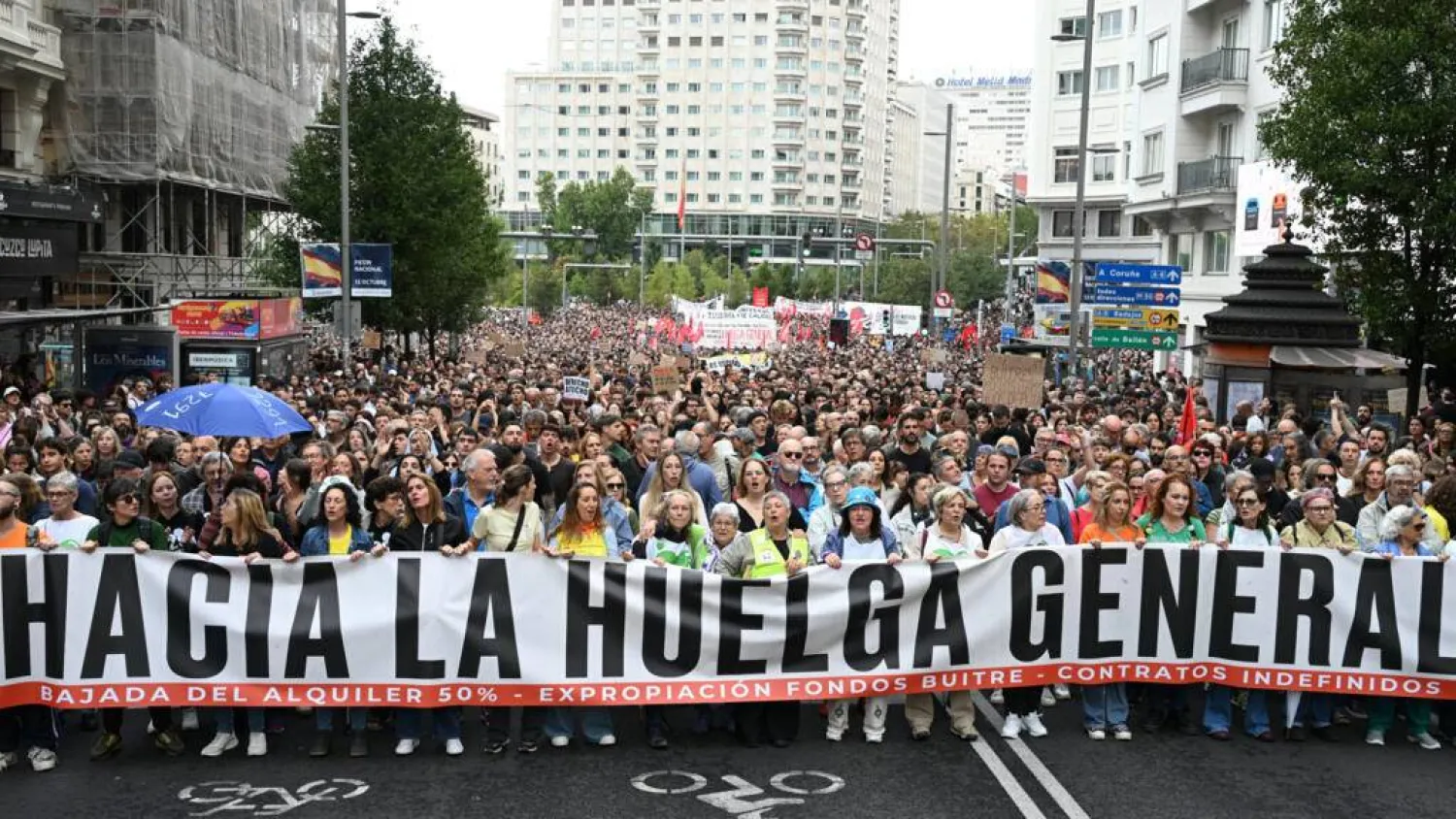
Housing Crisis Set to Dominate Spain's Snap Election

The main tenants' unions have spearheaded pressure on politicians to reform Spain's housing market. JAVIER SORIANO / AFP
TT

Housing Crisis Set to Dominate Spain's Snap Election

The main tenants' unions have spearheaded pressure on politicians to reform Spain's housing market. JAVIER SORIANO / AFP

After simmering below the surface for years, anger at unaffordable housing in Spain has bubbled over and precipitated a general election that will be dominated by the crisis.

The spark was ignited on September 23 when 87-year-old Maricarmen Abascal was evicted from her lifelong Madrid home on a stretcher after the real estate firm that owned the apartment drastically hiked the rent, AFP said.

Abascal, who died on Wednesday, became the symbol of a crisis that cuts across Spanish society: young and old, renters and buyers, workers and pensioners.

The uproar at her eviction triggered national demonstrations, with hundreds of people camping in central Madrid's Puerta del Sol square in the most symbolic protest.

As in other European countries, housing has long been a top public concern, particularly for young adults who are priced out of the market and stay with their parents into their 30s and beyond.

Growth in housing prices has far outstripped wages in recent years, eating up far more than the upper limit of 30 percent of income recommended by public bodies and housing professionals.

According to the latest figures by the National Statistics Institute (INE), the average gross monthly salary in Spain is around 2,460 euros ($2,750).

Renting a 50-square-meter (538-square-foot) apartment in Madrid cost on average 1,170 euros per month in September, according to real estate portal Idealista -- around half of a normal income.

- 'Society of inheritors' -

Many residents in popular destinations like Barcelona complain that short-term tourist accommodation is limiting supply and driving up prices.

Investment funds with large housing portfolios are another much-maligned group, accused of being "vulture funds" that acquire properties and hike rents for maximum profits.

A tiny public housing supply is another major factor, with Madrid representing an extreme example of the phenomenon.

A paradise for luxury real estate, the capital only has around 10,000 social housing units for its 3.5 million inhabitants.

Such is the demand for them that some public apartments are allocated by lottery.

A history of home ownership partly explains the small public housing stock. Under the dictatorship of General Francisco Franco (1939-1975), a housing minister said he wanted "a country of owners and not proletarians".

But the model is breaking down, especially for the young. While almost three in four households own their main residence, more than half of under-30s rented in 2025, according to the INE.

Jorge Galindo, director of the Centre for Economic Policy at Esade business school, said the 2008 global financial crash was a turning point for the Spanish housing market.

The bursting of a real estate bubble sparked the "collapse" of construction and "the destruction of a million jobs" in the sector, Galindo told AFP.

Since then, "supply has not kept up", falling from around 260,000 new builds per year in the 1990s to 92,000 in 2025, he said.

The expert warned that the country of around 50 million people risked becoming "a society of inheritors" in which home ownership depends on parents passing property to their children.

- Political upheaval -

How to solve a puzzle that has bedeviled successive governments will be a central debate of the snap election that Socialist Prime Minister Pedro Sanchez called for November 29.

Last week, Sanchez's leftist coalition proposed a series of measures including more restrictions on evictions, a ban on the "speculative" purchase of homes and the automatic renewal of tenant contracts.

But the minority government failed to pass them in parliament, leading Sanchez to call an early vote originally scheduled for 2027.

Spain's main unions have called a general strike for November 11 in large part due to the political paralysis over housing.

In 2023, Sanchez's government passed a law that provided for more social housing, the regulation of rents in areas under the greatest stress, and punishments for owners who left their properties empty.

But the law has not stopped the spiraling prices and popular discontent.

The main opposition right-wing Popular Party advocates a building boom to make up the deficit between supply and demand.

For Galindo, the debate contains a "paradox".

"Those who suffer most from the housing crisis are those with the least weight at the ballot box: young people, who vote less, and immigrants."


Netanyahu Vows to Eliminate Iran Threat ‘Once and for All’

10 November 2026, Israel, Jerusalem: Caretaker Israeli Prime Minister Benjamin Netanyahu delivers a speech on the sidelines of the opening session of the new Knesset. (dpa)
TT

Netanyahu Vows to Eliminate Iran Threat ‘Once and for All’

10 November 2026, Israel, Jerusalem: Caretaker Israeli Prime Minister Benjamin Netanyahu delivers a speech on the sidelines of the opening session of the new Knesset. (dpa)

Israel's caretaker prime minister Benjamin Netanyahu on Saturday reiterated his calls for a national unity government with his opponent Gadi Eisenkot, as well as his vow to eliminate the threat from Iran.

A meeting with Eisenkot on Thursday "only strengthened the conviction that it is essential to form a national unity government" to guarantee Israel's security, Netanyahu said in a video statement, adding that such a government could "eliminate the Iranian threat once and for all".


Ukraine’s Zelenskiy Escalates Criticism of SpaceX Over Speed Caps

Ukraine's President Volodymyr Zelenskiy holds a press briefing in Copenhagen November 10, 2026. (AFP)
TT

Ukraine’s Zelenskiy Escalates Criticism of SpaceX Over Speed Caps

Ukraine's President Volodymyr Zelenskiy holds a press briefing in Copenhagen November 10, 2026. (AFP)

Ukraine's President Volodymyr Zelenskiy ‌escalated his criticism of SpaceX on Saturday, saying speed restrictions on its military-grade Starshield satellite terminals had dangerous political implications and undermined critical air defenses.

Zelenskiy said Starshield terminals operating in temporarily Russian-occupied territories of Ukraine had been limited to a maximum speed of 161 kph for the past five days, hampering Ukraine's military capabilities.

The Ukrainian Defense Ministry has raised the issue with SpaceX at the ‌institutional level, ‌Zelenskiy said.

"The restrictions have now ‌been ⁠in place for ⁠five days. They say it is some kind of technical issue. We do not believe that is the case," Zelenskiy told reporters in remarks released by his office on Saturday.

"If you impose restrictions there, you are already partially recognizing the temporarily ⁠occupied territories as not ours. And ‌that is why I ‌believe we have the right to raise this ‌issue and restore the speed – so that there ‌are no restrictions at all."

Zelenskiy said the speed restrictions made it more difficult for Ukrainian air defense units to intercept Russian jet-powered drones and made Ukrainian cities ‌more vulnerable. He said he had ordered his top military and foreign ministry ⁠officials ⁠to address the issue and seek clarification.

SpaceX has pushed back against the allegations, denying that it introduced new restrictions or made any changes to its satellite operations.

It is the second such outage in recent weeks. In mid-October, Ukrainian officials said that SpaceX limited the speed of Starlink and its Starshield communication systems to about 160 kph (100 mph) amid tensions with US President Donald Trump's administration over Ukrainian attacks on Russian oil refineries. Service was then restored on October 24.


UN Official Urges Iran, US to Let Fertilizers Through Hormuz Strait

Jorge Moreira da Silva, Executive Director of UNOPS (United Nations Office for Project Services), and coordinator of the UN Strait of Hormuz Task Force established by the UN Secretary-General, speaks during an interview with AFP on the sidelines of the 31st United Climate Change Conference (COP31), at the media center located on the Antalya Expo Center in Antalya on November 14, 2026. (AFP)
TT

UN Official Urges Iran, US to Let Fertilizers Through Hormuz Strait

Jorge Moreira da Silva, Executive Director of UNOPS (United Nations Office for Project Services), and coordinator of the UN Strait of Hormuz Task Force established by the UN Secretary-General, speaks during an interview with AFP on the sidelines of the 31st United Climate Change Conference (COP31), at the media center located on the Antalya Expo Center in Antalya on November 14, 2026. (AFP)

Iran and the United States should "immediately" allow fertilizer shipments through the Strait of Hormuz to ease the crisis in some of the most vulnerable countries, a senior UN official said Saturday.

Jorge Moreira da Silva, head of the UN Office for Project Services, told the COP31 climate talks in the Turkish resort city of Antalya that the lack of fertilizers could push millions into poverty.

The Iranian blockade of the vital waterway, which started after the joint US-Israeli attack against Iran in late February, has choked shipping in the region and beyond. The US blockade of Iranian ports has further complicated matters.

While Iran and the United States are still trying to negotiate an end to the conflict, Moreira da Silva said he had the same message for both countries.

"They should continue their negotiations about the comprehensive deal -- but that deal should not avoid an immediate, exceptional, limited, and time-bound solution for the fertilizers," he said.

"Basically, what we need is five vessels a day with fertilizers," he added.

- Millions at risk -

Moreira da Silva heads up the UN task force dedicated to facilitating the safe passage of fertilizers during the crisis.

Before the conflict, a third of the world's fertilizers passed through the Strait of Hormuz, and since the blockades, their prices had risen by 30 percent, he said.

"But what I think is not sufficiently recognized is the disproportionate impact on the most vulnerable countries," he added.

Sudan's finance minister recently told him that the price of food there had doubled in six months, he added. In Nepal, they had told him that farmers could no longer afford to buy fertilizers.

"So, it's very important that we are aware that countries such as Mozambique, Kenya, Sudan, Somalia, Nepal, Bangladesh, Sri Lanka are facing very significant impact."

The effects of this shortage could be catastrophic, he warned.

"If we continue missing the planting seasons in different parts of the world we may have 45 million people facing severe and acute food insecurity," he said.

"We may have 30 million people being forced into poverty."

The UN had a system ready to get fertilizer shipments moving within seven to 10 days, he said.