Gas, Health Care, Utilities: High Costs Squeeze US Midterm Voters

Sherrod Brown, a Democratic candidate for the Senate, hopes to win Ohio voters over as households feel the squeeze from affordability fears. DUSTIN FRANZ / AFP
TT

Gas, Health Care, Utilities: High Costs Squeeze US Midterm Voters

Sherrod Brown, a Democratic candidate for the Senate, hopes to win Ohio voters over as households feel the squeeze from affordability fears. DUSTIN FRANZ / AFP

Former US steelworker Denise Barber retired three years ago, but steep gasoline prices and family healthcare needs are making the Ohio resident consider returning to part-time work to make ends meet.

The 68-year-old is among American voters squeezed by affordability worries ahead of November's midterm elections, an issue that Democrats hope can help them to victory.

"I'm hoping that somebody can undo some of the things that this president has caused, like this Iran war," Barber told AFP.

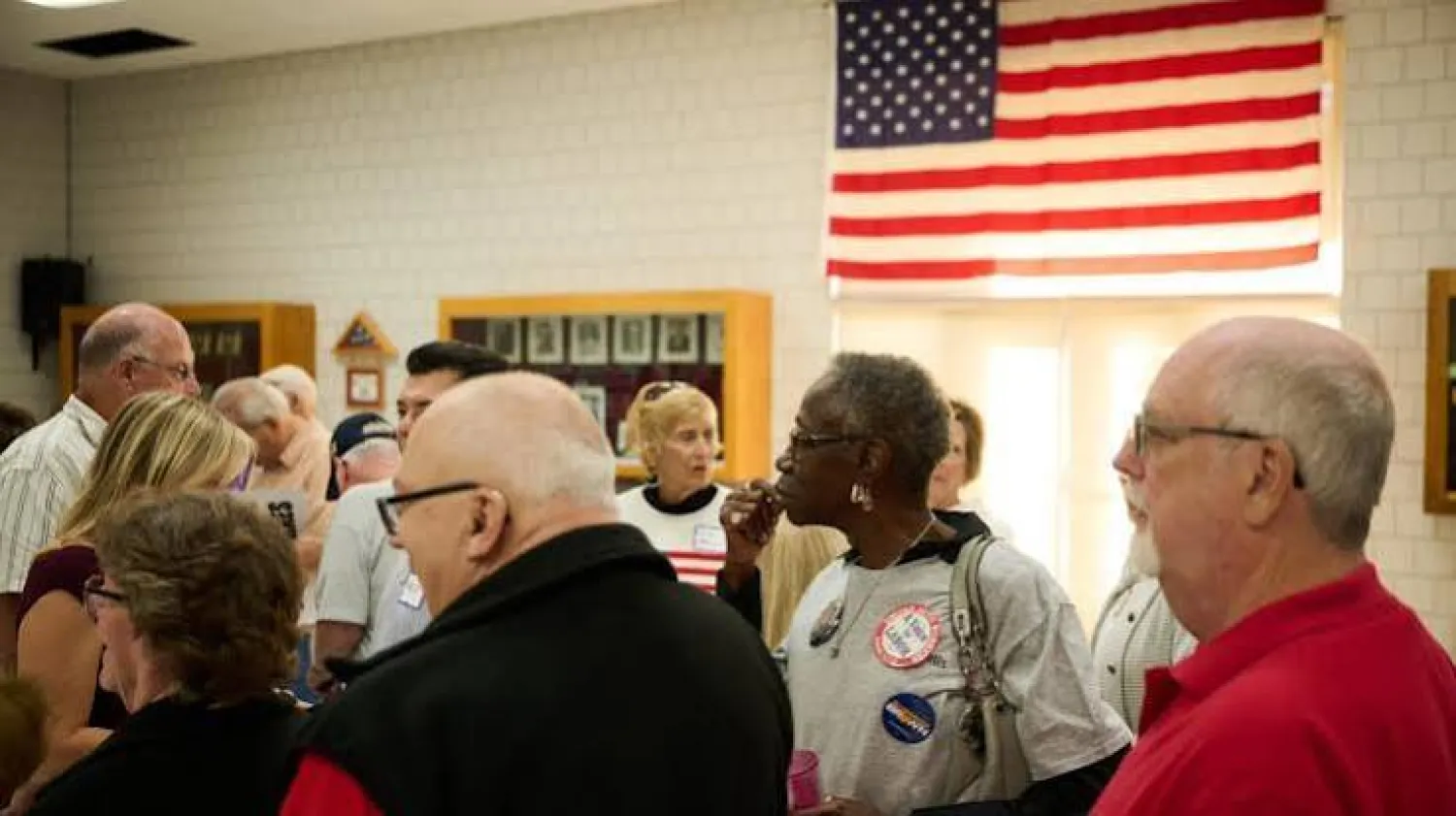
The Democratic former union worker was among dozens in Mahoning Valley -- known for its industrial history -- to show up at a town hall in recent weeks, expressing concern over hospital closures, cuts to health programs and rising cost of living.

Many districts in Ohio are expected to remain Republican. But the Buckeye State, which President Donald Trump won by double digits in 2024, has become a battleground.

Democrats are competitive in some House races and have a chance of seeing former three-term senator Sherrod Brown unseat Republican Jon Husted, who filled a vacancy left by Vice President JD Vance.

The question is whether frustrations over rising gasoline, grocery and utilities prices, exacerbated by other worries like healthcare issues, will spill into the ballot box.

Barber recalls driving her husband to medical appointments recently after he had a mini stroke, and how costs piled up as they live in a "medical desert."

"The price of gas driving up there is outrageous," said Barber, a steelworker of 22 years who later became an accountant after losing her job. "On a fixed income, it makes it really hard."

She is not alone, with affordability top-of-mind for US voters this year.

Some 29 percent spontaneously named an economic concern when asked what they wanted congressional candidates to discuss, a Pew survey in June found.

War with Iran has intensified stresses, as Tehran retaliated against US-Israel strikes from late February by choking off the Strait of Hormuz, sending energy costs soaring.

The average cost of regular gasoline has jumped over 45 percent since the war started, to $4.37 per gallon ($1.15 per liter), AAA motor club data shows.

For Barber, this sometimes meant hundreds of dollars more in weekly expenses.

"I'm going to have to find a job so that I can make up the difference," she said.

- 'Win them over' -

While Mahoning Valley in northeast Ohio has "become very Republican," Hudson Institute nonresident senior fellow Paul Sracic believes the party faces "real danger" in the Senate race.

"The party in power always does poorly in midterm elections," he told AFP. "It was going to be an uphill fight anyway."

But "we have gas prices going up, and gas prices are the best measure of how people feel about the economy," he said.

Husted has also been a supporter of data center investment, which has attracted backlash, Sracic said.

And US grocery prices stood 2.2 percent higher than a year ago in August, underscoring households' compounding costs.

Democrats are campaigning on these pressures.

"Working-class voters didn't want this war," Brown told reporters on the sidelines of a recent meet-and-greet in Warren, Ohio.

"They didn't want to see explosions in costs of everything," Brown added. "I'm going to win them over."

"Why do you think the data centers are pumping $30 million against me in this state? Because they know I'll stand up to them."

- 'Getting crunched' -

"Affordability is affecting every worker, not only in this area but really across the entire country," said David Green, a labor leader with the United Auto Workers (UAW) union in Ohio.

"Workers are getting crunched right now," he added.

"What's been really scary is over the last six months to a year, a lot of our smaller UAW facilities that are independent part suppliers, mom and pop shops, are having layoffs and some plant closures," Green said.

While the area around Youngstown was once predominantly Democrat, he said, it turned red in 2016 amid Trump's election pledges.

"There were a lot of broken promises," Green said, including that "all these jobs were coming back."

Some residents say they are still awaiting the manufacturing resurgence Trump promised.

Retired steelworker Mike Rubicz has seen Mahoning Valley "go from one of the main centers of the steel industry in the world to (virtually having) no steel mills left."

"Everyone in this valley is conscious of the need for manufacturing jobs," he said. "But the reality is, the ability of people to come to the valley and get a job is gone."


Putin Hails Elon Musk as 'Truly a Genius'

Putin's comments came amid tensions between the United States and Ukraine. Pavel Bednyakov / POOL/AFP
TT

Putin Hails Elon Musk as 'Truly a Genius'

Putin's comments came amid tensions between the United States and Ukraine. Pavel Bednyakov / POOL/AFP

US tech tycoon Elon Musk is "truly a genius" for deploying thousands of satellites into orbit, President Vladimir Putin said Wednesday, as Moscow seeks to develop its own satellite internet network.

The American tech titan is the owner of SpaceX, that launches rockets for NASA and runs the Starlink communications network, AFP said.

Russia, a spacefaring power, has long sought to develop its own satellite internet constellation for both civilian and military use.

Putin's comments come amid a spat between Ukraine and the United States over access to Starshield, a military-grade satellite network powered by Musk's SpaceX.

"Elon Musk is a genius, truly a genius," Putin said while touring an exhibition on the sidelines of a Russia-Africa summit in Moscow.

"He has how many units in orbit...? More than 5,000. And we're taking our first steps," he added.

"We are in close contact with our American partners, including Mr. Musk, because it is crucial in orbit not to interfere with one another."

Ukraine began reporting problems using Starshield this month, following a row between Ukraine's President Volodymyr Zelensky and US President Donald Trump over a US-Russia diesel deal.

Both Trump and Musk denied being responsible for the outages, although Musk later accused Ukraine of misusing SpaceX's Starlink internet service for military purposes.

Ukraine says the outages have frustrated its efforts to intercept Russian drones and has slowed its logistics on the front line, as the Ukraine-Russia conflict grinds through its fifth year.


Trump's Border: Quiet, But Few People are Happy

Border patrol is now picking up fewer than 10 people every day in this section of the frontier, down from 2,000 during the last administration. Olivier Touron / AFP
TT

Trump's Border: Quiet, But Few People are Happy

Border patrol is now picking up fewer than 10 people every day in this section of the frontier, down from 2,000 during the last administration. Olivier Touron / AFP

Between the hundreds of migrants arriving every day to seek asylum, chases of those fleeing, and the encounters with drug traffickers, Jason Mercado was overwhelmed during his time working for the US Border Patrol under Joe Biden.

"It's peaceful now," the retired agent says as he stands in front of the enormous wall that separates the United States from Mexico, near the town of San Luis, Arizona.

On the eve of the midterm elections, this arid region in the Southwest serves as proof that Donald Trump kept his central campaign promise: to restore order at the border, reported AFP.

In the sector around San Luis, the Border Patrol now apprehends fewer than 10 people per day -- a sharp decline from the up to 2,000 per day under the last administration.

This drop, which began during the final months of the Biden presidency, accelerated under the Republican billionaire's aggressive anti-immigration offensive.

Now filing an asylum claim at the border has become extremely difficult; migrants apprehended near the wall are almost never released while awaiting a hearing; and high-profile, forceful operations targeting undocumented immigrants across the United States have served as a deterrent.

Mercado's former colleagues tell him that during their patrols, things are "very quiet."

"One or two of them said the word 'boring,'" says the 56-year-old, a Republican voter, with a smile.

- Relief -

In the small town of San Luis, the sense of relief is palpable, even among Democrats, who sometimes struggled with the scope of the humanitarian crisis.

Churches and community organizations provided food and shelter for thousands of people in transit, while the hospital in Yuma, the county seat, was completely overwhelmed, and the federal government still owes it millions.

"Our tax dollars were going toward all of that," says Georgina Escamilla, speaking in Spanish in her Mexican restaurant.

"They were giving money to people coming from other countries, while those who live here receive no help," adds the 63-year-old, who leans to the left politically.

Yet, the return of calm masks a new sense of unease among the residents of this agricultural region -- one of the country's primary producers of lettuce and other vegetables.

"With Trump, we've shot ourselves in the foot," complains Ricardo Vasquez.

The 58-year-old farmworker is frustrated that he now has to pay more than 20 percent more for diesel, a cost he attributes to the conflict in Iran initiated by the president.

"The country wasn't doing so badly before he arrived, and now, with fuel prices, it feels like we're being slapped in the face, because everything is going up," he grumbles.

In his fields of lettuce and broccoli, Mike Pasquinelli no longer has to worry about the destruction caused by migrants fleeing the police -- incidents that previously wiped out portions of his harvest.

However, the surge in the cost of diesel and fertilizers, driven by the conflict in the Middle East, is eating into his bottom line.

- 'Uncertainty' -

"We're probably gonna have about a 20 percent reduction in profits... compared to last year," sighs the farmer, who serves as president of the Yuma Fresh Vegetables Association.

He has also had to contend with a drop in orders, stemming from tensions linked to the trade war with Canada, a major destination for his vegetable exports.

"There's been a lot of uncertainty on the foreign market, especially with the tariffs and retaliation between countries," he says.

"Most of the market has stabilized, but we've had some ups and downs."

This instability has also taken a toll on the logistics sector, another key employer in the region.

In his refrigerated warehouses, located right up against the border wall -- in an area through which dozens of trucks pass -- Mario Jauregui is fed up with "always playing the guessing game."

Tariffs, which have been repeatedly imposed and then lifted, have cut the volume of fruit his clients ship between Mexico and the United States by a fifth.

His industry is also facing setbacks because the Trump administration has stopped issuing commercial vehicle permits to certain foreign drivers.

"It's become so uncertain... nowadays that when we wake up the first thing that we do is look at the news," the conservative business owner grumbles.

"I don't think that that's a way to manage a country."

At 66, he has always voted Republican.

But with the November 3 election approaching, he finds himself hoping that Trump's Republican Party loses its congressional majority.

"I would much rather have a Democratic Congress and a Republican president," he says with a sigh. "We need to learn our lesson."


North Korea Fires 'Around a Dozen' Ballistic Missiles into East Sea

A TV screen shows a file image of a North Korean missile launch during a news program at Seoul Railway Station in Seoul, South Korea, September 20, 2026. Ahn Young-joon, AP Photo
TT

North Korea Fires 'Around a Dozen' Ballistic Missiles into East Sea

A TV screen shows a file image of a North Korean missile launch during a news program at Seoul Railway Station in Seoul, South Korea, September 20, 2026. Ahn Young-joon, AP Photo

North Korea fired "around a dozen" short-range ballistic missiles off its east coast on Thursday, Seoul's defense ministry said, less than a week after South Korea proposed talks over a growing border row.

The launches follow a slew of recent weapons tests by Pyongyang, including a new precision-guided torpedo system and an intermediate-range hypersonic missile, both of which were said to employ AI technology.

South Korea's Joint Chiefs of Staff (JCS) said its military detected "around a dozen short-range ballistic missiles fired from the Wonsan area of North Korea towards the East Sea", the body of water also known as the Sea of Japan.

The missiles flew about 250 kilometers, and "South Korea and the United States are conducting a detailed analysis of their exact specifications", Seoul's military said, adding it had stepped up surveillance of possible additional launches.

The Japan Coast Guard had earlier urged ships in the area to be vigilant.

Seoul's National Security Office, meanwhile, said the launches violated UN Security Council resolutions, labelling them "serious acts that do nothing to help manage the current situation".

Thursday's missile flurry comes against the backdrop of growing tensions over a landmine explosion along the heavily fortified border between the two Koreas that saw three South Korean soldiers wounded.

A joint Seoul-UN investigation earlier this month concluded that North Korea planted the landmines over a year ago.

Seoul accused Pyongyang of "a clear violation of the Armistice Agreement" and demanded an apology, something the North has mockingly dismissed.

- 'Show of force' -

"This should be seen as a fairly high-level show of force," Lim Eul-chul, a professor at Kyungnam University, told AFP.

"North Korea is demonstrating that it has the capability to completely destroy major South Korean and US military facilities," he said.

Pyongyang was also sending a political message, Lim added, by "showing off its overwhelming military power and warning Seoul not to interfere with its efforts to fortify the border".

Last week, Kim Yo Jong, the powerful sister of North Korean leader Kim Jong Un, said the North would place loudspeakers on standby along the border "within days" and had put unspecified "new counter means" on alert.

Both countries have occasionally turned to loudspeakers blaring propaganda across their shared border and other psychological warfare methods.

South Korea days later proposed military talks with the North to "mutually confirm the precise location" of their border and discuss restoring communication channels, but Pyongyang has yet to respond.

The DMZ is one of the world's most heavily fortified frontiers, and landmine incidents have previously heightened tensions between the two countries.

Seoul and Pyongyang remain technically at war, as the Korean conflict ended in 1953 with a truce rather than a peace treaty.

The ratcheting tensions come as US President Donald Trump's recent overtures to North Korea have raised concerns that Seoul -- an ally of Washington -- could be sidelined in potential nuclear talks involving Pyongyang.

In his most recent comments, Trump seemingly downplayed the possibility of a summit while insisting his relationship with Kim Jong Un was "very good".

In October, North Korea launched several short-range ballistic missiles a day after Trump suggested the two might meet this year.