


Israeli Media: Israel Threatened to Cut Intelligence Cooperation with Britain Amid Jerusalem Consulate Crisis

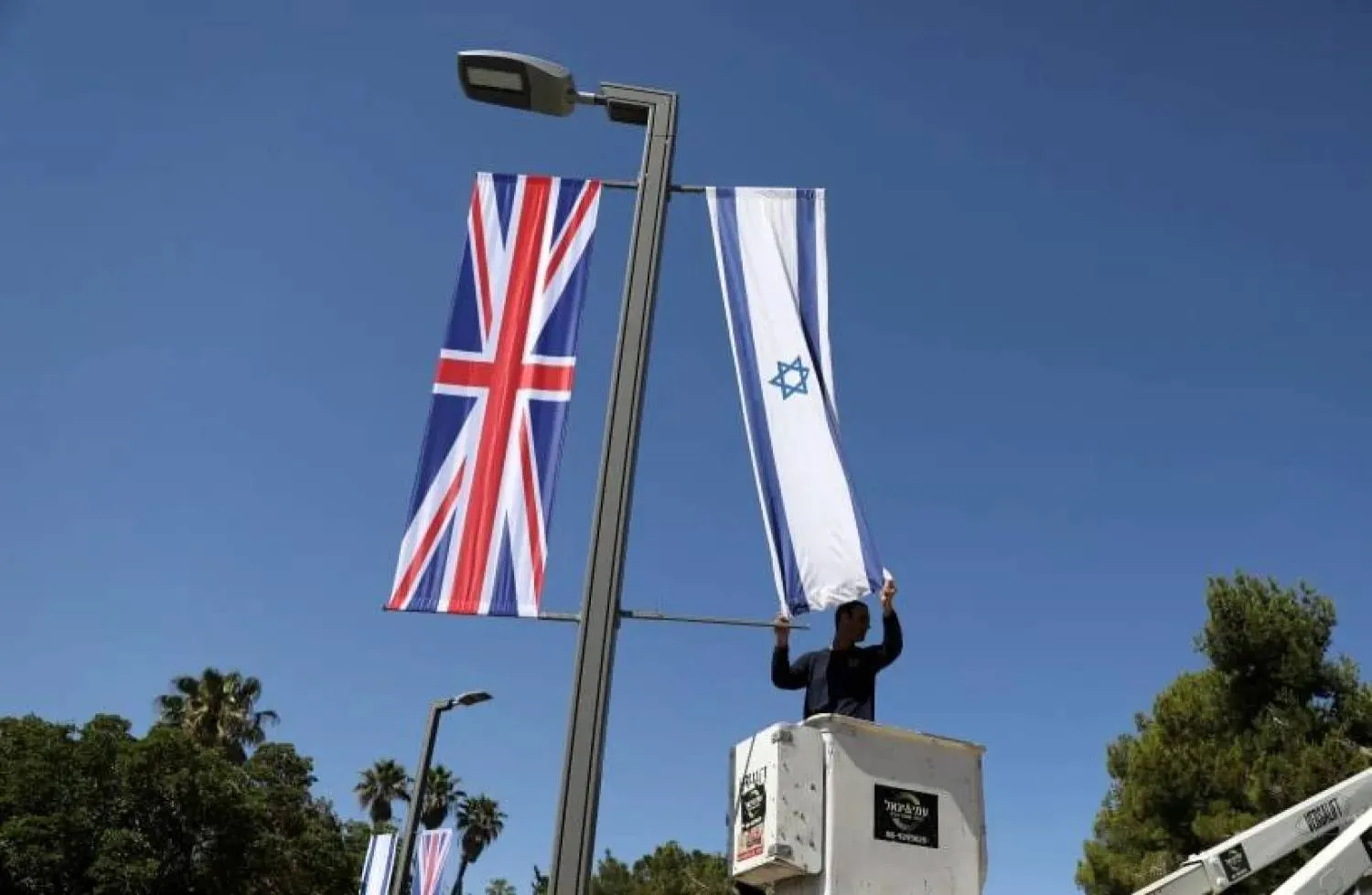
A Jerusalem municipality worker hangs an Israeli flag next to the British flag, the Union Jack, as he stands on a platform near Israel's presidential residence in Jerusalem ahead of the upcoming visit of Britain's Prince William, June 25, 2018 (Reuters)
TT

Israeli Media: Israel Threatened to Cut Intelligence Cooperation with Britain Amid Jerusalem Consulate Crisis

A Jerusalem municipality worker hangs an Israeli flag next to the British flag, the Union Jack, as he stands on a platform near Israel's presidential residence in Jerusalem ahead of the upcoming visit of Britain's Prince William, June 25, 2018 (Reuters)

The right-wing Israeli newspaper Israel Hayom revealed on Sunday details of an agreement reached between Israel and the United Kingdom following a diplomatic row over Tel Aviv’s decision to suspend operations of the British consulate in Jerusalem, which handles Palestinian affairs.

“Israel and the UK have reached a compromise over Britain’s diplomatic presence in Jerusalem, ending a standoff that had threatened to further strain relations between the two countries,” the newspaper wrote.

It said Britain had backed down from imposing measures against Israel, including the expulsion of Israeli diplomats from the UK.

The decision came after security agencies in London warned the government of the risks of further escalating the crisis. The agencies informed the government that Israel was threatening to sever security cooperation with British intelligence, a move that would seriously undermine national security, according to Israel Hayom.

Last Thursday, Britain announced its consulate in Jerusalem, which began operating in the city nearly 200 years ago, would continue its work on a more limited scale under the title “UK Mission, Jerusalem.” The decision came after Israel ordered the closure of the British consulate in response to the UK's sanctions on Israeli settlements.

Israel Hayom, which is close to Prime Minister Benjamin Netanyahu’s government, claimed that “in recent weeks, Israel has shared highly sensitive intelligence that enabled the foiling of Palestinian and Iranian terrorist plots in Britain, including at the military base hosting US fighter jets.”

Therefore, the two countries agreed to continue a dialogue to address the points of contention and prevent further deterioration in relations, while Israel backed down from imposing tough conditions.

Also under the reached agreement, the British consul general and 19 other diplomats will leave, while seven diplomats will remain, Israel Hayom wrote.

Although the British Consulate General in Jerusalem will no longer have a sign at the building's entrance bearing that title, it will retain its status as an official diplomatic mission serving Palestinians with a scaled-down presence, rebranded as “UK Mission, Jerusalem” and reporting directly to the UK Foreign Office.

The newspaper said the remaining consular services that will no longer be provided at the Jerusalem office will be made available to Palestinians through the British Embassy in Jordan, where most of the diplomats have relocated.

Israel on September 8 ordered Britain to close the East Jerusalem consulate within 30 days and remove its diplomats from the city, after Britain said it would impose a ban on trade of goods made in Israeli settlements in the occupied West Bank, including a ban on trade in goods produced there.

Israel had been adamant that the consulate will close even as Britain sought to keep it open, including sending the country’s top national security adviser to Israel last week for talks.

Britain’s consulate was founded in 1839, more than a century prior to the establishment of the State of Israel in 1948. The closure order does not affect Britain’s embassy in Tel Aviv, which handles diplomatic relations with Israel’s government.

The consulate, in the Sheikh Jarrah neighborhood of East Jerusalem, handles Britain’s relations with Palestinians in Jerusalem, as well as in the West Bank and Gaza. It also provides consular services to Palestinians.

Shortly before the 30-day deadline for Britain to close the consulate ended last Thursday, Reuters said Britain was likely to expel Israeli diplomats if Israel carries out its order to shut the British consulate in East Jerusalem.

It noted that if the consulate is closed, Britain is likely to respond ‌by expelling ⁠a similar number ⁠of Israeli diplomats from Israel's embassy to the United Kingdom, the sources said, speaking on the condition of anonymity.

But the two sides reached an 11th-hour compromise after the Israeli Foreign Ministry authorized the British to operate a reduced task force of just seven diplomats at the site.

The two countries also agreed to continue a dialogue to address the points of contention and prevent further deterioration in relations, with Britain, under the understandings, refraining from taking any further response measures, according to Israel Hayom.

In a post on X, Israeli Foreign Minister Gideon Sa'ar announced an agreement with London on the continuation of dialogue between the governments, within which both sides will be able to raise issues important to them.

“We believe in dialogue and will continue to believe in dialogue. Unfortunately, in recent years, no genuine dialogue has taken place with the Labor Government. This is despite good relations with Britain, reflected, among other things, in security and intelligence cooperation,” he wrote.

The minister added that “relations between Israel and Britain are important and have repeatedly proven their value also in protecting the lives and interests of British citizens.”


UN Chief Urges Drastic Emissions Cuts as COP31 Wrestles with Fossil Fuels

UN Secretary-General Antonio Guterres speaks at a press conference on the fifth day of the COP31 annual UN climate conference in Antalya, Türkiye, 13 November 2026. (EPA)
TT

UN Chief Urges Drastic Emissions Cuts as COP31 Wrestles with Fossil Fuels

UN Secretary-General Antonio Guterres speaks at a press conference on the fifth day of the COP31 annual UN climate conference in Antalya, Türkiye, 13 November 2026. (EPA)

UN Secretary-General Antonio Guterres on Friday called for an "immediate and drastic reduction" in greenhouse gas emissions, as divisions over fossil fuels dominated the first week of COP31 climate talks in Türkiye.

Big fossil fuel producers and consumers at the talks are resisting any deal that would specify firm new targets or a shift away from oil, gas and coal, observers said as the first week of talks drew to a close.

That poses a challenge for summit host Türkiye and lead negotiator Australia, which have another week to land the kind of ambitious agreement climate advocates such as Guterres say is needed.

"The central question is in the hands of member states, particularly the big emitters. They must recognize the need for an immediate and drastic reduction in emissions to keep the 1.5 goal still possible by the end of the century," he said, referring to the warming limit countries had agreed to ‌pursue under the 2015 ‌Paris Agreement.

A UN report last month found the world is on course to exceed ‌the 1.5 ⁠degrees Celsius (2.7 ⁠degrees Fahrenheit) warming threshold, a limit scientists say should prevent the worst effects of climate change.

As temperatures have risen, this year has been marked by extreme heatwaves across Western Europe and a glacier collapse in Nepal that triggered a flood that killed more than 1,450 people. Thousands more are still missing.

'DISPROPORTIONATE INFLUENCE'

Major oil producers have traditionally resisted language constraining fossil fuels, while large developing economies such as India have opposed measures they say could limit their development and energy choices, a dynamic that has compromised the outcomes of past deals.

The world’s biggest oil consumer, the United States, meanwhile, has skipped the talks for the second year ⁠in a row under President Donald Trump, who has called global warming a hoax and promoted ‌continued use of fossil fuels.

"We must confront the disproportionate influence of the fossil ‌fuel lobby. The future of our planet cannot be negotiated on the terms of those profiting from its destruction," said Guterres, who is leaving ‌his job at the end of December after two five-year terms.

"But I remain hopeful. I've also seen something extraordinary over ‌these 10 years. Renewable energy has moved from the margins to the mainstream. The economics have changed. The technology has advanced. A cleaner, safer, and more secure energy future is in our hands. The question is whether we have the courage and speed to reach for it."

ELECTRIFICATION AND NO FIRM TARGETS

COP31 host Türkiye is striving to place a proposal to expand global electrification at the center of an eventual deal, saying the ‌plan will lead to emissions cuts by speeding the shift away from fossil fuel-powered cars, boilers and other equipment.

The proposal does not require the increased electricity use to come ⁠from renewable sources, although some ⁠countries, including last year’s COP host Brazil, are advocating for progress on a plan to require countries to more clearly map out their transition away from fossil fuels.

Katrine Petersen, an observer for the non-governmental organization E3G, said whether those measures survive the talks depends on conversations in the days to come.

"We've also heard quite clearly from countries like India, the G77, that they don't want any firm targets. They don't want any kind of technology or fuel-specific language," she said. "(These are) the kind of consistent and ongoing divides that we've seen from those different parties before."

Diana Acconcia, head of the EU delegation, said Europe backed the electrification goal.

"Electrification is, in a way, an inclusive agenda because it is non-prescriptive in a way on how the electrification is achieved," she said. "Of course, for the European Union electrification is to be achieved by clean sources of energy."

The Australian team, which is leading negotiations under a split presidency arrangement, spent the first few days of the summit gathering views on what should be included in a political text agreed by consensus that will be followed by all the negotiated technical points.

Australia is taking further submissions from countries until Saturday night, with a view to formulating a draft text early next week.


Europe’s Security Cannot Be Part of Ukraine Peace Talks, EU Leaders Say

13 November 2026, Ireland, Dublin: German Chancellor Friedrich Merz speaks during a press conference on the sidelines of the EU summit at the Convention Centre in Dublin. (dpa)
TT

Europe’s Security Cannot Be Part of Ukraine Peace Talks, EU Leaders Say

13 November 2026, Ireland, Dublin: German Chancellor Friedrich Merz speaks during a press conference on the sidelines of the EU summit at the Convention Centre in Dublin. (dpa)

EU leaders said on Friday that Europe's security structure should not be a subject for Ukraine-Russia peace negotiations, but they did not answer the question of who should speak for Europe in any future talks.

The Kremlin said on Friday that Russia would be open to European countries taking part in Ukraine peace talks if it saw they were ready to contribute to the peace process.

German Chancellor Friedrich Merz described the Kremlin's comments as "the same old game" and said that Europe and the United States agreed on a clear message.

"There will be no discussions about ‌Ukraine without ‌Ukraine, and no discussions about Europe without Europe. Furthermore, there is no need ‌to ⁠talk about European ⁠security architecture. We have that already," Merz told reporters during a summit of European Union leaders in Dublin.

Russian officials have called for a broad agreement on Europe's security architecture to be reached before tackling the specifics of the war. Before its invasion of Ukraine in 2022, Russia demanded the withdrawal of NATO forces from countries that joined the alliance after 1997. NATO rejected the demand.

US negotiator Jared Kushner said in Moscow on Thursday that he had begun discussions with European partners on ⁠the continent's security architecture.

EUROPE PRIORITIZES CEASEFIRE IN RUSSIA-UKRAINE WAR

EU foreign policy chief ‌Kaja Kallas said Russian calls for discussions about Europe's ‌security architecture risked diverting attention from the need for a ceasefire. Latvian Prime Minister Andris Kulbergs called such ‌discussions "a trap".

During a meeting on Thursday, leaders from Poland, the Baltics and Nordic states warned ‌against brainstorming with the US or Russia about Europe’s security architecture, according to a European diplomat and a European official.

Forty European countries, meeting as a broader group in Dublin on Thursday, signed a declaration saying that any matter affecting European security should be decided with the involvement of Europeans.

EU leaders broadly agreed that Europe ‌needed to speak with one voice, but did not settle on a single individual to do so. Merz said discussions would continue.

"There are ⁠established institutional forms ⁠of (EU) representation — Kaja Kallas, for instance, is part of this — but the E3 format has also proven very effective," he said, in reference to an informal security grouping of France, Germany and Britain, which is no longer an EU member but a prominent NATO ally.

"Moreover, we always include Italy and Poland," Merz added.

Representatives from Britain, France, Germany, Italy and the EU attended Russia-Ukraine talks in Abu Dhabi earlier this week, where both Moscow and Kyiv cited some progress, though there was no sign of a breakthrough on key issues such as territory.

Swedish Prime Minister Ulf Kristersson said Britain, one of Europe's top three military powers, certainly had to be included in any future talks and that the five countries plus EU institutions would make sense.

"I'm quite flexible on that, so I think what we actually say is more important than the exact configuration of the people in the room," he said.


France Criticizes ‘Demagogic’ Move by Israel to Ban Hard-Left Leader Melenchon

 09 November 2026, France, Paris: France's Foreign Minister Jean-Noel Barrot, speaks during a G7 foreign ministers' meeting in Paris. (dpa)
09 November 2026, France, Paris: France's Foreign Minister Jean-Noel Barrot, speaks during a G7 foreign ministers' meeting in Paris. (dpa)
TT

France Criticizes ‘Demagogic’ Move by Israel to Ban Hard-Left Leader Melenchon

 09 November 2026, France, Paris: France's Foreign Minister Jean-Noel Barrot, speaks during a G7 foreign ministers' meeting in Paris. (dpa)
09 November 2026, France, Paris: France's Foreign Minister Jean-Noel Barrot, speaks during a G7 foreign ministers' meeting in Paris. (dpa)

France has ‌criticized as "demagogic" a decision by Israel to ban French hard-left presidential candidate Jean-Luc Melenchonand another leading figure in his France Unbowed (La France Insoumise) party from entering the country.

Israel's Foreign Ministry said on Thursday it would bar Melenchon and Mathilde Panot, the party’s parliamentary group chair, over "the extreme anti-Israel stance of La France Insoumise party and the outrageous statements made by ‌its leaders."

"This demagogic ‌decision, coming from a ‌government ⁠that has repeatedly violated international ⁠law, plays into the hands of those who, like La France Insoumise, thrive on exploiting the Israeli-Palestinian conflict," Foreign Minister Jean-Noel Barrot said on X.

"France will continue to work tirelessly toward a two-state solution and the ⁠peaceful coexistence of the Israeli and ‌Palestinian peoples,” he ‌said.

The Israeli Foreign Ministry said in a ‌statement on Thursday that both Melenchon and ‌Panot had made statements spreading "blood libels" against Israel, and that Melenchon had called for French ships to escort illegal flotillas to Gaza.

"Israel will respond ‌firmly to those who seek to harm it and will not allow ⁠individuals ⁠who act against Israel and incite against its citizens to enter the country," it said.

Melenchon told Franceinfo radio: "I am banned from entering a territory I did not ask to enter...I regret that the Israeli government is pursuing me like this."

In a campaign speech last Saturday, Melenchon made clear that, if he were elected president, French vessels would accompany activists hoping to force aid into the Gaza Strip.
