US Judge Backs CNN, MS Now, Politico Access to White House

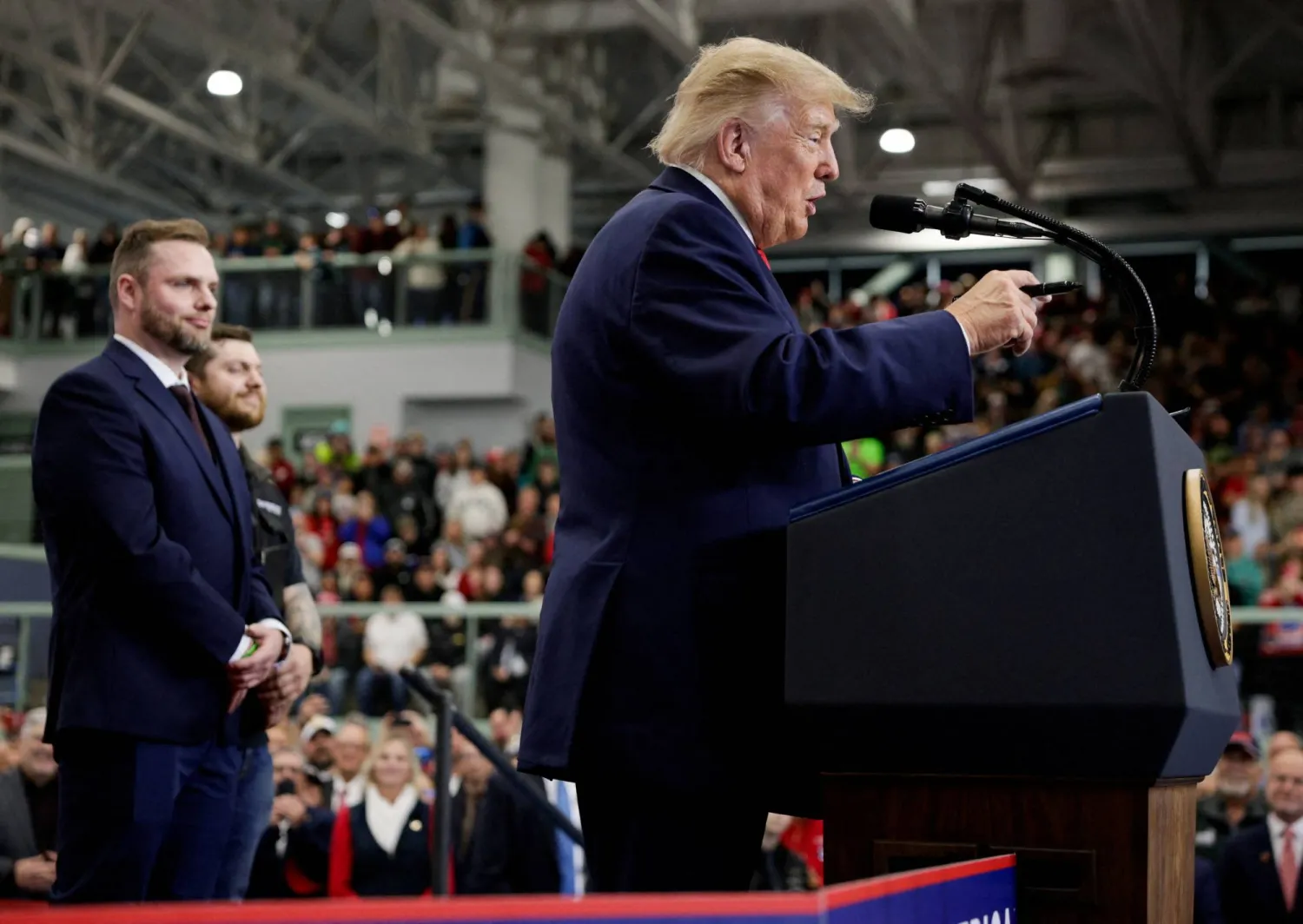
US President Donald Trump speaks on stage in Wasilla, Alaska, US, October 13, 2026. REUTERS/Evan Vucci
TT

US Judge Backs CNN, MS Now, Politico Access to White House

US President Donald Trump speaks on stage in Wasilla, Alaska, US, October 13, 2026. REUTERS/Evan Vucci

A federal judge blocked on Tuesday the White House from banning CNN, MS Now and Politico journalists, following President Donald Trump's decision to ban the news outlets last month.

District Judge Timothy Kelly ruled that the Trump administration must grant the journalists access to the White House while the lawsuit filed by the three outlets against the ban proceeds.

Kelly said the outlets were "likely to succeed not only on their due process claim, but also on their two First Amendment claims."

The First Amendment upholds the right to a free press.

Trump barred CNN, MS NOW and Politico from the White House on September 18 for distributing what he called "fake news" and "fiction and lies."

The three outlets filed a joint lawsuit seeking a preliminary injunction against the ban.

A court order temporarily restored the White House credentials of the journalists, AFP reported. That ban was set to expire Tuesday.

"The Court will extend the relief it already ordered, which will continue to preserve the status quo while this case proceeds," Kelly wrote in an opinion accompanying Tuesday's order.

"President Trump likely banned Plaintiffs from the White House because he believes that their reporting is generally inaccurate and biased against him," Kelly added.

Trump has long attacked media that have aired critical coverage of him, repeatedly blasting the press as the "enemy of the people."


North Korea Reviews Switzerland Relations After Sanctions on Youth Camp Linked to Russia-Ukraine War

Young North Korean girls hold up signboards with the names of participating countries during an opening ceremony at the Songdowon International Children's Camp, July 29, 2014, in Wonsan, North Korea. (AP)
TT

North Korea Reviews Switzerland Relations After Sanctions on Youth Camp Linked to Russia-Ukraine War

Young North Korean girls hold up signboards with the names of participating countries during an opening ceremony at the Songdowon International Children's Camp, July 29, 2014, in Wonsan, North Korea. (AP)

North Korea threatened Tuesday to close a Swiss diplomatic office that opened in Pyongyang last month, condemning Switzerland for imposing sanctions on a youth camp in eastern North Korea over its alleged role in the transfer of children from Russia-occupied areas of Ukraine.

Kim Yo Jong, the powerful sister of North Korean leader Kim Jong Un, described the Swiss sanctions on the Songdowon International Children’s Camp in the coastal city of Wonsan as an “open hostile act” and a “serious infringement” of the North’s sovereignty, according to a statement carried by state media.

Kim Yo Jong, one of Pyongyang’s top foreign policy officials, said the camp supported “legitimate” cooperation between North Korea and Russia. She didn't directly address Western accusations that some Ukrainian children abducted by Russian forces were sent there to be reeducated.

North Korea has closely aligned with Russia over the war in Ukraine, sending thousands of troops and large shipments of weapons in recent years to support Russian President Vladimir Putin’s full-scale invasion, possibly in exchange for economic assistance and military technology transfers.

Strengthened ties with Moscow and Beijing have been key drivers of Kim Jong Un’s increasingly assertive foreign policy as he positions North Korea as part of a united front against the United States.

Swiss Foreign Minister Ignazio Cassis traveled to North Korea in late October as Switzerland opened a diplomatic office in Pyongyang and held talks with senior North Korean officials, including Foreign Minister Choe Son Hui, over “promoting dialogue and cooperation,” North Korean state media said at the time.

Kim Yo Jong said that North Korea would need to “comprehensively reconsider the relations with unreliable Switzerland” following the sanctions on the camp and called on North Korean diplomats to take unspecified “corresponding” countermeasures.

“It is my view that the Swiss diplomatic office has spontaneously lost justification for its existence, which was opened in Pyongyang under the pretext of improving the relations, given that the Swiss Confederation has clarified its stand not to respect the sovereignty of the DPRK,” she said, using the initials of North Korea’s formal name, the Democratic People’s Republic of Korea.

In adding the Songdowon camp earlier this month to its broader sanctions related to Russia’s all-out invasion of Ukraine, Swiss authorities held the camp responsible for the “forced assimilation, including indoctrination, and militarized education of Ukrainian minors,” according to a document by Switzerland’s State Secretariat for Economic Affairs.

It said the camp participates in programs involving the transfer of Ukrainian children from Russia-occupied territories to North Korea and exposes them to propaganda and activities designed to promote pro-Russia narratives.

The United Kingdom in May and the European Union in September imposed similar sanctions on the Songdowon camp, freezing its assets and prohibiting financial transactions with the facility, although the practical impact of such measures is unclear given North Korea’s limited financial ties with European countries.


Trump Rewrites the Lame-Duck Rules with Flex on Nvidia CEO

US President Donald Trump presents the National Medal of Science to Nvidia CEO Jensen Huang during the "A New Golden Age" summit at the U.S. Institute of Peace, renamed The Donald J. Trump Institute of Peace by the Trump administration, in Washington, DC, US, October 8, 2026. (Reuters)
TT

Trump Rewrites the Lame-Duck Rules with Flex on Nvidia CEO

US President Donald Trump presents the National Medal of Science to Nvidia CEO Jensen Huang during the "A New Golden Age" summit at the U.S. Institute of Peace, renamed The Donald J. Trump Institute of Peace by the Trump administration, in Washington, DC, US, October 8, 2026. (Reuters)

President Donald Trump's intervention to restore Jensen Huang as CEO of Nvidia offered an early indication of how Trump, despite losing control of Congress to Democrats, can continue to wield power in Washington and beyond during what is traditionally considered the lame-duck phase of any presidency.

Days after the Nvidia board had ruled out restoring Huang following a series of damaging revelations about his relations with an alleged Chinese spy and other women, Trump seized control of the narrative.

He forcefully made the case for Huang's return in a press conference on Friday, then dispatched key members of his administration throughout the weekend to convince the board to reverse its position in an announcement shortly before the stock market opened on Monday.

Trump celebrated his victory with a nearly hour-long interview on CNBC in which he took credit for the turnabout and called Huang a "national treasure."

"The board decided to do what we wanted to do. And one of the things the board wanted to know: Is ‌there a national security ‌problem?" Trump told CNBC.

"And after a lot of research... we said, 'No, it's not a problem,'" Trump ‌said. "We ⁠feel very strongly ⁠that he's in good shape, very good shape."

The stock market soared. Members of Congress criticized the move. Meanwhile, Trump — just weeks from his party's historic midterm election blowout that many Republicans blamed on his falling popularity — was back at the center of the world's gaze.

"He's willing to do things in a very unorthodox manner," said presidential historian ⁠Thomas Alan Schwartz of Vanderbilt University. "Getting Huang back as CEO is clearly in the category of unorthodox."

NATIONAL ‌SECURITY CONCERNS REMAIN

It was not the first time Trump had inserted himself into major ‌corporate decisions, having pushed deals involving Intel and U.S. Steel. But his intervention with Nvidia went further by putting him directly into a boardroom decision ‌over who should lead a trillion-dollar American corporation at the center of the global artificial intelligence race.

Trump's actions may yet boomerang. Democrats, ‌who will have the widest majorities in decades to work with, vowed to investigate once they take control of Congress in January. Huang is scheduled to make a first round of testimony at a hearing next week.

Some of Trump's fellow Republicans joined Democrats on Monday in expressing fears that Huang's return imperiled US interests because of his relationship with a woman suspected of having links to Chinese intelligence.

“Allowing China to obtain America’s most advanced chips creates a significant national ‌security vulnerability," Senate Majority Leader John Thune said in a statement, promising strong export control measures.

Newt Gingrich, a former speaker of the US House of Representatives who is a close Trump ally, ⁠said on X, "There is something profoundly ⁠wrong" about Huang being reinstated.

"Congress should really dig into this as a national security issue of enormous proportions and also a significant failure in the federal bureaucracy," he said.

A BROADER PATTERN

Trump's intervention in corporate America has become a hallmark of his administration, particularly with companies considered important to US economic and national security.

After a public campaign from Trump and other members of his administration to block Nippon Steel's bid to buy U.S. Steel in a $14.9-billion acquisition, the Japanese company agreed to give an unusual degree of power to Trump over the company’s future. The administration gained the authority to name a board member, as well as the last word on idling plants, production cuts and moving jobs overseas.

Trump’s team also negotiated a 10% stake in Intel last year under a deal with the struggling chipmaker that converted government grants into an equity share. Trump had called for the resignation of Intel CEO Lip-Bu Tan over his ties to China before announcing a deal that made the US government the biggest shareholder in the chipmaker.

The administration also struck an agreement allowing Nvidia to sell its H20 chips to China in exchange for receiving 15% of those sales and an agreement for the Pentagon to become the largest shareholder in a small mining company, MP Materials, to boost output of rare earth magnets.



US Imposes Sanctions on Dozens Linked to Iran’s Shadow Banking Networks

US Treasury Secretary Scott Bessent testifies during a House Financial Services Committee hearing on the state of the international financial system on Capitol Hill in Washington, DC, on September 15, 2026. (AFP)
TT

US Imposes Sanctions on Dozens Linked to Iran’s Shadow Banking Networks

US Treasury Secretary Scott Bessent testifies during a House Financial Services Committee hearing on the state of the international financial system on Capitol Hill in Washington, DC, on September 15, 2026. (AFP)

The Trump administration has issued new Iran-related sanctions targeting dozens of people and entities, the Treasury Department said on Monday, stepping up its effort to isolate Iran from the global economy and disrupt its shadow banking networks.

The Treasury's Financial Crimes Enforcement Network (FinCEN) also released an analysis identifying nearly $15 billion of financial activity conducted from January 2025 to August 2026 that it said was potentially linked to Iranian shadow banking.

The Treasury said Monday's ‌sanctions hit ‌two dozen Iranian exchange houses and front ‌companies ⁠that have kept ⁠Iran's foreign trade running, including firms based in Türkiye and Hong Kong, as well as key personnel.

“Iran’s economy is underwater, and its leaders are panicking,” Treasury Secretary Scott Bessent said in a statement. “Iran’s shadow banking system is the last ⁠financial lifeline of a bankrupt regime. Treasury ‌will continue dismantling these illicit ‌networks until we have buried the head of the ‌snake.”

The Treasury said Iran’s shadow banking system is overseen ‌by the Central Bank of Iran and relies on dozens of Iran-based exchange houses and “rahbar companies,” bank affiliates that manage sanctions-evasion networks for their Iran-based clients.

Billions of dollars move ‌through the international financial system in this way, sustaining the last remnants of Iran’s ⁠foreign trade, ⁠it added.

The FinCEN report, based on data submitted by regulated US financial institutions, showed a decrease in the volume of potential Iranian shadow banking from January to August, which it said "may be indicative of at least partial disruption of Iran’s ability to operate shadow banking networks."

It showed that those networks continue to be connected, most prominently in Hong Kong and Singapore, through businesses spanning the oil, shipping and investment sectors.