Trump Puts New Russia Sanctions that He Recently Signed into Law on Hold, Citing National Interest

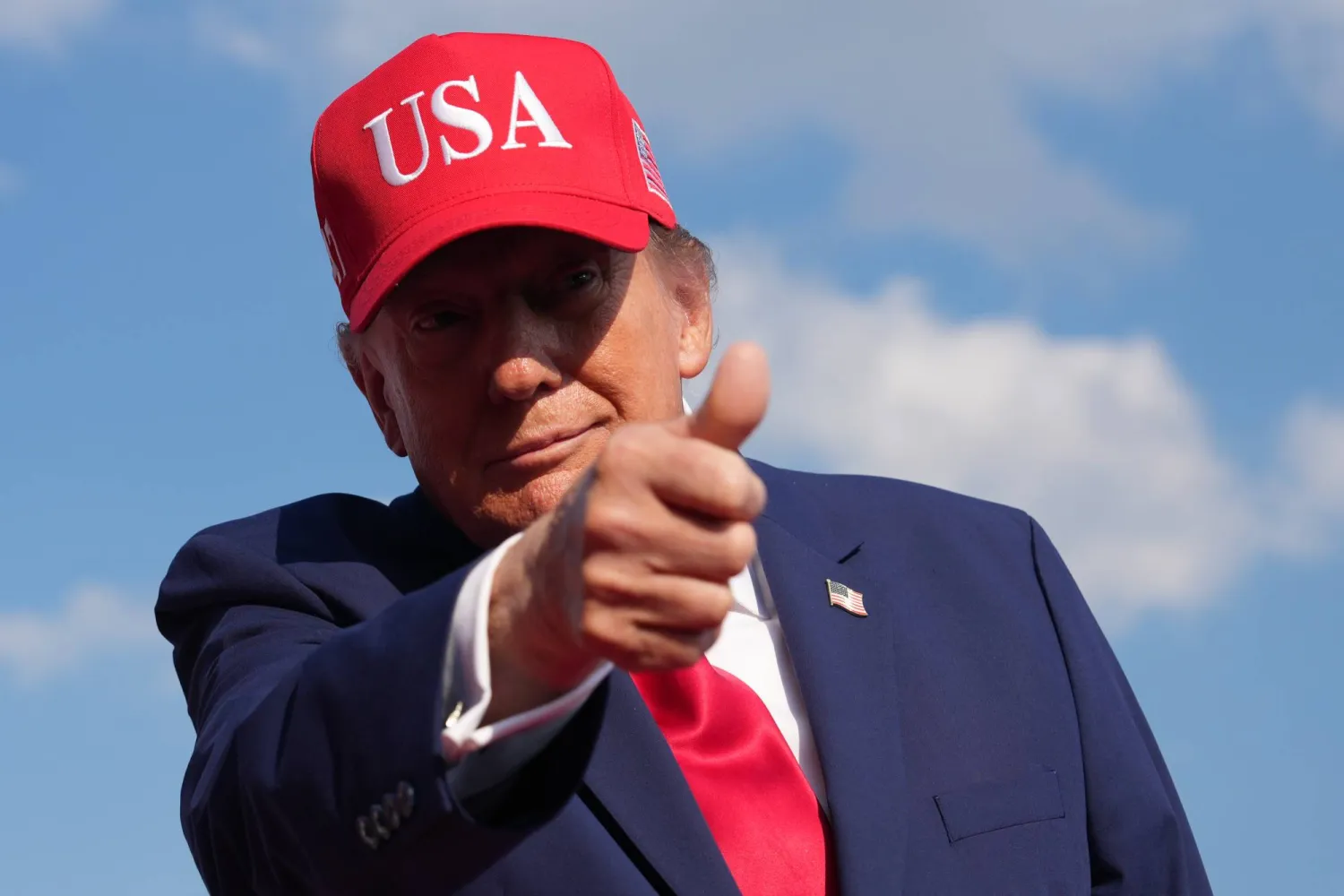
President Donald Trump arrives at a campaign rally at Dalton Municipal Airport, Friday, Oct. 16, 2026, in Dalton Ga. (AP Photo/Mark Schiefelbein)
TT

Trump Puts New Russia Sanctions that He Recently Signed into Law on Hold, Citing National Interest

President Donald Trump arrives at a campaign rally at Dalton Municipal Airport, Friday, Oct. 16, 2026, in Dalton Ga. (AP Photo/Mark Schiefelbein)

President Donald Trump on Friday signed an executive order that puts on hold a sweeping new sanctions package targeting the Russian economy, telling Congress the pause was in the national interest.

Trump personally signed the legislation just last month and his move came just two days before a deadline set in the law itself for its implementation. Named after late South Carolina Sen. Lindsey Graham, it had sought to clamp down more quickly on the flow of financial resources fueling the war against Ukraine.

Trump's unexpected decision comes a week after he stunningly said the US had agreed to purchase diesel from Russia to try to bring down global energy prices, despite that potentially hurting Ukraine in its war with Russia.

An AP-NORC Center for Public Affairs Research poll published Oct. 1 found that Americans disapprove of the president's handling of the Iran war and blame him for higher prices. Trump's approval ratings have sunk to near-historic lows and pressure is mounting as Republicans try to hold control of both chambers of Congress after midterm elections on Nov. 3.

Sanctions were seen as part of Graham's legacy Graham, a close ally and friend of the president, had just returned from Ukraine when he unexpectedly died in July. He had advocated for stricter US sanctions against Russia as a way of pressuring it to end its war in Ukraine.

His colleagues in Congress responded with bipartisan support after his death and Trump attached his signature to the legislation — then changed his mind Friday.

The package had been meant to starve Russian President Vladimir Putin of the resources Moscow needs to continue its war in Ukraine after invading its neighbor more than four years ago. The bill, also drafted by Sen. Richard Blumenthal, D-Conn., had sought to sanction Russian officials, banks and a shadow fleet of tankers that keeps Russian energy moving.

It also directed Trump to impose up to 100% tariffs on the top five importers of Russian oil or natural gas, with an exception for countries that import less than 15% of Russia’s natural gas exports and have taken significant steps to reduce those imports.

Democratic Virginia Rep. Don Beyer noted on social media shortly after the announcement of the sanctions being suspended that he and others had “warned" Trump might make such a move. The veteran congressman, who spoke out against the bill as it was debated, called on Congress to “fix this flawed law to stop Trump from capitulating to Putin and ensure that it truly supports Ukraine.”

The White House did not immediately explain how pausing the sanctions was in the national interest. The decision was posted on the White House website late in the evening, and the notification noted that the report explaining the decision had been submitted to Congress.

Still, it comes as Trump has increasingly lashed out at Ukrainian President Volodymyr Zelenskyy, blaming him for failing to make a deal with Putin to end the fighting.

The Trump administration, meanwhile, had remained mostly quiet since the passage of the bill with large majorities in the House and Senate following Graham’s sudden death — with lawmakers urged ahead by Zelenskyy.

Trump's action follows announced diesel deal with Putin

The president's latest action also followed him announcing last week that he had reached an agreement with Putin.

Trump said Russia will immediately supply more than 300,000 tons of diesel, followed by an additional 500,000 tons in November and 1 million tons “immediately thereafter.” Russia will deliver an additional 3 million tons “within a short period of time” after that, he wrote.

Trump’s striking a diesel deal with Putin has been pilloried by Republicans and Democrats alike who say it will help Russia execute its war against Ukraine -- without making a different to global fuel prices, which are elevated mostly due to Trump’s war on Iran.

The sanctions that Trump has now suspended, meanwhile, also had become a campaign centerpiece for Sen. Darline Graham, the late senator’s sister who was appointed to serve out the remaining months in his current term. She is now running to replace him in the Senate more permanently.

Darline Graham said in a statement after Trump signed the bill, “I wish Lindsey were here to celebrate this historic day." In a debate earlier this week with Democratic nominee Annie Andrews, Graham — who has Trump’s endorsement and is expected to campaign with him in South Carolina next week — said she had been “so proud” to help get the measure passed.

She acknowledged, however, that it was the president’s purview as to how he implemented it.

“It gives the president tools that he can use if he so chooses, to end the war through economic sanctions,” Graham said Sunday during a debate in Columbia. “So that’s up to him as to whether or not he wants to use it, or whether he wants to use something else, but I think the purpose of it is to bring down the gas prices and ultimately end the war. And when the war ends, gas prices will fall.”


European Air Traffic Targeted by New Threats in at Least 3 Incidents

Police officers work at Copenhagen Airport on November 6, 2026, in connection with new threats directed at air traffic. (AFP)
TT

European Air Traffic Targeted by New Threats in at Least 3 Incidents

Police officers work at Copenhagen Airport on November 6, 2026, in connection with new threats directed at air traffic. (AFP)

Police in Denmark and the Czech Republic investigated threats to air traffic on Friday, while a Romanian plane received a bomb threat following a string of hoaxes that have targeted flights and disrupted travel across Europe this week.

A flight from Prague to Bucharest operated by Romanian carrier Tarom received a bomb threat. The plane landed at its intended destination, and airport administration officials said the bomb threat proved to be false.

In the Danish capital, Copenhagen, police said Friday they were present at the airport for a second consecutive day “in connection with threats directed at air traffic.”

They said their immediate assessment was that there had been no danger to passengers or to others at the airport. It added that air traffic was proceeding safely and without disruption.

Czech police also said they were again dealing with threats against planes on Friday. They said necessary security measures have been taken in cooperation with Prague’s Vaclav Havel Airport that have “a minimal impact on the normal operations at the airport.”

Meanwhile in Ireland, the Dublin headquarters of national broadcaster RTE was evacuated Friday after a bomb threat, and live broadcasts were replaced with pre-recorded programs.

Ireland’s police force, An Garda Síochána, said it was “aware of a threat made against media organizations here and in Europe.” It said that it has been liaising with Irish media organizations and the threat will be investigated.

More than two dozen flights were affected by threats earlier in the week, with some diverted as authorities scrambled to rule out any danger.

Europe has experienced a slew of other disruptions recently, such as attacks on supermarket refrigeration systems, drone incursions and mysterious triggers to alert apps.

Fake bomb threats are relatively common, but it is unusual to see so many in such a short period. They come at a time of increased geopolitical tensions and warnings from authorities that Russia may be ramping up so-called hybrid threats in Europe.


Satellite Images Reveal New Construction Near Iran Missile Sites

A satellite photo shows suspected tunnel expansion (in the upper-right quadrant of the picture) at Shahid Modarres Garrison, near Tehran, Iran, in this handout image obtained by Reuters on July 5, 2024. (Planet Labs PBC/Handout via Reuters)
TT

Satellite Images Reveal New Construction Near Iran Missile Sites

A satellite photo shows suspected tunnel expansion (in the upper-right quadrant of the picture) at Shahid Modarres Garrison, near Tehran, Iran, in this handout image obtained by Reuters on July 5, 2024. (Planet Labs PBC/Handout via Reuters)

Iran appears to be undertaking significant new construction near at least two of its major missile sites and repairing bases damaged by months of US and Israeli air strikes, analysis of satellite images suggests, reported the BBC on Friday.

Evidence of digging and new buildings are visible in satellite imagery taken in November at the Garmdareh military base in Karaj near the capital Tehran and the Shahroud base in the north, analysts at British intelligence company MAIAR, who reviewed the photos, told BBC Verify.

At least 12 other military sites, including missile complexes and air bases, appear to show signs of repairs. New roofs have been built on destroyed buildings at the Kermanshah missile base in western Iran, near the border with Iraq, while damaged buildings and debris have been cleared at the Parchin military complex east of the capital.

"The excavations near Shahroud could potentially be related to the production of missiles," said Jim Lamson, a former CIA analyst who focused on Iran.

"Because the nearby air base at Shahroud has been targeted multiple times in recent years, Iran's Revolutionary Guards Corps (IRGC) is probably trying to find ways to move its production facilities underground," he explained.

At Karaj and Shahroud, satellite images appear to show significant excavation. At Karaj, multiple vehicles were visible in satellite images, while improvements appear to have been carried out to the nearby airbase.

The images from Karaj appear to show "a new portal for an underground facility", said Sam Lair, research analyst at the Foreign Policy Research Institute (FPRI), which has looked extensively into recent developments at Iranian sites, reported the BBC.

A MAIAR analyst also identified new construction and excavations outside tunnel entrances near the city of Qom, close to the Fordo underground uranium enrichment complex, which has been bombed by both the US and Israel multiple times.

Washington has repeatedly asserted that the strikes have severely degraded Iran's military capabilities. Tehran maintains that it holds substantial missile reserves, with state television broadcasting footage purporting to show dozens of missiles at the entrance of an underground facility.

Activity related to military assets would show that Tehran is bracing itself for further attacks by the US and Israel, said Mark Cancian, a military analyst with International Security Program at the Center for Strategic and International Studies (CSIS).

"The purpose is to better defend itself against future attacks," he said, according to the BBC. "It also indicates a priority on rebuilding military capability rather than rehabilitating the economy."


Israel Opposition Figure Makes U-Turn on Ultra-Orthodox Draft to Oust Netanyahu

Avigdor Liberman, then Israel's finance minister, speaks to members of the media in Jerusalem on September 11, 2022. (AFP)
TT

Israel Opposition Figure Makes U-Turn on Ultra-Orthodox Draft to Oust Netanyahu

Avigdor Liberman, then Israel's finance minister, speaks to members of the media in Jerusalem on September 11, 2022. (AFP)

A hardline figure in the Israeli opposition said Friday he would moderate longtime demands that ultra-Orthodox Jews serve in the military, seeking a coalition that can oust Prime Minister Benjamin Netanyahu.

Neither Netanyahu nor opposition chief Gadi Eisenkot reached a majority in the October 27 election, with Israeli society highly polarized over Netanyahu and worn down by three years of war.

Eisenkot could form a coalition if he works with Israeli-Arabs, whose seat count soared on anger over Netanyahu's far-right government, but that prospect faces strong disagreement from opposition partner Avigdor Liberman, a onetime aide to Netanyahu who now sharply criticizes the prime minister but shares his hawkish views on the Palestinians.

Liberman said Friday he would not back down on rejecting an alliance with Israeli-Arabs but said the opposition should negotiate with ultra-Orthodox Jews, despite his years of heated denunciations of the community for avoiding military service.

Saying the most important goals were removing Netanyahu and avoiding new elections, Liberman said it was time to compromise and "understand that trying to have everything risks getting nothing".

"This also includes the issue of the conscription law," he said in a social media statement.

"This pains me, and I know it pains many others as well. But given the full range of challenges we face today, the national interest of the State of Israel and the Jewish people must take precedence over all other considerations."

Liberman, whose Yisrael Beiteinu party won seven seats, has long demanded an end to an exemption that allows religious students to avoid the military service required of nearly all other Israelis.

Liberman even put up campaign posters vowing to crack down on the "draft-dodgers". During an appearance earlier this year, he described ultra-Orthodox Jews as "anti-Jewish" for their demands.

Netanyahu, while himself personally secular, has long relied on the two main ultra-Orthodox parties, although they left his government -- without seeking to remove him -- after he stopped short of enshrining the draft exemption into law.

One of the parties, United Torah Judaism, declined Thursday to back Netanyahu in forming the next government during consultations with President Isaac Herzog, although it also did not back Eisenkot.

The two ultra-Orthodox parties together have 13 votes, which would give Eisenkot a narrow majority in parliament.

Herzog will announce Sunday who will have the first chance at forming a government -- presumably Eisenkot as he received more recommendations from parties.

Ultra-Orthodox Jews' exemption from military service has fueled widespread resentment among other Israelis, with reservists serving multiple tours in the wars Israel has been fighting since the October 7, 2023 attack by Hamas.