
Bangladesh is battling to contain the world’s worst measles outbreak, a crisis exacerbated by weak data, inadequate outreach and vaccination gaps that experts say offers a warning to other nations about the deadly risk of falling immunization rates.
Bangladesh, whose routine vaccination program faltered in 2025, reported 202,000 suspected measles cases – 22,000 of them laboratory-confirmed – since the start of the outbreak in mid-March to October 9, the World Health Organization said. That’s more suspected cases than any other country this year, Reuters said.
So far, 1,147 people have died of the highly contagious disease, with 94% of reported deaths among children under five years old, the WHO said.
Bangladesh's experience shows the challenge of containing an outbreak when vaccination coverage falls below 95%, a level the WHO says is needed to prevent outbreaks. Bangladesh almost achieved that in recent years but in 2025 coverage dropped.
A Reuters review of WHO documents, alongside interviews with more than a dozen scientists, health workers and officials, shows Bangladesh was also hampered in its emergency response by data that left out millions of children, shortcomings in preparation and a failure to reach enough parents.
"This is a real warning to every country," said Mark Jit, a WHO vaccine adviser and professor at the School of Global Public Health at New York University.
Preventing an outbreak through vaccinations was easier, cheaper and safer than responding to an emergency, he said.
"The response will stop the outbreak eventually, but in the meantime, many will have had measles, and some will have died," he said.
Ziauddin Hyder, special assistant on health affairs to Prime Minister Tarique Rahman, told Reuters in September the government was doing everything it could to end the outbreak. The government did not respond to further questions sent in October for this article.
‘THEY CAME ONLY AFTER I BURIED MY SON’
In the northeast Sylhet region, one of the worst-hit areas in the nation of 178 million people, two-year-old Arman Hossain died unvaccinated in July, 24 hours after admission to hospital for treatment paid for by selling the family's three-wheeled auto rickshaw. His unvaccinated four-year-old sister survived.
His father Amin Mia, 26, said no health workers came to their remote village in Sylhet to offer vaccinations in time. "They came only after I buried my son," he said.
Measles usually kills two or three people in every 1,000 cases, the WHO says, but the disease can be more deadly in poorer nations because of factors such as malnutrition.
In the town of Chhatak, also in the Sylhet region, the daughter of 30-year-old carpenter Humayun Rashid died unvaccinated in June aged nine months. Labiba Akter could have received an inoculation in April when an emergency program lowered the vaccination age to six months from nine.
"No health worker came to tell us," her father said.
In May, Health Minister Sardar Md. Sakhawat Husain said the emergency drive had brought cases in hotspots "almost to zero" and the outbreak was under control.
Yet in September, Bangladesh reported a daily average of 1,198 new cases of measles, which causes a high fever, cough and telltale rash. That was the highest total since May.
The Bangladesh outbreak comes as vaccine hesitancy is rising, particularly in wealthier nations, amid skepticism championed by figures such as US Health Secretary Robert F. Kennedy Jr.
In Bangladesh, access to inoculations and awareness are bigger hurdles, experts said.
Until recently, Bangladesh had been a vaccination success story. The WHO and the United Nations children’s agency UNICEF estimated that in 2024 it achieved 96% coverage for the first vaccine dose and 93% for the second, which is given to capture the small percentage of children who don't develop immunity after one shot.
But that same year, protests erupted that ended 15 years of rule by Prime Minister Sheikh Hasina. In the ensuing political turmoil, health workers went on strike, vaccine orders were delayed and follow-up vaccinations that usually accompany routine programs were disrupted.
In a report published in July this year, WHO and UNICEF estimated first-dose coverage in 2025 had fallen to 90%, while second-dose coverage was 86%, several percentage points below the 95% needed for herd immunity.
The report also raised questions about the quality of official data on vaccinations for measles and other diseases for the years 2023 to 2025.
It said preliminary figures sometimes showed numbers of those inoculated exceeded 100% of those targeted, indicating mistakes in counting doses or target numbers.
EMERGENCY PROGRAMME MISSED MILLIONS
Still, when the measles outbreak erupted, Bangladesh responded swiftly and initially seemed to be winning the battle.
An emergency program was followed by an initial slowdown in new cases after almost 20 million children received a vaccination in April and May. The government said it had covered every child in the target age group of six months to five years.
But in reality the program fell short. This emerged when another routine health intervention in June had a target list with 4 million more children than the measles campaign despite covering the same age group.
"There is a gap," prime ministerial adviser Hyder told Reuters on September 14, as measles cases rose again, blaming vaccine hesitancy by parents or child illnesses for keeping kids away.
Other challenges have also emerged.
Documents detailing meetings in April and August between the government, the WHO and other health partners, reviewed by Reuters and not previously reported, show how efforts to act fast may have led to shortcomings.
Minutes from the April 19 meeting outlined how the government opted for just one round of so-called readiness checks before launching its emergency vaccination program due to time constraints, instead of the typical four rounds. Checks cover everything from ensuring fridges are available for keeping vaccines cool to determining how many children should be vaccinated.
The single round of checks suggested most - but not all - districts were ready, according to the minutes.
THE POOREST ‘PAY THE PRICE’
"When preparedness checks are not done properly, it is often the poorest and hardest-to-reach children who miss out on vaccination and pay the price," said Professor Mahmudur Rahman, an epidemiologist and chair of Bangladesh's National Verification Committee for Measles and Rubella Elimination.
Hyder said the April campaign was launched in four weeks. Yet Tajul Islam Abdul Bari, who led immunization in Bangladesh until 2017, said campaigns usually demand months of planning.
By the August meeting, shortcomings in the rollout were identified. Minutes noted the proportion of children with confirmed measles cases who had not been vaccinated was "virtually unchanged between pre-campaign (82%) and post-campaign (85%) ... underscoring persistent coverage gaps".
The WHO did not respond to questions about the April and August meetings. But deputy WHO representative to Bangladesh, Dr Rajesh Narwal, said the WHO was determined to support the government in its goal of vaccinating every child at risk.
"Routine immunization must become more effective and resilient so that these gaps do not develop again," he said.
In Sylhet, where official records show 180 children have died, 8 of 16 families Reuters interviewed in September said they had not seen health workers offering vaccinations. At least six families said health workers visited only after a child had died from measles in their community.
At the end of September, the government launched a new campaign to target 3.4 million children previously missed.
"We will involve people across villages so that no child is left behind," the health minister told a news conference.
Yet reaching every child remains a challenge. UNICEF and the Bangladesh Bureau of Statistics say as many as 40% of children go unregistered, while government data showed around a third of health worker posts are unfilled.
Health experts are also pushing the government to expand the program to vaccinate children over five. That age group represents a third of measles cases, the WHO says.
In addition, scientists in Bangladesh are studying why immunity is waning faster than expected in babies up to six months or so. They are usually still protected by maternal antibodies, experts say.
Ensuring prompt medical care is vital, the WHO says, another challenge for Bangladesh as it also fights a dengue epidemic.
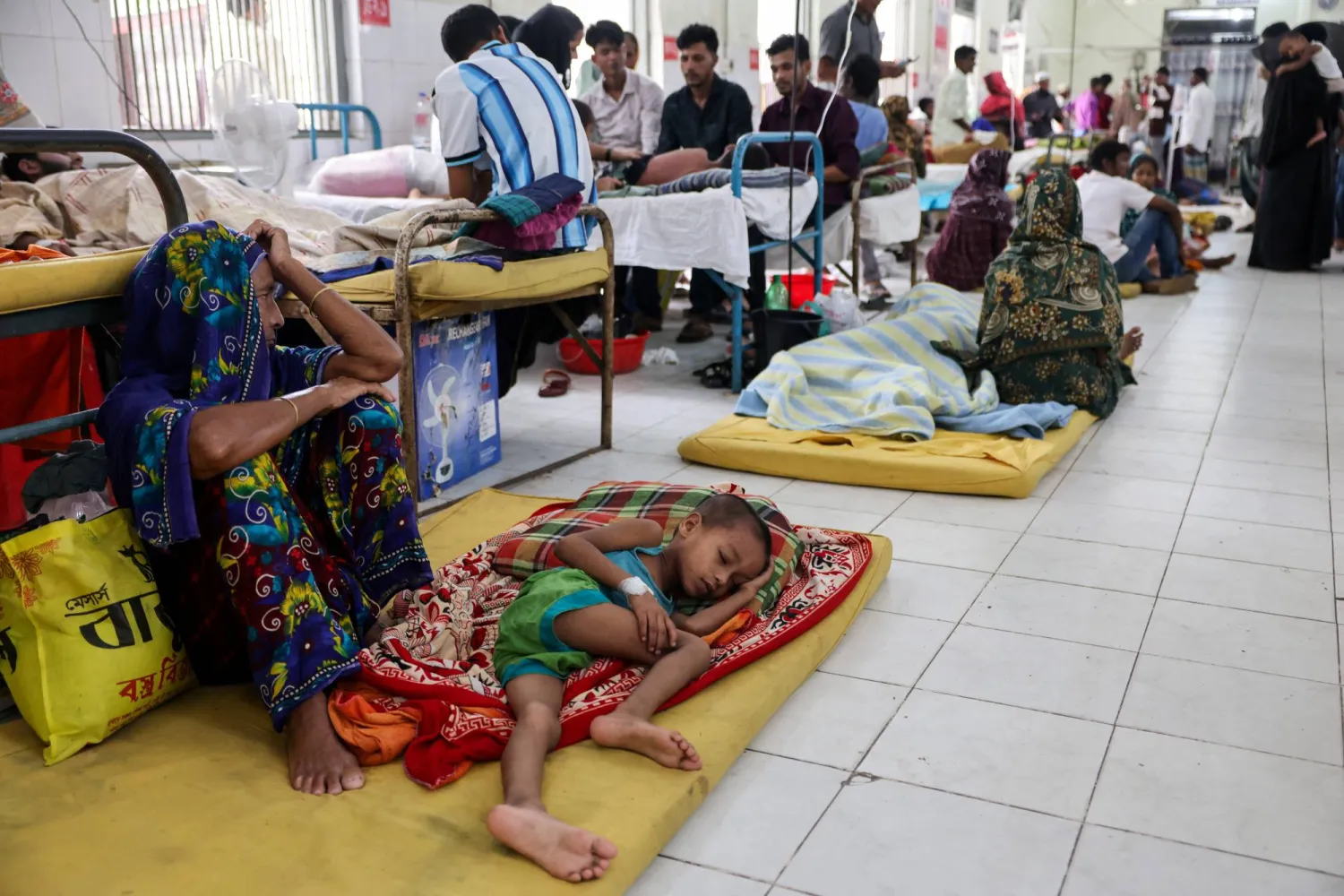
In September, every ward in Sylhet's 100-bed Shahid Shamsuddin Ahmed Hospital, which is treating measles, appeared overwhelmed. On the day Reuters visited, 178 patients were admitted.