Soldiers Guard Center of Milan as Thousands of Protesters March in Cities Across Europe

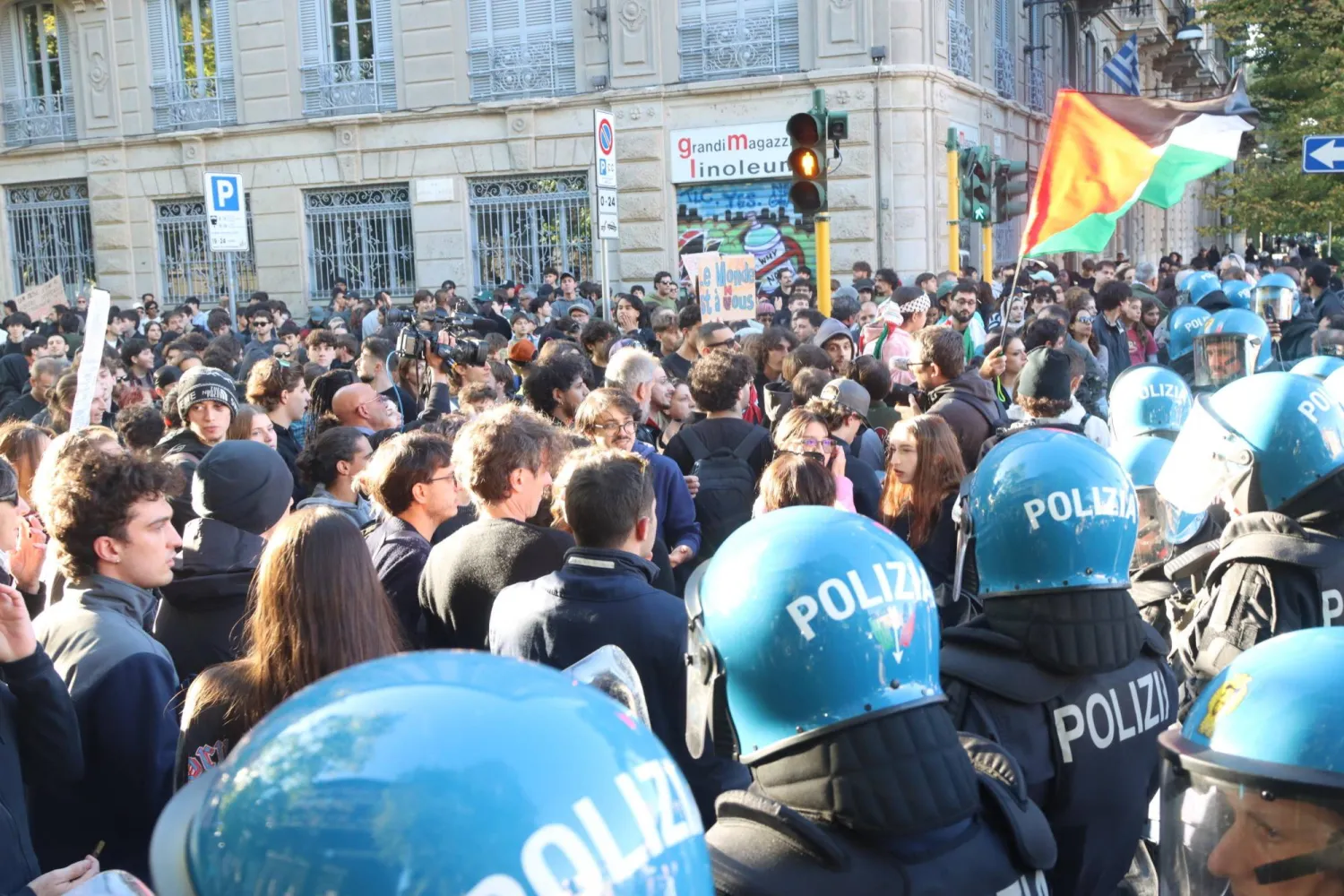
Protesters confront anti riot police during a demonstration at Lanza in Milan, Italy, 24 October 2026. (EPA)
TT

Soldiers Guard Center of Milan as Thousands of Protesters March in Cities Across Europe

Protesters confront anti riot police during a demonstration at Lanza in Milan, Italy, 24 October 2026. (EPA)

Thousands of young people marched Saturday through the streets of several Italian cities, including Milan, Rome and Turin, as authorities deployed large numbers of police and soldiers in a largely successful bid to stave off a repeat of the violent clashes and looting that marred similar protests last week.

The demonstration in Milan remained peaceful, but there were brief clashes with police in both Rome and Turin.

In Milan, thousands of young people marched the streets as soldiers were deployed and luxury boutiques were boarded up, but by late afternoon, most shops had opened, Italian media reported.

Premier Giorgia Meloni announced a raft of measures, including sending an additional 500 soldiers to Milan and tougher penalties for minors, who police said made up a large part of the violent protesters last week. In Milan, police detained several minors as a preventive measure, media reported.

While protests in France have claimed most international attention, large demonstrations also rocked many European cities Saturday from Milan to Rome to Madrid, Lisbon and Tirana.

The protests encompass a broad range of issues from education and corruption to anti-war movements, pensions and housing.
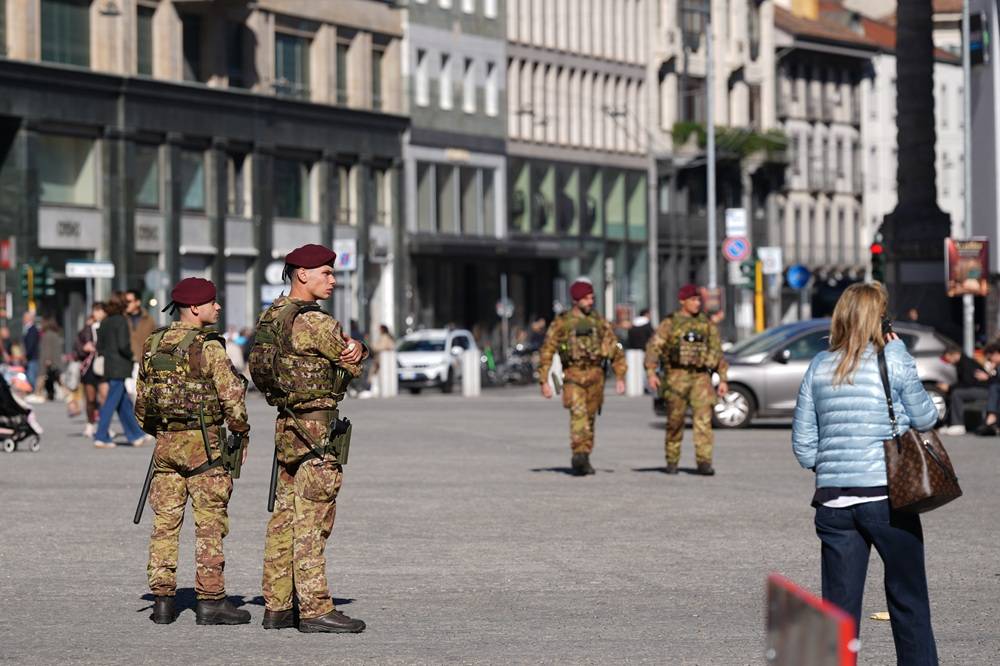
Italian army paratroopers patrol the streets of Milan, Saturday, Oct. 24, 2026, ahead of an expected protest against the rising cost of living and deteriorating public services during one of several protests in Italy organized by groups across the political spectrum. (AP)

Army vehicles and boarded-up luxury stores in Milan

In Milan, huge crowds of mostly young people gathered as night fell, chanting insults to Meloni and holding aloft banners such as “No to lies of the state.”

A group of protesters dumped manure outside Italy’s energy regulator and burned a symbolic, oversized electricity bill, images broadcast on local television showed.

The 500 soldiers deployed to Milan came in addition to hundreds already stationed there, supporting about 5,000 police and other security personnel. Authorities used drone surveillance, checks at railway stations, rapid-response units and online monitoring for potential calls to violence.

A mayoral hopeful, Pierfrancesco Majorino, who announced his candidacy Thursday, joined the marchers and remarked how peaceful the day was, according to Italian media. He will contest a center-left primary in early 2027. Milan's center-left Mayor Giuseppe Sala, who has held the role since 2016, is not running again.

Many stores, particularly luxury boutiques within Milan's fashion district including Omega, Tiffany and Gucci, boarded up their front windows. The Apple store also shut down and remained shut even as others reopened.

Rioters last weekend smashed their way into stores, targeting sneakers, athletic wear and sporting goods on streets that run off the city’s central Duomo square.

Security measures extended beyond the city center over concerns protesters could move into other neighborhoods.

The protesters ended their march peacefully Saturday evening outside the Milan Polytechnic, more than 3 kilometers (2 miles) from the city center.
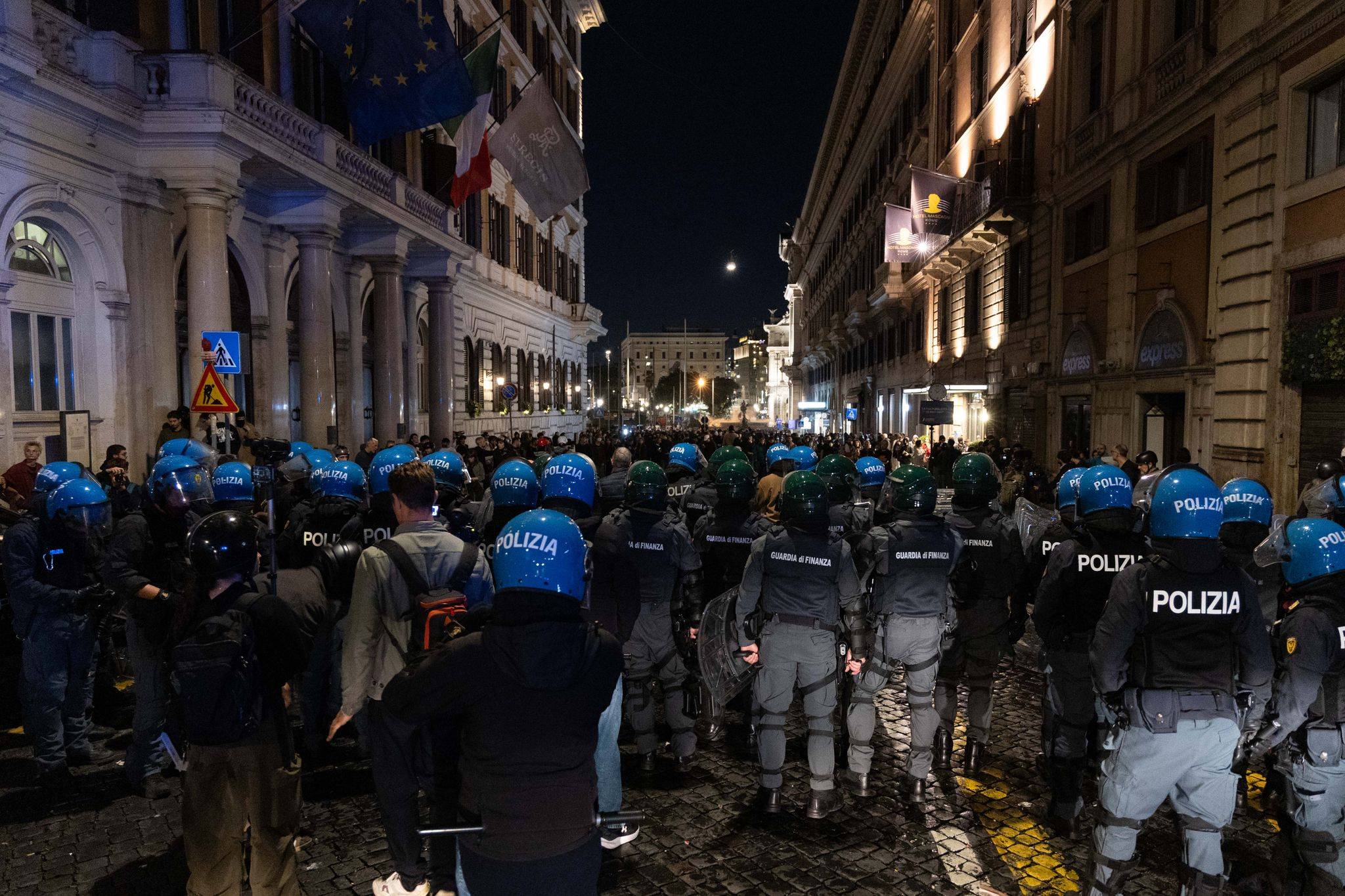
24 October 2026, Italy, Rome: Police officers stand guard during a march organized by the October 17 Movement against the rising cost of living. (dpa)

Officials said Saturday they were investigating a 30-year-old freelance journalist said to be the “mastermind” of the newly formed Oct. 17 movement, which has been the main driver of the recent protests in Italy.

Milan police say last week's violence and looting involved about 2,000 very young protesters, many of them “naturalized, second-generation Italians,” alongside foreign nationals. Over two days, police arrested 45 people, including 34 minors.

A group of about 30 far-right activists, described as hooligans linked to Inter Milan football club, made a brief appearance chanting anti-immigrant and anti-Muslim slogans but were isolated by police.

Defense Minister Guido Crosetto said the soldiers deployed Saturday were only recently allowed to use plastic restraint ties and only in areas around train stations, not throughout the city. They are not authorized to carry pepper spray or tasers, he said.

Protesters try to force entry into Colosseum in Rome

Security was also heightened in Rome, where authorities locked down luxury shopping streets and stepped up controls around the Circus Maximus and Piazza del Popolo.

A small number of protesters tried to force their way into the Colosseum, but were ushered out by guards. Elsewhere, several hundred students demonstrated peacefully to stress they were not rioters.

“I think the images from last week were truly something terrible, especially for the young people, for the students, for the vast majority of the younger generations who want to study ... and do not accept being represented by those who use issues and needs to devastate entire cities,” said Riccardo Ponzio, national president of an Italian far-right student association.

A separate anti-war march took place in central Rome. Organizers sought to distance themselves from potential unrest, urging participants to keep their faces uncovered and hands visible.

But it was these marchers who briefly clashed with police near the Piazza della Repubblica, even as organizers were trying to hold the crowd back using batons and tear gas. In the end, the protesters pulled back when a water cannon was turned on. They retreated to a location about half a kilometer away.
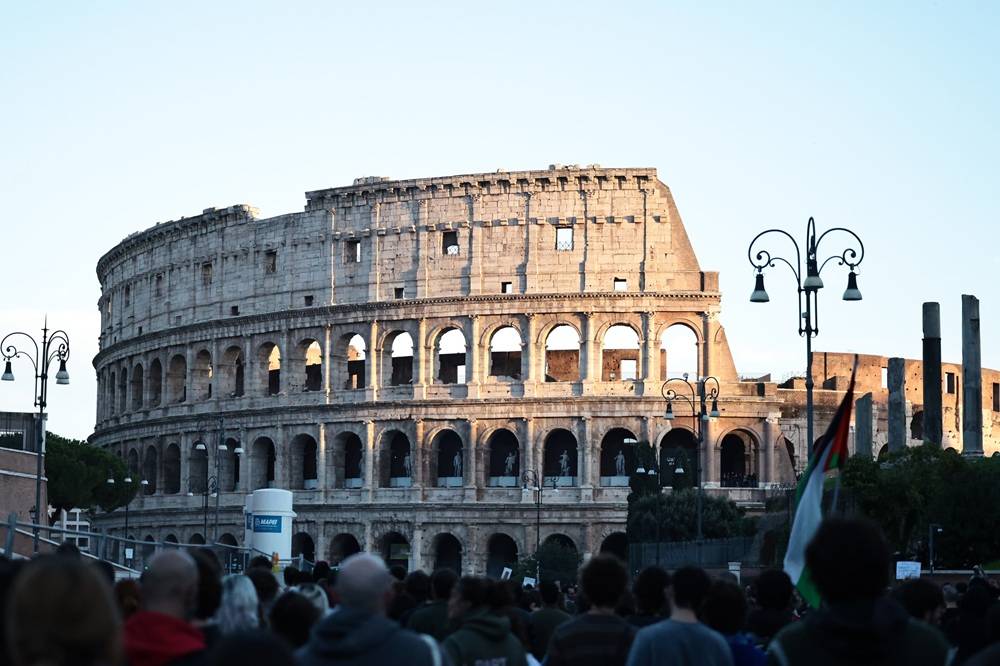
Students and peace activists gather in front of the Colosseum during an anti-war rally in Rome, Italy, 24 October 2026. (EPA)

Clashes and buildings set on fire in Albania

In Albania's capital Tirana, riot police used water cannons on large groups of protesters, some of whom set government buildings on fire and threw projectiles at police. Authorities said 2,500 officers patrolled the streets Saturday.

For over a week, protesters have hurled rocks, flares, firebombs and fireworks at police who have used batons and tear gas in clashes in the city center.

High school and university students are demanding lower tuition fees, greater state investment in education and protesting corruption in the education system. Some have joined a broader anti-government movement calling for the resignation of Socialist Prime Minister Edi Rama.

A separate protest organized by the opposition outside the prime minister's office turned violent earlier, with some activists lighting fires on the street.

Rama said Saturday his government was preparing a response to the students' demands and called them to a dialogue. He warned that violent protesters will face penalties.
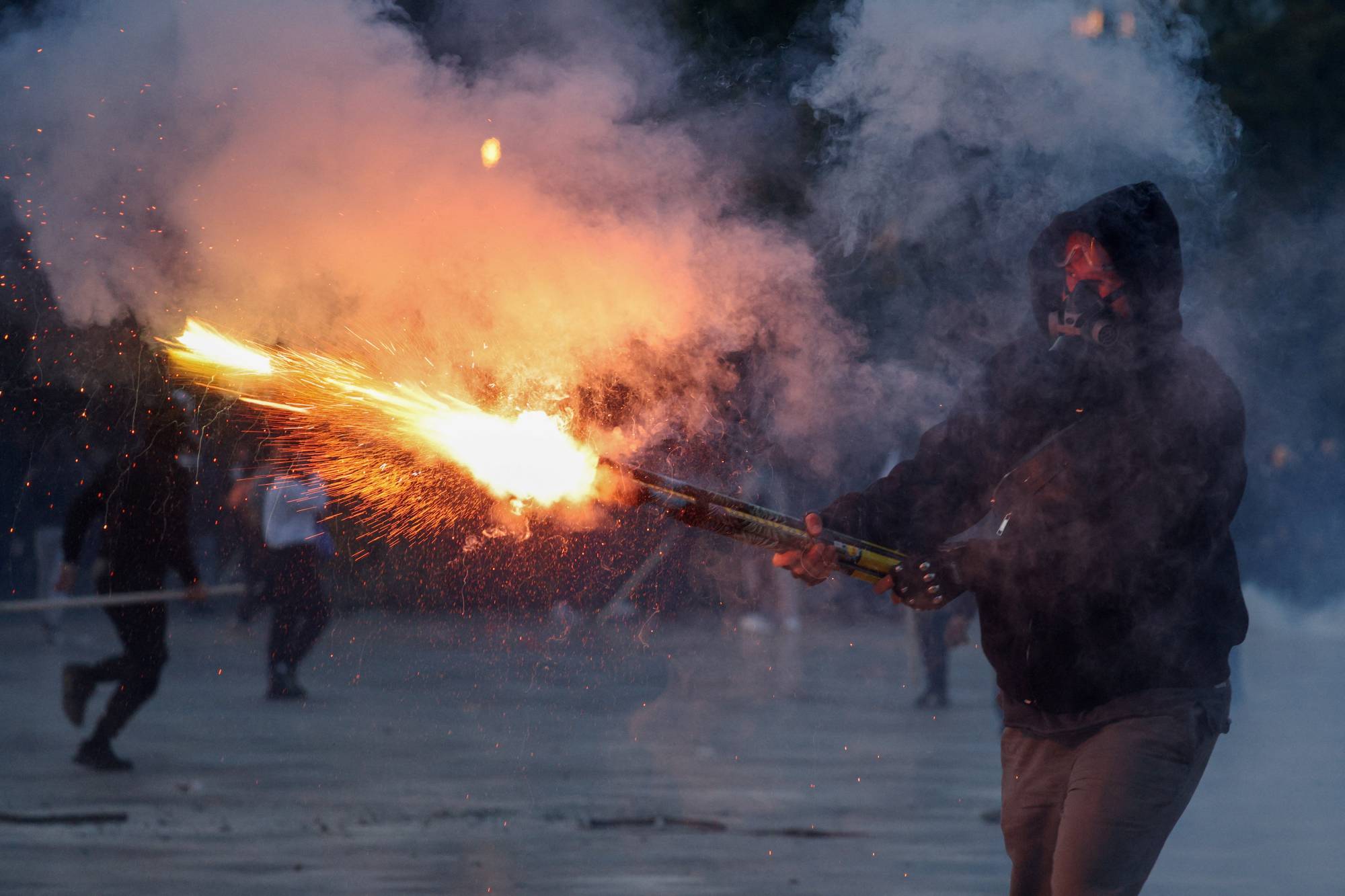
A demonstrator sets off a pyrotechnic device during an anti-government protest by students in Tirana, Albania, October 24, 2026. (Reuters)

Pensions and housing spark Madrid and Lisbon protests

Thousands of retirees and others marched peacefully in Spain's capital Saturday to demand public pensions aren’t meddled with.

“They are threatening us with privatizing pensions. It’s just another thing they want to profit from," said Maria José Benito, 68.

The protests came ahead of next month’s snap election as Prime Minister Pedro Sánchez’s Socialist Party criticized the conservative opposition Popular Party for making overtures about privatizing public pensions.

Spain also has been roiled by protests this fall around the issue of housing, as rental and home costs have risen in recent years beyond what many Spaniards can afford.

Taking their cue from Spaniards, protesters in Lisbon demanding affordable housing marched across the city on Saturday.

They have also targeted recent measures announced by the government of Prime Minister Luis Montenegro that include easing the cap on yearly rent increases and facilitating the eviction of tenants who fail to pay rent.

Montenegro defends the measures, saying that they aim at reinforcing trust between tenants and landlords and boosting the rentals market. Protesters claim that the measures are not balanced and put tenants in a more vulnerable position.


Iran President to Visit Moscow Next Week for Talks with Putin

Russian President Vladimir Putin meets with Iranian President Masoud Pezeshkian in Turkmenbashi earlier in October. (Reuters)
TT

Iran President to Visit Moscow Next Week for Talks with Putin

Russian President Vladimir Putin meets with Iranian President Masoud Pezeshkian in Turkmenbashi earlier in October. (Reuters)

Iranian Foreign Minister Abbas Araghchi stated that President Masoud Pezeshkian will travel to Moscow next week to meet his Russian counterpart, Vladimir Putin, as part of ongoing consultations between the two countries regarding bilateral cooperation and regional developments.

Araghchi noted, in a message addressing the recent visit of Russian Foreign Minister Sergei Lavrov to Tehran, that the talks focused on developing political and economic cooperation, implementing joint agreements, and strengthening the comprehensive strategic partnership between Iran and Russia.

The state-run Mehr News Agency quoted Araghchi as saying: "During this visit, we stressed the importance of continuing consultations to protect mutual interests and enhance regional peace and stability. This dialogue and these consultations will continue next week in Moscow in the presence of the presidents of both countries."

Lavrov visited Tehran on Monday, marking his first visit to Iran since the eruption of the war on February 28, where he met with Pezeshkian and Araghchi.

In a joint press conference with Araghchi, he said that Pezeshkian might visit Moscow "in the coming days," without specifying a date.

Lavrov called for a return to the pre-war status quo in the Strait of Hormuz, including the "restoration of freedom of navigation and guarantees against a recurrence of aggression," adding that Russia was ready to search for a way to resolve the crisis.

Russia "has no intention of abandoning the implementation of economic and investment agreements with Iran" despite the "difficult situation," he said, revealing that Russian experts are "gradually returning to the Bushehr nuclear plant".

Trade exchange between Moscow and Tehran grew by 21 percent last year, he added.

Pezeshkian and Putin recently met in Turkmenistan. Putin had informed Pezeshkian in early October of Moscow's readiness to contribute to mediation efforts.


Iran Judiciary Says Chief Holds Rare Meeting with Supreme Leader

 A police officer monitors traffic as he stands under portraits of Iran's supreme leader Mojtaba Khamenei in Tehran on October 21, 2026. (AFP)
A police officer monitors traffic as he stands under portraits of Iran's supreme leader Mojtaba Khamenei in Tehran on October 21, 2026. (AFP)
TT

Iran Judiciary Says Chief Holds Rare Meeting with Supreme Leader

 A police officer monitors traffic as he stands under portraits of Iran's supreme leader Mojtaba Khamenei in Tehran on October 21, 2026. (AFP)
A police officer monitors traffic as he stands under portraits of Iran's supreme leader Mojtaba Khamenei in Tehran on October 21, 2026. (AFP)

Iran's judiciary said on Saturday that its chief held a rare meeting with the country's supreme leader Mojtaba Khamenei, who has yet to appear in public since being appointed.

Mojtaba was chosen in March to succeed his father and longtime ruler Ali Khamenei, who was killed in US-Israeli strikes in central Tehran alongside senior military commanders at the start of the Middle East war, and was said to have been injured in the same attack.

Judiciary chief Gholamhossein Mohseni Ejei and the supreme leader discussed issues including "securing public rights, and effectively combating corruption and its bottlenecks", the judiciary's Mizan Online website reported.

They held talks on "pursuing the recovery of rights and compensation for material and moral damages arising from the crimes of American-Zionist criminals", it said.

The younger Khamenei has only communicated through written messages since his appointment, some of them published in handwriting attributed to him.

No video message from him has been released, and the time and location of his meeting with Ejei were not disclosed, as has been the case with previously reported meetings.

Earlier this week, Iran's chief negotiator Mohammad Bagher Ghalibaf also reportedly met with the supreme leader to discuss "the latest developments" in the war.

President Masoud Pezeshkian was reported to have met Mojtaba Khamenei in May, in what was among the first publicly reported meetings with the new leader.

Ali Abdollahi, then head of the Khatam al-Anbiya command center overseeing Iran's military operations, also met him later.

Abdollahi was subsequently appointed chief of the staff of Iranian armed forces while retaining his previous position.


Trump Votes Early in Florida for US Midterm Elections

 President Donald Trump, left, and first lady Melania Trump listen to a question from a reporter after casting their early-voting ballots for the 2026 midterm elections at the Palm Beach County Library in West Palm Beach, Fla., Saturday, Oct. 24, 2026. (AP)
President Donald Trump, left, and first lady Melania Trump listen to a question from a reporter after casting their early-voting ballots for the 2026 midterm elections at the Palm Beach County Library in West Palm Beach, Fla., Saturday, Oct. 24, 2026. (AP)
TT

Trump Votes Early in Florida for US Midterm Elections

 President Donald Trump, left, and first lady Melania Trump listen to a question from a reporter after casting their early-voting ballots for the 2026 midterm elections at the Palm Beach County Library in West Palm Beach, Fla., Saturday, Oct. 24, 2026. (AP)
President Donald Trump, left, and first lady Melania Trump listen to a question from a reporter after casting their early-voting ballots for the 2026 midterm elections at the Palm Beach County Library in West Palm Beach, Fla., Saturday, Oct. 24, 2026. (AP)

US President Donald Trump on Saturday voted early in his home state of Florida for the November 3 midterm elections, in which his Republican Party is battling to maintain control of Congress.

Trump and his wife, Melania, cast their ballots ahead of an appearance by the president at a campaign rally in the southern US state of Georgia.

Trump said he voted party line, or exclusively for members of his Republican Party.

Asked by reporters after voting about corruption as a major issue for voters, Trump insisted that it was happening in districts and cities controlled by Democrats.

"You ought to look at the real corruption -- it's Democrat corruption," he said.

The Republican billionaire, who has consistently refused to accept his defeat in the 2020 presidential election, baselessly alleging widespread voter fraud, reiterated allegations along those lines Saturday.

"I ran and I won in 2016, and I won in 2020, too, but it didn't work out that way," he said at the Palm Beach County Supervisor of Elections office in West Palm Beach. "It was a rigged election, but I won by millions of votes."

With 10 days to go until the midterms, which traditionally favor the party outside the White House, Trump faces dismal polls suggesting the Republicans will lose control of the House of Representatives and possibly the Senate.

Without a Republican majority in Congress, the 80-year-old president would have little room to push through his legislative agenda during his final two years in office.