


North Korean Leader Kim Jong Un Visits China to Inaugurate a New Cross-border Bridge

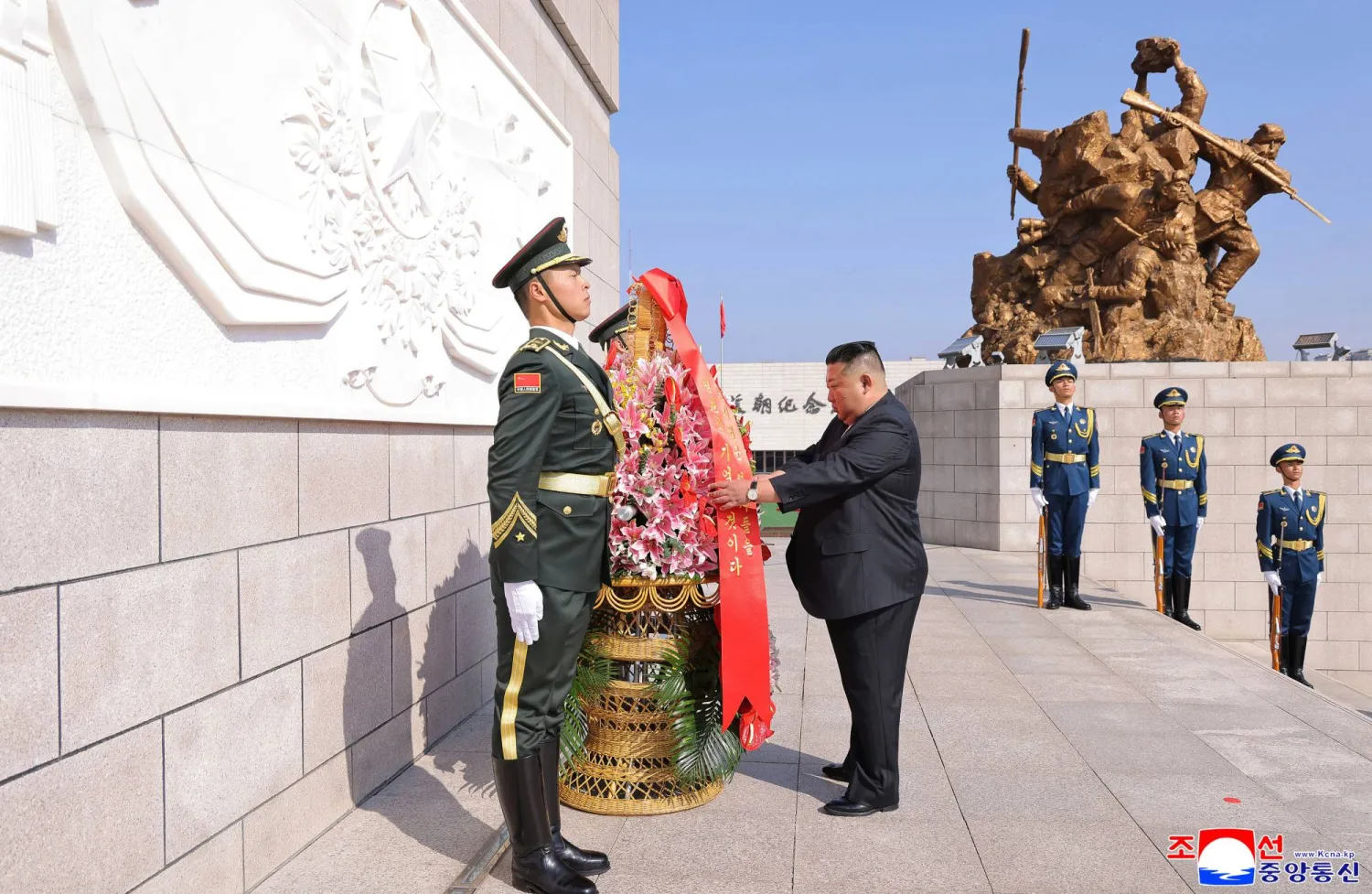
In this photo provided by the North Korean government, its leader Kim Jong Un offers a wreath at a monument in Dandong, China Saturday, Oct. 24, 2026. (Korean Central News Agency/Korea News Service via AP)
TT

North Korean Leader Kim Jong Un Visits China to Inaugurate a New Cross-border Bridge

In this photo provided by the North Korean government, its leader Kim Jong Un offers a wreath at a monument in Dandong, China Saturday, Oct. 24, 2026. (Korean Central News Agency/Korea News Service via AP)

North Korean leader Kim Jong Un visited China on Saturday, inaugurating a new bridge that connects the two countries and vowing to expand cooperation with his powerful neighbor.

Kim’s visit to China is his latest move in an increasingly assertive foreign policy as he seeks to align Pyongyang with Beijing and Moscow in a united front against the United States under what he portrays as a “new Cold War.” It's his first visit in a year, said The Associated Press.

Kim arrived in the Chinese border city of Dandong Saturday after crossing the newly opened bridge, according to South Korea’s Unification Ministry and China's official Xinhua News Agency.

Both sides promise to strengthen cooperation

In Dandong, Kim visited a memorial marking China's support of North Korea during the 1950-53 Korean War and met with Wang Huning, a member of the Standing Committee of China’s Communist Party.

At the memorial, Kim said that North Korea will “firmly carry forward the invincible DPRK-China friendship forged at the cost of blood all the time,” according to the North's official Korean Central News Agency. DPRK stands for the Democratic People's Republic of Korea, the North's official name.

During their meeting, Kim reaffirmed a resolve to develop bilateral cooperation, while Wang conveyed Chinese President Xi Jinping's greetings and said Kim's visit to the memorial was “of great significance” in carrying forward the friendship between the two countries, KCNA said.

The two toured a car factory as well, before Wang accompanied Kim to the bridge to send him off, according to KCNA and Xinhua.

New bridge was built to help expand trade between the countries

Experts said the opening of the New Yalu River Bridge this month was a key symbol of strengthening ties between North Korea and China and reflected their intent to expand trade, as it is expected to accommodate two-way traffic around the clock, including container shipments and heavy cargo trucks. The bridge was opened after more than a decade of delay.

While returning home via the bridge, Kim said “the bridge would undoubtedly and correctly fulfill its historic mission of linking the two countries and firmly joining the minds of the peoples of the two countries,” KCNA reported.

Kim has recently taken steps to bolster ties with China, the North’s traditional main ally and economic lifeline, after years of prioritizing ties with Russia. China, for its part, has sought to restore its unique influence over North Korea.

North Korea has sent thousands of troops and conventional weapons to support Russian President Vladimir Putin’s war in Ukraine, possibly in exchange for military and economic assistance.

Kim's visit timed to key battle anniversary in Korean War with China

Kim’s latest visit to China is his sixth since taking power in late 2011 following the death of his father, Kim Jong Il. The visit appears to be timed to underscore the strength of his ties with Beijing ahead of the Oct. 25 anniversary of China’s first major victory in the Korean War, which was days after Chinese troops crossed the Yalu River into North Korea in October 1950.

The war began with North Korea’s surprise attack on the South in June 1950, prompting a UN-led coalition headed by the United States to intervene and push back the offensive. North Korea was backed primarily by Chinese forces, with assistance from the then-Soviet Union’s air force, before fighting ended with a 1953 armistice that left the peninsula technically at war.

Xi traveled to Pyongyang in June for a meeting with Kim. During their summit, Xi expressed Beijing’s willingness to expand bilateral cooperation in trade, agriculture, construction and technology, while Kim described ties with China as a top strategic priority.

Kim last visited Beijing in September 2025, when he met with Xi and watched a military parade alongside Putin and other foreign leaders.

Kim has maintained a hard line toward Seoul and has so far rebuffed a proposal from US President Donald Trump to revive their diplomacy, which broke down in 2019 during Trump’s first term. Kim’s government has called for Washington to abandon its “hostile policy” and drop demands for the North’s denuclearization as a precondition for renewed talks.

South Korea’s liberal government, which favors engagement with the North, hopes renewed talks between Washington and Pyongyang will thaw inter-Korean relations, and has also urged China to play a “constructive” role in resolving the standoff. Seoul's spy agency told lawmakers last month that it saw a 50% possibility of a meeting between Trump and Kim on the sidelines of next month’s Asia-Pacific Economic Cooperation, or APEC, summit in Shenzhen, China.

“From Seoul’s perspective, if North Korea focuses more on economic development than military buildup and threats, that would be positive for diplomacy and security,” said Leif-Eric Easley, a professor at Ewha University in Seoul.

“But if Kim can extract ever more benefits from China and Russia, it is unclear what Seoul could offer that would be worth the political risks Pyongyang attaches to exchanges with a more prosperous, globalized, and free Korea.”



Costa Rica Bars UN Rapporteur on Palestinian Territory, Drawing Concern from Rights Chief

UN Special Rapporteur on the occupied Palestinian territories Francesca Albanese holds a press conference on the human rights situation in Gaza in Geneva on September 15, 2025. (AFP)
TT

Costa Rica Bars UN Rapporteur on Palestinian Territory, Drawing Concern from Rights Chief

UN Special Rapporteur on the occupied Palestinian territories Francesca Albanese holds a press conference on the human rights situation in Gaza in Geneva on September 15, 2025. (AFP)

Costa Rica denied entry to the United Nations special rapporteur on the occupied Palestinian territory, drawing criticism from UN human rights chief Volker Turk on Friday.

Costa Rica's move put the small Central American country's increasingly close alignment with Washington and Israel on security and foreign policy into the spotlight.

Turk said he was "deeply concerned" by Costa Rica's decision to bar Francesca Albanese from entering the country and urged authorities to reconsider after she was stopped at Juan Santamaria airport, which serves the capital San Jose.

Albanese, an Italian national, had ‌traveled to ‌Costa Rica to receive an honorary doctorate from ‌the ⁠state-run University of Costa ⁠Rica. A UN special rapporteur is an independent expert appointed by the UN Human Rights Council to investigate and report on rights abuses in a specific country.

The UN human rights office said on X that Albanese was denied entry on "claimed national security grounds." Costa Rica's migration office said it had acted after receiving ⁠an alert and that the decision was consistent with ‌national security measures.

Albanese, who has been ‌sanctioned by the United States under measures related to the International Criminal ‌Court, said she hoped Costa Rica would reverse the decision ‌and rejected what she described as efforts to link her to terrorism.

In a video call interview with journalist Ahmed Shihab-Eldin recorded from a gate at the airport, Albanese said authorities took her passport and that she ‌was offered a detention room to sleep in that was so smelly she almost got sick.

"I was ⁠almost forced ⁠to board the plane to be shipped back to Paris. I said no, and I opposed it... and they threatened to put me on the plane by force," she added.

Albanese has become one of the most outspoken international critics of Israel's conduct in Gaza, making her a frequent target of pro-Israel officials and governments.

Israel's UN ambassador, Danny Danon, praised Costa Rica's decision in a post on X.

Costa Rica, under President Laura Fernandez, has deepened cooperation with the United States on security and has moved closer to Israel, a notable shift for a country long associated with support for multilateral institutions.


Eisenkot Accuses Netanyahu's Party of Stalling Israeli Coalition Talks

Gadi Eisenkot, who is tasked with forming the next Israeli government, attends a conference at the parliament in Jerusalem on November 25, 2026. (AFP)
TT

Eisenkot Accuses Netanyahu's Party of Stalling Israeli Coalition Talks

Gadi Eisenkot, who is tasked with forming the next Israeli government, attends a conference at the parliament in Jerusalem on November 25, 2026. (AFP)

Gadi Eisenkot, who is trying to form the next Israeli government, on Friday accused the party of caretaker Prime Minister Benjamin Netanyahu of stalling coalition talks in a bid to bring about new elections.

Eisenkot's centrist Yashar party has in recent days agreed coalition deals with two allied parties, but the route to a parliamentary majority is still far from certain.

After the October election failed to deliver a clear majority for either bloc, Yashar has also held talks with Netanyahu's right-wing Likud party over the possibility of forming a national unity government involving both parties.

But no breakthroughs on that front have ostensibly been reached.

"Likud, for its part, was unwilling to compromise and, over two weeks, refused to put a single concrete proposal on the table," Eisenkot said in a statement on Friday.

"Their conduct points to an effort to run down the clock until the mandate expires, split the Change bloc and drag Israel into another election under the outgoing government," he added.

Eisenkot has until December 6 -- a deadline which can be extended by 14 days -- to form a government to replace Netanyahu.

His wide-ranging camp has faced divisions on whether to forge alliances with the ultra-Orthodox parties, or the Arab-majority lists, or whether to form a unity government with Likud.

"We are approaching a moment of decision," Eisenkot said on Friday.

"The question is whether Likud will engage in serious negotiations and commit to a partnership that requires compromise or keep up appearances and continue to stall," he added, but maintained he was still open to talks if Likud was "genuinely prepared to change course".

Likud, in turn, accused Eisenkot of working to form a "dangerous left-wing government" but nonetheless said it would still be open to a unity government.

Eisenkot's Yashar party has so far agreed coalition deals with the left-leaning Democrats party and the right-wing Israel Beiteinu party.

Together, they have a combined total of 36 lawmakers -- far short of the 61 needed for a parliamentary majority.


Iran Says Enemy Should Expect Action in Air and at Sea

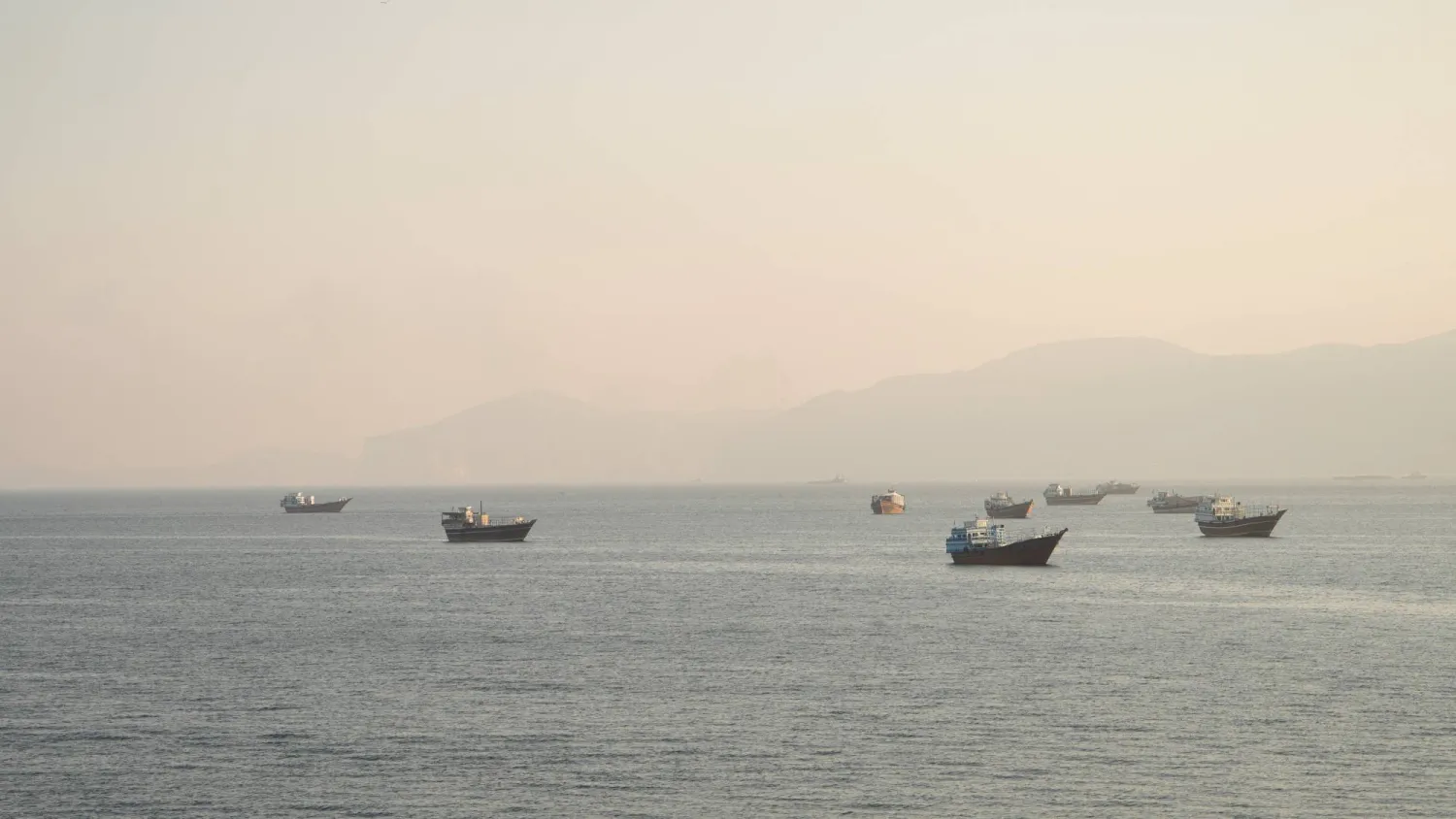
Vessels at the Strait of Hormuz, as seen from Musandam, Oman, November 23, 2026. (Reuters)
TT

Iran Says Enemy Should Expect Action in Air and at Sea

Vessels at the Strait of Hormuz, as seen from Musandam, Oman, November 23, 2026. (Reuters)

Iran's Revolutionary Guards Aerospace Force commander Majid Mousavi said in a post ‌on ‌X on ‌Friday ⁠that Iran's enemies should ⁠expect action in the air and ⁠at sea.

Breaking ‌the ‌blockade of ‌Iran ‌was the country's "firm mission and unwavering determination", ‌he said, a reference ⁠to the blockade ⁠imposed by the United States on Iranian ports.

The US military, meanwhile, said on Friday it disabled a commercial ship in the Gulf of Oman on ‌Thursday after its ‌crew attempted ‌to ⁠run the US ⁠blockade of Iran. 

Military aircraft launched precision munitions that struck the ⁠stern of ‌the ‌Palau-flagged M/V Pacific ‌Archer after ‌it departed from the port city of Bandar Abbas, ‌and the ship’s propulsion was disabled ⁠while ⁠the civilian crew was unharmed, US Central Command said in a statement.