Israel President Urges Against New Vote Despite Inconclusive Result

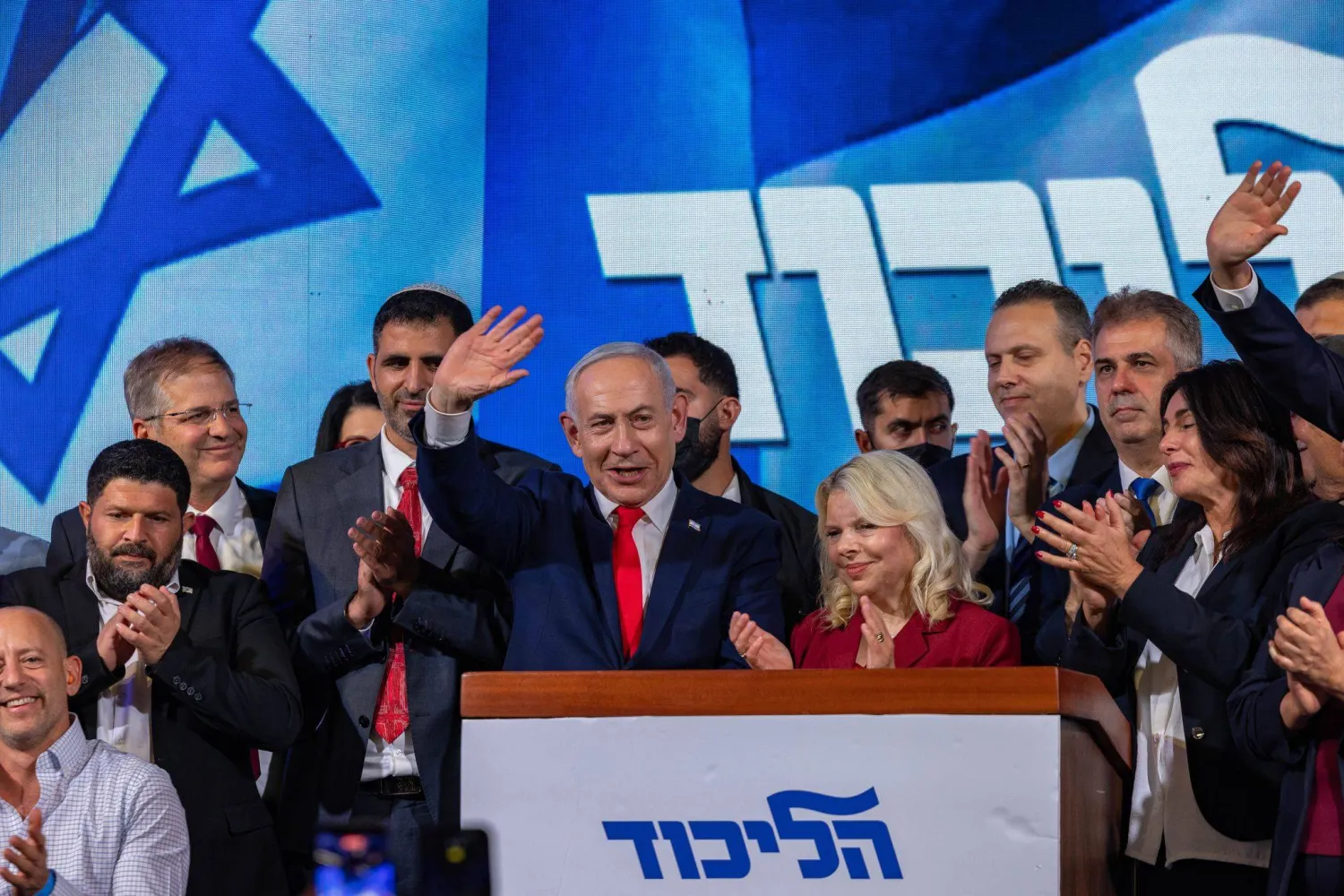
28 October 2026, Israel, Jerusalem: Israeli Prime Minister and Likud party leader Benjamin Netanyahu (C) speaks to supporters at the Likud party's election-night event at the International Convention Center in Teddy Hall, following the release of the exit poll results in Israel's legislative election. (dpa)
TT

Israel President Urges Against New Vote Despite Inconclusive Result

28 October 2026, Israel, Jerusalem: Israeli Prime Minister and Likud party leader Benjamin Netanyahu (C) speaks to supporters at the Likud party's election-night event at the International Convention Center in Teddy Hall, following the release of the exit poll results in Israel's legislative election. (dpa)

Israel's president voiced hope Wednesday for avoiding a second election after a hard-fought vote produced no clear winner, leaving Prime Minister Benjamin Netanyahu and the opposition scrambling for options and making Israeli Arab parties possible kingmakers. 

With more than 85 percent of ballots counted, Netanyahu's right-wing bloc was slightly ahead but still short of a majority after Tuesday's election, the first since the October 7, 2023 attack that led Israel to wage war in Gaza and across the region. 

Both Netanyahu, Israel's longest-serving prime minister who is allied with far-right and ultra-Orthodox Jewish parties, and Gadi Eisenkot, a former military chief leading a broad opposition bloc, said they would seek to form the next government. 

But neither looks set to reach the 61-seat threshold, with Netanyahu's bloc projected to win 53 of the 120 seats in parliament and Eisenkot's opposition set for 48. 

The final results could still change, but one group which made clear gains was Israeli Arabs, whose seats were set to jump to 19. 

"We must do everything we can, certainly after yesterday, to avoid another round of elections," said President Isaac Herzog, who is tasked with determining which candidate to tap to form a government, urging parties to keep "an open mind". 

- 'Have to talk to us' - 

Yousef Jabareen, head of the leftist Arab-majority Joint List, said the Israeli public had voted for new leadership and "anyone who wants to offer a substantive and genuine alternative to Netanyahu's blood-soaked government will have to talk to us". 

He later told AFP, however, that while he was willing to cooperate with an opposition-led government to unseat Netanyahu, he was not open to joining such a coalition outright. 

"We do not see the possibility of being part of an Israeli government coalition under the current political circumstances, particularly given the ongoing war in Gaza, the settlements in the West Bank" and other issues, he said. 

The ad hoc support of Arab lawmakers could enable Eisenkot to maintain a minority government, although few observers believe such an arrangement would survive for long. 

Arab voters, descendants of Palestinians who stayed after Israel's creation and who make up around 20 percent of the population, turned out in unprecedented numbers for Tuesday's vote, enraged by the Netanyahu government's ultra-nationalist Jewish vision for the country and the Palestinian territories. 

Netanyahu during the campaign relentlessly stoked fears of Arabs in power to motivate his base, and his Likud party on Wednesday accused the Arab lists of having "stolen" the election. 

It alleged "corruption, threats, violence, falsehoods and the use of prohibited software" to encourage voter turnout. It did not share evidence but said it would share it with authorities. 

Eisenkot and most of his allies have resisted partnering with Arab lawmakers. 

But Yair Golan, the head of Israel's main left-wing party and a member of Eisenkot's camp, became its first to call for such an alliance. 

"We must no longer accept Netanyahu's racist division between Jewish votes and Arab votes," Golan said on social media. 

- Iran conflict - 

A lack of a clear majority for either camp could mean weeks spent trying to cobble together coalitions, with new elections a possibility if negotiations fail. 

"Maybe everybody lost in these elections but the Arab parties. And for the Arab parties, it's unclear that they can make use of their huge success," Hebrew University of Jerusalem political scientist Gideon Rahat said. 

A stalemate could in the immediate term benefit Netanyahu, who would remain caretaker prime minister until a new government is formed. 

Both Netanyahu and Eisenkot appeared to indicate another factor was on the horizon: an Israeli attack alongside the United States on Iran. 

Netanyahu has ordered two campaigns against Iran, reluctantly stopping the most recent only after US President Donald Trump reached a now-defunct ceasefire. 

In the days leading up to the election, Netanyahu repeatedly called for the overthrow of Iran's government. News reports, which Netanyahu denied, said military top brass pushed back on his plans for pre-election action. 

Trump has said that the United States is no longer negotiating with Iran but will not attack until after next Tuesday's US midterm elections. 

Speaking at a rally, Netanyahu said that Israel had a "unique opportunity" with Trump to "forever eliminate the existential threat of Iran". 

Eisenkot in a post-election appearance warned Israel's security chiefs not to let Netanyahu put his political survival over the national interest. 

"Netanyahu, don't you dare use Israel's security for your political needs," he said. 

Defense Minister Israel Katz lashed out at the remarks on Wednesday, calling them "an anti-democratic statement detached from reality". 

All eyes will now be on Herzog, who has reportedly supported a unity government, which could take on more urgency if Netanyahu attacks Iran, although Eisenkot has publicly ruled out serving with him. 


UN Rights Chief Wants Next Israeli Govt to 'Change Course Massively'

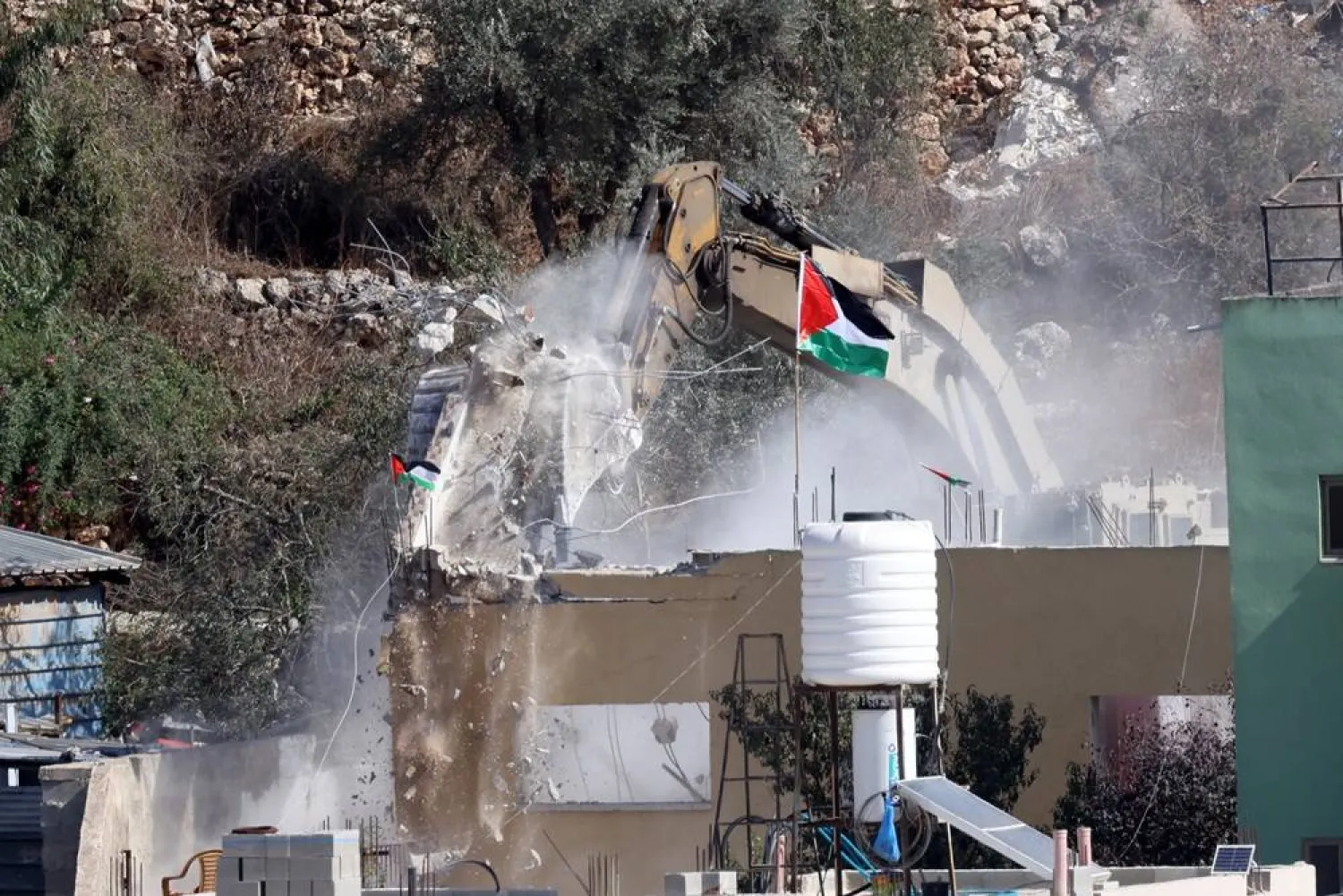
n Israeli bulldozer demolishes the house of Palestinian prisoner Ibrahim Abdul Karim Daoud at the West Bank village of Beita, 28 October 2026. (EPA)
TT

UN Rights Chief Wants Next Israeli Govt to 'Change Course Massively'

n Israeli bulldozer demolishes the house of Palestinian prisoner Ibrahim Abdul Karim Daoud at the West Bank village of Beita, 28 October 2026. (EPA)

UN rights chief Volker Turk said Wednesday he hopes a new Israeli government will "change course massively" and respect international law, as the country's political future hung in the balance after hard-fought elections.

"The message is: don't continue the current course of warfare where you think you are above international law, because I think that's what we have frankly seen in the current environment," he told reporters in New York.

"Israel has its obligations under international law, international humanitarian law, international human rights law, and they need to respect them, and I hope that the next government will do precisely that and change course massively," the Austrian diplomat added.

Earlier this week, Turk warned that Israel's military occupation in the occupied West Bank city of Hebron, launched after a deadly attack by Palestinian gunmen, raised serious concerns of "ethnic cleansing."

"Collective punishment is a grave violation of international law," he said in a statement Monday.

With more than 85 percent of ballots counted in Israel's election, Prime Minister Benjamin Netanyahu's right-wing bloc was slightly ahead but still short of a majority, making Israeli Arab parties possible kingmakers.

The Tuesday vote was the first election since the October 7, 2023 attack that led Israel to wage war in Gaza and across the region.


Israel Defense Minister Slams Eisenkot’s Call for Military to Resist PM Pressure

Israeli Prime Minister Benjamin Netanyahu and Defense Minister Israel Katz attend a graduation ceremony of new Israeli army officers at a base near Mitzpe Ramon, Israel, October 21, 2026. (Reuters)
TT

Israel Defense Minister Slams Eisenkot’s Call for Military to Resist PM Pressure

Israeli Prime Minister Benjamin Netanyahu and Defense Minister Israel Katz attend a graduation ceremony of new Israeli army officers at a base near Mitzpe Ramon, Israel, October 21, 2026. (Reuters)

Israel's defense minister on Wednesday denounced opposition candidate Gadi Eisenkot for urging the military to resist post-election pressure from Prime Minister Benjamin Netanyahu, who has threatened new strikes on Iran.

"His call to senior military officials not to obey the directives of the prime minister or me or of other relevant security authorities, on the grounds that 'they have his support', is an anti-democratic statement detached from reality," Israel Katz wrote on X.

Eisenkot, a former military chief, in a speech to supporters after Tuesday's election said that Netanyahu was a caretaker prime minister lacking a mandate and that the military should serve the state rather than the premier.

"Stand firm in the face of any attempt to challenge you. You have my unequivocal backing. Netanyahu, do not dare use Israel's security for your political needs," Eisenkot said.

Netanyahu has repeatedly threatened renewed war on Iran, after bombing campaigns backed by the United States last year and again this year.

Media reports, denied by Netanyahu, said that military chief Lieutenant General Eyal Zamir pushed back immediately before the election on the prime minister's new plans on Iran.

Katz said that Eisenkot's comments were the latest in "a campaign of lies" about tensions between Netanyahu and the military over Iran.


Caretaker Role Could Limit Netanyahu but Not Rule Out War with Iran

Israel's Prime Minister Benjamin Netanyahu addresses his supporters at the election night rally after the first exit polls were announced, in Jerusalem on early October 28, 2026, during Israel's legislative elections. (AFP)
TT

Caretaker Role Could Limit Netanyahu but Not Rule Out War with Iran

Israel's Prime Minister Benjamin Netanyahu addresses his supporters at the election night rally after the first exit polls were announced, in Jerusalem on early October 28, 2026, during Israel's legislative elections. (AFP)

Benjamin Netanyahu is expected to face more constraints as Israel's caretaker prime minister after Tuesday's election, but experts say his government could still retain significant powers including when it comes to waging war on Iran.

Neither Netanyahu’s right-wing coalition nor an opposition bloc led by former military chief Gadi Eisenkot is projected by Israeli media ‌to win ‌a majority in the country’s 120-seat legislature. Eisenkot has ‌acknowledged ⁠the prime minister ⁠was still in office as a caretaker but issued a warning that Netanyahu might use security for political ends.

Netanyahu's office has previously rejected accusations he is using the Iran conflict for political gain. His office did not immediately return a request for comment on Wednesday.

“If you look at the letter of the law, a caretaker government has the ⁠same authority, has the same powers as a regular ‌government,” said Guy Lurie, a research ‌fellow at the Israel Democracy Institute, adding however that a caretaker government “has a duty ‌of restraint” and more limited discretion to act in some areas.

A ‌caretaker government faces limitations when it comes to issues such as appointments, but has leeway to act in matters where there is a public interest, analysts say.

“In general, security issues are the clearest exception to this duty of ‌restraint,” said Or Asher, a researcher at the Tel Aviv-based Tachlith Institute, noting that Israel's supreme court has ⁠previously held ⁠that a caretaker government must avoid far-reaching decisions unless they are justified by a pressing necessity.

“The Supreme Court has historically avoided intervening in decisions to go to war, and parliamentary oversight is at its thinnest in the weeks after the new Knesset convenes and before its committees are formed,” Asher said, adding that “a caretaker prime minister can legally take Israel to war, including against Iran”.

After the final tally is in, Israel’s President Isaac Herzog is expected to consult party leaders and then tap the candidate he believes has the best chance of forming a government, with the nominee then getting up to 42 days to establish a government.