Israelis Await Final Election Results as Difficult Choices Lie Ahead

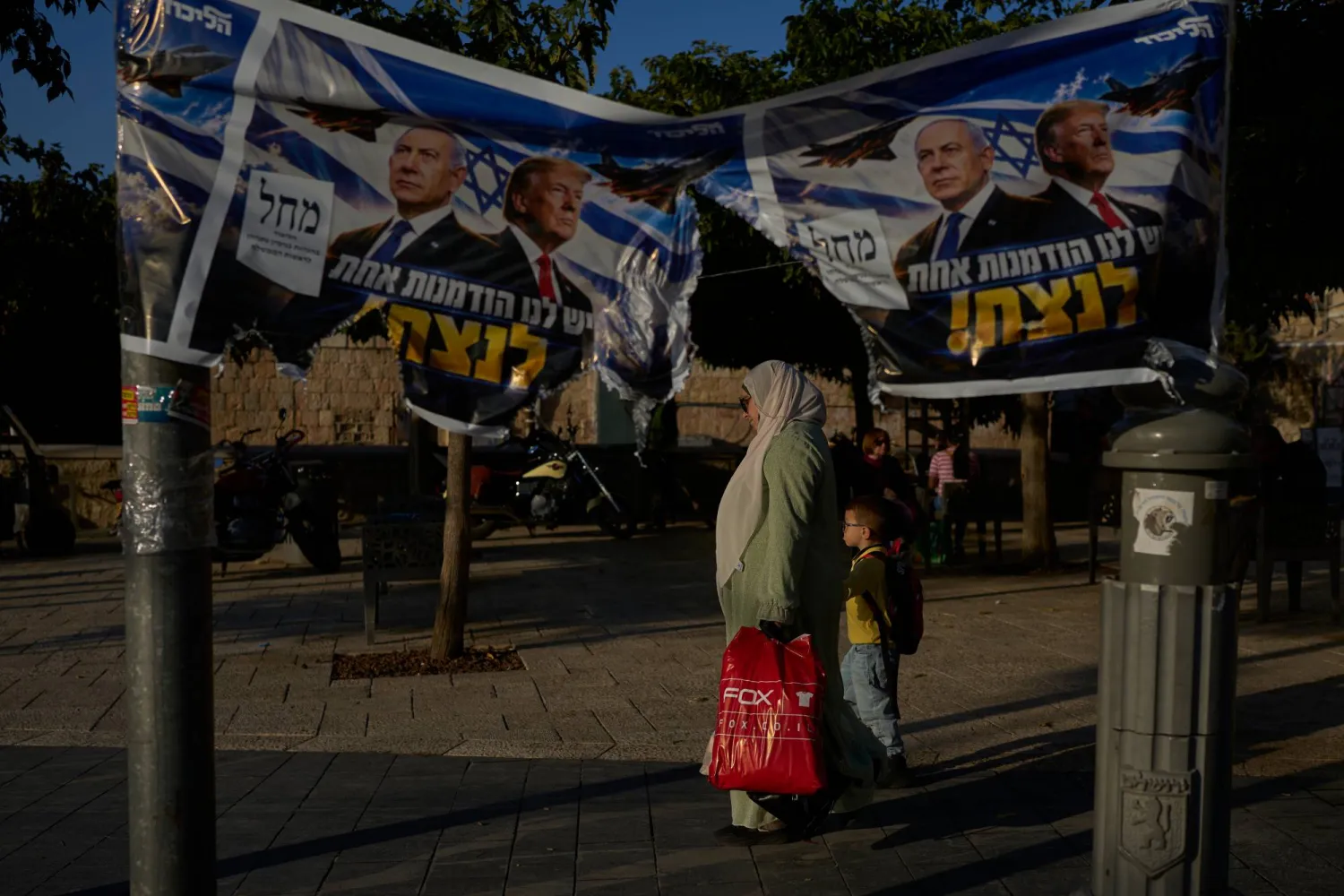
An Arab woman walks with a child next to a torn Likud party campaign ad featuring Israeli Prime Minister Benjamin Netanyahu and US President Donald Trump, with a Hebrew message reading "We have one opportunity to win," in Jerusalem on Wednesday, Oct. 28, 2026, a day after the elections in Israel. (AP Photo/Ohad Zwigenberg)
TT

Israelis Await Final Election Results as Difficult Choices Lie Ahead

An Arab woman walks with a child next to a torn Likud party campaign ad featuring Israeli Prime Minister Benjamin Netanyahu and US President Donald Trump, with a Hebrew message reading "We have one opportunity to win," in Jerusalem on Wednesday, Oct. 28, 2026, a day after the elections in Israel. (AP Photo/Ohad Zwigenberg)

Israelis on Thursday waited for final election results to confirm what they see taking shape: No majority of parliament seats for Prime Minister Benjamin Netanyahu and his allies, or for the array of parties seeking to unseat him.

Difficult decisions lie in the weeks ahead, including whether some Jewish and Arab parties would team up in a historic alliance, or whether some parties that campaigned on ousting Netanyahu would toss that aside and join forces with the deeply divisive prime minister. While this plays out, Netanyahu remains in charge.

Final results could come as early as Thursday evening after about a half-million absentee ballots are counted from military personnel, diplomats, people in prisons and hospitals, and others. They are not expected to sway the results dramatically.

Local media projected 53 parliament seats for Netanyahu's bloc, 48 seats for opposition parties and 19 for Arab-led ones, which also want Netanyahu out.

Potential complications emerged. The head of the Central Elections Committee asked the Shin Bet intelligence service to investigate alleged foreign interference in the vote. The letter dated Wednesday mentions alleged funding by “foreign entities against the Israeli interest,” without specifics, and could not speak to the validity of the claims. It requests findings within the week. Israeli law requires election results to be certified by Nov. 4.

Netanyahu's Likud party swiftly seized on the request to the Shin Bet, while the opposition has warned against “scare tactics.”

Netanyahu's Likud targets Arab-led parties

Likud, despite receiving the most votes, earlier accused Arab-led parties of stealing the election and asked the election committee to investigate. It did not provide specific evidence to support its claims. The election committee has said the number of reported irregularities in the relatively calm election was low.

Even without a role in a coalition, Arab-led parties could support other Netanyahu opponents in the next parliament, set to convene on Nov. 10. That could include electing a new speaker, giving them control of the agenda and potentially allowing them to advance and pass legislation before a new government is formed.

Netanyahu's chief rival, former military chief Gadi Eisenkot, in his first public statement since an address to supporters early Wednesday spoke of a government in service to all and reflecting the will of the people.

Eisenkot did not mention the prospect of joining forces with the Arab-led parties that had a strong showing, as some Arab citizens broke longstanding vows never to vote in a country where they have long faced discrimination. But he has said he is open to working with them to reach the 61-seat majority needed to control the 120-seat Knesset.

Ahmad Tibi, head of the Arab-led Joint List, told Army Radio he’s heard from the opposition bloc to discuss replacing the Knesset speaker, and he told them the party would support the bloc’s candidate. He also urged Eisenkot to have political courage.

The Joint List has noted the “unprecedented show of strength" by Arab voters and the Jewish voters “willing to swim against the tide of racism.”

There were small rallies overnight in Tel Aviv, and in far more conservative Jerusalem, in support of a coalition that includes Arab-led parties. Until 2021, no Arab party had joined a coalition government, and that was brief.

Israel’s president next week will task someone with forming the next government. It has traditionally been the leader of the party with the most votes, but that’s not required.

If a new government cannot be formed after multiple attempts, Israel would face a new election early next year. On Wednesday, President Isaac Herzog signaled he wanted to avoid that step – something Eisenkot has said as well.

New elections bring new questions, including whether Arab citizens would again go to the polls in large numbers and whether the tens of thousands of Israelis who flew home to vote would do it again. Many had said they took that step to save the country from Netanyahu.

A deeply divided Israel might see Netanyahu stay on Israel, already divided along multiple fault lines – Jews and Arabs, secular and religious – entered the election with huge and painful issues at stake.

Those include whether the fast-growing ultra-Orthodox population should remain exempted from compulsory military service in a country where many families have seen their sons and daughters killed in three years of inconclusive wars.

Netanyahu, Israel’s longest-serving prime minister, has been especially polarizing, with corruption allegations hanging over him along with accusations that he delayed making deals over the war in Gaza, including to free hostages, for political gain.

While many Israelis voted with security issues first in mind, the country’s international standing is also at stake after widespread criticism over the treatment of Palestinians in Gaza and growing violence by Jewish settlers in the occupied West Bank.

For Arab citizens, who make up 20% of Israel’s population, there is cautious hope of change. “God willing, we will have something for us in the government, something that will bring us our rights,” said Brosli Elias, a resident of Nazareth, one of Israel’s largest Arab cities.

Meanwhile, the threat of further strikes against Iran adds to the election uncertainty, as the Trump administration has spoken of new attacks after the midterm elections on Nov. 3. Experts have said Netanyahu could seize on a renewed all-out war to press for a unity government with him in charge.

That could delay what Netanyahu has long resisted: a public inquiry into the security failures that led to the deadliest extremist attack on Israel in the country’s history, the Hamas-led assault on Oct. 7, 2023, that sparked the war in Gaza.


Israelis Await Final Election Results as Difficult Choices Lie Ahead

An Arab woman walks with a child next to a torn Likud party campaign ad featuring Israeli Prime Minister Benjamin Netanyahu and US President Donald Trump, with a Hebrew message reading "We have one opportunity to win," in Jerusalem on Wednesday, Oct. 28, 2026, a day after the elections in Israel. (AP Photo/Ohad Zwigenberg)
TT

Israelis Await Final Election Results as Difficult Choices Lie Ahead

An Arab woman walks with a child next to a torn Likud party campaign ad featuring Israeli Prime Minister Benjamin Netanyahu and US President Donald Trump, with a Hebrew message reading "We have one opportunity to win," in Jerusalem on Wednesday, Oct. 28, 2026, a day after the elections in Israel. (AP Photo/Ohad Zwigenberg)

Israelis on Thursday waited for final election results to confirm what they see taking shape: No majority of parliament seats for Prime Minister Benjamin Netanyahu and his allies, or for the array of parties seeking to unseat him.

Difficult decisions lie in the weeks ahead, including whether some Jewish and Arab parties would team up in a historic alliance, or whether some parties that campaigned on ousting Netanyahu would toss that aside and join forces with the deeply divisive prime minister. While this plays out, Netanyahu remains in charge.

Final results could come as early as Thursday evening after about a half-million absentee ballots are counted from military personnel, diplomats, people in prisons and hospitals, and others. They are not expected to sway the results dramatically.

Local media projected 53 parliament seats for Netanyahu's bloc, 48 seats for opposition parties and 19 for Arab-led ones, which also want Netanyahu out.

Potential complications emerged. The head of the Central Elections Committee asked the Shin Bet intelligence service to investigate alleged foreign interference in the vote. The letter dated Wednesday mentions alleged funding by “foreign entities against the Israeli interest,” without specifics, and could not speak to the validity of the claims. It requests findings within the week. Israeli law requires election results to be certified by Nov. 4.

Netanyahu's Likud party swiftly seized on the request to the Shin Bet, while the opposition has warned against “scare tactics.”

Netanyahu's Likud targets Arab-led parties

Likud, despite receiving the most votes, earlier accused Arab-led parties of stealing the election and asked the election committee to investigate. It did not provide specific evidence to support its claims. The election committee has said the number of reported irregularities in the relatively calm election was low.

Even without a role in a coalition, Arab-led parties could support other Netanyahu opponents in the next parliament, set to convene on Nov. 10. That could include electing a new speaker, giving them control of the agenda and potentially allowing them to advance and pass legislation before a new government is formed.

Netanyahu's chief rival, former military chief Gadi Eisenkot, in his first public statement since an address to supporters early Wednesday spoke of a government in service to all and reflecting the will of the people.

Eisenkot did not mention the prospect of joining forces with the Arab-led parties that had a strong showing, as some Arab citizens broke longstanding vows never to vote in a country where they have long faced discrimination. But he has said he is open to working with them to reach the 61-seat majority needed to control the 120-seat Knesset.

Ahmad Tibi, head of the Arab-led Joint List, told Army Radio he’s heard from the opposition bloc to discuss replacing the Knesset speaker, and he told them the party would support the bloc’s candidate. He also urged Eisenkot to have political courage.

The Joint List has noted the “unprecedented show of strength" by Arab voters and the Jewish voters “willing to swim against the tide of racism.”

There were small rallies overnight in Tel Aviv, and in far more conservative Jerusalem, in support of a coalition that includes Arab-led parties. Until 2021, no Arab party had joined a coalition government, and that was brief.

Israel’s president next week will task someone with forming the next government. It has traditionally been the leader of the party with the most votes, but that’s not required.

If a new government cannot be formed after multiple attempts, Israel would face a new election early next year. On Wednesday, President Isaac Herzog signaled he wanted to avoid that step – something Eisenkot has said as well.

New elections bring new questions, including whether Arab citizens would again go to the polls in large numbers and whether the tens of thousands of Israelis who flew home to vote would do it again. Many had said they took that step to save the country from Netanyahu.

A deeply divided Israel might see Netanyahu stay on Israel, already divided along multiple fault lines – Jews and Arabs, secular and religious – entered the election with huge and painful issues at stake.

Those include whether the fast-growing ultra-Orthodox population should remain exempted from compulsory military service in a country where many families have seen their sons and daughters killed in three years of inconclusive wars.

Netanyahu, Israel’s longest-serving prime minister, has been especially polarizing, with corruption allegations hanging over him along with accusations that he delayed making deals over the war in Gaza, including to free hostages, for political gain.

While many Israelis voted with security issues first in mind, the country’s international standing is also at stake after widespread criticism over the treatment of Palestinians in Gaza and growing violence by Jewish settlers in the occupied West Bank.

For Arab citizens, who make up 20% of Israel’s population, there is cautious hope of change. “God willing, we will have something for us in the government, something that will bring us our rights,” said Brosli Elias, a resident of Nazareth, one of Israel’s largest Arab cities.

Meanwhile, the threat of further strikes against Iran adds to the election uncertainty, as the Trump administration has spoken of new attacks after the midterm elections on Nov. 3. Experts have said Netanyahu could seize on a renewed all-out war to press for a unity government with him in charge.

That could delay what Netanyahu has long resisted: a public inquiry into the security failures that led to the deadliest extremist attack on Israel in the country’s history, the Hamas-led assault on Oct. 7, 2023, that sparked the war in Gaza.


US Fires Top Army General in Latest Ouster

A top US general has been removed from his role, according to a US magazine. Anna Moneymaker / GETTY IMAGES NORTH AMERICA/AFP/File
TT

US Fires Top Army General in Latest Ouster

A top US general has been removed from his role, according to a US magazine. Anna Moneymaker / GETTY IMAGES NORTH AMERICA/AFP/File

The United States has fired its top military planner, The Atlantic reported Wednesday, in a surprise shake-up as President Donald Trump appears to be preparing to resume large-scale strikes against Iran.

Army Lieutenant General Brett Sylvia was removed this week from his role as head of strategy, plans and policy on the Joint Chiefs of Staff, the magazine reported, citing unidentified defense department officials.

Sylvia's ouster would be the latest in a series of high-profile departures from the military since Trump returned to power a year ago.

Secretary of Defense Pete Hegseth said last month that the United States has slashed the number of its generals and admirals by 20 percent, in a move he said is aimed at "accountability."

He suggested the cuts targeted officers who failed to get on board with his efforts to ensure the military is focused on war-fighting rather than the "woke" policies of previous administrations, describing the reductions as an "accomplishment."

No reason was given for Sylvia's departure and no replacement has been named, The Atlantic said.

AFP has contacted the Pentagon for comment.

The reported sacking comes as Trump is widely considered to be weighing fresh strikes against Iran after the US midterm elections on November 3.

"We may do another little Epic Fury," Trump said last week, referring to US-Israeli attacks on Tehran in February that triggered the war.

He did not give any indication on timing.

Neither the United States nor Iran has engaged in major attacks on land-based targets since early September, settling instead into a pattern of strikes on commercial ships.

Sylvia's previous roles included leading the 101st Airborne Division -- the US army's air assault division -- and heading a unit in Iraq.


Oxygen Cylinder Explodes Inside Ambulance, Killing at Least 10 in Pakistan

File photo: An ambulance carries the injured to the hospital, after a blast in Bajaur district of Khyber Pakhtunkhwa province, Pakistan July 30, 2023. Rescue 1122/Handout via REUTERS
TT

Oxygen Cylinder Explodes Inside Ambulance, Killing at Least 10 in Pakistan

File photo: An ambulance carries the injured to the hospital, after a blast in Bajaur district of Khyber Pakhtunkhwa province, Pakistan July 30, 2023. Rescue 1122/Handout via REUTERS

An oxygen cylinder exploded inside a parked ambulance at a government-run medical facility in southern Pakistan, killing at least 10 people, including a patient of the facility, police and hospital officials said Thursday.

The blast occurred overnight in Tharparkar district in the Sindh province, said district Police Chief Arif Aziz.

He said the victims included staff at the medical facility, patients, and their relatives.

Local police official Khalil Abro said patients were being transferred to another hospital when the explosion occurred. Images on social media and on television stations showed flames engulfing a vehicle, with one door open. Another image showed its blackened frame outside a building as people stood nearby.

Pakistani President Asif Ali Zardari expressed sorrow over the deaths and called for a prompt, transparent investigation to determine the cause, according to a statement from his office.

He also urged authorities to strengthen safety measures to prevent similar incidents, offered condolences to the victims’ families and wished the injured a speedy recovery.

In August, a fire triggered by an exploding air conditioner killed 14 newborns in a nursery at the Pakistan Institute of Medical Sciences in Islamabad. The only baby rescued from the nursery died weeks later, bringing the death toll to 15.