Russia and Ukraine Say Aid Is Entering Oleshky, Residents Can Leave if They Wish

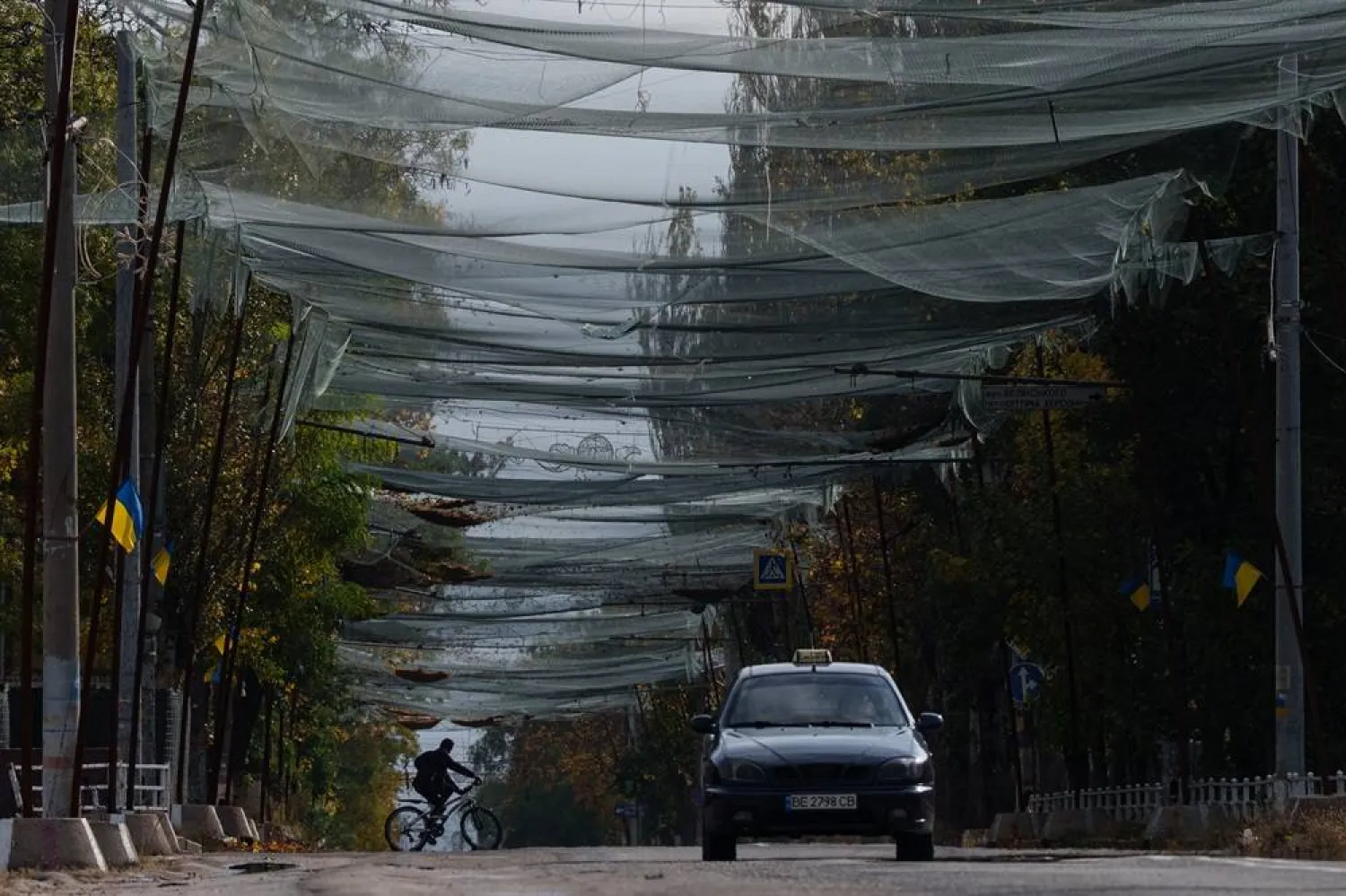
A local man rides a bicycle beneath anti-drone nets stretched over a street during a local ceasefire related to a humanitarian aid mission in Oleshky, in Kherson, Ukraine, Wednesday, Oct. 28, 2026. (AP)
TT

Russia and Ukraine Say Aid Is Entering Oleshky, Residents Can Leave if They Wish

A local man rides a bicycle beneath anti-drone nets stretched over a street during a local ceasefire related to a humanitarian aid mission in Oleshky, in Kherson, Ukraine, Wednesday, Oct. 28, 2026. (AP)

Desperate residents of a Russian-held town in southern Ukraine were due to receive food and medical supplies on Friday and be allowed to leave if they wish, officials from the two warring sides said.

The relief operation for the town of Oleshky was made possible by a ceasefire brokered by US first lady Melania Trump. It is the most striking example of cooperation between the two sides, who have been at war for four years and eight months in the deadliest conflict in Europe since World War Two, and have not stopped fighting elsewhere.

On Thursday, a Russian drone strike killed at least 14 people on a crowded rail platform in the Ukrainian city of Dnipro, local officials, and Moscow said on Friday that it had hit energy infrastructure in and around Kyiv and the Dnipro region, port facilities in the Odesa region and ‌cargo vessels that it ‌said were used by the military.

In Oleshky, Russian human rights commissioner Yana Lantratova and ‌her ⁠Ukrainian counterpart Dmytro ⁠Lubinets appeared side-by-side on Friday to update reporters on the mission.

"The aid was assembled based on the specific needs reported to us; it includes food, hygiene products, essential medical supplies, fuel - everything the people require," Lantratova said.

Lubinets said everyone in need of assistance would get it, including those who wished to leave.

"We have reached an agreement to assist citizens who wish to travel to Ukraine - they will be provided with the opportunity to do so. Likewise, assistance will be available to those who wish to travel to the Russian Federation," he said.

Oleshky, on the Dnipro River opposite the city of Kherson, was seized by Russian troops ⁠during the first days of their full-scale invasion of Ukraine in February 2022.

It has ‌suffered extensive damage and was badly flooded after the destruction of the ‌huge upriver Kakhovka dam in 2023.

Residents have given harrowing accounts of risking their lives travelling along mine-strewn roads - one known as ‌the "road of death" - just to get food and water. Some say they have survived on a cup of ‌rice or buckwheat a day, sometimes with a tomato, cucumber or wild plants added.

A local ceasefire came into force in Oleshky and the Kherson region early on Tuesday and has held for more than three days.

"This is the first time since 2022 that a ceasefire has been established across such an extensive stretch of the front line and has been maintained for such a significant ‌duration," Lubinets said.

The arrival of the aid convoy was preceded by demining operations this week in which Lantratova said a sapper and one other person were killed.

She said 25 ⁠buses were on hand ⁠to evacuate people, with special provision for those who are bedridden, and 50 medical personnel were present. There was even a bus with pet cages for those who wished to take their animals with them.

TWO SIDES STILL FAR APART ON HOW TO END THE WAR

The joint relief operation offers hope that the two sides are capable of working together, despite the ferocity of the war, in which both sides have intensified long-range air strikes while battlefield front lines remain largely static.

Kremlin spokesman Dmitry Peskov said there was a "high degree of coordination" between Lantratova and Lubinets.

US-mediated peace talks are due to resume next month in Abu Dhabi for the first time since February, as US President Donald Trump seeks to end a conflict he once said he could solve in a day.

Russia still hopes that Trump can pressure Kyiv into accepting a deal that meets many of Moscow's conditions, such as full Russian control of Ukraine's Donbas region and a bar on Ukraine joining NATO.

Kyiv wants to ensure that US intelligence-sharing continues, along with full access to Elon Musk's recently disrupted battlefield communications system, Starshield, and that European-bought US military hardware, including Patriot interceptor missiles, continues to flow.


Countries Open Path Towards 'Killer Robots' Pact

The European headquarters of the United Nations (UN) in Geneva, Switzerland, November 17, 2026. REUTERS/Denis Balibouse
TT

Countries Open Path Towards 'Killer Robots' Pact

The European headquarters of the United Nations (UN) in Geneva, Switzerland, November 17, 2026. REUTERS/Denis Balibouse

Countries opened a path Saturday towards finding an international agreement on regulating lethal autonomous weapons systems -- though campaigners seeking to stop so-called killer robots were disappointed by the "weakened" outcome.

After five grueling days of talks at the United Nations, which dragged on into overtime, states agreed on building some form of pact over the next two years.

However, with warfare being radically transformed by artificial intelligence, non-governmental organizations wanted far swifter, legally binding rules on handing power over human life and death to autonomous machines.

With full consensus required for any decision, talks at the UN's Review Conference of the Convention on Conventional Weapons in Geneva finally concluded at nearly 4:45 am (0345 GMT) on Saturday.

The 128 countries party to the convention "agreed to launch the elaboration of an international instrument on lethal autonomous weapons systems, which should be conducted over the next two years", conference president Julien Thoni told reporters afterwards.

While a majority of states want a legally binding agreement, countries that have the technology, including the United States and Russia, are reluctant to have their hands tied.

- Two-year timeline -

The process ahead should flesh out "which weapons can be forbidden according to international humanitarian law, and which is not forbidden but can be regulated", Thoni told AFP.

The Swiss diplomat said the parties would work on the instrument, and then decide on whether it should be a treaty, along with the extent to which its provisions should be binding.

He stressed that having the world's major military powers agreeing to work towards an instrument on lethal autonomous weapons systems (LAWS) was a big step forward.

Brazilian ambassador Frederico Meyer described a balancing act as "some countries have the power, some countries have the majority".

Before midnight, during a break in talks, delegates spent a long period huddled tightly around Russia's representative.
Later, a group of 15 delegates broke out for hushed talks on a staircase.

Diplomats inside could be seen pointing at amended text on the screens and refuelling on packets of crisps.

- 'Watered down' -

Campaign groups said the outcome fell well short of expectations.

Once activated, LAWS are capable of selecting and attacking targets without any human intervention.

According to Stop Killer Robots, a global coalition of more than 300 organisations, such systems have already been tested or deployed, including during the war in Ukraine.

"States adopted a watered-down mandate that fails to chart a clear path towards a legally binding instrument," said the group.

"Over 95 states expressed their support for a treaty. In the final hours, a small number of states weakened the mandate introducing uncertainty about the legal status of the final document."

- Diplomacy lagging behind technology -

Verity Coyle, the deputy director for arms at Human Rights Watch, said the outcome "does not provide the urgent action needed to agree new rules -- but the technology is racing ahead", she said.

Rain Liivoja, a director of the Asia-Pacific Institute for Law and Security, said the decision was one "nobody wanted but everyone could grudgingly live with", adding that consensus merely "makes everyone equally unhappy".

"It remains possible -- likely, even -- that there will be no treaty by the end of 2028," he added.

UN disarmament chief Izumi Nakamitsu said getting an instrument completed in two years was a "very compressed timeframe" which would require "a lot of negotiations".

She said countries should start thinking as soon as Monday about how to get as strong an instrument as possible to ban and regulate LAWS.

"The consequences of not having a strong instrument are very clear," she told reporters.

She said a group of governmental experts from the countries would make recommendations on the legal nature and specific form of the instrument, including whether it should be a binding protocol.

"The path to, or possibility to, have a legally binding instrument is still open," she insisted.


Tanker Catches Fire After Projectile Strike Near Strait of Hormuz, UKMTO Says

Vessels at the Strait of Hormuz, as seen from Musandam, Oman, November 17, 2026. (Reuters)
TT

Tanker Catches Fire After Projectile Strike Near Strait of Hormuz, UKMTO Says

Vessels at the Strait of Hormuz, as seen from Musandam, Oman, November 17, 2026. (Reuters)

A tanker caught fire after being struck by an unknown projectile while sailing outbound through the Strait of Hormuz, the United Kingdom Maritime Trade Operations (UKMTO) agency said on Friday.

The British navy-affiliated agency ‌UKMTO said ‌that the incident occurred ‌8 ⁠nautical miles north ⁠of the Omani town of Khasab, adding that no casualties or environmental impact were reported.

Iran's Revolutionary Guards said shortly afterwards that ⁠an oil tanker had caught ‌fire ‌after hitting a mine while ‌attempting to transit the Strait ‌of Hormuz near Khasab, Iranian state media reported.

Khasab lies on Oman's Musandam Peninsula at the ‌entrance to the Strait of Hormuz, a strategic waterway ⁠that ⁠carried nearly one-fifth of global crude oil supplies before the US-Israeli conflict with Iran.

Shipping through the Strait of Hormuz has been disrupted since Iran moved to close the waterway following the eruption of the conflict on February 28.


Myanmar Genocide Judgment May Bolster Gaza Case Against Israel

19 November 2026, Palestinian Territories, Deir al-Balah: Palestinians inspect widespread destruction of homes and displacement shelters following demolition operations carried out by the Israeli army in the early morning hours east of al-Maghazi refugee camp, central Gaza Strip. (dpa)
TT

Myanmar Genocide Judgment May Bolster Gaza Case Against Israel

19 November 2026, Palestinian Territories, Deir al-Balah: Palestinians inspect widespread destruction of homes and displacement shelters following demolition operations carried out by the Israeli army in the early morning hours east of al-Maghazi refugee camp, central Gaza Strip. (dpa)

The International Court of Justice's landmark ruling that Myanmar committed genocide against the Rohingya will strengthen South Africa's genocide case against Israel over the war in Gaza, legal experts said, establishing a precedent that genocidal intent can coexist with a military objective.

While the conflicts in Gaza and Myanmar are legally distinct, both cases before the World Court are based on allegations that states breached their obligations under the 1948 Genocide Convention.

On Thursday, the court found that Myanmar had violated the convention on multiple grounds stemming from mistreatment of the Muslim Rohingya minority by the armed forces.

South Africa, which has brought a genocide case against Israel over its conduct in Gaza, welcomed the judgment. Foreign Minister Ronald Lamola said it set an important precedent by establishing for the first time that a state had committed genocide.

He said it was of "great significance" to the case against Israel, which is not expected to be argued until 2029.

Both Myanmar and Israel have defended the actions of their armed forces as legitimate responses to insurgencies. But a majority of nine judges on the 15-member ‌bench found that ‌around 10,000 killings, including of children, the razing of homes, widespread sexual violence and the forced exodus of ‌more ⁠than 700,000 people in ⁠2017 amounted to state-sponsored genocide.

The ruling also handed other major legal victories to Gambia, which brought the case seven years ago on behalf of Muslim-majority countries.

The judges found that Myanmar had failed in its obligation to prevent genocide and said it must facilitate the return of Rohingya refugees and pay unspecified reparations.

The court also adopted conclusions from UN fact-finding reports, including one stating that mass deaths and rapes showed genocidal intent.

IMPORTANT PRECEDENT

Israeli legal scholar Yuval Shany said the ruling could broaden the arguments available to South Africa in its case against Israel.

He said the court maintained a requirement that genocidal intent be the “only reasonable inference,” but expanded the contextual factors it can consider beyond a pattern of conduct, to include the scale and systematic nature of acts and ⁠the history of persecution.

The approach “gives South Africa more avenues to argue for genocide” in Gaza, Shany said.

Proving genocide ‌is notoriously difficult because it requires establishing an "intent to destroy, in whole or in part, a ‌national, ethnical, racial or religious group, as such."

Five criminal acts can constitute genocide: killing members of a group, causing them serious bodily or mental harm, ‌creating conditions calculated to destroy them, preventing births, or forcibly transferring children to other groups.

Lamola said South Africa would study the judgment carefully with ‌a view to demonstrating, as the court had in the Rohingya case, that a state's actions, including ethnic cleansing, the killing of children, sexual violence and destruction of civilian infrastructure, can fall within the definition of genocide.

TARGETING OF CHILDREN, WOMEN

Another aspect of the ruling that could resonate in the Israel case was the court's emphasis on the systematic nature and scale of the crimes committed in Myanmar, said Marieke de Hoon, professor of international criminal law at the University of Amsterdam.

South ‌Africa alleges that Israel's military operations created conditions intended to prevent births and disproportionately affected women and children in Gaza. In its filing to the ICJ, it said an estimated 70% of those killed ⁠were non-combatants.

Israel rejects those allegations ⁠and says its operations have been conducted in accordance with international law.

"Arguments that a military intent or military objective would erase the idea that there could be a genocide intent are now rejected by the court," said De Hoon.

She said the judges found that some acts, including attacks on children and women and sexual violence, could not be explained by military objectives alone, leaving genocide as the only reasonable inference.

The Hague Initiative for International Cooperation (Thinc), a think tank funded by pro-Israeli groups, said the judgment would fundamentally alter how courts assess allegations of genocide by imposing a "lower threshold for proving genocidal intent, with serious consequences for Western militaries engaged in confronting terror," such as after Hamas' October 7, 2023 attack on Israel.

It is "not only a verdict in a particular case but a template," Thinc's director, Andrew Tucker, wrote in a reaction.

"Its propositions will be used in future cases: that genocidal intent may coexist with legitimate military objectives...that UN reports compiled without access can carry decisive weight; and that a state can breach the duty to prevent genocide without any finding that genocide occurred."

While the World Court judgment unequivocally found Myanmar responsible for genocide, proving the crime in court remains difficult, said Richard Horsey, senior adviser for Asia at the International Crisis Group.

"The ICJ has never before found that a state committed genocide. The legal bar is extremely high, but what this case shows is that it is surmountable,” he said.