Trump Confirms Strikes on Iran as Pezeshkian Urges Against Return to War

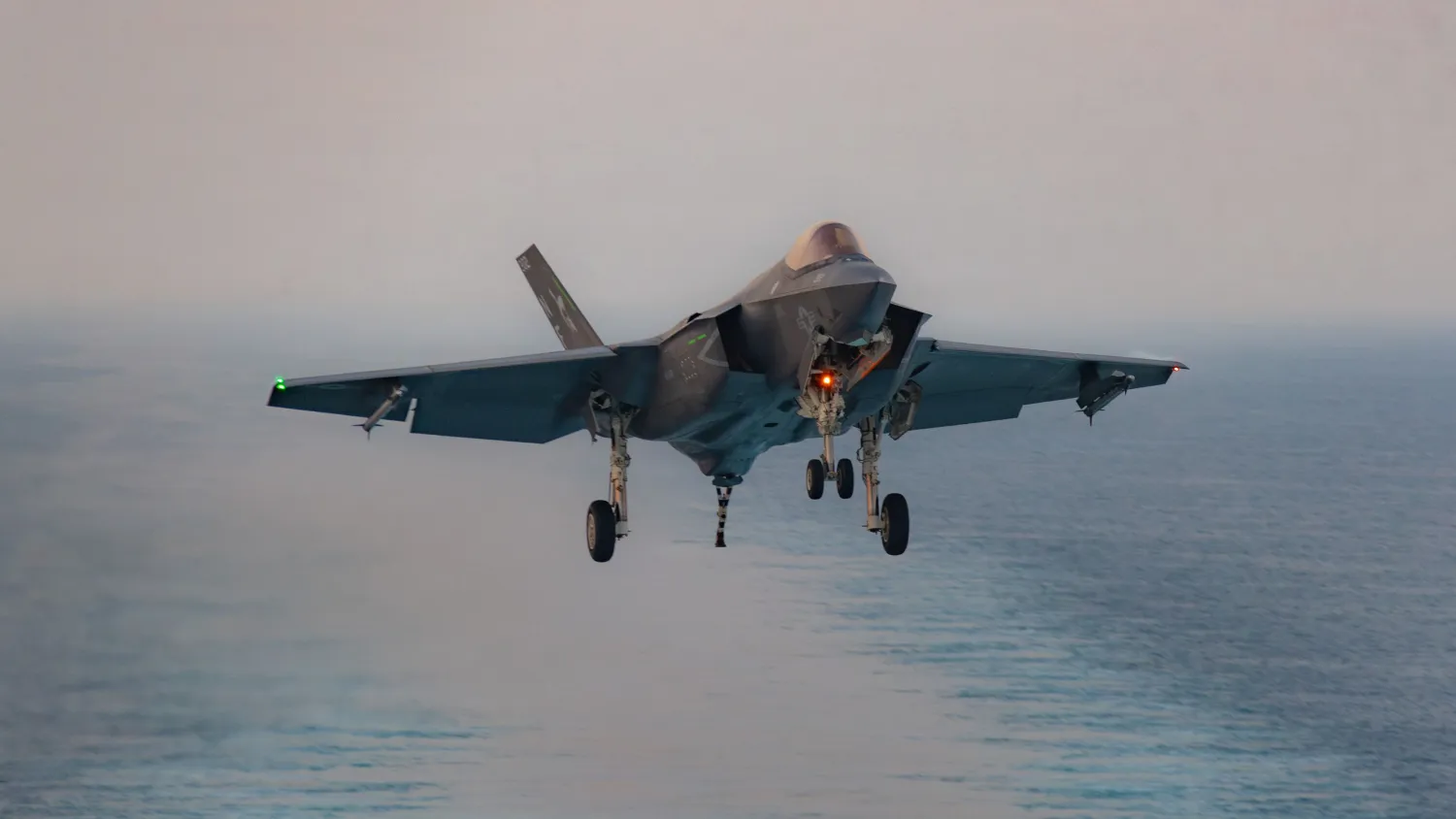
This US Navy handout photograph released by US Naval Forces Central Command shows an F-35C Lightning II preparing to land on the flight deck of Nimitz-class aircraft carrier USS George Washington on October 30, 2026. (Handout / US Navy / AFP)
TT

Trump Confirms Strikes on Iran as Pezeshkian Urges Against Return to War

This US Navy handout photograph released by US Naval Forces Central Command shows an F-35C Lightning II preparing to land on the flight deck of Nimitz-class aircraft carrier USS George Washington on October 30, 2026. (Handout / US Navy / AFP)

US President Donald Trump on Tuesday confirmed launching strikes on Iran as President Masoud Pezeshkian warned no one would benefit from a return to war. 

It came as US voters prepared to cast their ballots in midterm elections that threaten Trump's grip on power. 

Iran's chief negotiator in talks with the US, Mohammad Bagher Ghalibaf, said Tehran was "ready for battle with its finger on the trigger", while deputy foreign minister Kazem Gharibabadi said Iran retained the right to "legitimate self-defense" after the strikes. 

But Pezeshkian said his government was still trying to resolve the crisis "through dialogue", adding that "no one will benefit from this war" if it reignited, and emphasizing that the country's supreme leader had recently granted the government new powers to negotiate issues that were previously "off-limits". 

Trump confirmed the strikes on Iran in an interview with Fox News, after the Wall Street Journal, CNN, The New York Times and other outlets had reported strikes on Qeshm Island in the Strait of Hormuz. 

"They built an anti-aircraft facility... As soon as it was completed, we hit it last night very nicely," Trump said on the Fox & Friends show, adding that it was a "minor attack". 

- 'Iran wants a settlement' - 

The US and Israel launched their war with Iran with a massive wave of strikes in late February. The conflict has been stalemated for months. 

Asked if Israel was involved in the latest reported strikes, an Israeli military spokesperson told AFP, "No". 

The Qeshm attack came just hours after Trump signaled a deal with Iran "could happen", as US voters prepared to cast their ballots in midterms dominated by public dissatisfaction with the war and the inflation it has brought. 

"Iran wants a settlement, as soon as possible," Trump posted on his Truth Social platform. 

Iranian state news agency IRNA reported five explosions in rapid succession on Qeshm island, and that some residents reported seeing two aircraft flying in its skies. 

Ghalibaf said Tehran had made its position clear. 

"Just as Iran stands ready for battle with its finger on the trigger, it has also given the American side a powerful and rational response," he said in a televised speech. 

"The ball is now in America's court to prevent war." 

- 'Committed' - 

Qatar, a mediator in protracted indirect negotiations between the US and Iran, said it remained hopeful of an interim deal in the war. 

"Both parties remain committed to the negotiation process; as we mentioned, we are facilitating the real-time exchange of proposals between them," foreign ministry spokesman Majed Al Ansari told reporters. 

Both sides "are currently reviewing the ideas and proposals we have presented," he added. 

"We remain hopeful that there is still a chance for a deal to take place," he said, adding Doha was working "towards an interim deal". 

Iranian Foreign Minister Abbas Araghchi on Monday confirmed indirect negotiations were taking place. 

"Given the sensitivity and gravity of the current situation, consultations and deliberations are very intensive," Araghchi told state media. 

- Reopen the strait - 

US Vice President JD Vance said both he and Trump were optimistic about securing an agreement. 

"We've certainly made some progress. We'll see if we can make some more," Vance told reporters on Monday. 

A senior Iranian official said that Tehran was ready to reopen Hormuz, a key route for global oil and gas supplies, within two days but only if Washington agreed to its long-standing list of demands. 

In September, Iran proposed a seven-day plan to reopen the strait, with demands including ending the war on all fronts, unfreezing Iranian assets, lifting oil sanctions and ending its counter-blockade of Iranian ports. 

"The possibility of implementing this plan in two days is another indication of Iran's good-faith approach," Tehran's foreign ministry spokesman Esmaeil Baqaei told reporters at a briefing. 

- Billboard in Tehran - 

In the lead-up to Tuesday's vote, Trump kept up his threats against Tehran, saying on Sunday that the United States may have to give Iran "the hammer" at some unspecified time. 

On Saturday, the US leader said he still had to "take care" of one or two targets including so-called Pickaxe Mountain in central Iran, a suspected nuclear site which Tehran denies is such a facility. 

Iranian officials have repeatedly warned of wide-ranging retaliation if the US resumes the war. 

Authorities in Tehran installed a huge billboard in the heart of the capital, AFP journalists said on Tuesday. 

Over a photo of the US president, it reads: "We will kill Trump". 


Bomb Threat Prompts Checks on Israel-Bound Cruise Ship in Greek Port

View of the island of Halki from a ferry sailing to the island of Rhodes, amid the coronavirus disease (COVID-19) pandemic, off the island of Halki, Greece, April 13, 2021. (Reuters)
TT

Bomb Threat Prompts Checks on Israel-Bound Cruise Ship in Greek Port

View of the island of Halki from a ferry sailing to the island of Rhodes, amid the coronavirus disease (COVID-19) pandemic, off the island of Halki, Greece, April 13, 2021. (Reuters)

A ‌bomb threat to an Israel-bound cruise ship prompted a security operation at the Greek island port of Syros on Tuesday after an unknown person claimed an explosive device had been attached to ‌its hull, ‌Greek authorities said.

The Panama-flagged ‌Crown ⁠Iris was due ⁠to sail to Haifa carrying 940 passengers and 597 crew members when the threat was received.

Coast guard personnel assisted ⁠by an explosives detection dog ‌and ‌a private diver searched ‌the vessel, while a ‌special coast guard unit was deployed to the scene.

Initial checks found no explosive device. ‌Coast guard specialists are expected to arrive at ⁠9.30 ⁠p.m. (1930 GMT) to carry out further inspections before the ship can resume its voyage.

At least seven flights in Europe received bomb threats on Tuesday, causing disruption at airports although no devices were discovered.


US Will Halt $4 Billion in Aid to Israel, Trump Says

US President Donald Trump points his finger towards Israeli Prime Minister Benjamin Netanyahu as they shake hands during a press conference after meeting at Trump’s Mar-a-Lago club in Palm Beach, Florida, US, December 29, 2025. (Reuters)
TT

US Will Halt $4 Billion in Aid to Israel, Trump Says

US President Donald Trump points his finger towards Israeli Prime Minister Benjamin Netanyahu as they shake hands during a press conference after meeting at Trump’s Mar-a-Lago club in Palm Beach, Florida, US, December 29, 2025. (Reuters)

The United States will stop providing $4 billion in aid each year to Israel in 2027 but will sell arms to its closest ally in the Middle East, President Donald Trump said on Tuesday.

The Republican president told Fox News Channel during a phone call on Election Day for the midterms that Israeli Prime Minister Benjamin Netanyahu had approached him about the idea and that they have been talking about it for a couple of years.

Trump said Israel doesn’t need the aid and it’s a lot of money for the US to spend. But Trump also said that US aid to Israel has become a Democratic talking point for candidates such as Michigan US Senate candidate Abdul El-Sayed, a vocal critic of Israel.

Even far-right conservatives, who have supported Trump in the past, have taken issue with US support for Israel, with prominent commentators like Tucker Carlson openly questioning the value of the relationship.

“You can consider it barter. You can consider military aid or cash,” Trump said. “Look, we give them $4 billion of things and money, and they don’t need it. And I was approached by Bibi Netanyahu, and we’ve been talking about it for a couple of years because it’s a lot of money.”

There was no immediate comment from Netanyahu’s office. But at least some of his political opponents were cautious.

Opposition candidate Gadi Eisenkot said the announcement showed that Netanyahu must go.

"The fact that Israel's defense establishment is learning of a shift in our strategic relationship through the media, at the same time as the Israeli public, shows just how dangerous Benjamin Netanyahu's conduct is. He can no longer be trusted and must be replaced," Eisenkot said in a statement.

Yair Golan, a leader in Israel’s opposition bloc, said an end to US military aid would deal a “severe blow to Israel’s security” at a time when the country is fighting wars on multiple fronts.

“The burden of funding defense needs at such a critical juncture will fall entirely upon the Israeli public,” Golan, a former deputy military chief, said in a statement.

The United States has sent tens of billions of dollars in military aid to Israel over the last few years.

In 2016, President Barack Obama, a Democrat, signed an unprecedented security agreement with Israel to give its military $38 billion over 10 years, amounting to $3.8 billion a year. Under the agreement, Israel’s ability to spend part of the funds on Israeli military products was to be phased out and eventually all of the money would be spent on American military industries.

Netanyahu has talked about the need to wean Israel off the aid in the past and has said that the American aid would end at some point.

He told The Economist in January that he wanted to “taper off” US military aid in the next 10 years and that such a change was “in the works.”

But the optics of the aid had also become an issue, according to Trump, who singled out El-Sayed for using it as a talking point.

“The left uses the $4 billion payment — that everybody knows about, it’s no secret — as a signal of unfairness,” Trump said Tuesday on Fox. “And we can’t allow that to happen. I don’t like that, because it’s too easy. It’s almost too easy a target. And Bibi and I have been talking, and we’ve agreed. He was very understanding of it.”

Phasing out direct military and economic aid to Israel has long been a subject of debate in both countries and has gained traction in the last several years.

There are several issues that complicate it, though, not least of which are obligations the US has to Israel under the terms of the Camp David peace accords with Egypt, which require the United States to support Israel and Egypt with security assistance.

In addition, much of the assistance the US provides Israel comes in the form of foreign military financing, or FMF, that gives Israel the money but requires it to spend the money on American-produced weaponry, meaning the funds are plowed back into the US economy.

Unless Israel plans to spend the same amount on purchasing American materiel, US defense contractors may see an impact.

An academic study published last year showed the US under the administrations of President Joe Biden, a Democrat, and Trump provided at least $21.7 billion in military assistance to Israel after the start of the Gaza war in 2023. The study was published on the second anniversary of the Oct. 7, 2023, Hamas attacks in Israel that provoked the conflict.

Another study, also published last year by the Costs of War project at Brown University’s Watson School of International and Public Affairs, said the US had spent roughly $10 billion more on security aid and operations in the broader Middle East in the previous two years.

While the reports relied on open source material for most of their findings, they offered some of the most comprehensive accountings of US military aid to close ally Israel and estimated costs of direct American military involvement in the Middle East.


EU to Host Talks on Ukraine with United States and Others on Wednesday

 Ukrainian rescuers clear rubble from a destroyed residential building following an air attack in Dnipro on November 3, 2026, amid the Russian invasion of Ukraine. (AFP)
Ukrainian rescuers clear rubble from a destroyed residential building following an air attack in Dnipro on November 3, 2026, amid the Russian invasion of Ukraine. (AFP)
TT

EU to Host Talks on Ukraine with United States and Others on Wednesday

 Ukrainian rescuers clear rubble from a destroyed residential building following an air attack in Dnipro on November 3, 2026, amid the Russian invasion of Ukraine. (AFP)
Ukrainian rescuers clear rubble from a destroyed residential building following an air attack in Dnipro on November 3, 2026, amid the Russian invasion of Ukraine. (AFP)

The European Commission will host a meeting on Ukraine on Wednesday with representatives of the United States, Ukraine, NATO and European allies, the European Union's executive body said on Tuesday.

"So tomorrow the European Commission will host a meeting with representatives from Ukraine, from the United ‌States, France, Germany, the ‌UK, NATO and the ‌World ⁠Bank and this meeting ⁠will build on earlier talks that took place in Miami," Commission spokeswoman Paula Pinho told reporters in Brussels.

The delegations will discuss a "prosperity plan" and security guarantees for Ukraine, a ⁠source familiar with the plans told ‌Reuters.

US envoy ‌Steve Witkoff had said earlier that the ‌meeting would take place in Brussels.

NATO ‌will host further talks on Thursday, according to Allison Hart, a spokesperson for the military alliance.

She said representatives from France, ‌Germany, Britain and the United States would "discuss the way forward on ⁠bringing about ⁠a just and sustainable end to the war in Ukraine".

The United States will then bring together delegations from Ukraine and Russia in Abu Dhabi on November 10-11 to discuss ending Moscow's war in Ukraine, post-war security agreements and de-escalation, Witkoff said earlier in a post on social media platform X.