

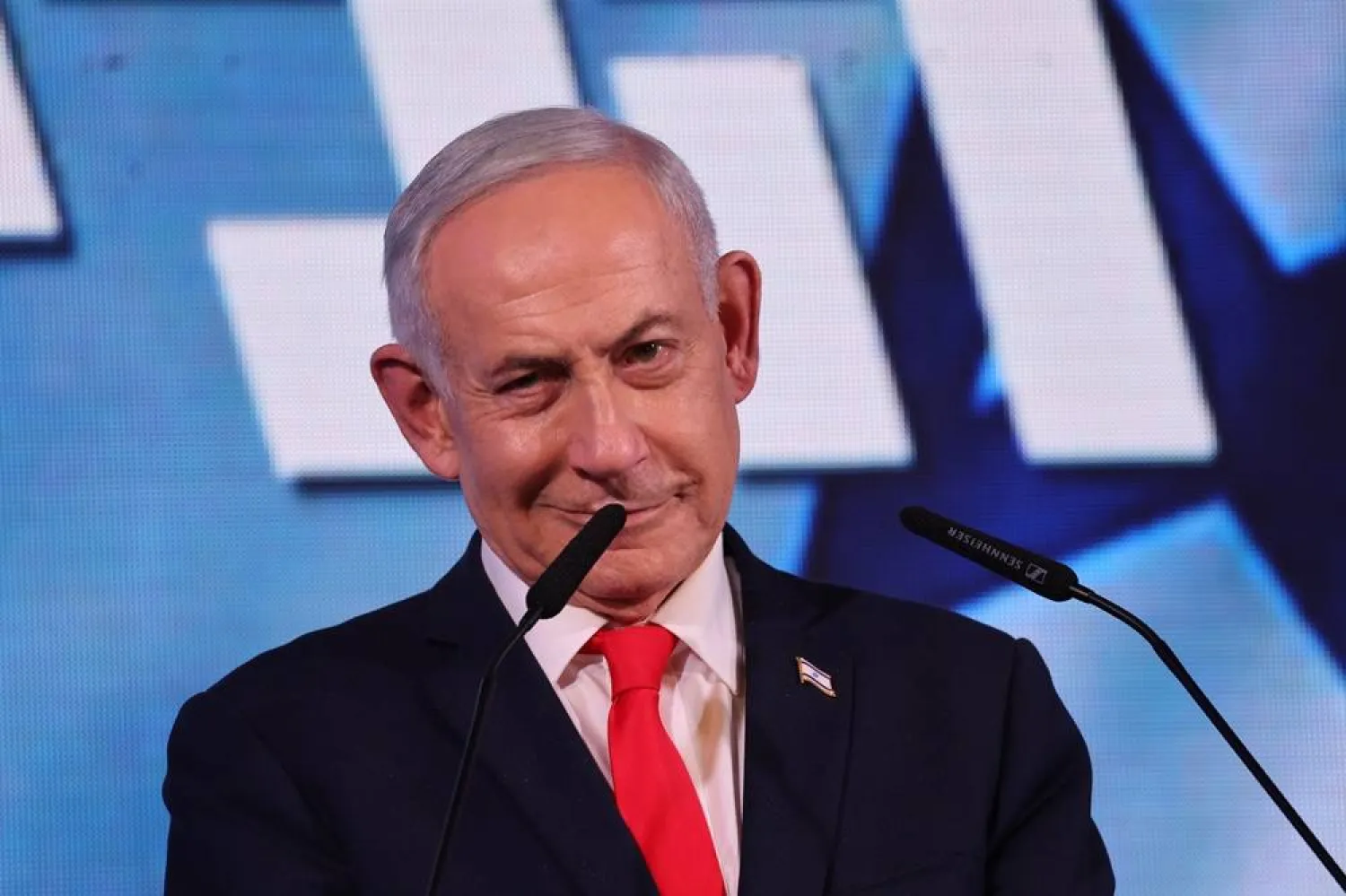

Netanyahu Is Pressing Trump to Attack Iran After the Midterms, Officials Say

Israeli Prime Minister Benjamin Netanyahu addresses supporters during a Likud party election event in Jerusalem, 28 October 2026. (EPA)
TT

Netanyahu Is Pressing Trump to Attack Iran After the Midterms, Officials Say

Israeli Prime Minister Benjamin Netanyahu addresses supporters during a Likud party election event in Jerusalem, 28 October 2026. (EPA)

Israeli Prime Minister Benjamin Netanyahu is pushing for another wave of strikes on Iran after Tuesday's midterm elections in the United States, according to two regional officials and a third person familiar with the matter.

A return to full-scale war with Iran could help Netanyahu to form an emergency government after he and his far-right allies lost their parliamentary majority in last week's elections. US President Donald Trump has alternated between threatening major strikes while pushing for a deal with Iran.

The two officials said diplomatic efforts have made progress, with Qatari mediators holding two rounds of talks last week with Iranian officials. The two officials said the mediators are trying to advance a framework for Iran to cease its attacks in the Strait of Hormuz in return for the US lifting its blockade on Iran's ports.

They said more talks are planned for this week. The two officials spoke on condition of anonymity because they were discussing classified briefings they had received from American, and in one case Israeli, officials.

One official said Netanyahu was working with senior officials in the US administration to persuade Trump to launch a quick but extensive air campaign and that the president does not appear to have made a decision.

Netanyahu pressed for strikes during a call over the weekend with Trump, who would not commit to taking military action, according to a person who was briefed on it.

Other regional powers are warning against more strikes, saying it would destabilize the region, a third regional official said. Iran-backed militias in Iraq could also get involved.

That official, and the person familiar with the Netanyahu-Trump call, were not authorized to speak publicly and spoke on condition of anonymity.

The Israeli government did not immediately comment. The White House did not directly respond to questions about Netanyahu and Trump’s discussion of potential new strikes during the weekend call.

Trump says he had a ‘very good’ call with Netanyahu

Trump told reporters on Sunday that he and Netanyahu had a “very good” call the day before. He said they discussed Iran but gave no details. Netanyahu had pushed for renewed strikes even before the Israeli election as he sought to highlight his security credentials to a public deeply scarred by Hamas' Oct. 7, 2023, attack.

Asked at a news conference Saturday about the possibility of new US strikes on Iran and Iranian retaliation, US Secretary of State Marco Rubio would not say what would happen next but reiterated that the Trump administration prefers a diplomatic solution and that talks were ongoing.

“He hasn’t made a decision,” Rubio said, referring to Trump.

“He’d prefer to solve it diplomatically," Rubio said, adding that Trump has “incredible confidence” in military action if that is needed.

Netanyahu has not commented on Iran since the election, and there was no word from his office on the latest call with Trump.

Iran says it is prepared for war while pursuing diplomacy

Iran wants guarantees that the US will implement its side of any agreement. The US and Israel have twice attacked Iran while it was engaged in negotiations over its disputed nuclear program.

Iranian officials say publicly they are prepared for war or diplomacy.

The new supreme leader, Mojtaba Khamenei, met with Iran’s military chiefs and said the response to “any kind and level of threat” from the US or Israel should be immediate and without “geographic limits,” and urged an expansion of the list of potential targets.

Khamenei has not been seen publicly since the opening strikes by Israel and the US on Feb. 28 killed his father, the previous supreme leader.

Iran’s security chief, Mohsen Rezaei, told state television that “the tone has completely changed” from the US and called it a “very good sign.” He gave no details about the letter he received from US Vice President JD Vance, which Iran acknowledged last week, and said he had not responded.



Iran Insists No Talks with the US Until Its Conditions Are Met

 Vessels at the Strait of Hormuz, as seen from Musandam, Oman, November 23, 2026. (Reuters)
Vessels at the Strait of Hormuz, as seen from Musandam, Oman, November 23, 2026. (Reuters)
TT

Iran Insists No Talks with the US Until Its Conditions Are Met

 Vessels at the Strait of Hormuz, as seen from Musandam, Oman, November 23, 2026. (Reuters)
Vessels at the Strait of Hormuz, as seen from Musandam, Oman, November 23, 2026. (Reuters)

Iran repeated Tuesday that there'll be no talks with the United States to end the conflict unless several conditions are met.

Iran’s chief negotiator and parliament speaker Mohammad Bagher Qalibaf said Tehran wouldn't negotiate with the US "until Iran’s seven conditions are met,” according to Iranian state television.

Iranian authorities haven't publicly stated what those conditions are. But Iranian state media have said they include the lifting of sanctions, the ending of the US naval blockade of Iranian ports and the release of seized Iranian assets.

He also warned that Iran would “shift the geographical scope of the conflict should the enemy make a mistake.”

Meanwhile, the naval arm of Iran’s Revolutionary Guard said the three oil tankers struck the naval mines because they were “in violation of regulations” regarding passage through the Strait of Hormuz.

The Guard’s navy said in a post on Telegram Monday that the strait “is not a place to test unauthorized routes or to disregard maritime warnings.”

It said the tankers were “engulfed in flames” after hitting the mines despite being under US aerial escort.


Iran Currency Plunges After Fresh US Sanctions

Iranians shop at a street market in Tehran, Iran, 23 November 2026, as the country faces an economic crisis amid ongoing US-Iran tensions. (EPA)
TT

Iran Currency Plunges After Fresh US Sanctions

Iranians shop at a street market in Tehran, Iran, 23 November 2026, as the country faces an economic crisis amid ongoing US-Iran tensions. (EPA)

Iran's currency plunged on the black market on Tuesday after Washington announced fresh sanctions, which the central bank governor said targeted a regular platform for registering transactions.

The US Treasury announced sanctions on Monday against more than two dozen Iranian exchange houses, alleged front companies and individuals said to be part of the country's "shadow banking" network. It said the network was "overseen" by the central bank.

By Tuesday afternoon, the US dollar was trading at around 2.82 million rials, up about five percent from around 2.68 million the day before, according to websites monitoring black market rates.

The euro also rose to around 3.07 million rials, up from 2.94 million on Monday, the websites said. Iranians use black market rates as the central bank rate is usually much lower.

Central Bank governor Abdolnaser Hemmati dismissed the sanctions, saying the US appeared to have "run out of targets" and had resorted to targeting a legitimate platform.

The sanctioned Iran Currency and Gold Exchange center "is merely a platform for registering transactions" and "is there for everyone to see," said Hemmati, according to Tasnim news agency.

The US Treasury's Office of Foreign Assets Control (OFAC) said it connects exporters earning foreign currency from overseas sales with importers seeking foreign currency to buy goods, facilitating tens of billions of dollars in trade annually.

"While Iran's shadow banking system moves the funds generated by Iran's international trade, the Iran Center for Exchange plays matchmaker and guides these funds to their ultimate destination inside Iran," OFAC said.

The latest sanctions were announced nearly nine months into the Middle East war, which broke out on February 28 when US-Israeli strikes killed Iran's supreme leader Ali Khamenei.

The conflict expanded after Iran retaliated with missile and drone strikes across the region, while armed groups it backs in Lebanon, Yemen and Iraq also entered the fray.

Washington has ramped up sanctions since August as part of an "economic asphyxiation" campaign, and launched a task force to disrupt land routes into Iran.

It has also maintained a naval blockade on Iranian ports to choke off the country's oil revenue in retaliation for Iran's effective blockade of the Strait of Hormuz, a vital global energy conduit.


Report: US Defense Chief Has Yet to Approve Patriot Missiles Already Allocated to Ukraine

 US Secretary of Defense Pete Hegseth attends a reception for "The President's Own" United States Marine Band on the South Lawn helipad at the White House in Washington, DC, US, November 20, 2026. (Reuters)
US Secretary of Defense Pete Hegseth attends a reception for "The President's Own" United States Marine Band on the South Lawn helipad at the White House in Washington, DC, US, November 20, 2026. (Reuters)
TT

Report: US Defense Chief Has Yet to Approve Patriot Missiles Already Allocated to Ukraine

 US Secretary of Defense Pete Hegseth attends a reception for "The President's Own" United States Marine Band on the South Lawn helipad at the White House in Washington, DC, US, November 20, 2026. (Reuters)
US Secretary of Defense Pete Hegseth attends a reception for "The President's Own" United States Marine Band on the South Lawn helipad at the White House in Washington, DC, US, November 20, 2026. (Reuters)

US Defense Secretary Pete Hegseth has yet to approve the transfer of about 60 Patriot air defense interceptors that Washington had already agreed to supply to Ukraine, the Financial Times reported on Tuesday, citing people familiar with the matter.

Ukraine has repeatedly said it urgently needs more missile interceptors to counter growing Russian missile and drone attacks.

The interceptors include US-made PAC-3 and PAC-2 missiles, some of which ‌are held ‌in European arsenals and are being financed ‌by ⁠Kyiv's Western allies, ⁠the newspaper said.

Reuters could not immediately verify the report. The Pentagon did not immediately respond to a request for comment.

The outstanding allocation includes PAC-3 interceptors scheduled for delivery between September and December, the FT said, adding that none of those shipments ⁠has yet been approved for transfer.

A further ‌20 or so PAC-2 ‌interceptors, an older Patriot missile variant, have also been ‌allocated to Ukraine but are awaiting approval for delivery, ‌FT added.

The FT also reported that a separate effort to secure US approval for Ukraine to produce its own Patriot interceptors has been delayed at the Pentagon.

A ‌Pentagon spokesperson told the newspaper there had been no change in US policy ⁠regarding support ⁠for Ukraine, while declining to comment further on the weapons.

"The Department of War has pursued multiple parallel lines of effort to accelerate transatlantic industrial co-operation on the Patriot air and missile defense system with European partners and Ukraine, and continues that work to this day," a Pentagon official told the FT.

Last month, the US approved a sale of 500 Patriot PAC-3 missiles to Ukraine valued at about $2.1 billion, although deliveries are not expected until the early 2030s.