Russia Pummels Ukraine After Putin Vowed ‘Painful’ Attack

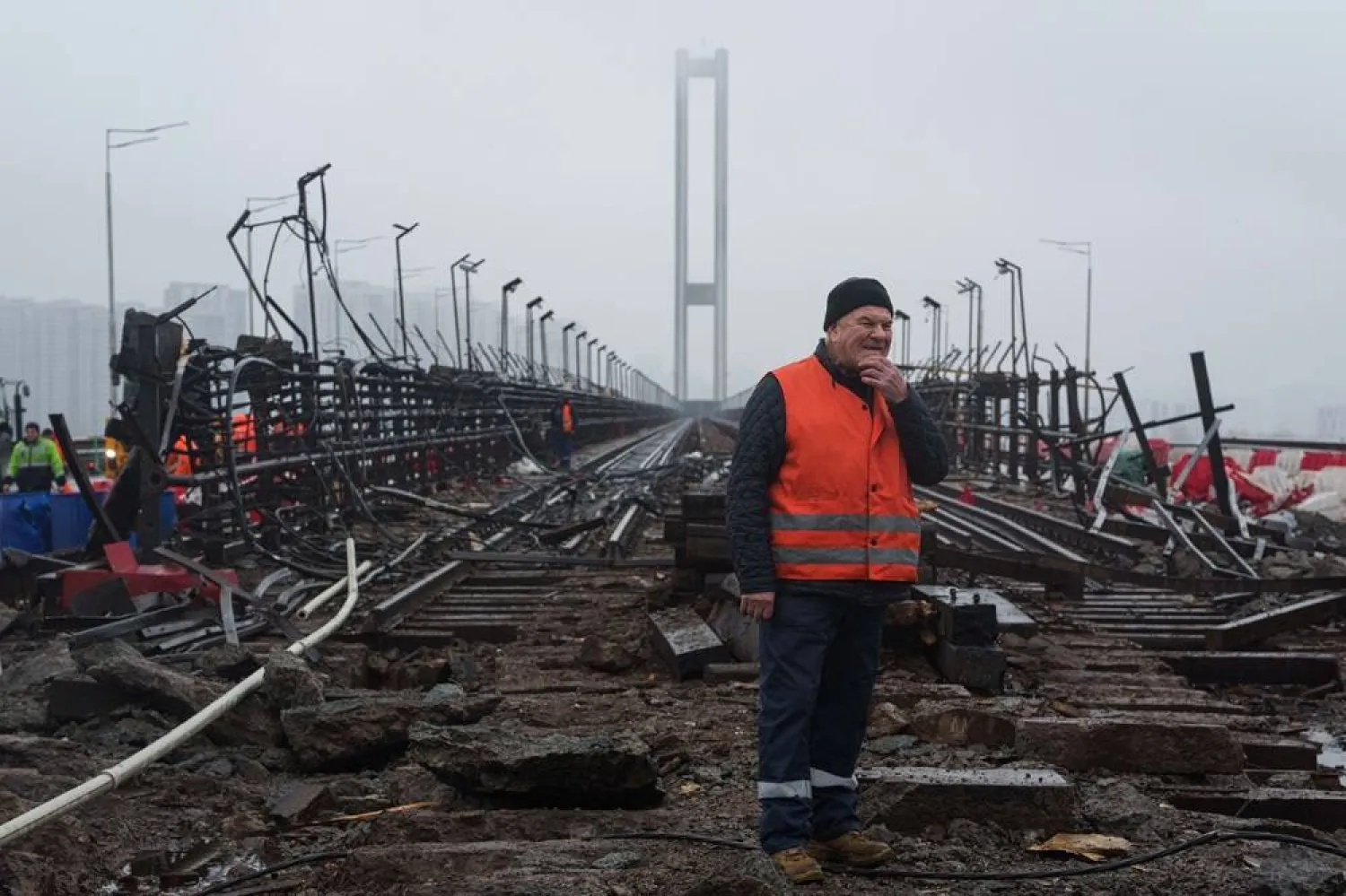
 A worker looks at the destruction of the Southern Bridge, which is damaged in a Russian missile strike, in Kyiv, Ukraine, Tuesday, Nov. 17, 2026. (AP)
A worker looks at the destruction of the Southern Bridge, which is damaged in a Russian missile strike, in Kyiv, Ukraine, Tuesday, Nov. 17, 2026. (AP)
TT

Russia Pummels Ukraine After Putin Vowed ‘Painful’ Attack

 A worker looks at the destruction of the Southern Bridge, which is damaged in a Russian missile strike, in Kyiv, Ukraine, Tuesday, Nov. 17, 2026. (AP)
A worker looks at the destruction of the Southern Bridge, which is damaged in a Russian missile strike, in Kyiv, Ukraine, Tuesday, Nov. 17, 2026. (AP)

Russia pummeled Ukraine with a barrage of missiles and drones overnight in a massive attack hours after President Vladimir Putin had vowed a "painful" response for Kyiv's strikes on the Crimean bridge this week. 

At least three people were killed in Kyiv and another two in Lviv, power was knocked out in parts of the capital and vital transport bridges were hit, officials said. 

The deadly strikes came after Putin met China's Xi Jinping and US President Donald Trump in China, where the Russian leader had touted the three men's "shared responsibility" for global security and issued a joint "declaration toward peace" that made no mention of Moscow's almost five-year invasion of Ukraine. 

AFP journalists saw people hunkering in Kyiv's metro stations -- which double as overnight air-raid shelters -- sleeping on yoga mats, camping chairs and in pop-up tents. 

Explosions rang out through the night and unofficial monitoring services reported up to three dozen missiles in Ukraine's air space at one point in the night. 

"At present, three people are known to have been killed," Kyiv Mayor Vitali Klitschko wrote on Telegram on Friday. 

At least another 15 were reported wounded, he said. 

Three bridges that cross the Dnipro river were also hit, threatening yet more disruption to daily life in the city. 

And two people were killed at a commuter train station on the outskirts of the western city of Lviv, the governor said. 

Russia has intensified its targeting of Kyiv over the last six months and ahead of what many fear will be the toughest winter of the war. 

Attacks throughout the day on Thursday -- while the summit in China was underway and as Ukrainian President Volodymyr Zelensky met his European backers in Berlin -- had damaged a landmark cathedral and embassies of foreign countries. 

The Austrian, Brazilian and Dutch embassies saw light damage after volleys of drones were fired on Kyiv in an hours-long barrage on the city center. 

Russia's military on Friday morning confirmed it had launched a "massive" attack with missiles and drones, saying they targeted military-industrial sites and transport infrastructure in several regions, including bridges in Kyiv. 

- Bridge retaliation - 

Speaking in China after meeting Trump and Xi, Putin had vowed no let-up in Russia's assaults on Ukraine. 

The war, unleashed with his 2022 invasion, has killed hundreds of thousands and forced millions to flee their homes in eastern and southern Ukraine. 

He had said Russia's response to Ukraine's strikes on a bridge linking Russia to the annexed Crimean peninsula would be "much more painful". 

Ukrainian attacks earlier this week severed the highway of the road-and-rail link in two, according to satellite images published by the Vantor imaging firm. 

The multi-billion-dollar 19-kilometer (12-mile) bridge is a symbol of Russia's annexation of the peninsula and has been a target for Ukraine throughout the war. 

One more person was killed in Ukraine's southern Zaporizhzhia region in the overnight attacks, while a hospital was hit in the northeastern city of Kharkiv, officials said. 

Russia's defense ministry said it had intercepted 310 Ukrainian drones fired at the country, while Moscow-installed officials in occupied eastern Ukraine reported three people killed there. 

- Moscow invite - 

US-led talks on ending the fighting have so far shown little signs of progress, with Moscow having stuck to its hardline demands. 

Putin has said any deal to end the war in Ukraine must be part of a wider agreement on European security. 

Speaking in China on Thursday, he said any form of Ukraine-Europe military cooperation as part of that deal would be a "problem." 

He has also so far refused to let European representatives join the US-led talks with Ukraine. 

Putin said Russia had invited Europeans to Moscow to discuss their position, before he would decide if they should join the negotiations. 

He did not say who he had invited. 

In Berlin, Zelensky said it would be a "mistake" for Europeans to travel to Moscow for the talks, but has urged them to be included in the negotiations taking place in third countries. 

European leaders have pushed back against Putin's calls to reshape European security, with the Russian leader seeking a massive roll-back of NATO forces in eastern and central Europe. 

German Chancellor Friedrich Merz insisted on Thursday that Europe will have a seat at the table at talks that should "take place soon". 


UN Cuts Food Aid Target Despite Looming Hunger Crisis

FILE- Rohingya Muslims, who crossed over from Myanmar into Bangladesh, stretch their arms out to collect food items distributed by aid agencies near Balukhali refugee camp, Bangladesh, Monday, Sept. 18, 2017. (AP Photo/Dar Yasin, File)
TT

UN Cuts Food Aid Target Despite Looming Hunger Crisis

FILE- Rohingya Muslims, who crossed over from Myanmar into Bangladesh, stretch their arms out to collect food items distributed by aid agencies near Balukhali refugee camp, Bangladesh, Monday, Sept. 18, 2017. (AP Photo/Dar Yasin, File)

The United Nations food agency said on Friday it plans to assist fewer people in the coming year due to funding constraints even as it warns of a possible global food crisis on the scale of the one that followed the war in Ukraine.

The World Food Programme - led by America's Luke Lindberg since last month - launched ⁠a 2027 appeal ⁠for $12 billion to help 91 million people around the world, fewer than the 110 million it aimed to help in 2026.

This represents just a third of the 266 million people facing ⁠acute and severe hunger as the Iran conflict drives up food and shipping costs and a powerful El Niño threatens agriculture, creating famine risks in places like war-torn Sudan.

"The shortfalls are forcing some hard choices," WFP director Laura Turner told a Geneva press briefing, adding that its 2026 appeal for $13 billion is ⁠only ⁠half funded. Another WFP official warned that another food crisis was likely in 2027 and that the agency would be constrained to focus on the most vulnerable.

"We could soon be facing a third global food crisis in six years," WFP's Matthew Hollingworth said, referring to price surges during the COVID pandemic and after Russia's invasion of Ukraine in 2022.


UK, EU Hold Rare Summit to Strengthen Ties as Burnham Seeks to Mend Brexit Damage

(L-R) European Commission President Ursula von der Leyen, British Prime Minister Andy Burnham and European Council President Antonio Costa at the start of EU-UK summit in Brussels, Belgium, 20 November 2026. (EPA)
TT

UK, EU Hold Rare Summit to Strengthen Ties as Burnham Seeks to Mend Brexit Damage

(L-R) European Commission President Ursula von der Leyen, British Prime Minister Andy Burnham and European Council President Antonio Costa at the start of EU-UK summit in Brussels, Belgium, 20 November 2026. (EPA)

A decade after the people of Britain voted to leave the European Union, top EU officials met with Prime Minister Andy Burnham on Friday, looking to mend more fences, and just perhaps, to pave the way for them to get back together.

Burnham said the two sides would agree to a “pragmatic” set of deals that will make it easier for food products and young people to move between Britain and the bloc, but leave big questions about the relationship unanswered. Months — likely years — of negotiations lie ahead on everything from student fees to manufacturing rules.

“The deal is done,” a British government spokesperson said, adding that details would be published in a joint statement later.

Burnham was scheduled to hold just under an hour of talks in Brussels with European Council President António Costa and European Commission President Ursula von der Leyen. Then they'll all meet in a plenary session with UK government ministers and European commissioners.

Burnham has described the rare EU-UK summit — only the second since Britain became the first country to leave the world’s biggest trading bloc — as a step toward undoing a decade of damage caused by the divorce.

“The Brexit we were given has not worked. We have lost more than we gained,” he said this week.

Burnham has said all options should be on the table for future relations, including rejoining the now-27-nation bloc. But he's stressed that reversing Brexit is just one possible outcome, and far from imminent. It would need the backing not just of British voters, but the unanimous support of a mistrustful EU. Still, he has broken a long political code of silence on the option of rejoining.

Ahead of the meeting, von der Leyen said she wanted it to be “a summit of ambition and concrete results. More opportunities for young people. Easier agrifood trade. And a stronger cooperation on economic security.”

Burnham pitched the package of agreements expected to be agreed Friday as a way of “cutting costs, keeping prices down in the supermarkets and creating opportunities for young people.”

He said that “a closer partnership with Europe is good for working people, good for Britain and good for Europe.”

The deals are set to include an agreement for up to 100,000 young adults from Britain to live and work in EU countries for up to three years, and the same number of Europeans to come to the UK.

There will also be an emissions trading agreement and a deal to remove checks on food and agricultural products that will make things cheaper and easier for British exporters to Europe. Burnham said Friday the deals could add 0.5% to Britain’s economy — he'd previously set it at 0.4%.

But nothing in UK-EU relations is ever quick or simple. An EU official said the package is contingent on the two sides reaching agreement on university tuition fees in the next six months. EU negotiators want European students to pay domestic fees if they study in Britain rather than the higher fees for foreign students, something the UK has resisted. The official said negotiations had not been easy, but they sensed good will to resolve the issue.

The official was designated to brief reporters about the summit but only on condition that they not be named.

Talks are also continuing on Britain's desire to have access to the bloc’s “made in Europe” rules for manufacturing.

Critics say the deals are a betrayal of Brexit

To get the deals, the UK must accept some EU rules and standards that it has no role in setting. Supporters of Brexit say that undermines Britain’s independence.

“I’m afraid that the great Brexit debate has just started again,” Reform UK leader Nigel Farage told the BBC. He said “it’s perfectly clear that this very, very soon becomes a debate about: do we rejoin or do we stay out?”

The war in Ukraine, and the UK’s military strength, are drawing the two back together, and the summit provides the EU with an opportunity to discuss stronger cooperation on security and defense, as well as efforts to restrict irregular migration.

“Our security and prosperity are closely intertwined, making a strong partnership between us essential,” Costa said ahead of the meeting. “By deepening our cooperation, we can strengthen our ability to address the challenges of our time, strengthen our resilience and promote stability in Europe and beyond.”

Nevertheless, feelings remain raw, and EU officials have been reluctant to encourage talk of the UK rejoining. They are weary from the shifting demands of seven British prime ministers over the last decade and want real clarity about the country’s intentions.

Ireland’s ambassador in London, Sonja Hyland, said that when Britain voted for Brexit, “there was a lack of clarity as to exactly what that meant.” If Britain wants to reopen negotiations, she said, it must “make a clear decision as to what it wants.”


2 Men to Stand Trial in UK Next Year over RAF Fairford Incident Allegedly Linked to Iran

FILE PHOTO: A B‑1B Lancer bomber arrives at RAF Fairford airbase, after police declared a major incident at the base in Fairford, Gloucestershire, Britain, September 29, 2026. REUTERS/Toby Shepheard/File Photo
TT

2 Men to Stand Trial in UK Next Year over RAF Fairford Incident Allegedly Linked to Iran

FILE PHOTO: A B‑1B Lancer bomber arrives at RAF Fairford airbase, after police declared a major incident at the base in Fairford, Gloucestershire, Britain, September 29, 2026. REUTERS/Toby Shepheard/File Photo

Two men charged over September's security incident at the RAF Fairford military base, which British and US prosecutors say was orchestrated on behalf of Iran, will stand trial in London in November next year, a judge said on Friday.

RAF Fairford had been used by the US to carry out strikes on Iran, but B-1 bombers were withdrawn on security grounds shortly after five British men were arrested outside the base in southwest England in the early hours of September 27.

The incident occurred during ⁠the US-led war ⁠against Iran, and British police and Prime Minister Andy Burnham said Iran was likely involved, which Tehran's ambassador to Britain has denied.

US prosecutors have since charged three other men while, separately, the US removed American aircraft from a second airbase in Britain last week ⁠over security issues.

Mohmed Abdulkarim, 24, and Nouman Essghir, 25, appeared in court by videolink, and their lawyers said both were likely to plead not guilty, Reuters reported.

British prosecutors say Abdulkarim, a British national, arranged for five men to drive to RAF Fairford at the behest of a man called "Ali", who is alleged to have been acting in the interests of Iran.

Abdulkarim is charged under Britain's National Security Act with engaging in ⁠conduct that ⁠was likely to materially assist a foreign intelligence service between August 31 and September 28.

His co-defendant, Essghir, is a dual British-Iranian national and the only one of the five arrested outside RAF Fairford to be charged, though the charge relates to alleged reconnaissance of the base on August 22.

Judge Bobbie Cheema-Grubb fixed a trial date of November 22, 2027.

Police previously said that six other people, four of whom are British nationals who were arrested outside RAF Fairford on September 27, remain on police bail.