


Killing of Iraq's Hashemi Stirs Fear of New Violent Phase

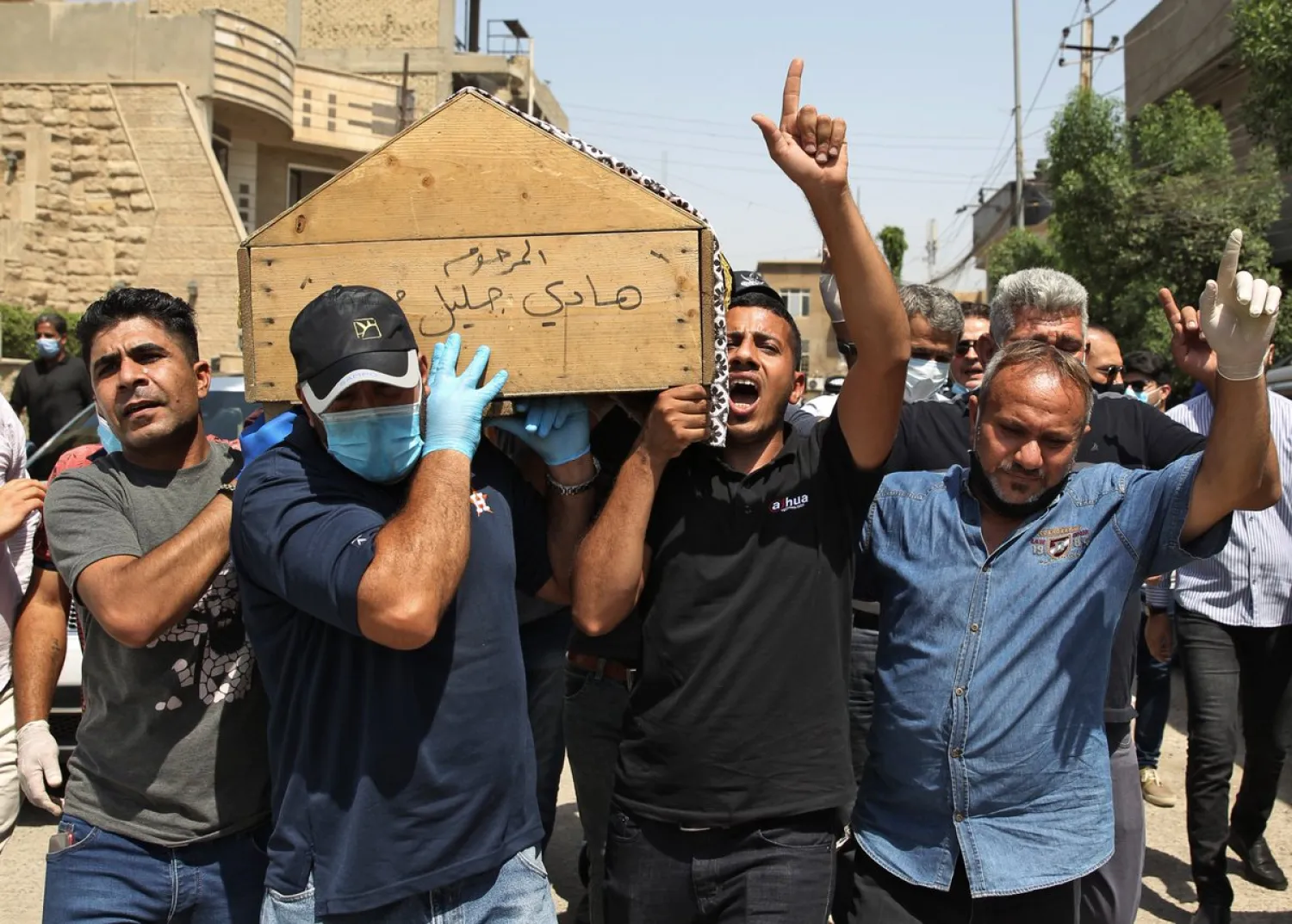
Mourners carry the coffin of Iraqi security expert Hisham al-Hashemi, who was shot dead outside his house in the Iraqi capital | AFP
TT

Killing of Iraq's Hashemi Stirs Fear of New Violent Phase

Mourners carry the coffin of Iraqi security expert Hisham al-Hashemi, who was shot dead outside his house in the Iraqi capital | AFP

The killing of security expert Hisham al-Hashemi has stirred fears Iraq is entering a dark and violent phase, as boiling tensions between pro-Iran factions and the government reach new heights.

Hashemi, 47, was gunned down outside his home in east Baghdad late Monday by masked assailants on motorcycles.

While the perpetrators remain on the run, experts say the death signals a dramatic turn for political violence brewing since mass protests erupted in October.

"Armed forces of various affiliations have killed protesters and others willing to publicly criticize the government and armed forces with impunity," said Belkis Wille of Human Rights Watch.

"But killing someone of his stature smacks of a country where some groups have become so emboldened by the complete impunity for serious abuses, that they can kill anyone they want to without paying a price," he said.

Over the course of years, Hashemi had developed a vast network encompassing top decision-makers, former militants, and rival political parties, often mediating among them.

His exceptional access had granted him a level of protection, those close to him said, but the balance started to tip in October.

His support for popular protests against a government seen as too close to Iran infuriated Tehran-backed factions in Iraq's Hashed al-Shaabi (Popular Mobilization Forces) military network.

Hashemi skirted threats to mediate between protesters and senior government officials, even as activists were fatally shot outside their homes and dozens more abducted.

"The parameters changed starting in October. There was a new modus operandi, and a shift in the confrontation with pro-Iran factions," said Adel Bakawan, an Iraqi expert who knew Hashemi.

- 'Won't be the last' -

Other experts say the real turning point was in January, when a US strike on Baghdad killed Iranian General Qasem Soleimani and Hashed deputy head Abu Mahdi al-Muhandis.

Hardline factions within the Hashed, particularly those close to Iran like Kataeb Hezbollah, vowed revenge against both the US and its allies inside Iraq, whatever the cost.

As someone with close ties to foreign governments, Hashemi was seen as a potential target, and he left Baghdad for a few days in late January, he told AFP at the time.

"Hisham was aware that things had shifted," said Renad Mansour, a researcher at London-based Chatham House who worked with Hashemi for years.

"The killing of Abu Mahdi unleashed all of these groups that he had been trying to control and centralize. We're still feeling the shock waves," he said.

Hashed al-Shaabi itself published a statement mourning Hashemi's murder.

"We demand security forces follow up on this crime and catch the terrorist group that assassinated Hashemi," it said.

Within the network, Kataeb Hezbollah has accused then-spy chief Mustafa al-Kadhimi of complicity in the deadly strike and deeply opposed his rise to Iraq's premiership in May.

Hashemi had advised Kadhimi for years, a relationship that put the expert in "danger" when the former intelligence head became premier, those close to him said.

In recent weeks, Hashemi had been particularly critical of rogue elements of the Hashed and had received threats from at least two hardline factions, his associates said. His family, meanwhile, said he had been threatened by ISIS.

"For the first time since 2003, there is a sacred alliance between the government and an influential group of intellectuals. Now, people who are both symbols of the protests and the government are being targeted," said Bakawan, who knew Hashemi personally.

"This may be the first prominent figure killed but it won't be the last. There are other names on this blacklist," he added.

- 'Suicidal mission' -

Kadhimi has pledged to hold Hashemi's killers to account, and swiftly sacked the police chief in the Baghdad district where the expert was killed.

But there is little hope for real accountability.

Less than two weeks ago, Kadhimi ordered the arrests of Kataeb Hezbollah fighters who were allegedly preparing a rocket attack on Baghdad's high-security Green Zone, home to the US embassy and other foreign missions.

But within days, all but one of those detained were released and their faction even pledged court action against Kadhimi.

Hashemi's killing appears to be a new challenge, said Iraqi politician Raed Fahmi.

"This is a political assassination that represents both the silencing of freedom of speech, and a challenge to the government, its prime minister and any reform plan," he said.

Other Iraqi activists told AFP they had long feared being targeted for speaking out against Iran-backed groups.

"This could have been any one of us. Our friends have already been notified to leave immediately," said Omar Mohammad, a historian who documented atrocities in Mosul under IS.

"If Kadhimi will not take a strong step, civil life in Iraq will vanish. But I'm afraid he won't do it. It's a suicidal mission," he told AFP.



Libya PM Undergoes 'Successful' Treatment at Heart Hospital

Head of Libya's Government of National Unity (GNU) Abdulhamid Dbeibah. (GNU)
TT

Libya PM Undergoes 'Successful' Treatment at Heart Hospital

Head of Libya's Government of National Unity (GNU) Abdulhamid Dbeibah. (GNU)

Libya's Prime Minister Abdulhamid Dbeibah has undergone "successful" treatment at a heart hospital, his office said Saturday, but his specific ailment was not disclosed.

"I assure you that I am fine, by God's grace," said a statement posted on social media overnight.

The treatment was carried out at a facility in the northwestern Libyan city of Misrata on an undisclosed date, said AFP.

Dbeibah said he later travelled abroad for "additional medical checkups for reassurance", though this was not the primary reason for his trip.

Italian media outlets previously reported he had been admitted to a leading cardiac facility in Milan on Thursday for a general check-up.

"The matter is simply that I underwent some additional medical checkups for reassurance while I was abroad due to a prior external commitment," he said.

"The results confirmed the success of the treatment I received in Libya, praise be to God."

The prime minister leads a UN-recognized government based in Tripoli that controls western Libya, while the country's east is run by another administration backed by military strongman Khalifa Haftar.

Libya has remained divided since chaos erupted following the 2011 Arab Spring uprising that toppled longtime leader Muammar Gaddafi.


Eight Hezbollah Members Killed in Israel’s Friday Strikes on Lebanon

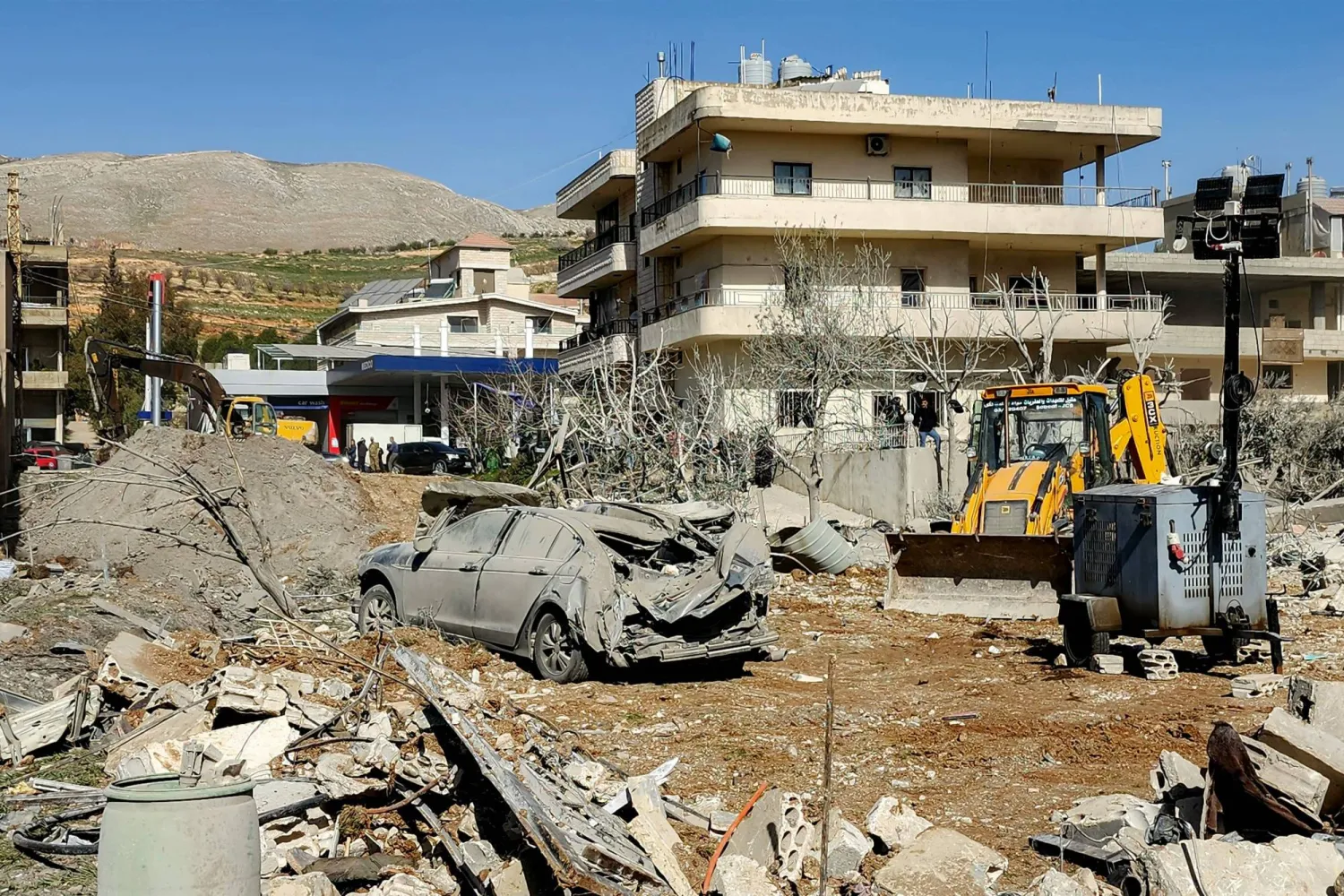
A bulldozer clears debris near heavily-damaged buildings in the village of Bednayel in Lebanon's eastern Bekaa Valley region on February 21, 2026, following Israeli strikes. (AFP)
TT

Eight Hezbollah Members Killed in Israel’s Friday Strikes on Lebanon

A bulldozer clears debris near heavily-damaged buildings in the village of Bednayel in Lebanon's eastern Bekaa Valley region on February 21, 2026, following Israeli strikes. (AFP)

Attacks carried out by Israel on Friday in eastern Lebanon killed eight members of Hezbollah, an official from the group told AFP on Saturday.

Lebanon's health ministry said Friday that a total of 10 people were killed in strikes that hit the eastern Bekaa region.

The Israeli military said it targeted "several terrorists of Hezbollah's missile array in three different command centers in the Baalbek area".

Lebanon's president on Saturday condemned the attacks, the latest despite a ceasefire with Hezbollah.

In a statement, Joseph Aoun called the attacks "a blatant act of aggression aimed at thwarting diplomatic efforts" by the United States and other nations to establish stability.

A lawmaker from Hezbollah called on Beirut to suspend meetings of a multinational committee tasked with monitoring the truce.

Washington is one of five members on the committee overseeing the ceasefire implemented in November 2024, with the body scheduled to meet again next week.

Israel has repeatedly bombed Lebanon despite the ceasefire, usually saying it is targeting Hezbollah but occasionally also the group's Palestinian ally Hamas.

The Friday attacks on southern and eastern Lebanon killed 12 people, according to the health ministry, 10 of them in the east of the country.

Israel's military said it struck "several terrorists of Hezbollah's missile array in three different command centers in the Baalbek area".

Hezbollah said a commander was killed in the raids. Its lawmaker Rami Abu Hamdan said on Saturday the group "will not accept the authorities acting as mere political analysts, dismissing these as Israeli strikes we have grown accustomed to before every meeting of the committee".

He called on Beirut to "suspend the committee's meetings until the enemy ceases its attacks".

Hezbollah, while weakened following war with Israel, remains a strong political force in Lebanon represented in parliament.

Lebanon's government last year committed to disarming the Iran-backed group, with the army saying last month it had completed the first phase of the plan covering the area near the Israeli border.

Israel, which accuses Hezbollah of rearming since the war, has called the Lebanese army's progress on disarming the group insufficient.


Ramadan’s First Friday Prayers Are Held at Jerusalem’s Al-Aqsa Mosque

Palestinians worshippers gather at Al-Aqsa Mosque compound for the first Friday prayers during the holy month of Ramadan, in the Old City of Jerusalem, 20 February 2026. (EPA)
TT

Ramadan’s First Friday Prayers Are Held at Jerusalem’s Al-Aqsa Mosque

Palestinians worshippers gather at Al-Aqsa Mosque compound for the first Friday prayers during the holy month of Ramadan, in the Old City of Jerusalem, 20 February 2026. (EPA)

Tens of thousands of Palestinians gathered under heavy Israeli restrictions at Jerusalem's Al-Aqsa Mosque compound for the first Friday prayers of the Muslim holy month of Ramadan, including some who were allowed to enter from the occupied West Bank.

The Ramadan prayers at Al-Aqsa took place for the first time since a shaky ceasefire deal between Israel and Hamas went into effect in October. It was the first opportunity many had to leave the West Bank and pray at the site in Jerusalem’s Old City since Ramadan last year.

Israel restricted the number of Palestinians allowed to enter from the West Bank to 10,000 on Friday, and only allowed men over 55 and women over 50 as well as children up to 12. It has imposed similar restrictions in the past, citing security concerns.

The hilltop, which Jews refer to as the Temple Mount, is the holiest site in Judaism and was home to the ancient biblical temples. Muslims call the site the Noble Sanctuary. Today it is home to Al-Aqsa Mosque, the third-holiest site in Islam.

It has frequently been a flashpoint in the Israeli-Palestinian conflict.

Israeli police said more than 3,000 police were deployed across Jerusalem. They said their presence was not meant to show aggression or force but was aimed at providing help in case of an emergency.

Many Palestinians view the heightened Israeli security presence, and increasing visits by religious and nationalist Israeli Jews, as a provocation. They fear that Israel intends to take over or partition the compound. The Israeli government denies having any such plans.

Jerusalem’s Islamic Waqf, the Jordanian religious authority that administers the compound, said there were 80,000 in attendance. In normal times, Ramadan Friday prayers at Al-Aqsa can draw up to 200,000.

Ezaldeen Mustafah, a Palestinian from the West Bank, was among those lamenting the restrictions.

“We need more people than this,” he said.

Some Palestinians from the West Bank on Friday said they were turned away from crossing into Jerusalem even though they had permits. Jihad Bisharat said he was told his permit had been canceled and was sent back. Israel's army didn't immediately respond to a request for comment.

The Old City, home to major religious sites sacred to Jews, Christians and Muslims, is in east Jerusalem, which Israel captured in the 1967 Mideast war, along with the West Bank and the Gaza Strip. The Palestinians want all three territories for a future state with its capital in east Jerusalem. Israel annexed east Jerusalem, a move not recognized by most of the international community, and considers the entire city to be its capital.

Ramadan in Gaza

Many Palestinians said the month’s typically festive spirit is eluding them as they struggle with grief and losses following two years of conflict in Gaza sparked by Hamas' Oct. 7, 2023, attack into Israel.

“All the mosques have been bombed,” said Ramiz Firwana, a Gaza resident who gathered with other worshippers for a Friday sermon and prayers held in schoolyard.

On Thursday evening, families sat amid the rubble and destruction for iftar, the meal held at the end of the daily dawn-to-dusk fast.

“Despite the displacement, the pain and the destruction, we want to rejoice and live,” said Mohammad Kollab, from Khan Younis. “We are not a people destined only for destruction and killing."

Israel’s military offensive has killed more than 72,000 Palestinians, according to Gaza’s Health Ministry, and caused widespread destruction and displaced most of the territory’s residents. Israel launched the offensive after Hamas-led militants killed some 1,200 people, mostly civilians, and took another 251 hostage in the initial attack.

The Oct. 10 US-brokered ceasefire deal has brought an end to major military operations and the release of the remaining hostages. But Palestinians, including many civilians, are still being killed in near-daily strikes that Israel says are aimed at militants who threaten or attack its forces.