Crew of NASA's Earthbound Simulated Mars Habitat Emerge after a Year

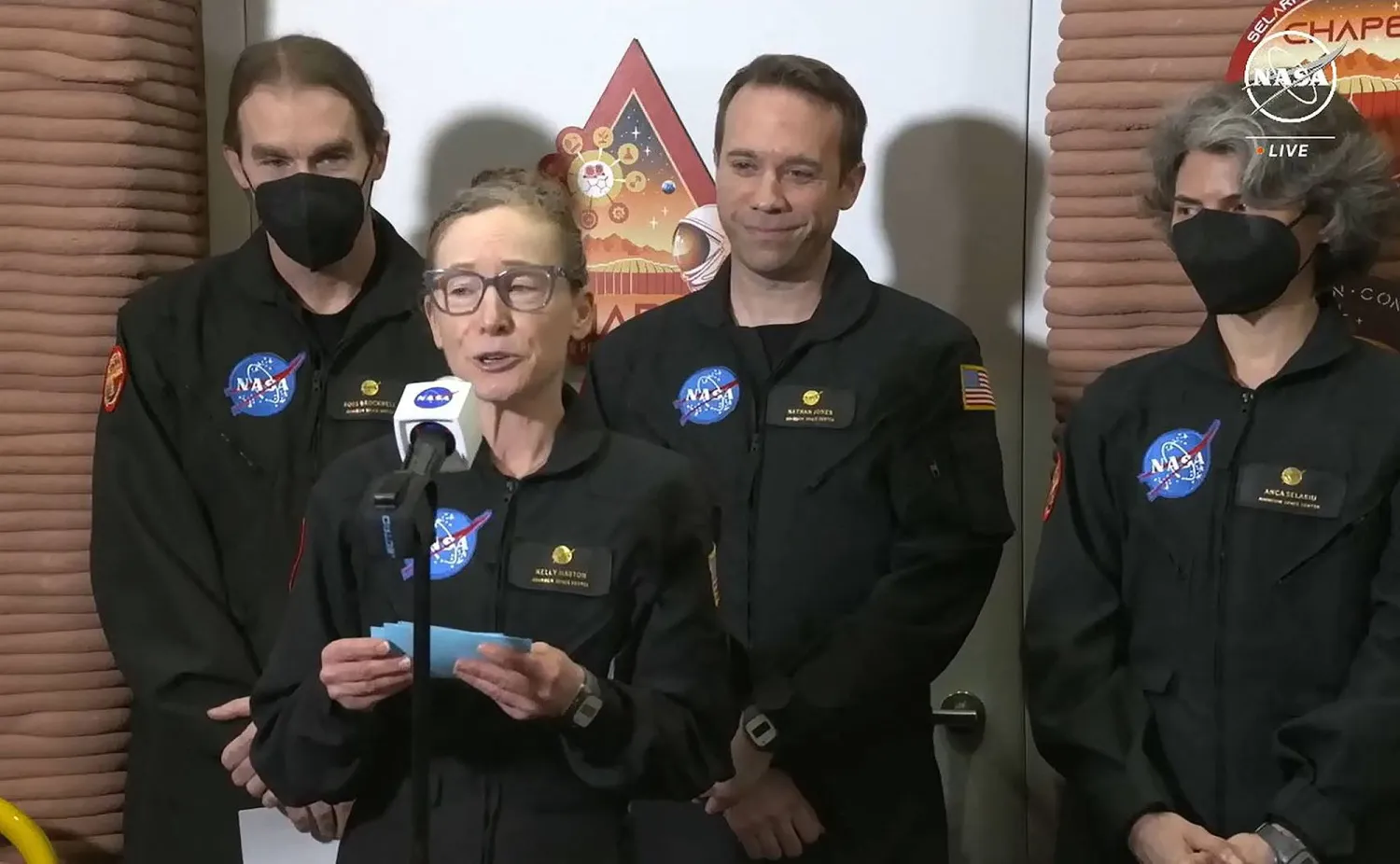
In this still image taken from a July 6, 2024, NASA TV broadcast, volunteer crew commander Kelly Haston speaks alongside crewmates (L-R) Ross Brockwell, Nathan Jones and Anca Selariu, as they exit the first simulated yearlong Mars habitat mission at Johnson Space Center in Houston, Texas. (Photo by Jose ROMERO / NASA TV / AFP)
TT

Crew of NASA's Earthbound Simulated Mars Habitat Emerge after a Year

In this still image taken from a July 6, 2024, NASA TV broadcast, volunteer crew commander Kelly Haston speaks alongside crewmates (L-R) Ross Brockwell, Nathan Jones and Anca Selariu, as they exit the first simulated yearlong Mars habitat mission at Johnson Space Center in Houston, Texas. (Photo by Jose ROMERO / NASA TV / AFP)

The crew of a NASA mission to Mars emerged from their craft after a yearlong voyage that never left Earth.
The four volunteer crew members spent more than 12 months inside NASA's first simulated Mars environment at Johnson Space Center in Houston, coming out of the artificial alien environment Saturday around 5 p.m, The Associated Press reported.
Kelly Haston, Anca Selariu, Ross Brockwell and Nathan Jones entered the 3D-printed habitat on June 25, 2023, as the maiden crew of the space agency's Crew Health and Performance Exploration Analog project.
Haston, the mission commander, began with a simple, “Hello.”
“It’s actually just so wonderful to be able to say ‘hello’ to you all,” she said.
Jones, a physician and the mission medical officer, said their 378 days in confinement “went by quickly.”
The quartet lived and worked inside the space of 17,000 square feet (1,579 square meters) to simulate a mission to the red planet, the fourth from the sun and a frequent focus of discussion among scientists and sci-fi fans alike concerning a possible voyage taking humans beyond our moon.
The first CHAPEA crew focused on establishing possible conditions for future Mars operations through simulated spacewalks, dubbed “Marswalks,” as well as growing and harvesting vegetables to supplement their provisions and maintaining the habitat and their equipment.
They also worked through challenges a real Mars crew would be expected to experience including limited resources, isolation and delays in communication of up to 22 minutes with their home planet on the other side of the habitat's walls, NASA said.
Two additional CHAPEA missions are planned and crews will continue conducting simulated spacewalks and gathering data on factors related to physical and behavioral health and performance, NASA said.
Steve Koerner, deputy director of Johnson Space Center, said most of the first crew's experimentation focused on nutrition and how that affected their performance. The work was “crucial science as we prepare to send people on to the red planet,” he said.
“They've been separated from their families, placed on a carefully prescribed meal plan and undergone a lot of observation,” Koerner said.
“Mars is our goal,” he said, calling the project an important step in America's intent to be a leader in the global space exploration effort.
Emerging after a knock on the habitat's door by Kjell Lindgren, an astronaut and the deputy director of flight operations, the four volunteers spoke of the gratitude they had for each other and those who waited patiently outside, as well as lessons learned about a prospective manned mission to Mars and life on Earth.
Brockwell, the crew's flight engineer, said the mission showed him the importance of living sustainably for the benefit of everyone on Earth.
“I’m very grateful to have had this incredible opportunity to live for a year within the spirit of planetary adventure towards an exciting future, and I’m grateful for the chance to live the idea that we must utilize resources no faster than they can be replenished and produce waste no faster than they can be processed back into resources," Brockwell said.
“We cannot live, dream, create or explore on any significant timeframe if we don’t live these principles, but if we do, we can achieve and sustain amazing and inspiring things like exploring other worlds," he said.
Science officer Anca Selariu said she had been asked many times why there is a fixation on Mars.
“Why go to Mars? Because it’s possible,” she said. "Because space can unite and bring out the best in us. Because it’s one defining step that ‘Earthlings’ will take to light the way into the next centuries.”



Sinner Sees off Popyrin to Reach Doha Quarters

 Italy's Jannik Sinner greets the fans after defeating Australia's Alexei Popyrin in their men's singles match at the Qatar Open tennis tournament in Doha on February 18, 2026. (AFP)
Italy's Jannik Sinner greets the fans after defeating Australia's Alexei Popyrin in their men's singles match at the Qatar Open tennis tournament in Doha on February 18, 2026. (AFP)
TT

Sinner Sees off Popyrin to Reach Doha Quarters

 Italy's Jannik Sinner greets the fans after defeating Australia's Alexei Popyrin in their men's singles match at the Qatar Open tennis tournament in Doha on February 18, 2026. (AFP)
Italy's Jannik Sinner greets the fans after defeating Australia's Alexei Popyrin in their men's singles match at the Qatar Open tennis tournament in Doha on February 18, 2026. (AFP)

Jannik Sinner powered past Alexei Popyrin in straight sets on Wednesday to reach the last eight of the Qatar Open and edge closer to a possible final meeting with Carlos Alcaraz.

The Italian, playing his first tournament since losing to Novak Djokovic in the Australian Open semi-finals last month, eased to a 6-3, 7-5 second-round win in Doha.

Sinner will play Jakub Mensik in Thursday's quarter-finals.

Australian world number 53 Popyrin battled gamely but failed to create a break-point opportunity against his clinical opponent.

Sinner dropped just three points on serve in an excellent first set which he took courtesy of a break in the sixth game.

Popyrin fought hard in the second but could not force a tie-break as Sinner broke to grab a 6-5 lead before confidently serving it out.

World number one Alcaraz takes on Frenchman Valentin Royer in his second-round match later.


Berlin Film Festival Rejects Accusation of Censorship on Gaza

Berlinale Festival Director Tricia Tuttle speaks during the Berlinale Camera award ceremony honoring British composer Max Richter during the 76th Berlin International Film Festival, in Berlin, Germany, 18 February 2026. (EPA)
TT

Berlin Film Festival Rejects Accusation of Censorship on Gaza

Berlinale Festival Director Tricia Tuttle speaks during the Berlinale Camera award ceremony honoring British composer Max Richter during the 76th Berlin International Film Festival, in Berlin, Germany, 18 February 2026. (EPA)

The director of the Berlin Film Festival on Wednesday rejected accusations from more than 80 film industry figures that the festival had helped censor artists who oppose Israel's actions in Gaza.

In an open letter published on Tuesday, Oscar-winning actors Javier Bardem and Tilda Swinton were among dozens who criticized the Berlinale's "silence" on the issue and said they were "dismayed" at its "involvement in censoring artists who oppose Israel's ongoing genocide against Palestinians in Gaza".

In an interview with Screen Daily, the Berlinale's director, Tricia Tuttle, said the festival backs "free speech within the bounds of German law".

She said she recognized that the letter came from "the depth of anger and frustration about the suffering of people in Gaza".

However, she rejected accusations of censorship, saying that the letter contained "misinformation" and "inaccurate claims about the Berlinale" made without evidence or anonymously.

The row over Gaza has dogged this year's edition of the festival since jury president Wim Wenders answered a question on the conflict by saying: "We cannot really enter the field of politics."

The comments prompted award-winning novelist Arundhati Roy, who had been due to present a restored version of a film she wrote, to withdraw from the festival.

Tuttle said the festival represents "lots of people who have different views, including lots of people who live in Germany who want a more complex understanding of Israel's positionality than maybe the rest of the world has right now".

German politicians have been largely supportive of Israel as Germany seeks to atone for the legacy of the Holocaust.

However, German public opinion has been more critical of Israeli actions in Gaza.

Commenting on the row to the Welt TV channel, German Culture Minister Wolfram Weimer defended Wenders and Tuttle from criticism, saying they were running the festival "in a very balanced way, very sensitively".

"Artists should not be told what to do when it comes to politics. The Berlinale is not an NGO with a camera and directors," Weimer said.

Gaza has frequently been a topic of controversy at the Berlinale in recent years.

In 2024, the festival's documentary award went to "No Other Land", which follows the dispossession of Palestinian communities in the Israeli-occupied West Bank.

German government officials criticized "one-sided" remarks about Gaza by the directors of that film and others at that year's awards ceremony.


Iranian Mourning Ceremonies Prompt New Crackdowns in Echo of 1979 Revolution

Iranians walk on a street in Tehran, Iran, 16 February 2026. (EPA)
TT

Iranian Mourning Ceremonies Prompt New Crackdowns in Echo of 1979 Revolution

Iranians walk on a street in Tehran, Iran, 16 February 2026. (EPA)

Iranians have returned to the streets this week to mourn those killed by security forces during last month's anti-government demonstrations, sparking some new crackdowns in an echo of the 1979 revolution that brought down the US-backed Shah.

The anti-Shah revolutionaries turned Shiite Muslim memorial processions 40 days after each death into new protests, which prompted renewed violence from the authorities and fresh "martyrs" for the cause.

The clerical establishment's opponents, deploying the same tactics after five decades, have yet to match the momentum of those times, but Iran's clerical rulers, threatened with military attack by US President Donald Trump over their nuclear and security policies, have demonstrated their concern.

They deployed security forces to some cemeteries and invited citizens to attend state-organized 40-day "Chehelom" ceremonies on Tuesday after apologizing to "all those affected" by violence they blamed on people described as "terrorists".

"They tried to prevent history repeating itself by holding these ceremonies in mosques across ‌the country. To ‌prevent any gatherings of angry families in cemeteries, but they failed," said one rights activist ‌in ⁠Iran who declined ⁠to be named for fear of retribution.

SECURITY FORCES CLASH WITH MOURNERS

Videos circulating on social media showed families holding their own memorials across Iran on Tuesday, 40 days after security forces began two days of widespread shooting that human rights groups say killed thousands of protesters.

Some of Tuesday's memorials turned into wider anti-government protests and some were met with deadly force.

In the Kurdish town of Abdanan in Ilam province, witnesses and activists said security forces opened fire on hundreds of mourners gathered at a cemetery.

Videos showed people scattering as gunfire rang out amid chants of "Death to the dictator", a reference to Iran's Supreme Leader Ali Khamenei.

Reuters journalists verified that ⁠the videos were filmed at the cemetery. They were unable to verify the date but ‌found no versions posted before Tuesday: eyewitnesses and activists said that was when ‌people gathered at the cemetery were fired upon.

Hengaw, a Kurdish Iranian rights group, said at least three people were injured and nine ‌arrested in Abdanan. Similar clashes were reported in Mashhad and Hamedan. Sources in Iran said internet access was heavily restricted ‌in those cities.

WEDNESDAY IS 40 DAYS SINCE HEIGHT OF JANUARY PROTESTS

More mourning ceremonies were expected to be taking place on Wednesday, 40 days since the deadliest two days of the January unrest, although communications restrictions meant that it was not immediately possible to tell how many or their outcome.

January's unrest grew from modest economic protests in December among traders in Tehran's Grand Bazaar into the gravest threat to ‌Iran's theocracy in nearly five decades, with protesters calling for ruling clerics to step down.

Authorities cut internet access, blaming "armed terrorists" linked to Israel and the United States ⁠for the violence, and have arrested ⁠journalists, lawyers, activists, human rights advocates and students, rights groups say.

Iranian officials have told Reuters the leadership is worried a US strike could erode its grip on power by fueling more protests. Repression, inequality, corruption and the sponsorship of proxies abroad are the main grievances.

"How long can they kill people to stay in power? People are angry, people are frustrated," said government employee Sara, 28, from the central city of Isfahan.

"The Islamic Republic has brought nothing but war, economic misery and death to my country".

Trump has deployed aircraft carriers, fighter jets, guided-missile destroyers and other capabilities to the Middle East for a possible attack if talks to limit Iran's nuclear program and weaken its foreign proxies do not yield results.

Even without a US attack, continued isolation from Western sanctions would likely fuel further public anger.

In 1979, the anti-Shah revolt in provincial towns and villages was amplified by oil workers whose strikes cut most of Iran's revenue, and bazaar merchants who funded the rebel clerics.

This time there have been no reports of either, but people have adopted some of the small-scale tactics, chanting “Allah is great” and “Death to the dictator”, often from rooftops, during nightly demonstrations, according to witnesses and social media posts.