


Türkiye and Syria Agree to Improve Ties after Talks in Moscow

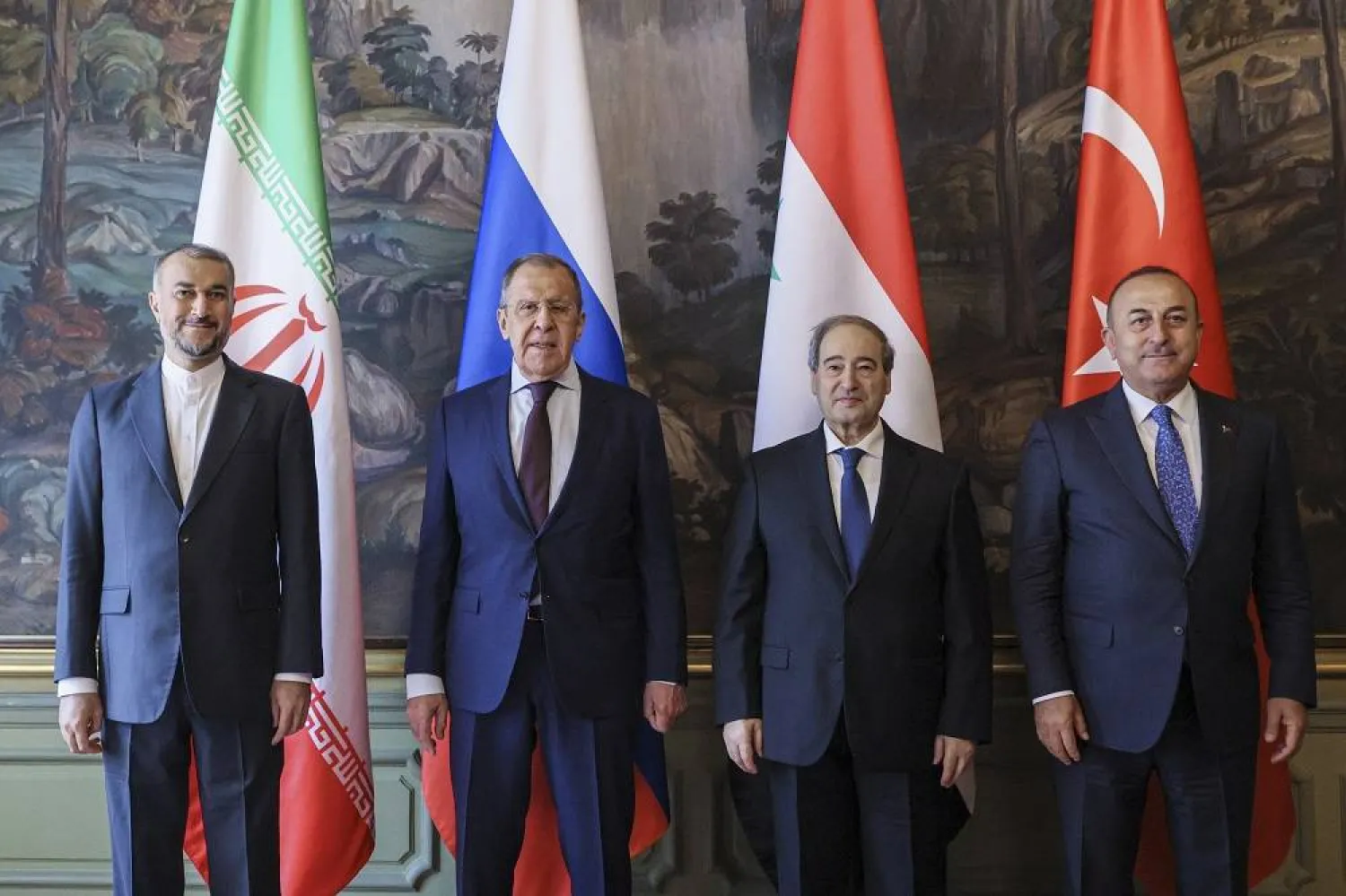
A handout picture made available by Russian Foreign ministry press service shows (L-R) Iranian Foreign Minister Hossein Amir Abdollahian, Russian Foreign Minister Sergei Lavrov, Syrian Foreign Minister Faisal Mekdad and Turkish Foreign Minister Mevlut Cavusoglu posing for a family photo during a meeting in Moscow, Russia, 10 May 2023. (EPA / Russian Foreign ministry press service)
TT

Türkiye and Syria Agree to Improve Ties after Talks in Moscow

A handout picture made available by Russian Foreign ministry press service shows (L-R) Iranian Foreign Minister Hossein Amir Abdollahian, Russian Foreign Minister Sergei Lavrov, Syrian Foreign Minister Faisal Mekdad and Turkish Foreign Minister Mevlut Cavusoglu posing for a family photo during a meeting in Moscow, Russia, 10 May 2023. (EPA / Russian Foreign ministry press service)

Syria and Türkiye agreed Wednesday to set up a “roadmap” to improve strained ties, following talks alongside Russia and Iran in Moscow.

The agreement comes a week after Syria and Arab governments meeting in Jordan agreed to establish a roadmap of their own to resolve Syria's lengthy civil war and bolster ties. Syria has been returning to the Arab fold and slowly restoring ties with its neighbors.

The Arab League also readmitted Syria's membership after a 12-year suspension in the onset of the conflict on Sunday, before Saudi Arabia delivered a formal invitation earlier Wednesday to President Bashar al-Assad to attend the upcoming summit in Jeddah.

Throughout the 12-year conflict, Türkiye has backed armed opposition groups in the country's northwest seeking to remove Assad from power. The Syrian government has frequently denounced Ankara’s hold over parts of a northwest enclave previously seized by Assad’s opponents. Türkiye captured the territory through several military incursions since 2016 against US-backed Kurdish forces.

Russia on the other hand intervened militarily in Syria starting in September 2015, and alongside Iran played a pivotal role in keeping Assad in power and to reclaim much of the country back. Moscow has maintained a military presence in the Mideast country even as the bulk of its forces are busy fighting in Ukraine.

Moscow has spent years trying to help Assad rebuild ties with Türkiye and other countries that were fractured in the war, which has killed nearly 500,000 people and displaced half of Syria’s prewar population of 23 million.

Russia’s foreign minister on Wednesday hosted his counterparts from Türkiye, Syria and Iran for talks that marked the highest-level contact between Ankara and Damascus since the start of the Syrian war over a decade ago.

Talks to establish a plan to improve relations between Türkiye and Syria would be done in coordination with ongoing communication between the four countries' defense ministries.

“The ministers noted the positive and constructive atmosphere of the exchange of views and agreed to continue high-level contacts and technical talks in the quadripartite format in the coming period,” a statement from the Russian Foreign Ministry after the talks read.

The statement added that they called for more international aid to Syria, not only to help the country's struggling population but also “in the interests of voluntary, safe, and dignified” refugee returns and post-war reconstruction.

The efforts toward a Turkish-Syrian reconciliation come as Turkish President Recep Tayyip Erdogan is under intense pressure at home to send Syrian refugees back amid a steep economic downturn and increasing anti-refugee sentiment. He is seeking reelection on Sunday, when Türkiye holds both presidential and parliamentary elections.

Syrian state media quoted Syrian Foreign Minister Faisal Mekdad as saying during Wednesday's meeting that Syria and Türkiye “share goals and common interests.”  

He said that “despite all the negatives over the past years,” Damascus saw the talks as an opportunity “for both governments to cooperate with the help and support of our friends Russia and Iran.”

Yet Mekdad added that the Syrian government’s “main goal” was to end all “illegal” military presences in the country, including that of Turkish forces.

“We will continue to demand and insist on the subject of withdrawal,” he was quoted as saying.

Following a deadly earthquake in February that killed tens of thousands of people in Syria and Türkiye, regional normalization with Damascus began to accelerate.  

In April, Moscow hosted the defense ministers of Türkiye, Syria and Iran for talks that it said focused on “practical steps to strengthen security in the Syrian Arab Republic and to normalize Syrian-Turkish relations.”



Iraq PM Vows to Prevent Attacks After French Soldier Killed

Iraqi Prime Minister Mohammed Shia al-Sudani attends an event in Baghdad, Iraq, Jan. 9, 2024. (Reuters)
TT

Iraq PM Vows to Prevent Attacks After French Soldier Killed

Iraqi Prime Minister Mohammed Shia al-Sudani attends an event in Baghdad, Iraq, Jan. 9, 2024. (Reuters)

Iraq's Prime Minister Mohammed Shia al-Sudani vowed on Friday to prevent attacks after the killing of a French soldier in an attack in the autonomous Kurdistan region.

Sudani expressed his "solidarity" with France in a phone call with French President Emmanuel Macron.

He said that "the necessary measures will be taken to prevent the recurrence of such incidents", and an investigation will be conducted into the attack.

The president of Iraq's Kurdistan region Nechirvan Barzani, in a call with Macron, also expressed his condolences and called for the Iraqi government to "set limits on outlaw groups".


Syria, Lebanon Test Ties Amid Regional Escalation

Lebanese President Joseph Aoun meets with Syrian President Ahmed al-Sharaa during the Arab Summit in Egypt, March 4, 2025 (AP)
TT

Syria, Lebanon Test Ties Amid Regional Escalation

Lebanese President Joseph Aoun meets with Syrian President Ahmed al-Sharaa during the Arab Summit in Egypt, March 4, 2025 (AP)

Before a March 10 phone call between Syrian President Ahmed al-Sharaa and Lebanese President Joseph Aoun to discuss regional developments and their impact on the security and stability of both countries and the wider region, it appeared the two leaders had not been in direct contact since each assumed the presidency a little over a year ago.

In the days before speaking with Aoun, al-Sharaa contacted several Lebanese political figures. On March 6, he spoke with Prime Minister Nawaf Salam and former Progressive Socialist Party leader Walid Jumblatt. On March 8, he called Kataeb Party leader MP Sami Gemayel.

During those calls, al-Sharaa expressed “solidarity with the Lebanese people in these difficult circumstances Lebanon is going through.”

He said the reinforcement of the Syrian military presence along the Syrian-Lebanese border on March 3 was intended solely to strengthen border control and safeguard Syria’s internal security. He described the steps as similar to measures taken along the Syrian-Iraqi border.

The contacts came against the backdrop of war in the region and broader regional developments, and included discussions on the future of Syrian-Lebanese relations. Al-Sharaa stressed the importance of continued coordination between the two countries.

According to the Kataeb Party’s official website, the call between al-Sharaa and Gemayel took place in a positive atmosphere and included discussion of opening a new chapter in bilateral relations.

Al-Sharaa said ties between Syria and Lebanon should rest on “mutual respect between the two states,” alongside stronger economic cooperation and integration that serves the interests of both peoples.

However, the two days following the March 8 call triggered speculation that relations between the two countries were strained because of current and past issues.

Al-Sharaa moved to dispel that speculation with a direct call to Aoun. The following day, French President Emmanuel Macron said he had spoken with both leaders and welcomed the dialogue, saying “the coordination launched by the Lebanese and Syrian leaderships is important” and that France would continue to support it.

Overall, the contacts have raised cautious optimism about neighborly relations at a sensitive moment.

Asharq Al-Awsat asked Syrian analysts how they see relations between the two countries evolving in the near term amid ongoing regional developments.

Foundations of the relationship

Bassam Barabandi, a Syrian analyst and former diplomat based in Washington, said Damascus approaches relations with Lebanon on several foundations.

First is non-interference in Lebanon’s internal politics. Second is border security, particularly preventing Hezbollah from operating inside Syria or transferring weapons through Syrian territory, as well as halting drug smuggling through Syria, which requires direct cooperation with Lebanon.

Third is the issue of Syrians held in Lebanese prisons, which he said is under discussion.

Barabandi said contacts between the two sides, including the call between al-Sharaa and Aoun, produced understandings on several issues, notably mutual non-interference in internal affairs and handling files related to Syrian fugitives in Lebanon and Syrian refugees.

He noted that Lebanon’s political system requires engagement with multiple actors, since the president is only one part of a broader governing structure. Communicating Syrian assurances or positions, therefore, requires outreach to different political leaders.

In that context, al-Sharaa contacted Gemayel to thank him for efforts aimed at accelerating solutions for Syrians detained in Lebanon, and in recognition of his political weight among Christians.

The Syrian president also contacted Jumblatt, Lebanon’s top Druze leader.

Further contacts with other figures could follow if needed, Barabandi said.

He added that the Syrian government supports steps taken by the Lebanese government regarding Hezbollah, particularly efforts related to disarming the group.

Expanding dialogue

Jumaa Mohammed Laheeb, director of research and studies at the Syrian Future Movement, said the current dynamic between Damascus and Beirut reflects a dual reality: relatively advanced security and political coordination alongside political uncertainty.

That uncertainty is most evident in sensitive files, particularly those related to detainees, he said. In that context, al-Sharaa’s call with Salam can be understood.

Laheeb said the call and Syria’s expression of support for Lebanon amid the regional escalation focused on two main issues: border control and reassuring the Lebanese government that Syrian military deployments aim to strengthen control within Syrian territory rather than stoke tensions in Lebanon.

Such communication reflects effective operational channels between the two governments, particularly after understandings reached in recent years on smuggling and border crossings. But those channels alone cannot resolve politically and historically sensitive files such as detainees and the missing, he said.

Laheeb said the Lebanese presidency sits at the center of complex domestic balances involving Hezbollah’s influence, as well as Christian, Sunni and Druze segments.

Al-Sharaa’s initial reluctance to call Aoun directly — while opening communication with figures such as Jumblatt and Gemayel — reflects a Syrian effort to broaden the range of Lebanese actors it engages with.

Damascus appears to be seeking greater regional legitimacy by opening dialogue with forces opposed to Hezbollah’s dominance, he said. But key decisions on issues such as detainees, refugees and border security still pass through domestic circles in which Hezbollah retains considerable influence.

The detainee file, he said, remains a bargaining chip rather than a purely humanitarian priority, leading to delays and partial solutions rather than a comprehensive settlement.

Testing relations with Damascus

Syrian researcher Ahmad Abazid said Damascus does not want to become involved in the current war or intervene militarily against Hezbollah. However, he said the Syrian government has, from the outset, made support for the Lebanese state a cornerstone of its relationship with Lebanon, alongside what he described as genuine hostility toward Hezbollah.

For that reason, he said, it is natural for Damascus to support Aoun’s initiative to disarm the group.

At the same time, Abazid argued Hezbollah would be the weaker side in any confrontation with the new Syrian army. The history of relations between the group and Syrian opposition would likely push many fighters to confront Hezbollah if such a battle emerged, he said.

He also pointed to rising tensions. Hezbollah said Syrian territory had been used as the launch point for a second Israeli operation in the Lebanese town of Nabi Sheet in the Bekaa Valley. Shortly afterward, the Syrian army said Hezbollah had fired artillery shells at the Sarghaya region in western Syria.

Abazid said the escalation could reflect two possible dynamics. One is an Iranian attempt to spread instability across the region during the current war to increase pressure on all sides, particularly Arab states.

The other is that Hezbollah feels threatened by the Syrian side, especially as Lebanese actors have refrained from launching military initiatives against the group and after remarks by US envoy Tom Barrack suggesting possible Syrian intervention in Lebanon.


Iraq PM Vows to Prevent Attacks After French Soldier Killed

Iraqi Prime Minister Mohammed Shia al-Sudani attends an event in Baghdad, Iraq, Jan. 9, 2024. (Reuters)
TT

Iraq PM Vows to Prevent Attacks After French Soldier Killed

Iraqi Prime Minister Mohammed Shia al-Sudani attends an event in Baghdad, Iraq, Jan. 9, 2024. (Reuters)

Iraq's Prime Minister Mohammed Shia al-Sudani vowed on Friday to prevent attacks after the killing of a French soldier in an attack in the autonomous Kurdistan region.

Sudani expressed his "solidarity" with France in a phone call with French President Emmanuel Macron.

He said that "the necessary measures will be taken to prevent the recurrence of such incidents", and an investigation will be conducted into the attack.

The president of Iraq's Kurdistan region Nechirvan Barzani, in a call with Macron, also expressed his condolences and called for the Iraqi government to "set limits on outlaw groups".