

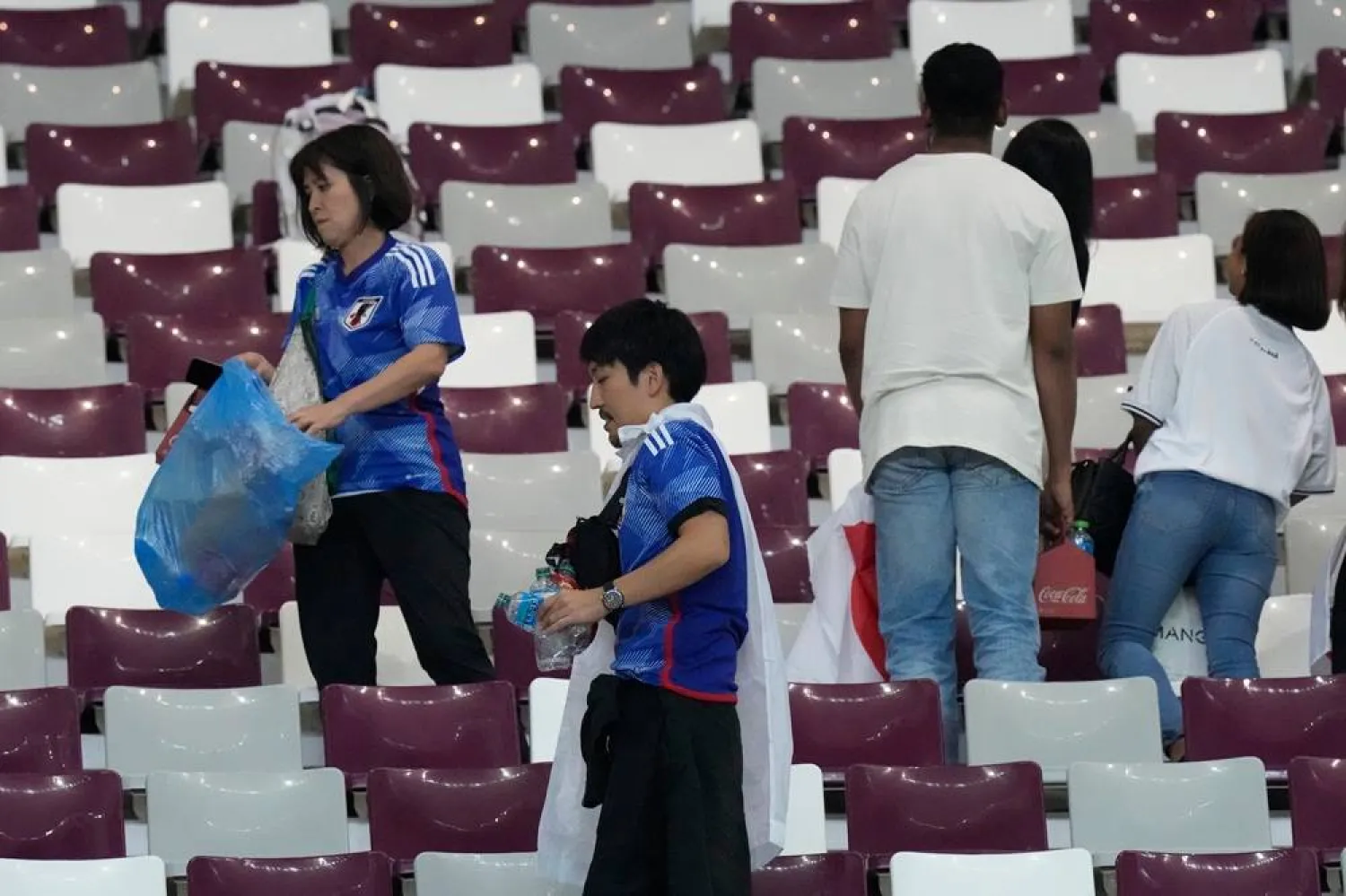

A Bird Leaves Nothing Behind: The Lesson Behind Japan’s World Cup Stadium Cleanups

Japan supporters clean the stands at the end of the World Cup group E football match between Germany and Japan, at the Khalifa International Stadium in Doha, Qatar, Wednesday, Nov. 23, 2022. (AP)
TT

A Bird Leaves Nothing Behind: The Lesson Behind Japan’s World Cup Stadium Cleanups

Japan supporters clean the stands at the end of the World Cup group E football match between Germany and Japan, at the Khalifa International Stadium in Doha, Qatar, Wednesday, Nov. 23, 2022. (AP)

If there's one country guaranteed to clean up at the World Cup, it's Japan.

Literally.

Scenes of Japanese football fans sweeping stadiums and picking up trash after a match first drew public attention in France in 1998 — Japan's first appearance in the World Cup.

The tradition has continued every four years. It happened at the World Cup in Qatar in 2022, and it's certain to continue when Japan opens play in June with group games in Arlington, Texas, and Monterrey, Mexico.

The cleanup astonishes non-Japanese who might be accustomed to leaving stadiums and stepping over half-eaten food, shredded paper wrappers, and cups — empty or with liquid dribbling out.

At the World Cup in Russia in 2018, Japanese players famously cleaned the dressing room after a loss and left a thank-you note in Russian. In 2022, fans left thank-you notes on rubbish bags written in Arabic, English and Japanese.

Why do Japanese behave this way? It's not that complicated. Beginning in elementary school, students are socialized to behave this way — in the classroom, in the school yard or on a playing field.

“Japanese sports fans at world events who clean up the stadium are behaving much the same way they did when they learned how to enjoy sports as school boys and girls,” Koichi Nakano, who teaches politics and history at Sophia University, told The Associated Press.

There is a phrase in Japanese that explains it.

“Tatsu tori ato wo nigosazu.”

The literal translation is: “A bird leaves nothing behind.”

Rendered in English the message is: “Return it the way you found it.”

Many Japanese elementary schools don’t have janitors, so the clean-up work is left to students. Office workers often dedicate time to sprucing up their areas.

Also, there are relatively few trash containers in public spaces in Japan, so people take their waste home with them. This keeps the sidewalks cleaner, saves the cost of emptying trash cans, and keeps away vermin.

“The way most ordinary soccer fans experience soccer at school is no different from other sports, and the emphasis is not just on physical education but also on moral education as well,” Nakano added.

Collective vs. the individual

Raised in Germany, Barbara Holthus is the deputy director of the German Institute for Japanese Studies in Tokyo. A sociologist, she agrees it's prudent not to put Japanese on a pedestal. Japan, like any country, has its own challenges and shortcomings.

“An academically sound explanation is that people in Japan just happen to be socialized different,” she told The AP. “If you grew up with a certain way of how things are being done, you apply that to even cleaning up a stadium afterwards.”

At work here is also the Japanese concept of “meiwaku,” which implies not causing trouble or annoying others. From the Japanese point of view, leaving rubbish piled up in a stadium would be a bother to others.

Japan is a relatively crowded place, and greater Tokyo alone has about 35 million people, almost the population of the entire state of California. People need to get along.

“Japanese learn early on that you don't want to inconvenience other people,” Holthus said.

She said the focus is often on the collective, compared with the West where the emphasis is on the individual and individual rights.

“You don’t want to bother people. It goes to all areas of life in Japan,” Holthus added. “We are raised (in the West) that we don’t have to clean up after ourselves in public spaces because there is going to be some kind of public service doing that.”

And because Japanese people have received widespread praise for the clean-up, the behavior has been reinforced.

“Now that the media has latched onto the story and lavished praise on Japanese fans, they have made it a point of pride to display those values and norms,” Jeff Kingston, who teaches history at Temple University in Japan, wrote in an email.

A Japanese tradition

The clean-up tradition is not limited to football’s marquee tournament. The same thing happened last year at the Under-20 World Cup in Chile as Japanese fans cleaned up after a match. And even more recently last month at Wembley Stadium in London where Japan defeated England 1-0 in an international friendly.

“It’s one of our traditions,” said Toshi Yoshizawa, who was leading the cleanup in Chile. “We grew up with the teaching that we should leave a place cleaner than when we arrived.”

William Kelly, an emeritus professor of anthropology at Yale University and a specialist on Japan, said the tradition is linked to football more than other sports. He speculated it's tied to the establishment of Japan's professional football league more than 30 years ago.

“It (the J-League) was trying to distinguish itself from baseball by emphasizing teams’ community embeddedness and commitment,” Kelly wrote in an email. “Soccer fans felt, and feel, more a part of the club and its stadium.”



Morocco ‘Unstoppable’ Says Coach After Netherlands Thriller

Football - FIFA World Cup 2026 - Round of 32 - Netherlands v Morocco - Estadio Monterrey, Monterrey, Mexico - June 29, 2026 Morocco coach Mohamed Ouahbi and Bilal El Khannouss celebrate after the match as Morocco qualify for the round of 16 stage of the World Cup. (Reuters)
TT

Morocco ‘Unstoppable’ Says Coach After Netherlands Thriller

Football - FIFA World Cup 2026 - Round of 32 - Netherlands v Morocco - Estadio Monterrey, Monterrey, Mexico - June 29, 2026 Morocco coach Mohamed Ouahbi and Bilal El Khannouss celebrate after the match as Morocco qualify for the round of 16 stage of the World Cup. (Reuters)

Morocco coach Mohamed Ouahbi believes his team is primed to make a deep run at the World Cup, declaring that the Atlas Lions could be "unstoppable" if they play to their potential.

The Moroccans, beaten semi-finalists at the 2022 World Cup, advanced to the last 16 on Monday after winning a thrilling battle with the Netherlands on penalties in Monterrey.

It was another stylish display by the African champions, who dominated for long periods in a match that finished 1-1 after extra-time.

Ouahbi said Moroccan football is now reaping the benefits of the 2022 team's groundbreaking exploits in becoming the first African team to reach the World Cup semi-finals.

"The World Cup in Qatar changed the mentality of the Morocco team, and I'm well placed to speak about this," said Ouahbi, who last year coached Morocco to a momentous victory at the Under-20 World Cup in Chile.

Morocco forward #09 Soufiane Rahimi celebrates with fans after winning in the shootout during the 2026 World Cup round of 32 football match between the Netherlands and Morocco at the Monterrey Stadium in Guadalupe on June 29, 2026. (AFP)

"Moroccan players in Morocco believe in themselves, the supporters, the fans believe in us as well. It's so important. They're demanding, but it's because they know just how far we can go," he said.

Morocco face co-hosts Canada in the last 16, with a potential quarter-final meeting with France looming on the horizon.

Ouahbi said there would be no question of complacency against Canada.

"We know that it's game after game, and people think that it's kept to be easy for us, it's going to be a walk in the park for Morocco, which is not the case. Canada is a team that is going to be difficult for us."

But Ouahbi said Morocco could go even further than the 2022 team if they fired on all cylinders.

"What we need to be telling ourselves is no one can stop us," he said. "We're unstoppable if we play the football that we know how to play.

The Moroccan team starts to celebrate after winning on penalty kicks the World Cup round of 32 soccer match between the Netherlands and Morocco in Guadalupe, near Monterrey, Mexico, Monday, June 29, 2026. (AP)

"But nobody is unbeatable. And I tell my guys that as well. If we get things wrong, we'll go home, and we need to ensure that we have all the tools that we're using, the tools in our arsenal to go as far as we can, and that's the mentality that we want all of our players in Morocco to have."

Netherlands coach Ronald Koeman meanwhile said Morocco's emergence reflected the quality of African football.

"It's very clear watching this World Cup that African teams have greatly improved in tactical sense, and also in the way they play their matches," Koeman said.

"Morocco is the country that, in terms of talents, really generates good players, young players that continue to join the major clubs in Europe. It's not without a reason why they have a higher ranking than the Netherlands."


Coach: Paraguay's Players Are Now Legends after Shootout Win over Germany

Paraguay's head coach Gustavo Alfaro celebrates with his players after winning the FIFA World Cup 2026 Round of 32 match Germany against Paraguay, in Boston, Massachusetts, USA, 29 June 2026.  EPA/GREG COOPER
Paraguay's head coach Gustavo Alfaro celebrates with his players after winning the FIFA World Cup 2026 Round of 32 match Germany against Paraguay, in Boston, Massachusetts, USA, 29 June 2026. EPA/GREG COOPER
TT

Coach: Paraguay's Players Are Now Legends after Shootout Win over Germany

Paraguay's head coach Gustavo Alfaro celebrates with his players after winning the FIFA World Cup 2026 Round of 32 match Germany against Paraguay, in Boston, Massachusetts, USA, 29 June 2026.  EPA/GREG COOPER
Paraguay's head coach Gustavo Alfaro celebrates with his players after winning the FIFA World Cup 2026 Round of 32 match Germany against Paraguay, in Boston, Massachusetts, USA, 29 June 2026. EPA/GREG COOPER

Paraguay's players have turned themselves into football legends by defeating Germany in the World Cup on Monday, coach Gustavo Alfaro said.

"We never believe that we are beaten," Alfaro told reporters after his team's penalty shootout victory. "Twenty-six warriors went out there and they came back as legends."

The Argentine coach had come under criticism after Paraguay lost their opener 4-1 to co-hosts the United States, and scored only one more goal in their other two group matches.

However, they squeezed into the ⁠knockout rounds and ⁠then stunned Germany 4-3 on penalties after the teams were tied 1-1 over 120 minutes, handing the four-time champions their first-ever World Cup shootout defeat.

Alfaro said the heavy defeat by the United States had paved the way for Monday's historic win.

"If we had not learned from ⁠the loss, we would not have been prepared for this match," Reuters quoted him as saying. "I told the players that we have lived through an epic evening."

Paraguay opened the scoring against the run of play in the 42nd minute with a Julio Enciso header before Kai Havertz equalized in the 54th minute.

The South Americans then dug in, surviving a disallowed German goal and hanging on for penalties.

Jose Canale hammered home the winning kick, but only after two of ⁠his teammates ⁠failed to convert theirs.

"As things always are with us, we don't do things without suffering," Alfaro said, adding a special tribute for Canale whose professional career has been marked by loan spells with clubs in Paraguay, Argentina and Mexico.

"Canale is one of life's champions because he has had to go through a lot of adversity," Alfaro said. "A night like this is one of the gifts that life can give you. It's divine justice."

Paraguay will face either France or Sweden in the round of 16 on July 4.


Shootout Win Sends Morocco Past Netherlands, Into Matchup vs. Canada

Morocco's Ismael Saibari (11) reacts after scoring the winning penalty during the World Cup round of 32 soccer match between the Netherlands and Morocco in Guadalupe, near Monterrey, Mexico, Monday, June 29, 2026. (AP Photo/Ricardo Mazalan)
TT

Shootout Win Sends Morocco Past Netherlands, Into Matchup vs. Canada

Morocco's Ismael Saibari (11) reacts after scoring the winning penalty during the World Cup round of 32 soccer match between the Netherlands and Morocco in Guadalupe, near Monterrey, Mexico, Monday, June 29, 2026. (AP Photo/Ricardo Mazalan)

Ismael Saibari scored in the fifth round of a penalty shootout and Morocco remained alive at the World Cup following a 1-1 draw with the Netherlands in the round of 32 on Monday at Guadalupe, Mexico.

Saibari's kick into the left side of the goal gave Morocco a 3-2 victory in the shootout and set up a round of 16 match against Canada on Saturday at Houston, Reuters reported.

Morocco trailed 1-0 and was minutes from elimination before 6-foot-4 defender Issa Diop scored on a header off a long cross from Chemsdine Talbi just seconds after the clock reached the 90-minute mark. Diop tallied his first international goal after ⁠switching his allegiance ⁠to Morocco from France earlier this year.

Yassine Bounou made one save for Morocco over the 120 minutes of regulation time.

However, his biggest stop of the night came in the fifth round of the shootout when he used his left hand to stop a shot toward the top of the goal from Crysencio Summerville.

Soufiane ⁠Rahimi and Talbi also scored for Morocco in the penalty shootout. Justin Kluivert, Quinten Timber and Summerville all missed from the spot for the Netherlands.

The Dutch had reached the round of 16 each of the previous 11 times they competed at the World Cup.

Cody Gakpo scored from near the penalty spot in the 72nd minute to give the Netherlands a late lead. Bart Verbruggen had four saves for the Dutch in regulation but guessed wrong and dived to his left on Saibari's decisive shot.

Morocco took 11 ⁠shots in ⁠the 120 minutes, while the Netherlands had six. The African side had a 5-2 edge in attempts on target.

In a duel of two top-10 teams in the FIFA world rankings, the seventh-ranked Netherlands finally broke through when Gakpo scored off a spinning pass from Summerville while on the turf.

Gakpo went to his knees and buried his head into the ground in a solemn celebration just days after announcing that he and his partner lost their unborn child.

Sixth-ranked Morocco advanced after they were the runner-up in Group C. They advanced to the semifinals of the 2022 World Cup in Qatar. The Netherlands were eliminated after they were the winner of Group F.