


Arab Summits... A History of Decisions and Transformations

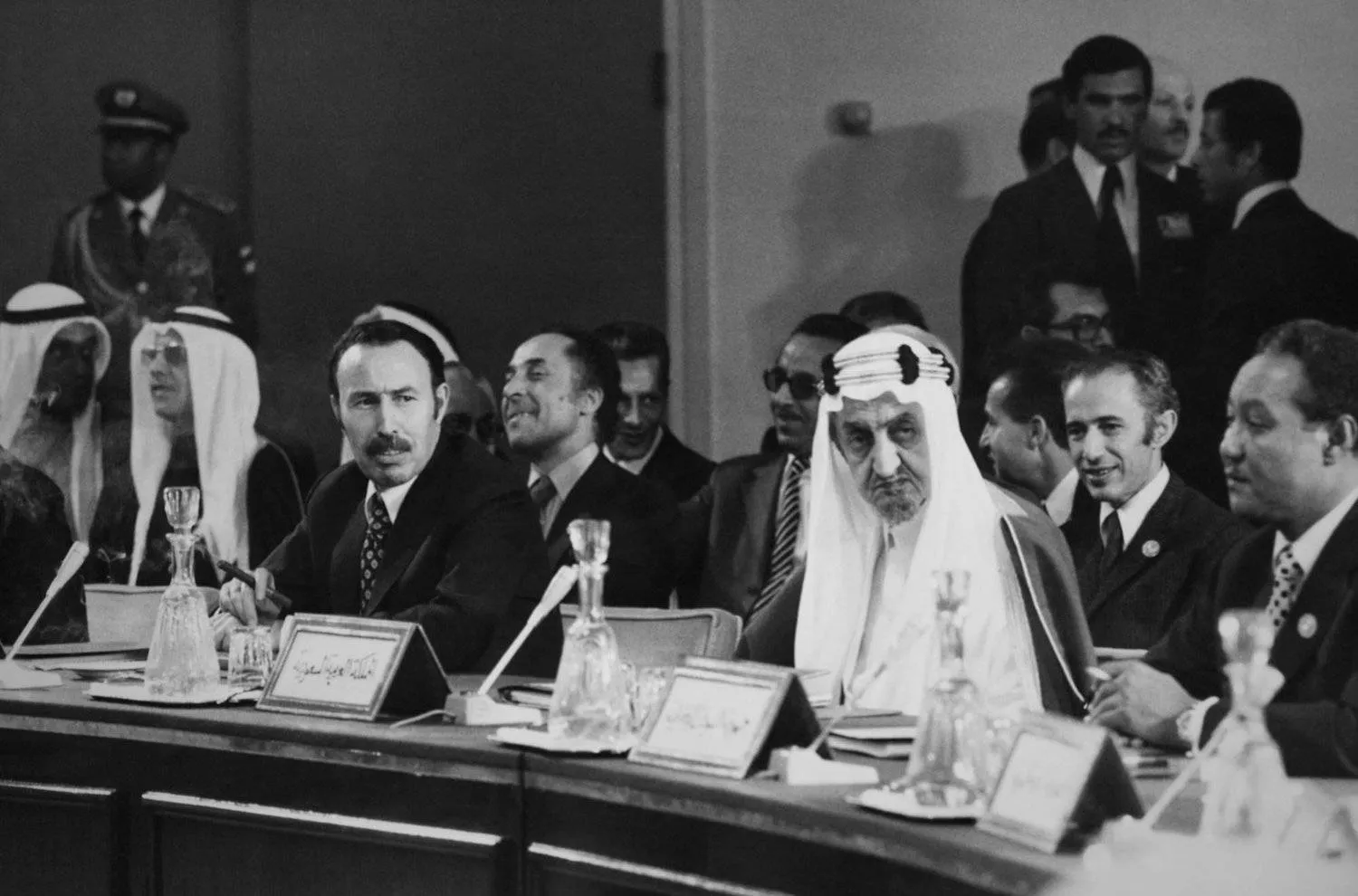
King Faisal and Algerian President Houari Boumediene at the Arab League’s 1974 summit in Rabat, Morocco (Getty Images)
TT

Arab Summits... A History of Decisions and Transformations

King Faisal and Algerian President Houari Boumediene at the Arab League’s 1974 summit in Rabat, Morocco (Getty Images)

Over eight decades, Arab League leaders have convened 46 summits, including 31 regular and 15 emergency sessions, as well as 4 Arab economic development summits. These gatherings have involved extensive consultations, deliberations, and transformations, leaving a lasting impact on Arab collective action, while some have become forgotten in Arab memory.

Ahmed Youssef Ahmed, Professor of Political Science and former Dean of the Arab Research Institute affiliated with the Arab League, highlights the Cairo Summit of 1964 as one of the most influential Arab summits in shaping the Arab landscape.

At that time, unprecedented Arab-Arab conflicts prevailed. There was Arab resentment against the Iraqi regime’s policies seeking to annex Kuwait, as well as tension between Egypt and Syria following their separation in 1961.

Moreover, Egyptian-Saudi differences emerged against the backdrop of the Yemeni revolution, along with armed clashes between Algeria and Morocco due to border disputes. Concurrently, Israel accelerated its projects to divert the course of the Jordan River.

In an interview with Asharq Al-Awsat, Ahmed emphasized that during the summit, Arab chiefs of staff acknowledged their incapacity to address Israeli projects at that time. As a result, an emergency summit was called, with the participation of all Arab leaders except the King of Libya, who delegated his crown prince to attend.

The summit established alternative Arab projects against Israeli initiatives, promoted harmony among Arab nations, formed a unified Arab military leadership, and laid the foundation for the Palestinian Liberation Organization (PLO) as the legitimate representative of the Palestinian people.

While Arab summits continued to convene annually, the Arab memory may hold a special recollection of the Khartoum Summit in August 1967, known as the “Three Noes” summit. The three noes of Khartoum stood for: “No peace with Israel, no negotiation with Israel, no recognition of Israel.”

Ahmed recalled the accompanying atmosphere of that summit, noting that it took place at a crucial time following the “devastating defeat” of Arab armies in June 1967. He highlights that the summit witnessed an Egyptian-Saudi agreement on resolving the conflict in Yemen.

At the summit, Saudi Arabia, Libya, and Kuwait offered substantial financial support to the countries confronting Israel, a decision regarded by Ahmed as a pivotal moment for Arab national security.

The summit witnessed a fading of Arab contradictions as the shared objective of mitigating the consequences of aggression took center stage. It is worth noting that the primary supporters of the confronting countries were monarchies, which had previously been perceived as contradictory to countries like Egypt and Syria.

After three years, the Arab world witnessed the “fastest Arab summit in history,” according to Ahmed.

The Cairo Summit, held in September 1970, swiftly convened within 24 hours amid perilous circumstances arising from the clash between Jordanian authorities and Palestinian resistance. This summit established a red line prohibiting Arab states from clashing with the resistance, leading to a ceasefire agreement and concluding with the departure of Egyptian President Gamal Abdel Nasser.

Another noteworthy summit is the Sirte Summit, hosted by Colonel Muammar Gaddafi in 2010, just a year before his ousting. Furthermore, the 2015 Sharm El-Sheikh Summit saw Arab endorsement of the “Decisive Storm” campaign led by Saudi Arabia in Yemen, which, as stated by Ahmed, “halted Iranian expansion in Yemen.”

The Makkah Summit, held in May 2019, was the latest exceptional Arab summit addressing Iranian intervention. Prompted by attacks on commercial vessels in UAE waters and Houthi attacks on Saudi oil pumping stations, the summit affirmed Arab solidarity against Iranian interventions. It condemned Iran’s interference in Bahrain, its impact on Syria’s unity, its occupation of Emirati islands, and its support for terrorist groups.

Following a hiatus due to the COVID-19 pandemic, Arab summits resumed in 2022 with a “Reconciliation” themed summit in Algeria. Although previous discussions sought to restore Syria’s membership in the Arab League, it was not accomplished at that time. The objective of “Reconciliation” was postponed to the current summit in Jeddah, which will mark the first fully attended Arab summit in 12 years.



Israeli Reservist Rams Vehicle into Palestinian Man Praying in West Bank

Israeli security forces secure a street as they leave the Palestinian village of Bizariya, in the occupied West Bank, where Israeli authorities demolished the house of a Palestinian man killed in July after he and another man reportedly killed an Israeli settler on the same day, on December 24, 2025. (AFP)
TT

Israeli Reservist Rams Vehicle into Palestinian Man Praying in West Bank

Israeli security forces secure a street as they leave the Palestinian village of Bizariya, in the occupied West Bank, where Israeli authorities demolished the house of a Palestinian man killed in July after he and another man reportedly killed an Israeli settler on the same day, on December 24, 2025. (AFP)

An Israeli reservist soldier rammed his vehicle into a Palestinian man as he prayed on a roadside in ​the occupied West Bank on Thursday, after earlier firing shots in the area, the Israeli military said.

"Footage was received of an armed individual running over a Palestinian individual," it said in a statement, adding the individual was a reservist ‌and his ‌military service had ‌been terminated.

The ⁠reservist ​acted "in severe ‌violation of his authority" and his weapon had been confiscated, the military said.

Israeli media reported that he was being held under house arrest.

The Israeli police did not immediately respond to a Reuters request for comment.

The ⁠Palestinian man went to hospital for checks after ‌the attack, but was unhurt ‍and is now ‍at home.

Video which aired on Palestinian ‍TV shows a man in civilian clothing with a gun slung over his shoulder driving an off-road vehicle into a man praying on ​the side of the road.

This year ​was one of the most violent on ⁠record for Israeli civilian attacks against Palestinians in the West Bank, according to United Nations data that shows more than 750 injuries.

More than a thousand Palestinians were killed in the West Bank between October 7, 2023 and October 17, 2025, mostly in operations by security forces and some by settler violence, according to the UN In ‌the same period, 57 Israelis were killed in Palestinian attacks.


Deadly Blast Hits Mosque in Syria’s Homs, Saraya Ansar al-Sunna Claims Responsibility

Syrian security forces stand inside a damaged mosque after several people were killed in an explosion at a mosque as the Syrian Arab News Agency (SANA) said, in Homs, Syria December 26, 2025. REUTERS/Ali Ahmed al-Najjar
TT

Deadly Blast Hits Mosque in Syria’s Homs, Saraya Ansar al-Sunna Claims Responsibility

Syrian security forces stand inside a damaged mosque after several people were killed in an explosion at a mosque as the Syrian Arab News Agency (SANA) said, in Homs, Syria December 26, 2025. REUTERS/Ali Ahmed al-Najjar

A bombing at a mosque in Syria during Friday prayers killed at least eight people and wounded 18 others, authorities said.

Images released by Syria’s state-run Arab News Agency showed blood on the mosque’s carpets, holes in the walls, shattered windows and fire damage. The Imam Ali bin Abi Talib Mosque is located in Homs, Syria's third-largest city.

SANA, citing a security source, said that preliminary investigations indicate that explosive devices were planted inside the mosque. Authorities were searching for the perpetrators, who have not yet been identified, and a security cordon was placed around the building, Syria’s Interior Ministry said in a statement.

In a statement on Telegram, the Saraya Ansar al-Sunna said its fighters "detonated a number of explosive devices" in the mosque.

The same group had previously claimed a suicide attack in June in which a gunman opened fire and then detonated an explosive vest inside a Greek Orthodox church in Dweil’a, on the outskirts of Damascus, killing 25 people as worshippers prayed on a Sunday.

Several countries, including Saudi Arabia, Jordan and Lebanon, condemned the attack. 


Fuel Shortage Forces Gaza Hospital to Suspend Most Services

The sun sets behind a makeshift tent camp for displaced Palestinians set up in an area of al-Bureij camp, in the central Gaza Strip, Wednesday, Dec. 24, 2025. (AP)
TT

Fuel Shortage Forces Gaza Hospital to Suspend Most Services

The sun sets behind a makeshift tent camp for displaced Palestinians set up in an area of al-Bureij camp, in the central Gaza Strip, Wednesday, Dec. 24, 2025. (AP)

A major Gaza hospital has suspended several services because of a critical fuel shortage in the devastated Palestinian territory, which continues to face a severe humanitarian crisis, it said.

Devastated by more than two years of war, the Al-Awda Hospital in the central Gaza district of Nuseirat cares for around 60 in-patients and receives nearly 1,000 people seeking medical treatment each day.

"Most services have been temporarily stopped due to a shortage of the fuel needed for the generators," said Ahmed Mehanna, a senior official involved in managing the hospital.

"Only essential departments remain operational: the emergency unit, maternity ward and pediatrics."

To keep these services running, the hospital has been forced to rent a small generator, he added.

Under normal conditions, Al-Awda Hospital consumes between 1,000 and 1,200 liters of diesel per day. At present, however, it has only 800 liters available.

"We stress that this shutdown is temporary and linked to the availability of fuel," Mehanna said, warning that a prolonged fuel shortage "would pose a direct threat to the hospital's ability to deliver basic services".

He urged local and international organizations to intervene swiftly to ensure a steady supply of fuel.

Despite a fragile truce observed since October 10, the Gaza Strip remains engulfed in a severe humanitarian crisis.

While the ceasefire agreement stipulated the entry of 600 aid trucks per day into Gaza, only 100 to 300 carrying humanitarian assistance can currently enter, according to the United Nations and non-governmental organizations.

The remaining convoys largely transport commercial goods that remain inaccessible to most of Gaza's 2.2 million people.

- Health hard hit -

On a daily basis, the vast majority of Gaza's residents rely on aid from UN agencies and international NGOs for survival.

Gaza's health sector has been among the hardest hit by the war.

During the fighting, the Israeli miliary repeatedly struck hospitals and medical centers across Gaza, accusing Hamas of operating command centers there, an allegation the group denied.

International medical charity Doctors Without Borders now manages roughly one-third of Gaza's 2,300 hospital beds, while all five stabilization centers for children suffering from severe malnutrition are supported by international NGOs.

The war in Gaza was sparked on October 7, 2023, following an unprecedented Hamas attack on Israel that resulted in the deaths of 1,221 people, most of them civilians, according to an AFP tally based on official Israeli figures.

In Israel's ensuing military campaign in Gaza, at least 70,942 people - also mostly civilians - have been killed, according to the health ministry in the Hamas-run territory.