Perhaps all that remains of the Oslo Accords, signed 33 years ago between the Palestinians and Israelis, is an authority without real authority in the West Bank, widespread chaos, destruction and bloodshed in the Gaza Strip, and an East Jerusalem resembling West Jerusalem, both under full Israeli control.
All three — the West Bank, Gaza and East Jerusalem — were supposed to constitute the Palestinian state just five years after the agreement was signed in 1993, or so Palestinians believed and hoped at the time.
Yet Oslo’s main problem cannot simply be considered its failure to deliver the hoped-for state. Since it was signed, the Palestinian Authority’s ability to govern has declined, while the territory under its control has shrunk day by day.
The PA’s role has changed considerably. Israeli governments have left it besieged, powerless and nearly bankrupt, facing numerous financial and security problems and countless internal problems affecting it and all Palestinians — in politics, security, public safety, salaries, health, the economy, electricity, water, fuel and the banking system.
Today, 33 years after the agreement, Palestinians find themselves in a central struggle to prevent the liquidation of the Palestinian cause and their displacement from their land. After Oslo, their struggle had been to establish a state.
All the blame can be placed on Oslo, its course and the decision to pursue it, as many Palestinians do. But its other party cannot be overlooked: Israel, which did not sign the agreement for it to succeed. This was precisely what then-Israeli Prime Minister Yitzhak Shamir had promised: negotiations that would begin but never end, until nothing remained to negotiate over.
Nor can it be overlooked that a large segment of Palestinians themselves did not want the agreement either. Armed factions worked relentlessly to thwart it to the end, using all the power and weapons at their disposal.
Many on both sides regarded it as a dagger in their side and openly said they did not want it. In reality, it gave them neither peace nor security. Yet it has remained alive, refusing to die, even after Hamas launched the Al-Aqsa Flood attack in October 2023, sweeping away many things but not what remained of Oslo.
What is the Oslo agreement?
The Declaration of Principles on Interim Self-Government Arrangements was signed on Sept. 13, 1993. It provided for the phased withdrawal of Israeli forces from the West Bank and Gaza Strip and the establishment of a Palestinian Interim Self-Government Authority during a five-year transitional period, culminating in a permanent settlement based on UN Security Council Resolutions 242 and 338.
The agreement spoke of ending “decades of confrontation and conflict” and recognizing each side’s “mutual legitimate and political rights.”
The agreement clearly addressed the transitional period and permanent-status negotiations. The five-year transitional period was to begin with the withdrawal from the Gaza Strip and Jericho area. Permanent-status negotiations between the Israeli government and representatives of the Palestinian people were to begin as soon as possible, but no later than the beginning of the third year of the transitional period.
It also stipulated that those negotiations would cover the remaining issues, including Jerusalem, refugees, settlements, security arrangements, borders, relations and cooperation with other neighbors, and other matters of common interest.
The agreement also resulted in the establishment of a Joint Israeli-Palestinian Liaison Committee to address issues requiring coordination, other matters of common interest and disputes.
The Oslo agreement divides the West Bank into Areas A, B and C. Area A includes the main Palestinian population centers and is under Palestinian security and administrative control, comprising 18% of the West Bank. Area B, comprising 21%, is under Palestinian administrative control and Israeli security control. Area C, comprising 61%, is under Israeli security and administrative control.
After October 2023, Israel no longer recognized these divisions.
What happened after Oslo?
A few years after the signing, Israel stopped completing the scheduled withdrawal of its forces. Instead, it repeatedly entered Area A, territory under full Palestinian security jurisdiction, and took measures that disrupted the transitional phase intended to achieve independence.
Israel carried out assassinations and killings, raided Area A, built more settlements and tightened political, security and economic pressure on the PA as though Oslo did not exist, while demanding greater security coordination from the PA under the agreement.
Israelis who opposed Oslo did not formally abolish it. They wanted it in intensive care — neither alive nor dead. Palestinians did not like Oslo either, but struggled to keep it alive even though they repeatedly declared it finished.
The Palestinians could not rid themselves of it because they simply could not maintain the PA without Oslo. That would mean a return to occupation — a thousand steps backward. For the Israelis, declaring themselves free of Oslo would mean dissolving the PA and returning to the occupation of the West Bank, the last outcome they wanted.
In short, everyone despised Oslo, but they wanted it. It continued to constrain them and produce further agreements.
Oslo’s extensions
It can be said that for many years, Palestinians and Israelis found themselves tied to Oslo. In an effort to keep it alive, the Palestinians concluded further agreements with Israel that could be described as extensions of Oslo.
Israel did not abide by any agreement it signed. Instead, it brought the PA to an unprecedented level of weakness after significantly changing its role. The PA entered one of the worst periods in its history, with the territory under its control shrinking, no political or economic horizon, a crippling financial crisis and another security crisis.
The Israeli left-wing group Peace Now has said that the Oslo agreement contributed significantly to increasing the number of settlements and settlers in the Palestinian territories.
Whether this amounted to marking time or moving backward, it was the reality Israel wanted, and it continued until the Al-Aqsa Flood war that began on Oct. 7, 2023.
After the war, everything changed. Israel began what resembled a war against the PA, the Palestinians and the dream of statehood. Israel appeared to want to reverse Oslo altogether and erase it, and no longer wanted the Palestinians or an agreement binding it to them.
Oslo, Netanyahu and Oct. 7
Israeli Prime Minister Benjamin Netanyahu has made no secret of his opposition to Oslo. Months into the Gaza war, Netanyahu called the Oslo agreement Israel’s great mistake, claiming that “the Palestinian Authority in the West Bank and Hamas in Gaza want to destroy Israel. One side says so openly, while the other does so through education and the International Criminal Court.”
Netanyahu’s attack on the PA was not new, but it was the clearest in revealing part of his plan to undermine the authority.
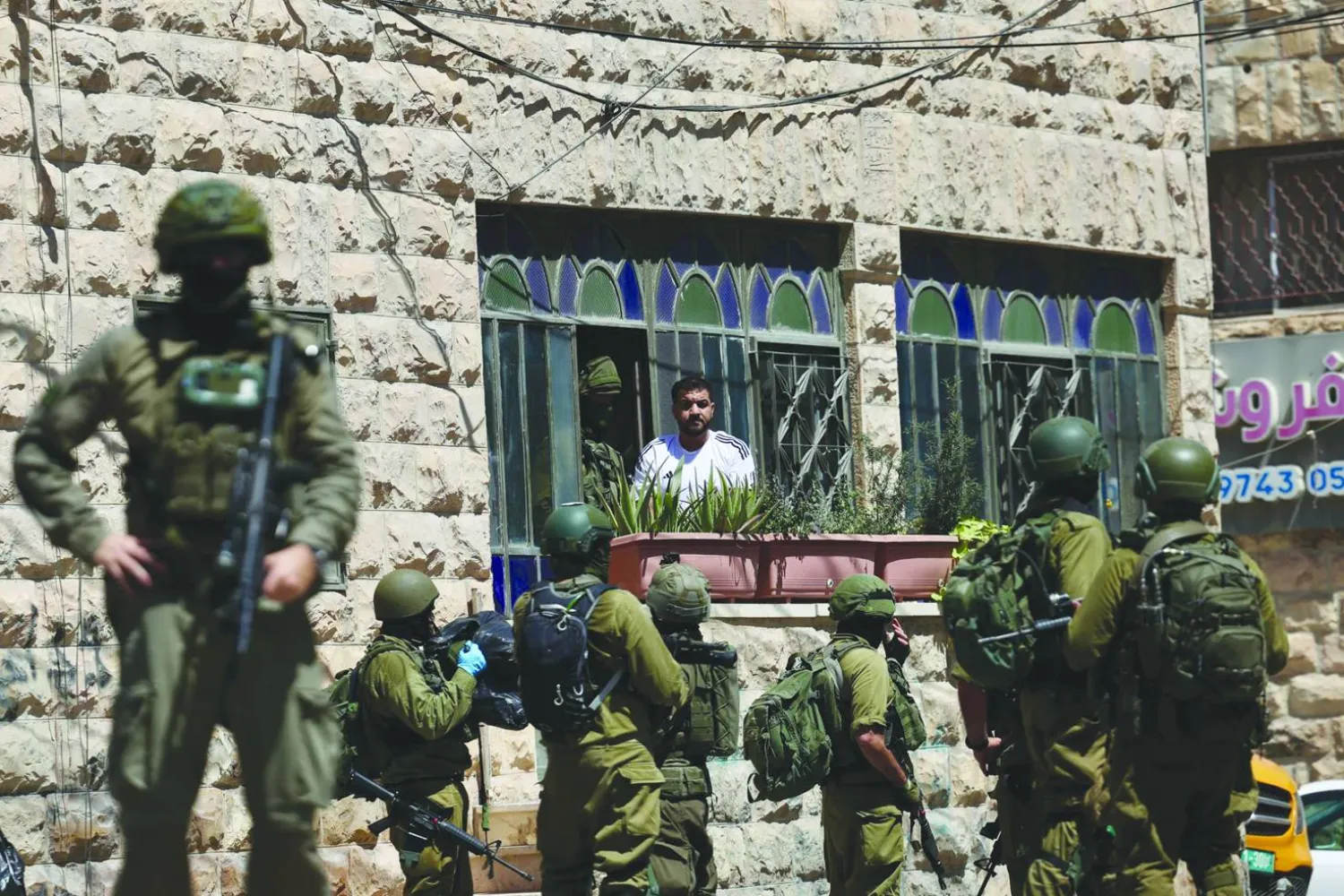
Since Oct. 7, 2023, Israel has begun treating the PA as though it did not exist. Israel escalated in the West Bank, with the army attacking cities, refugee camps and towns and permanently occupying some of them. It killed Palestinians in airstrikes, arrested them and destroyed infrastructure, while settlers were given free rein to kill, attack and seize vast areas by force.
At the same time, Israel advanced a plan to expand existing settlements and establish new ones, linking them through contiguous settlement belts. The plan served to expand settlement activity on the one hand, and to encircle and fragment the West Bank and create a barrier between the West Bank and Israel on the other.
PA remains committed to Oslo’s peaceful approach
After 33 years, what remains of Oslo is an Israel that continues to expand, with greater powers, and a Palestinian Authority with a president, security forces and ministries, but no state and fewer powers — along with more settlers, a devastated Gaza and a Jerusalem under Israeli control.
Yet the PA, now going through one of the worst periods in its history, remains fully committed to the Oslo agreement.
In May, Palestinian President Mahmoud Abbas said he remained committed to Oslo and subsequent agreements, the Palestine Liberation Organization and its program based on the unity of the Palestinian political system and a single legitimate weapon, as well as reforms and presidential and legislative elections, reaffirming his commitment to a peaceful approach amid a series of bloody wars in the region.
Contrary to what many believe or demand, Abbas told Fatah’s Eighth General Conference in Ramallah in May that inflicting a new Nakba on Gaza, killing and wounding more than 270,000 Palestinians there, making the territory uninhabitable, working to annex the West Bank through laws aimed at stealing land, unleashing settler terrorism in the West Bank, continuing to withhold Palestinian funds, besieging the economy, committing violations against Muslim and Christian holy sites in Jerusalem and attempting to divide Al-Aqsa Mosque required a return to implementing the signed agreements.
These included the Oslo Accords, the Paris Protocol on Economic Relations and the 2023 Aqaba and Sharm el-Sheikh understandings, as well as an end to unilateral measures that violate international law.
“We want the ‘treacherous’ Oslo agreement. We want to preserve it,” Abbas said sarcastically, mocking criticism of the agreement.
Abbas immediately attacked Hamas’s Oct. 7 assault.
“Whatever the assessment of what happened on Oct. 7 — the ‘glorious’ Oct. 7,” he said sarcastically, “things are judged by their outcomes.”
“We were slaughtered, displaced and our country was destroyed because of this act,” he added.
It was as though Abbas wanted to voice what many of his supporters and Fatah members say: “Oslo brought the Palestinians back to their homeland, laid the foundations of the state and brought an airport and a seaport to Gaza, while Oct. 7 destroyed everything and displaced Palestinians abroad.”
Opponents of Abbas and Fatah respond to that argument by asking: “Why is Israel ravaging the West Bank, which did not carry out Oct. 7? And why does Oslo not protect you?”
The confrontation between the two arguments does not appear close to being resolved. History remains the judge between the two experiences, while Israel continues to encroach on the dream of a Palestinian state.