


Sudan Drivers Sit Idle as War Shuts Down Transportation

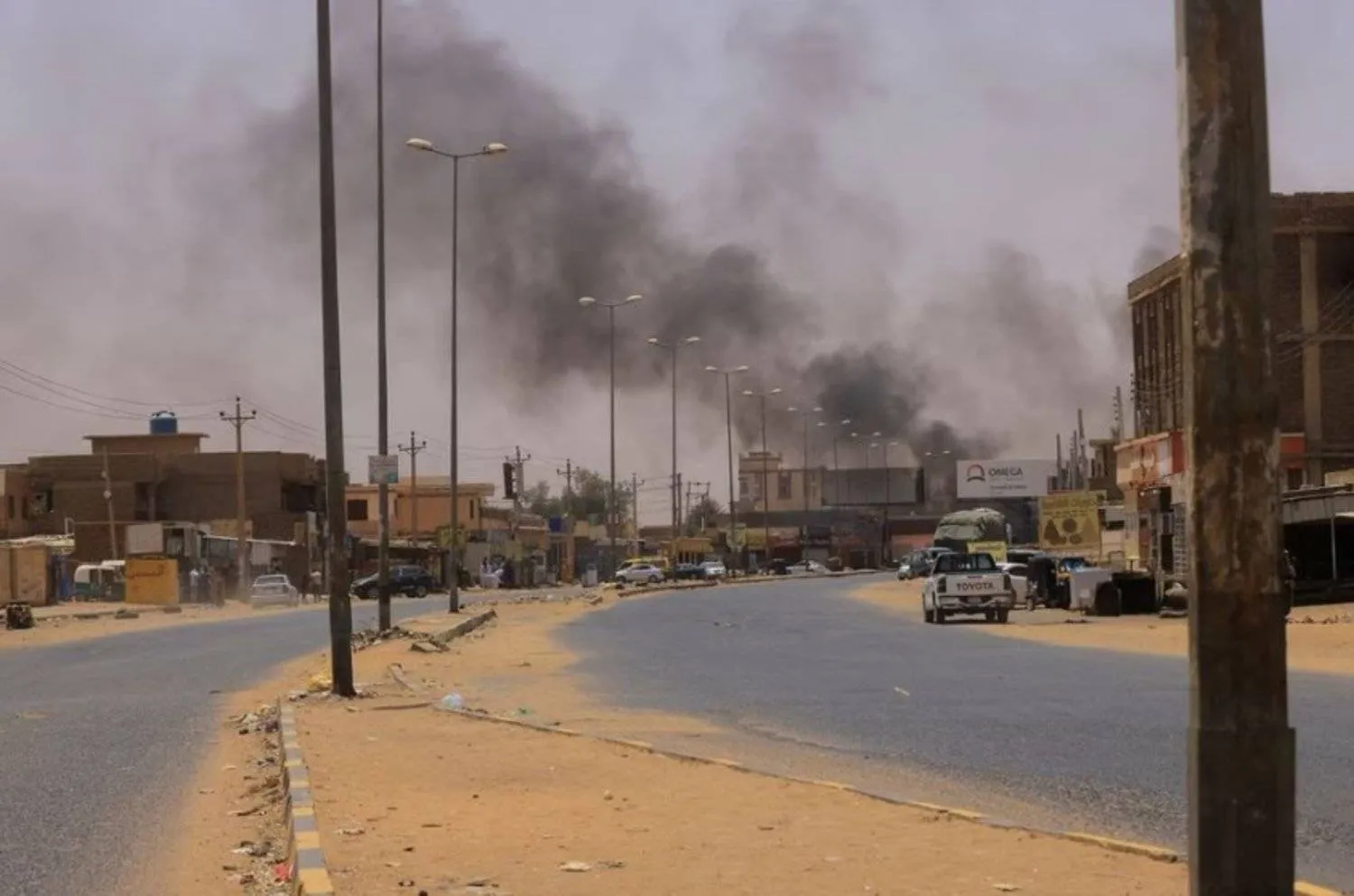
Smoke rises in Omdurman, near Halfaya Bridge, during clashes between the Rapid Support Forces and the army as seen from Khartoum North, Sudan April 15, 2023. REUTERS/Mohamed Nureldin Abdallah
TT

Sudan Drivers Sit Idle as War Shuts Down Transportation

Smoke rises in Omdurman, near Halfaya Bridge, during clashes between the Rapid Support Forces and the army as seen from Khartoum North, Sudan April 15, 2023. REUTERS/Mohamed Nureldin Abdallah

Mahana Abdelrahman used to criss-cross Sudan in his truck, delivering shipments across the vast country, but three months of brutal war have drastically reduced road transportation, grinding business to a halt.

Now, the 45-year-old driver chain-smokes and sips coffee at a cafe on the outskirts of Wad Madani, a city that has welcomed him and many others who fled the war-weary capital Khartoum, some 160 kilometres (100 miles) to the north.

In 20 years of working as a lorry driver, usually carrying goods from Red Sea ports, Abdelrahman has "never seen anything like this war", he told AFP.

The fighting, which erupted on April 15 when a power struggle between rival generals spilled into all-out war, has killed thousands and displaced millions.

"I used to drive across the country four times a month, now I've been here for three weeks and there's nothing to carry anywhere," Abdelrahman lamented.

Around him, lines of parked lorries in their hundreds stretched as far as the eye can see, while drivers were playing cards and drinking tea in the small road-side cafes of Al-Jazirah state.

Hundreds of thousands of displaced Khartoum residents have found safety in Al-Jazirah, but -- like in other parts of the country -- still face dire shortages of food, medicine and other supplies.

With air strikes, artillery blasts and countless checkpoints around Khartoum, road traffic across the country has dropped by 90 percent since fighting began, according to a report by Sudan's national chamber of transport seen by AFP.

This has had a serious effect on commercial activity.

According to figures from Sudan's ports authority, total exports since January amounted to $282 million. That figure stood at $2.5 billion for the first half of 2021.

Driver Mohamed al-Tijani said that even when there is cargo to shuttle, the journey has become far longer than it used to be.

With fuel costs soaring, up to 20 times pre-war prices, travel has also become more expensive.

To avoid the violence and the checkpoints set up by both army and the paramilitary Rapid Support Forces, drivers try to bypass Khartoum entirely, "making our journey to the ports at least 400 kilometres longer", 50-year-old Tijani told AFP.

Million remain trapped in the inaccessible capital, often without the means to support themselves as factories were shelled, warehouses looted and markets ransacked.

In the early days of the fighting, passenger buses would travel in convoys, carrying terrified Sudanese fleeing the fledgling violence. Now, they have stopped moving in and out of Khartoum.

Before the war, "around 70 percent of bus travel used to be between Khartoum and the other states" in the country, driver Hussein Abdelqader told AFP.

He said his business, which relied on Sudan's heavily centralised road network, has plummeted.

Another driver, Moataz Omar, used to transport families from Khartoum to Sudan's border with Egypt -- a 1,000-kilometre journey -- in the first weeks of the war.

"But as the fighting got worse, it became impossible to enter Khartoum," he told AFP.

The already gruelling trip between the Egyptian border and Al-Jazirah's makeshift transport hub has more than doubled, Omar said.

Drivers "now have to head east to Red Sea state, and then through Kassala to Gedaref," on the southeastern border with Ethiopia, before heading back up north, in a 2,600-kilometre loop nearly impossible to find passengers for.

"I've stopped making the trips north," he said.

As the war shows no signs of abating, the drivers -- like much of Sudan's population -- fear for their livelihood.

"We're afraid we're going to lose our jobs," said Tijani. "The companies aren't going to pay our salaries if they're not making money."

Some buses still make the costly and meandering trips around the Sudan. The country's trains, however, all sit collecting dust.

Passenger and freight cars, which used to travel between the capital and Atbara in the north as well as Wad Madani in the south, stopped in their tracks with the first blasts in Khartoum.

They have not moved since.

A railway official said trains carrying cargo from sea ports have also stopped.

The tracks which traverse Khartoum North "have become a battlefield themselves," he told AFP, requesting anonymity as he was not authorised to speak to the media.

It was not just the railway that has been affected.

Khartoum North has become a shell of its former self -- a ghost town with no water or electricity, most of its residents escaped south to Wad Madani, or north to Egypt.



Türkiye, Hamas Discuss Gaza Ceasefire Deal’s Second Phase, Turkish Source Says

Palestinian children play next to tents in a makeshift camp for displaced people set up on the beach in Gaza City, Tuesday, Dec. 16, 2025. (AP)
TT

Türkiye, Hamas Discuss Gaza Ceasefire Deal’s Second Phase, Turkish Source Says

Palestinian children play next to tents in a makeshift camp for displaced people set up on the beach in Gaza City, Tuesday, Dec. 16, 2025. (AP)

Turkish Foreign Minister Hakan Fidan on Wednesday ​met with Hamas political bureau officials in Ankara to discuss the ceasefire in Gaza and advancing the ‌agreement to ‌its ‌second ⁠phase, ​a ‌Turkish Foreign Ministry source said according to Reuters.

The source said the Hamas officials told Fidan that they had fulfilled ⁠their requirements as ‌part of the ‍ceasefire ‍deal, but that Israel's ‍continued targeting of Gaza aimed to prevent the agreement from ​moving to the next phase.

The Hamas members ⁠also said humanitarian aid entering Gaza was not sufficient, and that goods like medication, equipment for housing, and fuel were needed, the source ‌added.


Israel Says It Killed Hamas Financial Officer in Gaza

Buildings destroyed during Israeli ground and air operations stand in the Gaza Strip, as seen from southern Israel, Thursday, Dec. 18, 2025. (AP)
TT

Israel Says It Killed Hamas Financial Officer in Gaza

Buildings destroyed during Israeli ground and air operations stand in the Gaza Strip, as seen from southern Israel, Thursday, Dec. 18, 2025. (AP)

The Israeli army said Wednesday that it had identified a Hamas financial official it killed two weeks ago in a strike in the Gaza Strip.

Abdel Hay Zaqut, a financial official in Hamas's armed wing, on December 13 in the same strike that killed military commander Raed Saad, seen by Israel as one of the architects of Hamas's October 7, 2023 attack.

The Israeli army's Arabic-language spokesperson, Avichay Adraee, said on Wednesday that Zaqut was killed while he was in a vehicle alongside Raed Saad in "a joint operation by the Israeli army and the Shin Bet", Israel's internal security agency.

Zaqut "belonged to the financial department of the armed wing" of Hamas, Adraee wrote on X.

"Over the past year, Zaqut was responsible for collecting and transferring tens of millions of dollars to Hamas's armed wing with the aim of continuing the fight against the State of Israel," he said.

Hamas's leader for the Gaza Strip, Khalil al-Hayya, confirmed on December 14 the death of Saad and "his companions", though he did not name Zaqut.

The Israeli army said Saad headed the weapons production headquarters of Hamas's military wing and oversaw the group's build-up of capabilities.

Since October 10, a fragile truce has been in force in the Gaza Strip, although Israel and Hamas accuse each other of violations.

The war began with Hamas's 2023 attack on Israel, which resulted in the deaths of more than 1,200 people, most of them civilians, according to an AFP tally based on official figures.

Israel's retaliatory campaign has killed more than 70,000 people in the Gaza Strip, according to the health ministry in the Hamas-run territory, a figure the UN deems is credible.


Lebanon Central Bank Governor Expresses Reservations Over Draft Law on Deposit Recovery

 Lebanese Prime Minister Nawaf Salam heads a cabinet meeting in Beirut, Lebanon December 23, 2025. (Reuters)
Lebanese Prime Minister Nawaf Salam heads a cabinet meeting in Beirut, Lebanon December 23, 2025. (Reuters)
TT

Lebanon Central Bank Governor Expresses Reservations Over Draft Law on Deposit Recovery

 Lebanese Prime Minister Nawaf Salam heads a cabinet meeting in Beirut, Lebanon December 23, 2025. (Reuters)
Lebanese Prime Minister Nawaf Salam heads a cabinet meeting in Beirut, Lebanon December 23, 2025. (Reuters)

Lebanon’s Central Bank governor has expressed some reservations over a draft law allowing depositors to gradually recover funds ​frozen in the banking system since a financial collapse in 2019, a move critical to reviving the economy.

Karim Souaid described the proposed timetable for the cash component of deposit repayments as "somewhat ambitious" in a statement on Tuesday.

He suggested ‌it may ‌be adjusted without hindering ‌the depositors' ⁠rights ​guarantee "regular, ‌uninterrupted, and complete payments over time".

He also urged the cabinet to conduct a careful review of the draft law , calling for clarifications to ensure fairness and credibility before it is submitted to parliament.

The central ⁠bank governor said the draft required further refinement, ‌including clearer provisions to guarantee equitable ‍treatment of depositors ‍and to reinforce the state’s commitments ‍under the law.

The 2019 financial collapse - the result of decades of unsustainable financial policies, waste and corruption - led the state to default ​on its sovereign debt and sank the Lebanese pound.

The draft law marks ⁠the first time Beirut has put forward legislation aimed at addressing a vast funding shortfall - estimated at $70 billion in 2022 but now believed to be higher.

Prime Minister Nawaf Salam on Monday urged ministers to swiftly approve the draft legislation.

The cabinet discussed the law on Monday and Tuesday and is set to continue discussions ‌on Friday.