

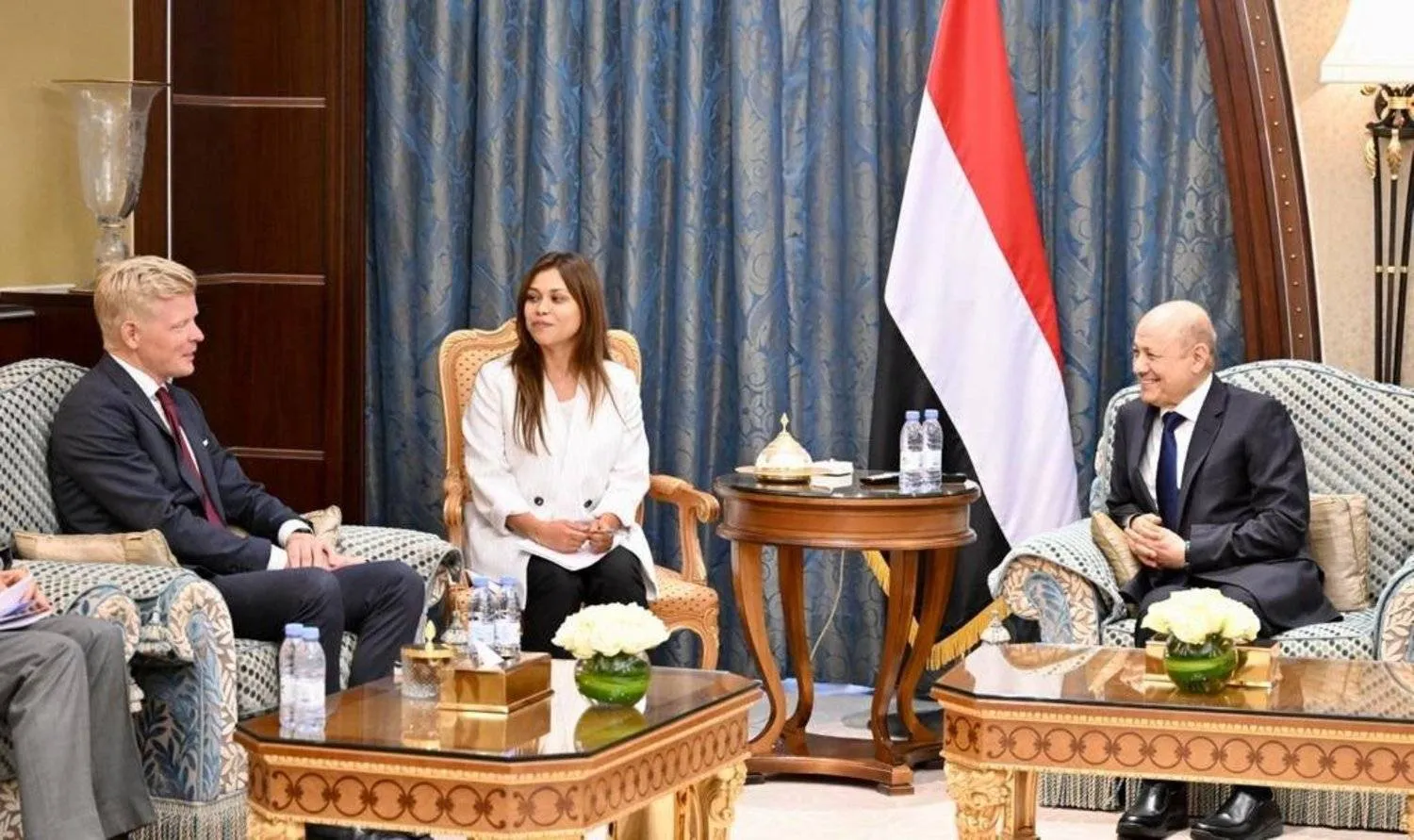

UN Envoy Says Violence Rate Drops in Yemen amid Persisting Conflicts on Certain Fronts

UN Envoy Says Violence Rate Drops in Yemen amid Persisting Conflicts on Certain Fronts
TT

UN Envoy Says Violence Rate Drops in Yemen amid Persisting Conflicts on Certain Fronts

UN Envoy Says Violence Rate Drops in Yemen amid Persisting Conflicts on Certain Fronts

The UN Secretary-General's envoy to Yemen, Hans Grundberg, announced that hostilities on the frontlines have not returned to pre-truce levels, despite his assertion that fighting has continued on some frontlines.

In his briefing to the Security Council on Wednesday, the UN envoy said that all parties to the conflict are willing to seek solutions.

However, intermittent fighting and exchanges of fire have continued on some frontlines, particularly in Taiz, Marib, Dhale, Hodeida, Shabwa, and Saada, said Grundberg, noting that there have been public threats to return to war, without indicating who is making those threats.

The UN envoy renewed his appeal to the two parties to release all detainees based on the "all-for-all principle."

He reviewed his recent mediation efforts with the Yemeni parties and regional countries, including his visit last week to Riyadh, where he met with the head of the Yemeni Presidential Leadership Council, Rashad al-Alimi, and several senior Yemeni and Saudi officials.

Grundberg also traveled to Muscat to hold meetings with Houthi representatives and Omani officials to establish "a clear agreement" on the way forward that includes restarting an inclusive Yemeni political process.

"There have been public threats to return to war. This rhetoric is not conducive to maintaining a fruitful mediation environment," warned the envoy, calling on the parties to refrain from "escalatory rhetoric and to continue to use and build on dialogue channels established under the truce."

- No improvement without economy

Grundberg described the Yemeni economic situation as "increasingly dire," noting that both sides continue to "resort to antagonistic economic measures to weaken the other side" and warned that "these tactics primarily hurt civilians."

He praised Saudi Arabia's pledge of $1.2 billion earlier this month, saying it was a "welcome step," noting that "there will be no lasting improvement in the situation until the parties come together to discuss and agree on sustainable solutions to Yemen's economic and fiscal challenges."

He recalled the siege imposed on Taiz Governorate eight years ago, stressing that there was a "dire need for road openings in Taiz and other governorates to facilitate the freedom of movement of Yemenis who have faced restrictions to accessing their basic needs and engaging in economic opportunities."

Grundberg expressed concern about reports that activities of violent extremists have recently increased in the Abyan and Shabwa governorates, explaining that "political and economic instability are fertile grounds for violent extremist groups."

"The fragility of the situation and its impact on Yemeni women and men highlight the urgent need to reach a consensus on the way forward. My Office is working to convene the parties to address some of their immediate priorities to build confidence and move toward an inclusive and sustainable political settlement."

He emphasized that the Office of the Special Envoy of the Secretary-General for Yemen (OSESGY) "continues to explore options" with the parties to address the needs of all Yemenis, including regular public sector salary payments nationwide, improved service provision, affordable essential commodities, a functional banking system, and facilitating commercial activity.

The OSESGY continues engaging "with all parties on the technical elements required for a sustainable nationwide ceasefire."

The UN envoy urged the parties to "progress towards a more formal ceasefire."

He believed the comprehensive political process under the UN auspices should "provide a platform for a plurality of Yemenis from across the country to collectively discuss and determine their own future."

Grundberg reiterated that the continued unity and steadfast support of this Council and the international community, more broadly, have been a pivotal asset for his mediation efforts.

He cited the recent progress on FSO Safer, which showed how concerted international support and multilateral cooperation can bring tangible results.

"The removal of the oil from the FSO Safer to a new vessel has prevented an environmental and humanitarian catastrophe."



Israel Military Says Soldier Killed in Gaza 

A drone view shows the destruction in a residential neighborhood, after the withdrawal of the Israeli forces from the area, amid a ceasefire between Israel and Hamas in Gaza, in Gaza City, October 21, 2025. (Reuters)
TT

Israel Military Says Soldier Killed in Gaza 

A drone view shows the destruction in a residential neighborhood, after the withdrawal of the Israeli forces from the area, amid a ceasefire between Israel and Hamas in Gaza, in Gaza City, October 21, 2025. (Reuters)

The Israeli military announced that one of its soldiers had been killed in combat in southern Gaza on Wednesday, but a security source said the death appeared to have been caused by "friendly fire".

"Staff Sergeant Ofri Yafe, aged 21, from HaYogev, a soldier in the Paratroopers Reconnaissance Unit, fell during combat in the southern Gaza Strip," the military said in a statement.

A security source, however, told AFP that the soldier appeared to have been "killed by friendly fire", without providing further details.

"The incident is still under investigation," the source added.

The death brings to five the number of Israeli soldiers killed in Gaza since a ceasefire took effect on October 10.


Syria: SDF’s Mazloum Abdi Says Implementation of Integration Deal May Take Time

People sit outdoors surrounded by nature, with the Tigris river flowing in the background, following a long atmospheric depression, near the Syrian-Turkish border in Derik, Syria, February 16, 2026 REUTERS/Orhan Qereman
TT

Syria: SDF’s Mazloum Abdi Says Implementation of Integration Deal May Take Time

People sit outdoors surrounded by nature, with the Tigris river flowing in the background, following a long atmospheric depression, near the Syrian-Turkish border in Derik, Syria, February 16, 2026 REUTERS/Orhan Qereman

Mazloum Abdi, commander of the Syrian Democratic Forces, said the process of merging the SDF with Syrian government forces “may take some time,” despite expressing confidence in the eventual success of the agreement.

His remarks came after earlier comments in which he acknowledged differences with Damascus over the concept of “decentralization.”

Speaking at a tribal conference in the northeastern city of Hasakah on Tuesday, Abdi said the issue of integration would not be resolved quickly, but stressed that the agreement remains on track.

He said the deal reached last month stipulates that three Syrian army brigades will be created out of the SDF.

Abdi added that all SDF military units have withdrawn to their barracks in an effort to preserve stability and continue implementing the announced integration agreement with the Syrian state.

He also emphasized the need for armed forces to withdraw from the vicinity of the city of Ayn al-Arab (Kobani), to be replaced by security forces tasked with maintaining order.


Israeli Far-Right Minister to Push for ‘Migration’ of West Bank, Gaza Palestinians 

A Palestinian man checks leather belts as people prepare for Ramadan, in the old city of Hebron in the Israeli-occupied West Bank, February 17,2026. (Reuters)
TT

Israeli Far-Right Minister to Push for ‘Migration’ of West Bank, Gaza Palestinians 

A Palestinian man checks leather belts as people prepare for Ramadan, in the old city of Hebron in the Israeli-occupied West Bank, February 17,2026. (Reuters)

Israel's far-right Finance Minister Bezalel Smotrich said he would pursue a policy of "encouraging the migration" of Palestinians from the occupied West Bank and Gaza Strip, Israeli media reported Wednesday.

"We will eliminate the idea of an Arab terror state," said Smotrich, speaking at an event organized by his Religious Zionism Party late on Tuesday.

"We will finally, formally, and in practical terms nullify the cursed Oslo Accords and embark on a path toward sovereignty, while encouraging emigration from both Gaza and Judea and Samaria.

"There is no other long-term solution," added Smotrich, who himself lives in a settlement in the West Bank.

Since last week, Israel has approved a series of measures backed by far-right ministers to tighten control over the West Bank, including in areas administered by the Palestinian Authority under the Oslo Accords, in place since the 1990s.

The measures include a process to register land in the West Bank as "state property" and facilitate direct purchases of land by Jewish Israelis.

The measures have triggered widespread international outrage.

On Tuesday, the UN missions of 85 countries condemned the measures, which critics say amount to de facto annexation of the Palestinian territory.

"We strongly condemn unilateral Israeli decisions and measures aimed at expanding Israel's unlawful presence in the West Bank," they said in a statement.

"Such decisions are contrary to Israel's obligations under international law and must be immediately reversed.

"We underline in this regard our strong opposition to any form of annexation."

UN Secretary-General Antonio Guterres on Monday called on Israel to reverse its land registration policy, calling it "destabilizing" and "unlawful".

The West Bank would form the largest part of any future Palestinian state. Many on Israel's religious right view it as Israeli land.

Israeli NGOs have also raised the alarm over a settlement plan signed by the government which they say would mark the first expansion of Jerusalem's borders into the occupied West Bank since 1967.

The planned development, announced by Israel's Ministry of Construction and Housing, is formally a westward expansion of the Geva Binyamin, or Adam, settlement situated northeast of Jerusalem in the West Bank.

The current Israeli government has fast-tracked settlement expansion, approving a record 52 settlements in 2025.

Excluding Israeli-annexed east Jerusalem, more than 500,000 Israelis live in West Bank settlements and outposts, which are illegal under international law.