


Satellite Images Show Iran Repairing and Fortifying Sites amid US Tensions

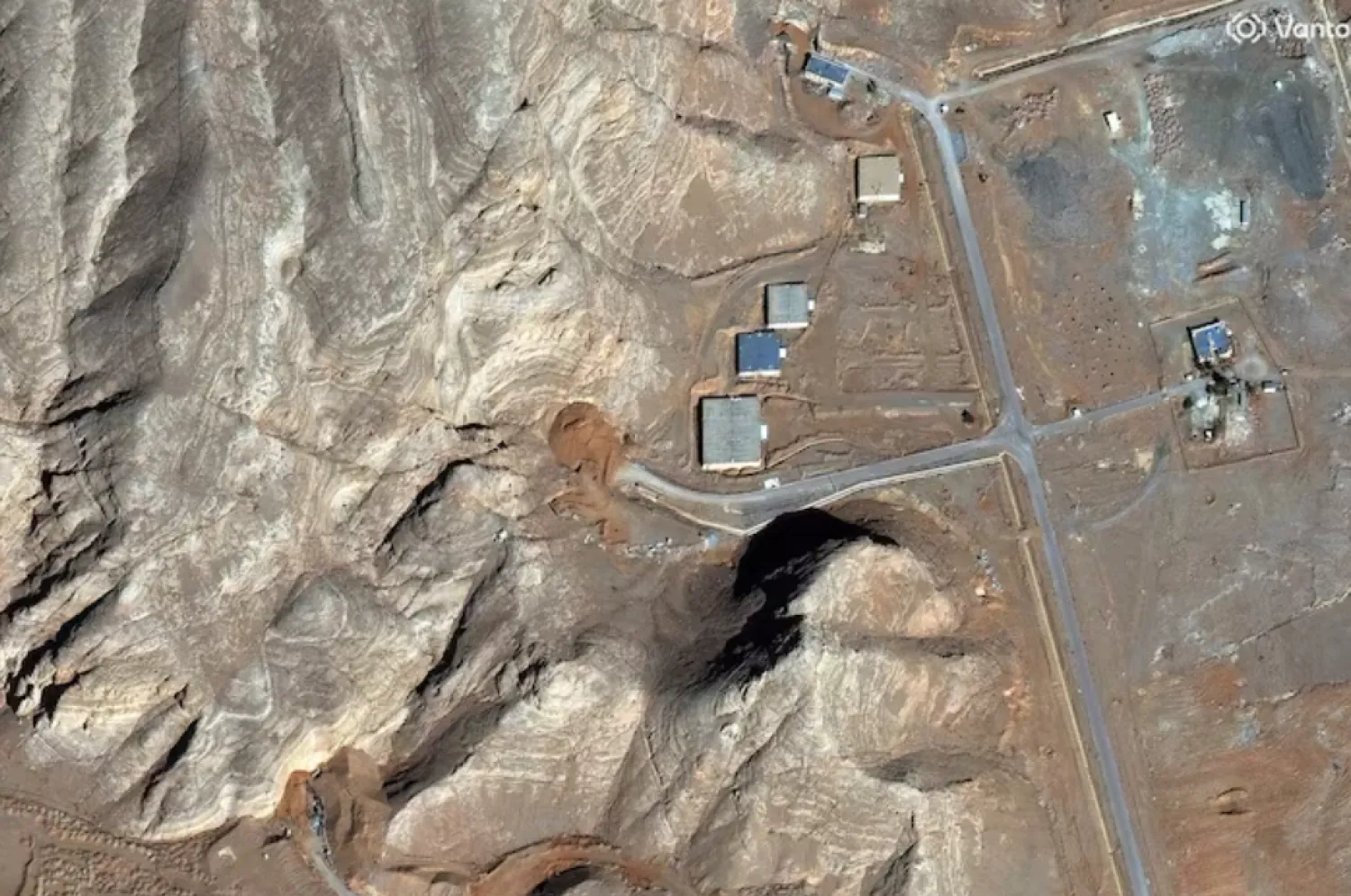
A satellite image shows tunnel entrances covered with soil at Isfahan nuclear complex, in Isfahan, Iran, February 10, 2026. Vantor/Handout via REUTERS
TT

Satellite Images Show Iran Repairing and Fortifying Sites amid US Tensions

A satellite image shows tunnel entrances covered with soil at Isfahan nuclear complex, in Isfahan, Iran, February 10, 2026. Vantor/Handout via REUTERS

Satellite images show that Iran has recently built a concrete shield over a new facility at a sensitive military site and covered it in soil, experts say, advancing work at a location reportedly bombed by Israel in 2024 amid tensions with the US.

Images also show that Iran has buried tunnel entrances at a nuclear site bombed by the US during Israel's 12-day war with Iran last year, fortified tunnel entrances near another, and has repaired missile bases struck in the conflict.

They offer a glimpse of Iranian activities at some of the sites at the center of tensions with Israel and the US, as Washington seeks to negotiate a deal with Tehran on its nuclear program while threatening military action if talks fail.

Some 30 km (20 miles) southeast of Tehran, the Parchin complex is one of Iran's most sensitive military sites. Western intelligence has suggested Tehran carried out tests relevant to nuclear bomb detonations there more than two decades ago.

Iran has always denied seeking atomic weapons. Israel reportedly struck Parchin in October 2024.

Satellite imagery taken before and after that attack shows extensive damage to a rectangular building at Parchin, and apparent reconstruction in images from November 6, 2024.

Imagery from October 12, 2025 shows development at the site, with the skeleton of a new structure visible and two smaller structures adjacent to it. Progress is apparent in imagery from November 14, with what appears to be a metallic roof covering the large structure.

But imagery from December 13 shows the facility partly covered. By February 16, it cannot be seen at all, hidden by what experts say is a concrete structure.

The Institute for Science and International Security (ISIS), in a January 22 analysis of satellite imagery, pointed to progress in the construction of a "concrete sarcophagus" around a newly built facility at the site, which it identified as Taleghan 2.

ISIS reported in November that imagery showed "ongoing construction and the presence of what appears to resemble a long, cylindrical chamber, maybe a high-explosives containment vessel, likely measuring approximately 36 meters long and 12 meters in diameter placed inside a building".

"High-explosive containment vessels are critical to the development of nuclear weapons," ISIS added, "but can also be used in many other conventional weapons development processes."

William Goodhind, a forensic imagery analyst with Contested Ground, said the roof had a similar hue to the surrounding area, adding: "It has most likely been covered with dirt to obscure the concrete color."

ISIS founder David Albright wrote on X: "Stalling the negotiations has its benefits: Over the last two to three weeks, Iran has been busy burying the new Taleghan 2 facility ... More soil is available and the facility may soon become a fully unrecognizable bunker, providing significant protection from aerial strikes."

TUNNEL ENTRANCES BURIED AT ISFAHAN NUCLEAR COMPLEX

The Isfahan complex is one of three Iranian uranium-enrichment plants bombed by the United States in June.

In addition to facilities that are part of the nuclear fuel cycle, Isfahan includes an underground area where diplomats say much of Iran's enriched uranium has been stored.

Satellite images taken in late January showed new efforts to bury two tunnel entrances at the complex, ISIS reported on January 29. In a February 9 update, ISIS said a third entrance had also been backfilled with soil, meaning all entrances to the tunnel complex were now "completely buried".

A February 10 image shows all three tunnels buried, Goodhind said.

ISIS reported on February 9 that "backfilling the tunnel entrances would help dampen any potential airstrike and also make ground access in a special forces raid to seize or destroy any highly enriched uranium that may be housed inside difficult".

TUNNEL ENTRANCES FORTIFIED AT COMPLEX NEAR NATANZ SITE

ISIS has reported that satellite images point to ongoing efforts since February 10 to "harden and defensively strengthen" two entrances to a tunnel complex under a mountain some 2 km (1.2 miles) from Natanz - the site that holds Iran's other two uranium enrichment plants.

Imagery shows "ongoing activity throughout the complex related to this effort, involving the movement of numerous vehicles, including dump trucks, cement mixers, and other heavy equipment", ISIS wrote.

Iran's plans for the facility, called Pickaxe Mountain, are unclear, ISIS said.

SHIRAZ SOUTH MISSILE BASE

About 10 km (6 miles) south of Shiraz in southern Iran, this is one of 25 primary bases capable of launching medium-range ballistic missiles, according to Alma Research and Education Center, an Israeli organization. Alma assessed the site had suffered light, above-ground damage in last year's war.

A comparison of images taken on July 3, 2025 and January 30 shows reconstruction and clearance efforts at the main logistics and likely command compound at the base, Goodhind said.

"The key takeaway is that the compound has yet to return to its full operational capacity from prior to the airstrikes."

QOM MISSILE BASE

Some 40 km north of the city of Qom, this base suffered moderate above-ground damage, according to Alma.

A comparison of images taken between July 16, 2025, and February 1 shows a new roof over a damaged building. The roof repairs appear to have begun on November 17 and were most likely complete 10 days later, Goodhind said.



Iranian Official Says Kharg Oil Exports 'Normal', after US Strikes

A satellite image of Iran's Kharg Island (AFP)
TT

Iranian Official Says Kharg Oil Exports 'Normal', after US Strikes

A satellite image of Iran's Kharg Island (AFP)

Oil export operations from Iran's Kharg island in the Gulf were proceeding as normal Saturday after US strikes on the crude export hub which caused no casualties, a regional official said.

Activities of oil companies "at this export terminal are continuing as normal", said Ehsan Jahaniyan, deputy governor of Iran's southern Bushehr province, quoted by the IRNA news agency.

The Fars news agency, citing sources on the island, earlier reported there had been no damage to oil facilities after President Donald Trump said US strikes had destroyed only military targets, AFP reported.

Trump had threatened to target oil infrastructure on the island, a crucial hub for Iran, if Tehran continues to block the strategic Strait of Hormuz.

Iran has, in turn, threatened to target US-linked oil infrastructure.

Deputy governor Jahaniyan said that after the attacks "daily life and routine activities of the residents are also fully maintained."

The attack "did not cause any casualties among military personnel, company employees, or residents of Kharg island, he added.

According to Fars, the US operation "tried to damage the army's defenses, the Joshan naval base, the airport control tower and the helicopter hangar of the Iran Continental Shelf Oil Company."

Kharg Island, a scrubby stretch of land in the northern Gulf around 30 kilometres (19 miles) off the Iranian mainland, handles roughly 90 percent of Iran's crude exports.


Four Killed in Russian Air Attack on Ukraine

Four Killed in Russian Air Attack on Ukraine
TT

Four Killed in Russian Air Attack on Ukraine

Four Killed in Russian Air Attack on Ukraine

Russia hammered Ukraine with missiles and drones overnight, killing four people and causing damage across five regions of the country, Ukrainian officials said on Saturday.

The main target was energy infrastructure outside the capital Kyiv, President Volodymyr Zelenskiy said, adding that residential buildings, schools and businesses were also damaged, Reuters reported.

He said the Sumy, Kharkiv, Dnipro and Mykolaiv regions were also targeted in an attack that included around 430 drones and 68 missiles, most of which were downed by air defences.

Saturday's strikes come as the spiraling Iran conflict has distracted international attention from a US-backed peace push in the four-year war, which Kyiv says Moscow has no interest in ending.

"Russia will try to exploit the war in the Middle East to cause even greater destruction here in Europe, in Ukraine," Zelenskiy wrote on X.

He repeated his call for Kyiv's partners to boost production of critical air-defence weapons, stocks of which have been diminishing as the US and its allies in the Gulf have fended off Iranian strikes.

Russia's winter attacks on Ukraine have left swathes of major cities without power or heating, part of a campaign to weaken resolve as Moscow's troops press a battlefield offensive and demand Kyiv cede more territory in the east.

Ukraine's forces have targeted Russian strategic infrastructure such as oil refineries, depots and terminals in long-range strikes.

Ukraine's Energy Ministry said on Saturday that consumers in six regions were without electricity after the overnight strikes and Russian shelling of frontline areas.

"There's no way Russia will stop," said local resident Natalia Fetko, 57, whose building was damaged in the strike. "Nothing is enough for them."

All four deaths occurred in the Kyiv region, where 15 people were also wounded and damage recorded in four districts, according to regional military administrator Mykola Kalashnyk.

Saturday's attack also prompted NATO member Poland to scramble jets to protect its airspace, but no violations were observed, Warsaw's military said.


Son of Ousted Shah Says Ready for Iran Transition 'Under My Leadership'

Smoke rises following an explosion during a protest marking the annual al-Quds Day (Jerusalem Day) on the last Friday of the holy month of Ramadan, amid the US-Israeli conflict with Iran, in Tehran, Iran, March 13, 2026.- Reuters
TT

Son of Ousted Shah Says Ready for Iran Transition 'Under My Leadership'

Smoke rises following an explosion during a protest marking the annual al-Quds Day (Jerusalem Day) on the last Friday of the holy month of Ramadan, amid the US-Israeli conflict with Iran, in Tehran, Iran, March 13, 2026.- Reuters

The exiled son of Iran's last shah who was ousted by the 1979 revolution said on Saturday he was ready to lead a transition "as soon as the Islamic Republic falls".

In a message on his social media channels, US-based Reza Pahlavi said he had already been working to select individuals both inside and outside Iran to serve on what he called a "Transitional System".

Pahlavi leads one of several opposition movements based outside Iran but his prominence grew after January protests against the clerical system, with some demonstrators calling for a return of the monarchy, according to AFP.

Longstanding supreme leader Ali Khamenei was killed on February 28 in US-Israeli airstrikes but after a fortnight of war the clerical system remains in place even if his successor, his son Mojtaba, has yet to make a public appearance.

Pahlavi said that Saeed Ghasseminejad, senior Iran and financial economics advisor at the US-based think tank Foundation for Defense of Democracies (FDD), which is staunchly critical of the Islamic republic, had been leading the process to select members of a transitional body.

"Capable individuals both inside and outside the country have been identified and evaluated to lead various sections of the Transitional System," he said

"The Transitional System, under my leadership, will be ready to assume governance of the country as soon as the Islamic Republic falls, and in the shortest possible time, establish order, security, freedom, and the conditions for Iran's prosperity and flourishing," he added.

In a boost to Pahlavi, vast pro-monarchy rallies took place in February in Munich and several cities in North America in the biggest yet such show of support.

But he has notably also failed to win recognition from US President Donald Trump, who has never officially met with Pahlavi and repeatedly expressed scepticism over his ability to lead Iran.

"They talk about the son of the shah, they talk about other people, but (he) hasn't been there in many years," Trump said this week.

Pahlavi was undergoing air force training in the US when his father Mohammad Reza Pahlavi was ousted and never returned to the country.

Trump has repeatedly referred to Venezuela, where in January US forces captured president Nicolas Maduro, with Washington now working with his former deputy Delcy Rodriguez.

But it remains unclear how such a scenario could play out in Iran.

"I like the idea of internal because it works well, I think we have proven that so far in Venezuela," Trump said.