


Upcoming Yemeni Project Seeks to Empower Provinces with More Authority, Autonomy

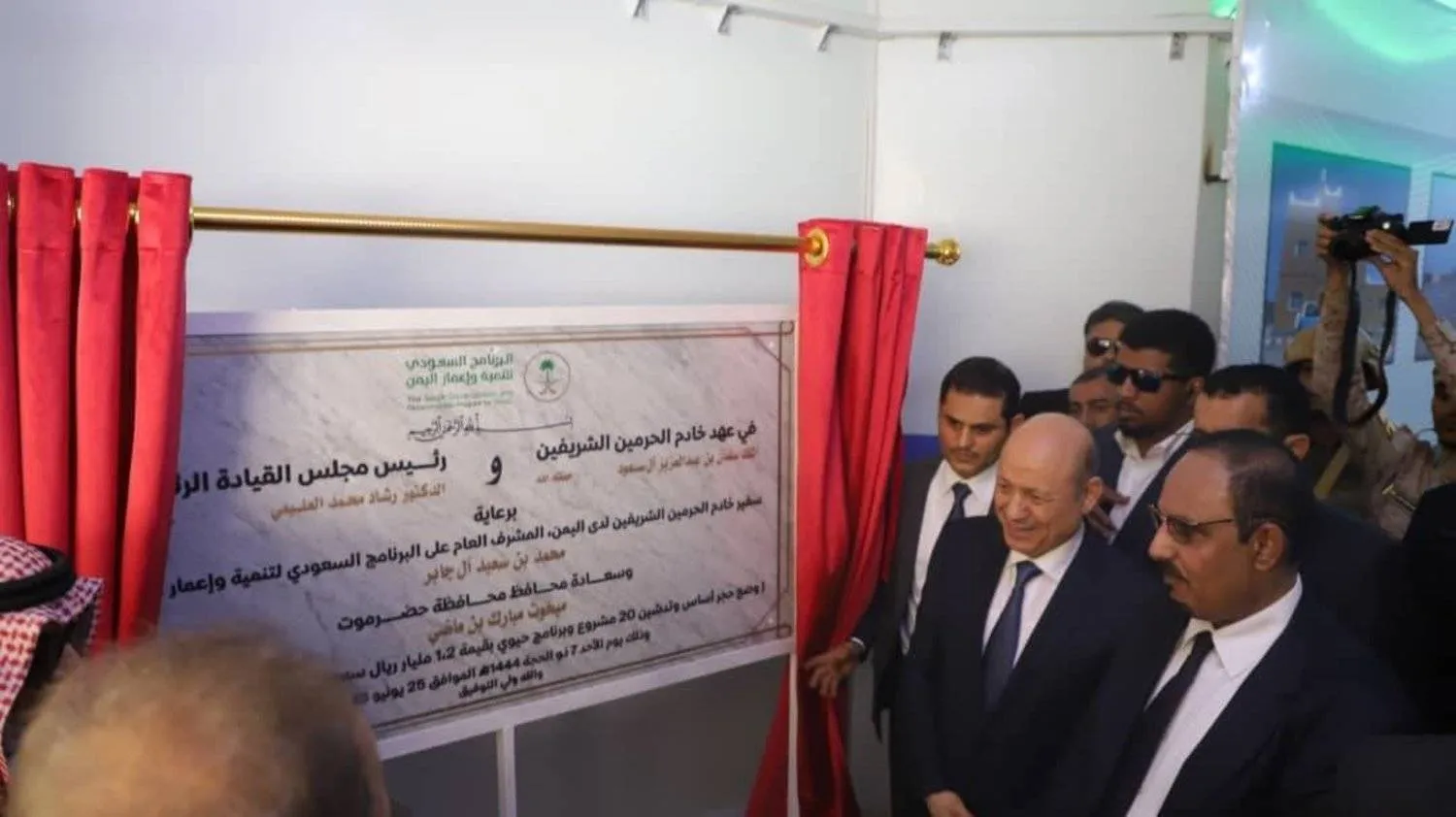
Chairman of the Yemeni Presidential Leadership Council Dr. Rashad al-Alimi lays the foundation for projects, exceeding SAR1 billion and executed by the Saudi Program for Yemen’s Development and Reconstruction, in Hadhramaut. (Asharq Al-Awsat)
TT

Upcoming Yemeni Project Seeks to Empower Provinces with More Authority, Autonomy

Chairman of the Yemeni Presidential Leadership Council Dr. Rashad al-Alimi lays the foundation for projects, exceeding SAR1 billion and executed by the Saudi Program for Yemen’s Development and Reconstruction, in Hadhramaut. (Asharq Al-Awsat)

Yemeni officials are working on drafting a roadmap that grants local authorities in provinces greater powers and independence from the central government after the nearly eight-year war severely weakened public institutions.

The project will be implemented in the interim capital Aden, Hadhramaut, and Taiz in an initial test phase before applying it to the remaining provinces.

Eng. Badr Baslama, the head of the Technical Committee for the “Empowerment of Local Authorities” project, told Asharq Al-Awsat that capacity-building would take place all provinces.

However, the initial focus will be on Aden, Hadhramaut, and Taiz to derive lessons and refine aspects of the project so that they may serve as a model for other regions.

The new project, supported by the Yemeni presidency, and with regional and international backing, aims to empower local authorities in provinces to achieve sustainable economic development involving communities and the private sector.

During the war, Iran-backed Houthi militias have managed to forcibly seize institutions in the capital, Sanaa.

During a visit to Hadhramaut in late June, Chairman of the Presidential Leadership Council (PLC) Dr. Rashad al-Alimi stressed the commitment to enhance the role of local authorities in all liberated provinces to consolidate security and stability and improve services.

Baslama explained that after the implementation of the project, provinces will be able to offer services in collaboration with the private sector. They will have the necessary funding to carry out projects to redefine the concept and role of the state that will regulate operations and set market and economic standards.

Baslama lamented that the war had led to the complete disintegration and weakness of state institutions, rendering them incapable of providing services. Local authorities found themselves unprepared for this situation.

“Previously, 97% of projects came from central authorities, with local authorities overseeing implementation. However, due to the war, local authorities now bear full responsibility for services and tasks they were neither prepared nor equipped for,” he said.

He further emphasized local authorities’ efforts to find solutions, provide minimal development and services, and sometimes even surpass their legal powers.

“Provinces exceeded their legally granted powers due to the war. Additionally, unallocated funds caused significant disorder and rampant corruption at local levels,” he noted.

The new “Empowerment of Local Authorities” project focuses on delivering services, local development, and job opportunities for sustainable stability, affirmed Baslama.

“This project addresses the most significant concerns at the provincial level, which are services, local development, and job creation,” he said.

“The direction from the Presidential Leadership Council is to create a project empowering local authorities to provide services and promote local development for job opportunities,” he added.

Under the roadmap, local authorities will gain more powers.

“Resource allocation is also an issue,” he noted, adding that “this will be resolved through phased implementation in the roadmap, gradually granting powers and resources, capacity building, according to a timeline.”

Baslama noted a misconception about resources.

“Some believe resources are limited to oil and gas, but there is more,” he explained.

“Looking at the fishing sector, many provinces, especially in the south, have coastlines (...) We need to explore other resources.”

“Before independence, Abayan long-staple cotton was sold at the London Stock Exchange as one of the world's finest. Why not revive it? We must revitalize economic sectors,” asserted Baslama.

Baslama believes that one of the prominent challenges facing the project is the reluctance of central government institutions to relinquish their granted authorities. Letting go of these powers to local authorities poses a significant issue.



EU Exploring Support for New Gaza Administration Committee, Document Says

Palestinians push a cart past the rubble of residential buildings destroyed during the two-year Israeli offensives, in Gaza City, February 17, 2026. REUTERS/Mahmoud Issa
TT

EU Exploring Support for New Gaza Administration Committee, Document Says

Palestinians push a cart past the rubble of residential buildings destroyed during the two-year Israeli offensives, in Gaza City, February 17, 2026. REUTERS/Mahmoud Issa

The European Union is exploring possible support for a new committee established to take over the civil administration of Gaza, according to a document produced by the bloc's diplomatic arm and seen by Reuters.

"The EU is engaging with the newly established transitional governance structures for Gaza," the European External Action Service wrote in a document circulated to member states on Tuesday.

"The EU is also exploring possible support to the National Committee for the Administration of Gaza," it added.

European foreign ministers will discuss the situation in Gaza during a meeting in Brussels on February 23.


Israel Military Says Soldier Killed in Gaza 

A drone view shows the destruction in a residential neighborhood, after the withdrawal of the Israeli forces from the area, amid a ceasefire between Israel and Hamas in Gaza, in Gaza City, October 21, 2025. (Reuters)
TT

Israel Military Says Soldier Killed in Gaza 

A drone view shows the destruction in a residential neighborhood, after the withdrawal of the Israeli forces from the area, amid a ceasefire between Israel and Hamas in Gaza, in Gaza City, October 21, 2025. (Reuters)

The Israeli military announced that one of its soldiers had been killed in combat in southern Gaza on Wednesday, but a security source said the death appeared to have been caused by "friendly fire".

"Staff Sergeant Ofri Yafe, aged 21, from HaYogev, a soldier in the Paratroopers Reconnaissance Unit, fell during combat in the southern Gaza Strip," the military said in a statement.

A security source, however, told AFP that the soldier appeared to have been "killed by friendly fire", without providing further details.

"The incident is still under investigation," the source added.

The death brings to five the number of Israeli soldiers killed in Gaza since a ceasefire took effect on October 10.


Syria: SDF’s Mazloum Abdi Says Implementation of Integration Deal May Take Time

People sit outdoors surrounded by nature, with the Tigris river flowing in the background, following a long atmospheric depression, near the Syrian-Turkish border in Derik, Syria, February 16, 2026 REUTERS/Orhan Qereman
TT

Syria: SDF’s Mazloum Abdi Says Implementation of Integration Deal May Take Time

People sit outdoors surrounded by nature, with the Tigris river flowing in the background, following a long atmospheric depression, near the Syrian-Turkish border in Derik, Syria, February 16, 2026 REUTERS/Orhan Qereman

Mazloum Abdi, commander of the Syrian Democratic Forces, said the process of merging the SDF with Syrian government forces “may take some time,” despite expressing confidence in the eventual success of the agreement.

His remarks came after earlier comments in which he acknowledged differences with Damascus over the concept of “decentralization.”

Speaking at a tribal conference in the northeastern city of Hasakah on Tuesday, Abdi said the issue of integration would not be resolved quickly, but stressed that the agreement remains on track.

He said the deal reached last month stipulates that three Syrian army brigades will be created out of the SDF.

Abdi added that all SDF military units have withdrawn to their barracks in an effort to preserve stability and continue implementing the announced integration agreement with the Syrian state.

He also emphasized the need for armed forces to withdraw from the vicinity of the city of Ayn al-Arab (Kobani), to be replaced by security forces tasked with maintaining order.