
Israel ‘at War’ as Hamas Unleashes Surprise Attack from Gaza

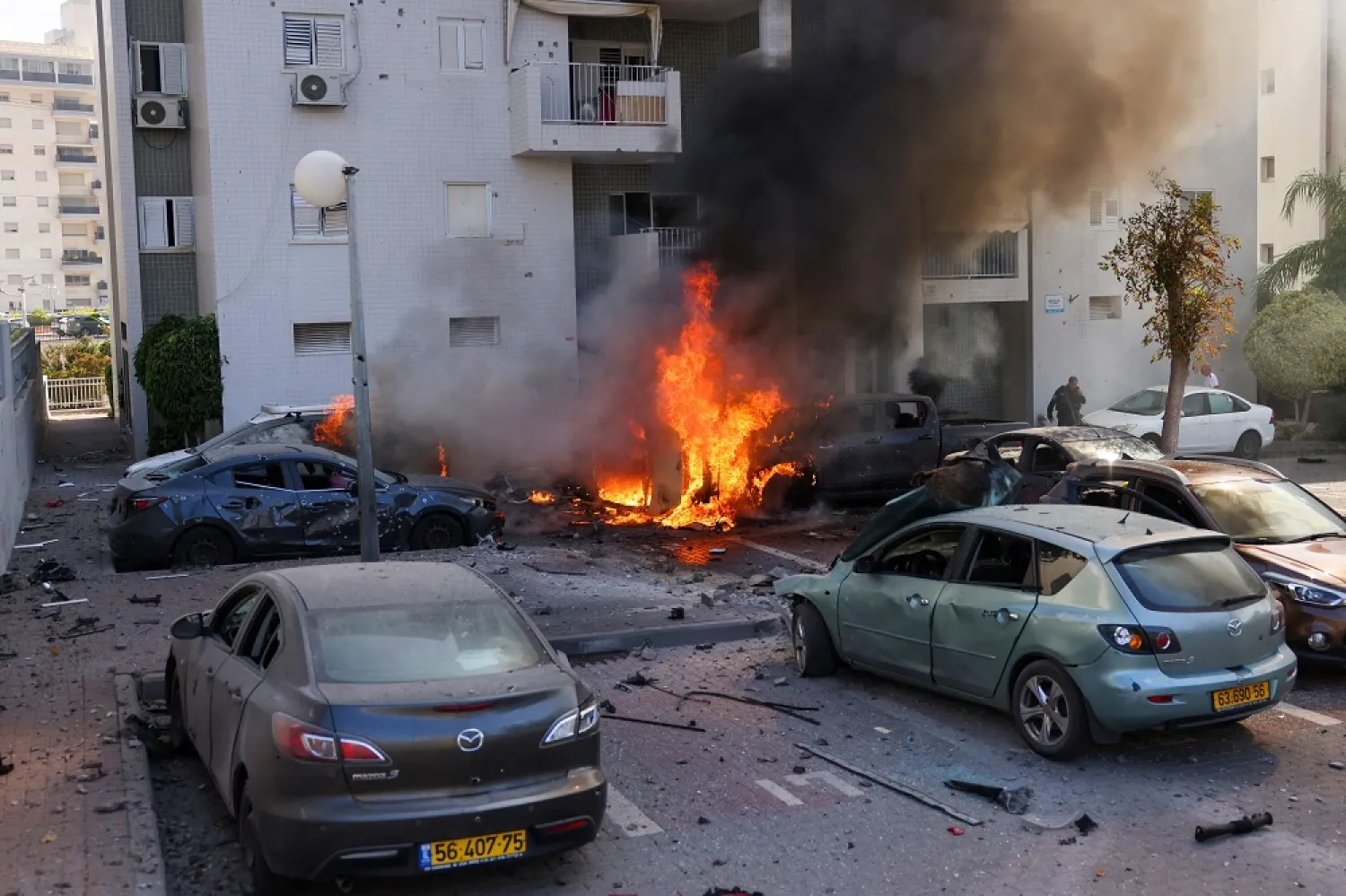
A member of the Israeli security forces stands near burning cars following a rocket attack from the Gaza Strip in Ashkelon, southern Israel, on October 7, 2023. (AFP)
TT

Israel ‘at War’ as Hamas Unleashes Surprise Attack from Gaza

A member of the Israeli security forces stands near burning cars following a rocket attack from the Gaza Strip in Ashkelon, southern Israel, on October 7, 2023. (AFP)

Palestinian movement Hamas launched the biggest attack on Israel in years on Saturday, killing dozens of people and taking hostages in a surprise assault that combined gunmen crossing into Israel with a barrage of rockets fired from the Gaza Strip.

Israel said the Iran-backed group had declared war as its army confirmed fighting with militants in several Israeli towns and military bases near Gaza, and Prime Minister Benjamin Netanyahu vowed to retaliate.

"Our enemy will pay a price the type of which it has never known," he said. "We are in a war and we will win it".

Palestinian President Mahmoud Abbas said the Palestinian people have the right to defend themselves against the "terror of settlers and occupation troops", the official news agency WAFA quoted him as saying.  

He spoke at an emergency meeting held in Ramallah with a number of top officials from the Palestinian Authority.

Israel's N12 News reported that at least 100 Israelis were killed. A Reuters photographer saw multiple bodies lying in streets of the southern town of Sderot.

The Israeli military said it had responded with air strikes into Gaza, where witnesses reported hearing heavy explosions and multiple dead and wounded being carried into hospitals. The Israeli military said navy forces killed dozens of Palestinian gunmen trying to infiltrate Israel by sea.

Hamas deputy chief Saleh al-Arouri told Al Jazeera that the group was holding a big number of Israeli captives, including senior officials. He said Hamas had enough captives to make Israel free all Palestinians in its jails.

The military confirmed Israelis were being held captive in Gaza and soldiers have been killed, according to N12 and Reshet 13 news outlets.

Gaza health officials said 198 Palestinians had been killed in air strikes as bombardments hit deep into Gaza City, sending clouds of black smoke spiraling into the sky.

Hamas said the attack was driven by what it said were Israel's escalated attacks on Palestinians in the West Bank, Jerusalem and against Palestinians in Israeli prisons.

"This is the day of the greatest battle to end the last occupation on earth," Hamas military commander Mohammad Deif said, announcing the start of the operation in a broadcast on Hamas media and calling on Palestinians everywhere to fight.

Hamas advocates Israel's destruction.

Gunbattles in Israeli towns

The attack marked an unprecedented infiltration into Israel by an unknown number of Hamas gunmen crossing from the Gaza Strip, and the heaviest blow for Israel in the conflict with Palestinians since the suicide bombings of the Second Intifada some two decades ago.

Israel and Hamas fought a 10-day war in 2021. The bloodshed came a day after Israel marked the 50th anniversary of the 1973 war that brought the country to the verge of catastrophic defeat in a surprise attack by Syria and Egypt.

The militant Islamic Jihad group said it had joined the attacks and was holding several Israeli soldiers captive. Hamas footage on its Telegram account showed its fighters pulling Israeli soldiers out of a tank.

Israeli media reported gunbattles between bands of Palestinian fighters and security forces in towns in southern Israel. Israel's police chief said there were "21 active scenes" in southern Israel.

In Gaza, people rushed to buy supplies in anticipation of days of conflict ahead. Some evacuated their homes and headed for shelters.

UN Middle East peace envoy Tor Wennesland condemned the attacks on Israel, warning in a statement: "This is a dangerous precipice, and I appeal to all to pull back from the brink."

The violence also drew criticism from Washington and other Western capitals.

"The United States unequivocally condemns the unprovoked attacks by Hamas terrorists against Israeli civilians. There is never any justification for terrorism," said White House National Security Council Spokesperson Adrienne Watson.

'Please send help'

Speaking to Israel N12 News by phone from Nir Oz, a kibbutz near Gaza, a woman identified as Dorin said gunmen had infiltrated her house and tried to open the bomb shelter where she was hiding.

"They just came in again, please send help," she said. "There are a lot of homes harmed ... My husband is holding the door closed ... They are firing rounds of bullets."

Israeli Defense Minister Gallant said "troops are fighting against the enemy at every location" and authorized the call-up of reservists.

Footage circulating on social media appeared to show clashes in city streets as well as gunmen in jeeps roaming the countryside.

"We were told there are terrorists inside the kibbutz, we can hear gunfire," a young woman named Dvir, from Beeri Kibbutz, told Israeli Army Radio from her bomb shelter.

Hamas media displayed videos of what it said were bodies of Israeli soldiers brought into Gaza by fighters, and Palestinian gunmen inside Israeli homes and touring an Israeli town in jeeps reportedly been driven into Israel by the attackers.

Reuters was not immediately able to verify the footage.

In Gaza, the roar of rocket launches could be heard and residents reported armed clashes along the separation fence with Israel, near the southern town of Khan Younis, and said they had seen significant movement of armed fighters.

Palestinians in Gaza were bracing for Israel's response.

"We are afraid," Palestinian woman, Amal Abu Daqqa, told Reuters as she left her house in Khan Younis.

The escalation comes against a backdrop of surging violence between Israel and Palestinian militants in the West Bank, which together with the Gaza Strip is part of the territories where Palestinians have long sought to establish a state.

It also comes at a time of political upheaval in Israel, which has been riven by deep divisions over moves to overhaul the judiciary.

An adviser to Iran's Supreme Leader Ali Khamenei congratulated Palestinian fighters for the attack.


Hamas Says Weapons Are 'Legitimate Right'

A Palestinian amputee walks in Yafa street among the destroyed Al Mahata mosque and destroyed buildings, in Al Tuffah neighborhood, east of Gaza City, 13 December 2025, near the yellow line amid a ceasefire between Israel and Hamas. EPA/MOHAMMED SABER
TT

Hamas Says Weapons Are 'Legitimate Right'

A Palestinian amputee walks in Yafa street among the destroyed Al Mahata mosque and destroyed buildings, in Al Tuffah neighborhood, east of Gaza City, 13 December 2025, near the yellow line amid a ceasefire between Israel and Hamas. EPA/MOHAMMED SABER

Hamas' Gaza chief Khalil al-Hayya said on Sunday that the group had a "legitimate right" to hold weapons and that any proposal for the next phases of the Gaza ceasefire must uphold that right.

"Resistance and its weapons are a legitimate right guaranteed by international law and are linked to the establishment of a Palestinian state," said al-Hayya in a televised address on the militant group's Al-Aqsa TV.

"We are open to studying any proposals that preserve this right while guaranteeing the establishment of a Palestinian state."

Al-Hayya also confirmed that the head of the group's weapons production was killed in an Israeli strike in the Gaza Strip the day before.

"The Palestinian people are currently going through difficult times and suffering greatly... with the martyrdom of more than 70,000 people, the latest of whom was the mujahid commander Raed Saad and his companions."

Israel announced on Saturday that it had killed Saad, describing him as "one of the architects" of the October 7, 2023 attack on Israel that sparked the war in Gaza.

It was the highest-profile assassination of a senior Hamas figure since the Gaza ceasefire deal came into effect in October this year.

The US-sponsored ceasefire remains fragile as Israel and Hamas accuse each other almost daily of violations.

The agreement is composed of three phases. In the first phase of the deal, Palestinian militants committed to releasing the remaining 48 living and dead captives held in the territory.

So far they have released all of the hostages except for one body.

Under the second phase Israeli troops would further withdraw from their positions in Gaza and be replaced by an international stabilization force, while Hamas would lay down its weapons.

Israel has repeatedly insisted Hamas "will be disarmed.”

The third phase includes the reconstruction of the vast areas of Gaza levelled by Israel's retaliatory military campaign.


Algeria’s Kabylie Unites against MAK Separatist Project

Activists rally in Bejaia against separatist project, private accounts
TT

Algeria’s Kabylie Unites against MAK Separatist Project

Activists rally in Bejaia against separatist project, private accounts

Algeria’s Kabylie region is witnessing unusual momentum and activity, marked by initiatives opposing a separatist group’s plan to proclaim an “Independent State of Kabylie” on Sunday in France.

The move is one chapter in ongoing tensions with Algeria, which accuses Paris of “harboring enemies of its territorial unity.”

In Bejaia province, about 250 km east of Algiers and the largest city in Kabylie, residents and local groups have launched a series of initiatives in recent days to express their rejection of any proposal that undermines national unity.

The national flag has been widely hung from the facades of homes and shops, while taxis and public and private transport vehicles have also been decorated with the flag, creating a scene dominated by national colors across the city’s streets and neighborhoods.

Rejecting any threat to national unity

Coinciding with the anniversary of demonstrations held in 1960 during Algeria’s war of independence from France from 1954 to 1962, the Bejaia Directorate of Youth and Sports organized a convoy of cars adorned with national flags on Thursday.

The convoy set off from the city center and passed through several streets and villages under the slogan “Algeria is one and united,” under the supervision of local authorities.

In the same context, a real estate developer raised the national flag on the main facade of one of the city’s largest residential complexes, a 28-story building, in a move that drew positive reactions from residents and was seen as another expression of attachment to national symbols.

Bejaia’s neighborhoods have also witnessed a form of symbolic competition through the display of flags of varying sizes.

A large flag was raised in November 1, 1954 Square, with announcements of further initiatives to unfurl a massive flag atop Mount Gouraya, the city’s most prominent tourist landmark, with the participation of several local associations.

Bejaia University students issued a statement rejecting the separatist project carried by the Movement for the Self Determination of Kabylie, known by its French acronym MAK.

They reaffirmed their commitment to “the unity and sovereignty of Algeria” and called for confronting what they described as “narratives that undermine national cohesion,” referring to the planned declaration of an “Independent State of Kabylie,” which MAK says it will announce on Sunday in Paris under the leadership of its head, Ferhat Mehenni, who is wanted in Algeria on terrorism charges.

In the same vein, a number of intellectuals and activists in Bejaia expressed similar positions through statements and comments, while a popular gathering is expected to be held near the House of Culture on Sunday to voice opposition to the move.

The local journalists’ organization in Bejaia also announced its rejection of “any plan targeting the country’s unity,” stressing in a statement that “preserving a unified Algeria is a collective responsibility that is not open to compromise.”

Calls to confront MAK

Abdelkader Bengrina, head of the pro-government National Construction Movement party, said on Saturday during a meeting with party officials that “what this terrorist movement is attempting today is a desperate effort to turn back the clock and revive colonial ambitions that were buried decades ago.”

He added that “their determination to declare the independence of Kabylie from Algeria is nothing more than a new chapter in a farcical play aimed at testing the pulse of the Algerian nation and dragging the country into chaos.”

“We are fully confident that our security forces will strike with an iron fist against the plans of this movement and its operational cells wherever they exist, within the framework of the law,” he said.

Bengrina implicitly accused France of hosting separatists and their project, saying that “some European capitals are crying foul these days when one of their agents is exposed while posing as a tourist, even though his mission was to promote separatist discourse and encourage chaos.”

He was referring to French journalist Christophe Gleizes, who was sentenced by a court in Tizi Ouzou to seven years in prison on charges of “maintaining links with a leader of the Movement for the Self Determination of Kabylie.”

By contrast, Mehenni said in comments to the media in France, where he lives as a political refugee, that “there is no turning back,” arguing that “the policies pursued by Algeria in Kabylie since 1963 make independence the only solution.”

The movement was founded in 2001 following deadly clashes between security forces and segments of the Kabylie population that left 160 people dead.

Initially advocating autonomy, it later shifted toward full secession.

In May 2021, Algerian authorities designated the group a “terrorist organization,” accusing its members of planning violent acts and receiving foreign funding.

The movement relies heavily on emigrants originating from Kabylie, particularly in France and North America, but has little presence inside Algeria.

Authorities have arrested many of its members in the three Kabylie provinces of Tizi Ouzou, Bejaia and Bouira, all east of the capital, including MAK’s representative in the region, Bouaziz Ait Chebib.

Deep rooted political forces in the region have strongly rejected the separatist step, led by the Socialist Forces Front, which condemned what it described as “a separatist project that undermines Algeria’s national unity.”


Libya’s Sabratha on Alert after Killing of Militia Figure ‘Al-Amo’

Members of the Apparatus for Combating Security Threats (file photo)
TT

Libya’s Sabratha on Alert after Killing of Militia Figure ‘Al-Amo’

Members of the Apparatus for Combating Security Threats (file photo)

Security forces fanned out across the coastal city of Sabratha, 70 km west of Tripoli, after militia leader Ahmed al-Dabbashi, known as al-Amo, was killed during a raid, triggering clashes that left two members of a state security body dead, residents and officials said.

Witnesses reported a heavy security presence across the Libyan city on Saturday, as the Apparatus for Combating Security Threats, a formation aligned with the Government of National Unity, said it had established control over Sabratha after neutralizing al-Amo.

The apparatus said late on Friday that two members of its western branch died of their wounds after what it described as an attack by criminal groups loyal to al-Amo near a traffic light by the city hospital. It said the deaths would be recorded in its roll of military honor, and vowed to keep pursuing anyone it deems a threat to Libya’s security.

Earlier, the apparatus said al-Amo was killed when its units stormed a hideout used by his network. It said his brother, Saleh al-Dabbashi, was arrested and that six of its personnel were seriously wounded and taken to intensive care.

A Libyan security source, speaking to local media on condition of anonymity, said the Defense Ministry in the Tripoli-based government was reviewing the situation after losing influence in several districts from Janzour in the east to the outskirts of Ajilat in the west.

The source accused the ministry of having previously backed and directed al-Amo to tie down forces from the nearby city of Zawiya on Sabratha's western flank. The Defense Ministry did not immediately comment.

Although the apparatus is an official body within the unity government, it operates with a degree of autonomy in the field, putting it in frequent friction with Defense Ministry-aligned formations in western Libya. The apparatus’s deputy chief is Mohamed Bahroun, known as “al-Far,” a powerful figure in the west.

Strategic coastal hub

Sabratha sits on the main coastal highway that runs from the Tunisian border through western towns to Zawiya and Janzour on the approaches to Tripoli.

Control of the city confers leverage over a vital overland supply route between Tunisia and the capital, and helps block any western advance toward Tripoli.

Sabratha also offers access to a small port and lies close to energy infrastructure, including the strategic Mellitah oil and gas complex.

Since 2014, the city has been a flashpoint for competing authorities in Tripoli and their allied local forces, as well as factions aligned with eastern-based rivals.

It has seen repeated bouts of fighting and shifts in control, most dramatically in 2016 when ISIS briefly seized the city before being driven out with US air support. The episode cemented Sabratha’s weight in both local and international security calculations.

In recent years Sabratha has become a center of gravity for the Apparatus for Combating Security Threats, which reports to the Interior Ministry. That presence has fueled regular friction with Defense Ministry units and long-standing local militias.

Power balance shifts

Analysts say the killing of al-Amo and the apparatus’s subsequent sweep through the city mark a sharp turn in the local balance of power, strengthening the apparatus while dealing a blow to Prime Minister Abdul Hamid al-Dbeibah’s government west of the capital.

The developments came as al-Dbeibah inaugurated Libya’s National Museum in Tripoli on Friday evening at an event attended by foreign diplomats, describing the museum as a repository of national memory and a legacy for future generations.

Al-Dabbashi, long wanted internationally on allegations of human trafficking and narcotics smuggling, retained loyalists in and around Sabratha despite periodic crackdowns.

His death, the arrest of his brother, and the deployment of state units across key intersections suggest an effort by the apparatus to consolidate control and deter reprisals.

The situation in Sabratha remained tense on Saturday, residents said, with security units maintaining checkpoints and patrols along the coastal road and within the city.