


Sudan Shelling Kills 15, RSF Claims Gains In Darfur

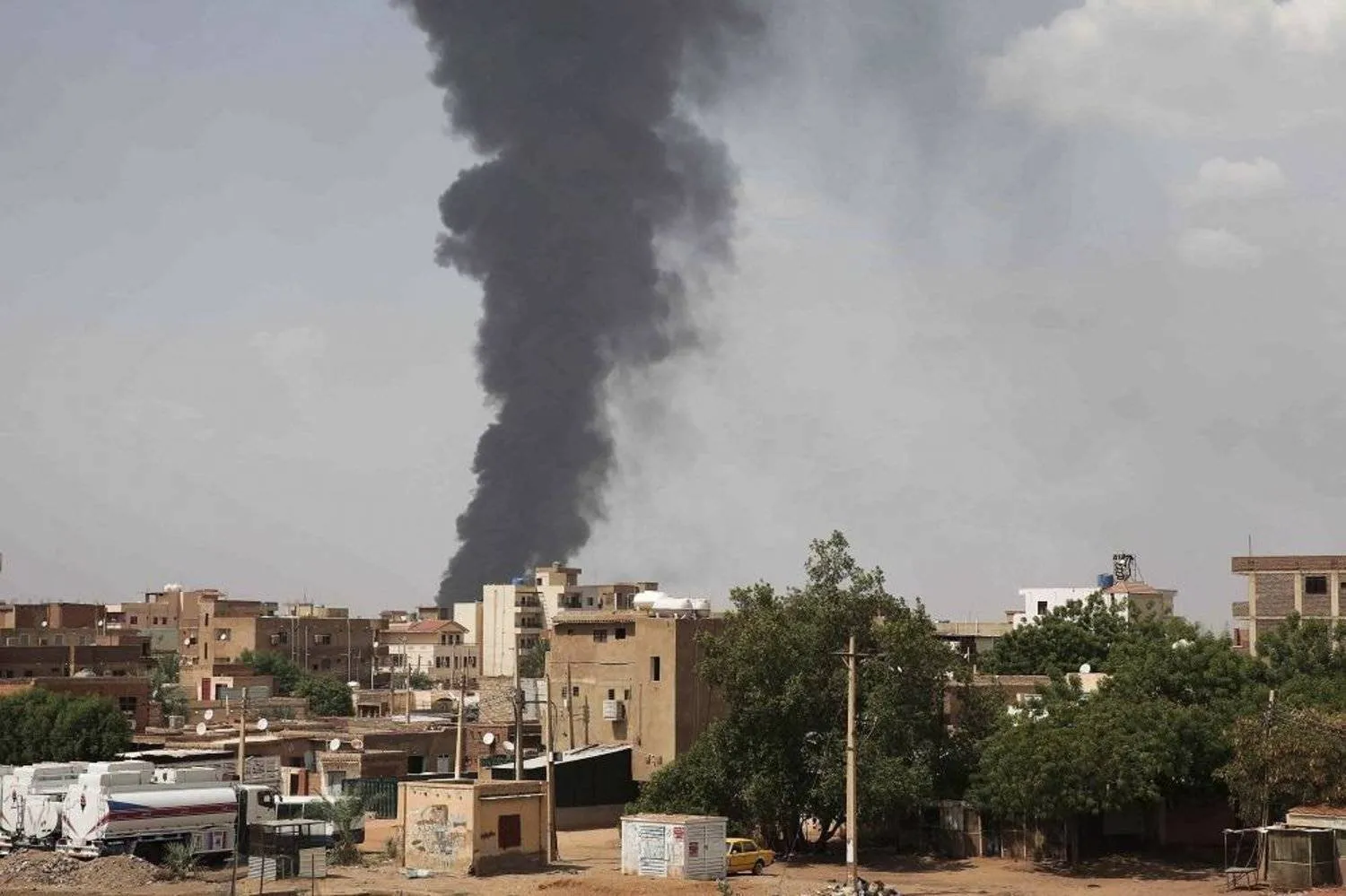
Smoke rises over Khartoum, Sudan, Thursday, June 8, 2023, as fighting between the Sudanese army and paramilitary Rapid Support Forces continues. (AP)
TT

Sudan Shelling Kills 15, RSF Claims Gains In Darfur

Smoke rises over Khartoum, Sudan, Thursday, June 8, 2023, as fighting between the Sudanese army and paramilitary Rapid Support Forces continues. (AP)

At least 15 civilians in Khartoum were killed on Saturday "when shells fell on their homes", a medical source said, as paramilitary fighters battling Sudan's army claimed gains in Darfur.

The victims' bodies were taken to Al-Nau hospital in Omdurman, a district of greater Khartoum, the medical source told AFP, speaking on condition of anonymity.

Fighting since April between the forces of army chief Abdel Fattah al-Burhan and his former deputy Mohamed Hamdan Daglo, who commands the Rapid Support Forces (RSF), has raged in heavily populated areas.

The struggle between the rival generals has crippled essential services in Sudan and razed entire neighbourhoods of the capital and the vast western region of Darfur.

In nearly seven months of war, more than 10,400 people have been killed, according to a conservative estimate from the Armed Conflict Location & Event Data Project.

The United Nations says the violence has forced more than 6 million people to flee, both within and outside Sudan.

Representatives of the warring sides are currently in the Saudi city of Jeddah for negotiations mediated by Saudi Arabia and the United States, but the fighting back home has raged unabated.

For weeks, the RSF has been advancing on army bases in Darfur, a region already scarred by decades of conflict and atrocities committed against civilians by armed groups including the RSF's predecessor, the Janjaweed militia.

On Saturday, the paramilitary force announced it had "liberated" an army base in El Geneina, the capital of West Darfur state where a communications blackout has raised fears of fresh horrors.

According to Clementine Nkweta-Salami, the UN's most senior representative in the country, reports of "civilians being caught in the ongoing fighting" in Darfur recall "the events in El Geneina" in June, when rights groups and witnesses reported massacres, rampant sexual violence and mass graves.

More than half a million people have fled the violence in Darfur to neighbouring Chad, which is just 30 kilometres (18 miles) from El Geneina.

The events in West Darfur and other reports of ethnically motivated killings by the RSF and allied militias have triggered a new investigation by the International Criminal Court into alleged war crimes and crimes against humanity.

The army base in El Geneina is the third the RSF has claimed to have captured in a week, after Zalingei, the capital of Central Darfur, and Nyala, the South Darfur state capital and the second largest city in Sudan.

US Secretary of State Antony Blinken issued an unusually strong statement on Monday, warning against signs of an "imminent large-scale attack" in El Fasher, the capital of North Darfur state.

The attack "would subject civilians, including hundreds of thousands of displaced persons -- many of whom only recently fled to El Fasher from other areas -- to extreme danger," Blinken said.

Darfur is a region the size of France, and home to a quarter of Sudan's 48 million people.

As Sudan's civilians face what UN humanitarian chief Martin Griffiths has called "one of the worst humanitarian nightmares in recent history", both sides have positioned themselves as peacemakers in the resumed negotiations in Saudi Arabia.

US officials say the goals for now are limited to allowing in humanitarian assistance and pushing for a sustainable ceasefire.

In previous negotiations, every agreed truce was almost immediately violated by both sides, and have both also been accused of obstructing, attacking or looting aid.

The RSF on Monday published a video of its commander, Daglo, who has kept mostly out of sight throughout the conflict, in which he blamed Burhan for the war and congratulated his forces for their "victory" in Darfur.

Daglo said the RSF "has no problem with peace", but it will not agree to "a ceasefire that allows the army" to regroup.



Sudan’s al-Burhan Orders Investigation Into Deadly Airstrike on Gold Mine

Sudan's army chief Abdel Fattah al-Burhan gestures to soldiers inside the presidential palace after the Sudanese army said it had taken control of the building, in the capital Khartoum, Sudan March 26, 2025. Sudan Transitional Sovereignty Council/Handout via REUTERS
TT

Sudan’s al-Burhan Orders Investigation Into Deadly Airstrike on Gold Mine

Sudan's army chief Abdel Fattah al-Burhan gestures to soldiers inside the presidential palace after the Sudanese army said it had taken control of the building, in the capital Khartoum, Sudan March 26, 2025. Sudan Transitional Sovereignty Council/Handout via REUTERS

Sudan's army chief Abdel Fattah al-Burhan has ordered a probe into what he called a "painful incident" near the Egyptian border, where an airstrike hit a gold mine two days earlier.

The estimated death toll from the airstrike has risen to more than 200 dead, with dozens wounded and missing.

Both the National Umma Party and the Darfur Victims Advocacy organization put the death toll at 200 and the number of injured at around 120.

The Emergency Lawyers, a rights group documenting abuses in the war between Sudan's army and the Rapid Support Forces (RSF), said the strike in the mountainous Jabal al-Uqaydat mining area on Saturday killed 72 people.

In a statement on Monday, Sudan's Transitional Sovereignty Council, which Burhan heads as army chief, said he had formed a fact-finding committee made up of prosecutors, judicial officials and security representatives "to investigate the circumstances of the incident" and "submit a report on the results.”

The council added that Sudanese and Egyptian authorities "had remained in contact" since the strike to determine what happened.

In a phone call with his Sudanese counterpart on Monday, Egyptian Foreign Minister Badr Abdelatty stressed the "mutual respect that binds the two brotherly nations,” including respect for each state's "territorial integrity and safety of its territory and borders.”


Syria Establishes ‘Capital Security Service’ to Bolster Damascus Security

Syria's Interior Minister Anas Khattab (C) inspects an area near the Four Seasons Hotel following two blasts in Damascus on July 7, 2026. (Photo by LOUAI BESHARA / AFP)
TT

Syria Establishes ‘Capital Security Service’ to Bolster Damascus Security

Syria's Interior Minister Anas Khattab (C) inspects an area near the Four Seasons Hotel following two blasts in Damascus on July 7, 2026. (Photo by LOUAI BESHARA / AFP)

Syria established a special security service apparatus for its capital, Damascus, in a bid to bolster security, uncover sleeper cells and thwart attempts to destabilize the city, a senior Syrian military official told Asharq Al-Awsat Tuesday.

The official told the daily that the Capital Security Service was established and Brig. Gen. Abdul Aziz Hilal al-Ahmad appointed as its chief to “bolster security in Damascus through a more targeted approach and uncover any sleeper cells seeking to undermine the capital’s security.”

The official said he did not believe Damascus faced any immediate threat, but warned that “sabotage cells” continued to seek to undermine security in the capital, driven by foreign agendas and ties. He also accused Israel and Iran of seeking to destabilize Syria by backing local sabotage groups operating across several provinces.

The official stressed that Damascus hosts foreign embassies, diplomatic missions and offices of international and United Nations agencies and organizations, making it a key center of state sovereignty. Any breach of the capital’s security would undermine the state’s credibility and authority, he said, adding that the new service was intended to thwart attempts to unsettle the city.

Brig. Gen. Abdul Aziz Hilal al-Ahmad previously headed internal security in Latakia province, where he led operations against armed groups and former military and security figures linked to Bashar al-Assad’s regime after taking office on May 25, 2025.

No official decree announcing al-Ahmad’s appointment has been issued, though security and military sources confirmed it to several media outlets, including Asharq Al-Awsat. On Saturday, the Interior Ministry named Brig. Gen. Nayef al-Ibrahim as his successor in Latakia.

Since the ouster of the former regime, Syria’s new authorities have worked to rebuild and modernize the security sector with regional and international support. However, repeated security incidents in Damascus over the past two years have underscored persistent instability and security gaps, with experts saying much work remains to prevent further bombings.

Wael Alwan, executive director of the Jusoor Center for Studies, told Asharq Al-Awsat that authorities were working to restore security and stability across Syria, but intelligence reports pointed to activity in Damascus by Iran-backed Hezbollah and affiliated local groups, as well as ISIS.

He said previous attacks by ISIS cells and remnants of the former regime appeared aimed more at generating media attention than striking strategic security, political or military targets, citing rocket fire toward the Mazzeh area and explosions during the French president’s visit.

Alwan said Iran-backed groups, ISIS and Israeli interference sought to portray Syria as unstable and its government as unable to maintain security, undermining recovery by deterring investment, curbing tourism and deepening economic and social pressures. He added that Iran stood to benefit from chaos, which could create opportunities for its allied militias and former regime loyalists to return, rebuild their networks and expand their influence.

Alwan said the establishment of the Capital Security Service reflected the government’s cautious approach and efforts to preempt security threats by strengthening surveillance and intelligence capabilities to track former regime loyalists, ISIS cells and Iran-backed operatives, and thwart attacks before they occur.

For his part, Syrian political and security researcher Diaa Qaddour told Asharq Al-Awsat that the appointment was part of a broader restructuring of security agencies following the ouster of the former regime, reflecting a focus on securing the capital against threats from ISIS and dormant Iran-linked cells to reinforce state authority and prevent chaos.


Baghdad Accuses Tehran, Washington of ‘Strangling’ the Iraqi Economy

The Prime Minister lays the foundation stone for the “Watan Initiative” in Nineveh on Monday (PM's Media Office)
TT

Baghdad Accuses Tehran, Washington of ‘Strangling’ the Iraqi Economy

The Prime Minister lays the foundation stone for the “Watan Initiative” in Nineveh on Monday (PM's Media Office)

Iraqi government spokesman Haider Al-Aboudi has accused both Iran and the United States of “strangling” Iraq’s economy by failing to grant exemptions that would allow Iraqi oil exports through the Strait of Hormuz.

In a television interview, Al-Aboudi said: “Iraq’s economy is living under the burden of a suffocating blockade, with a complete absence of any Iranian or American response to granting exemptions for oil exports.”

Al-Aboudi also launched a sharp attack on the government of former Prime Minister Mohammed Al-Sudani, accusing it of causing losses of nearly 36 trillion Iraqi dinars to the state treasury through its 2023 decision to reduce the exchange rate from 1,470 dinars per U.S. dollar to 1,320 dinars per dollar.

His remarks come as the current government seeks to counter criticism over its decision, announced last Tuesday, to devalue the dinar to 1,520 per dollar.

The decision to alter the exchange rate continues to generate significant debate as the government has failed to close the gap between the official rate of 1,520 dinars per dollar and the parallel market rate of 1,630 dinars. This discrepancy has contributed to substantial increases in the prices of many essential goods, including food items.

The exchange-rate issue has also sparked broad political reactions. Nouri Al-Maliki, leader of the State of Law Coalition, called in a post on X for citizens not to use the dollar exchange-rate adjustment as a pretext for stirring concern.

Despite measures introduced by the government to curb soaring prices, including injecting additional dollars into the market and offering construction materials to citizens through installment-payment schemes, prices have remained high. This has exposed the government to further public and political criticism.

Legal Challenge

Observers do not rule out the possibility that Prime Minister Ali al-Zaidi could face legal scrutiny. Saud al-Saadi, head of the parliamentary Huqooq Bloc, has filed an official appeal before the Federal Supreme Court, challenging Cabinet Resolution No. 544 concerning the exchange rate of the US dollar against the Iraqi dinar.

Speaking to the press on Monday, al-Saadi said that the Court had received the appeal and informed him that an official hearing date would be scheduled at a later time.

Denial of Pursuing Currency Speculators

In a related development, Al-Aboudi stated that the prime minister had “categorically rejected any intervention by security agencies or the use of police measures to regulate the market.”

The denial came in response to an audio recording in which a citizen called the Interior Ministry’s complaints hotline and asked whether complaints or reports could be filed against exchange companies selling dollars at the parallel-market rate of 1,650 dinars, compared with the official rate of 1,520 dinars per dollar. A complaints official reportedly answered in the affirmative.

On Sunday evening, both the Security Media Cell and the Ministry of Defense quickly denied that the complaints official’s response reflected government policy.

In a statement, the Security Media Cell said that directives from Commander-in-Chief Ali al-Zaidi emphasized that the dollar exchange-rate issue is a financial and economic matter, not a security matter.

The statement stressed that exchange rates are governed by market mechanisms and the laws of supply and demand and fall under the jurisdiction of financial and monetary authorities, foremost among them the Central Bank of Iraq.

The statement further underscored that there are no instructions for security forces to intervene in market activity or influence exchange rates, noting that their role is limited to enforcing the law and carrying out judicial orders issued by competent authorities.

It added that any action taken against violators or individuals engaged in illegal foreign-currency transactions would be conducted in accordance with established legal and judicial procedures and in coordination with the Central Bank of Iraq, which is responsible for supervising financial and banking institutions, regulating exchange companies, monitoring compliance with relevant regulations, and taking the necessary administrative measures to safeguard financial transactions and support duly licensed firms.

The Security Media Cell called on citizens, merchants, exchange companies, and market participants to remain reassured and continue conducting their lawful financial and commercial activities normally.

The complaints official’s remarks had reportedly alarmed exchange companies, which often have to deal according to prevailing market rates rather than the official rate. Some industry workers said the comments actually contributed to driving exchange rates higher in the parallel market rather than lowering them.

Personal Conduct

As a result of the confusion and concern caused by the audio recording, the Interior Ministry issued a statement clarifying the circumstances surrounding the phone call made by a citizen to an employee of the Central Response and Control Directorate (911), who had been asked about dollar buying and selling rates at exchange companies.

The ministry stated that the employee’s response constituted “a personal action” and did not represent the ministry’s official position, as he was not authorized to provide information or statements on matters outside the scope of his assigned duties and responsibilities.

The ministry also confirmed that it had taken the necessary legal measures against the employee in accordance with applicable regulations and instructions, reaffirming its commitment to professional discipline within the public service.