


Arab States Urge Security Council to Adopt Resolution to End War on Gaza

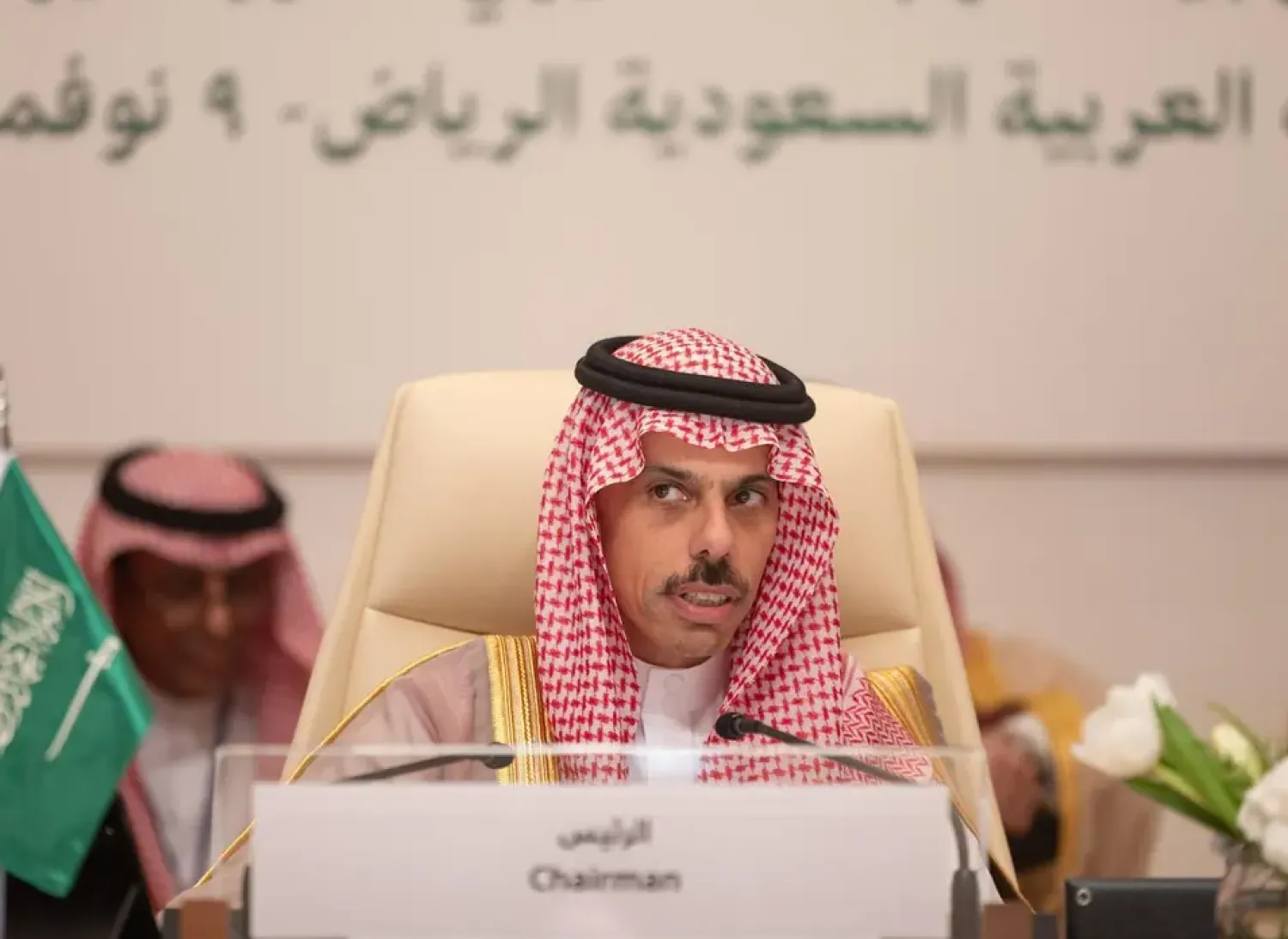
Saudi FM Prince Faisal bin Farhan chairs a meeting of Arab foreign ministers in Riyadh. (SPA)
TT

Arab States Urge Security Council to Adopt Resolution to End War on Gaza

Saudi FM Prince Faisal bin Farhan chairs a meeting of Arab foreign ministers in Riyadh. (SPA)

The Arab foreign ministers asserted the need for the upcoming Arab Extraordinary Summit on Palestine to take decisions that lead to an immediate cessation of Israeli military operations and end Palestinians' tragedies in Gaza.

Saudi Minister of Foreign Affairs Prince Faisal bin Farhan chaired the Arab foreign ministers' preparatory meeting for the extraordinary session of the Arab Summit to discuss Israeli aggression on the Gaza Strip.

The Arab League Secretary-General, Ahmed Aboul Gheit, and various Arab ministerial delegations attended the meeting.

On Saturday, the Arab League will hold an extraordinary session in Riyadh entitled "Solidarity with Palestine."

Speaking before the ministers, the Saudi Foreign Minister stressed that the upcoming summit comes in response to the critical situation in the Strip.

Prince Faisal called on the international community, including the Security Council, to shoulder the responsibilities and take deterrent action to end this tragedy.

He asserted that the Security Council must issue a resolution aimed at an immediate cessation of military operations, providing civil protection, releasing hostages and prisoners, and stopping the forced displacement of Palestinians in compliance with international laws and common humanitarian principles.

The Saudi FM also called for lifting the siege on the enclave and enabling the delivery of relief aid and urgent medical supplies without restrictions and in a sustainable manner.

It would alleviate the humanitarian catastrophe that claimed the lives of innocent people, more than half of whom were children and women.

The situation warns of serious consequences for regional and international security and stability.

He declared that within the framework of Saudi Arabia's awareness of its international responsibility and in line with the principles of humanitarian solidarity, the King Salman Humanitarian Aid and Relief Center (KSrelief) launched the Sahm platform to provide relief to the Palestinian people.

"The Kingdom will spare no effort to alleviate the humanitarian suffering of our Palestinian brothers and provide them with a dignified life," Prince Faisal said.

Bin Farhan stressed the importance of achieving just, comprehensive, and lasting peace under international legitimacy resolutions.

He reiterated the call for establishing a Palestinian state on the 1967 borders with East Jerusalem as its capital, reiterating the Kingdom's strategic commitment to peace.

Since the outbreak of the war, the Kingdom has been keen to consult and coordinate with its international brothers and partners to search for a solution, said the Minister.

He hoped the summit will contribute to stimulating the international community into taking decisive action to stop the bloodshed and create the appropriate conditions to work towards peace.

At the end of their meeting, the Arab ministers agreed on several points, including condemning the Israeli aggression against the Strip and its war crimes and stressing the need to halt it.

They warned the international community against the continuation of the attack and the killing and destruction it causes.

In turn, Arab League Assistant Sec-Gen Hossam Zaki confirmed that the meeting approved the final version and draft resolution that will be submitted to the summit on Saturday.

The Arab position demands a ceasefire in the Palestinian territories, asserted Zaki.

He explained that the meeting discussed a group of Arab political positions on the Palestinian issue, which allows the international community to understand the Arab and Palestinian situation in a way that boosts efforts aimed at ending Israeli aggression.

He also asserted that the Arab position was clear and explicit on "an immediate ceasefire." ‏

Zaki reiterated the Arab rejection of all ideas or efforts of the occupying forces or other countries to separate Gaza from the rest of the occupied Palestinian territory, adding that the Arab position does not agree with this position.



Lebanon Says France to Host Conference to Support Army

French Special Presidential Envoy to Lebanon, Jean-Yves Le Drian looks on during a meeting with Lebanese Prime Minister Nawaf Salam (not pictured) at the Government Palace in Beirut, Lebanon, 14 January 2026. (EPA)
TT

Lebanon Says France to Host Conference to Support Army

French Special Presidential Envoy to Lebanon, Jean-Yves Le Drian looks on during a meeting with Lebanese Prime Minister Nawaf Salam (not pictured) at the Government Palace in Beirut, Lebanon, 14 January 2026. (EPA)

Lebanon said Wednesday that a conference in support of the country's army as it seeks to disarm Hezbollah would take place in Paris on March 5.

The announcement follows recent promises of support to the military, which lacks funds, equipment and technical expertise.

Presidency spokeswoman Najat Charafeddine said President Joseph Aoun met French envoy Jean-Yves Le Drian, Saudi envoy Yazid bin Farhan and ambassadors including from the US, Egypt and Qatar, discussing preparations for "a conference to support the Lebanese army and internal security forces".

"It was decided to hold the conference in Paris on March 5, to be opened by French President Emmanuel Macron," she said at the presidential palace.

Under US pressure and fearing expanded Israeli strikes, Lebanon has committed to disarming the Iran-backed Hezbollah, which was badly weakened in more than a year of hostilities with Israel that largely ended in late 2024.

Last week, Lebanon's army said it had completed the first phase of its plan to disarm the group, covering the area south of the Litani river, around 30 kilometers (20 miles) from the Israeli border.

A plan for the disarmament north of the Litani is to be presented to cabinet next month.
Israel, which accuses Hezbollah or rearming, has criticized the army's progress as insufficient, while Hezbollah has rejected calls to surrender its weapons.

Lebanon's army has dismantled tunnels and other military infrastructure belonging to Hezbollah near the Israeli border in recent months, seizing weapons and ammunition, despite its limited capacities.

Despite the ceasefire, Israel has kept up regular strikes on Lebanon, usually saying it is targeting Hezbollah, and has maintained troops in five south Lebanon areas it deems strategic.

Last month, talks with international envoys in Paris touched on the Lebanese army's needs, while its chief agreed to document its progress in disarming Hezbollah.


Iraqi Officials Arrest Man Wanted by Australian Police as 'Number One Priority'

Australian Federal Police Commissioner Krissy Barrett said the arrested man, Kazem Hamad, was a threat to national security. (Getty Images file)
TT

Iraqi Officials Arrest Man Wanted by Australian Police as 'Number One Priority'

Australian Federal Police Commissioner Krissy Barrett said the arrested man, Kazem Hamad, was a threat to national security. (Getty Images file)

Iraqi officials have arrested a man wanted by Australian Federal Police as a person of interest in ​the investigation into a spate of firebombings, including an antisemitic attack on a Melbourne synagogue, police said on Wednesday.

Australian Federal Police Commissioner Krissy Barrett said the arrested man, Kazem Hamad, was a threat to national security and that she had identified ‌him as her "Number ‌One priority".

Iraq's National ‌Center ⁠for ​International ‌Judicial Cooperation said in a statement that Kadhim Malik Hamad Rabah al-Hajami had been arrested as part of a drugs investigation, after a request from Australia.

Barrett said Iraqi officials had made an independent decision to arrest the man ⁠in their own criminal investigation, after Australian Federal Police provided ‌information to Iraqi law enforcement ‍late last year.

"This ‍arrest is a significant disruption to an ‍alleged serious criminal and his alleged criminal enterprise in Australia," she said in a statement.

In October, Barrett said that in addition to being a ​suspect in arson attacks in Australia linked to the tobacco trade, the man ⁠was "a person of interest in the investigation into the alleged politically-motivated arson attack on the Adass Israel Synagogue" in Melbourne.

Australia expelled Iran's ambassador in August after the Australian Security Intelligence Organization traced the funding of hooded criminals who allegedly set fire to the Melbourne synagogue in December 2024 to Iran's Revolutionary Guard Corps.

Hamad, previously convicted in Australia for drug trafficking ‌offences, was deported from Australia to Iraq in 2023.


Syria Asks Lebanon to Hand Over Assad-Era Officers

A drone view shows the port of the coastal city of Latakia, Syria, March 11, 2025. (Reuters)
TT

Syria Asks Lebanon to Hand Over Assad-Era Officers

A drone view shows the port of the coastal city of Latakia, Syria, March 11, 2025. (Reuters)

Syrian authorities have asked Lebanese security forces to hand over more than 200 senior officers who fled to Lebanon after the fall of Bashar al-Assad, following a Reuters investigation that showed how the neighboring country was a hub for insurgent plotting.

On December 18, a ​top Syrian security official, Brig. Abdul Rahman al-Dabbagh, met with his Lebanese counterparts in Beirut to discuss the exiled Assad-era officers, according to three senior Syrian sources, two Lebanese security officials, and a diplomat with knowledge of the visit.

The meetings came days after a Reuters investigation detailed rival plots being pursued by Rami Makhlouf, the billionaire cousin of the ousted president, and Maj. Gen. Kamal Hassan, former head of military intelligence, both living in exile in Moscow, to finance potential Alawite militant groups in Lebanon and along the Syrian coast. Syria and Lebanon share a 375-kilometer border.

The two rival camps aim to undermine the new Syrian government under President Ahmed al-Sharaa. Reuters found they are sending money to intermediaries in Lebanon to try and stir uprisings that would divide Syria and allow the plotters to regain control over the coastal areas. The population of those areas is dominated ‌by Alawites, the minority ‌sect associated with the Assad family and the dictatorship’s ruling elite.

Al-Dabbagh, an aide to the ‌head ⁠of ​internal security ‌in Syria’s Latakia province, an Alawite stronghold, met with Lebanese intelligence chief Tony Kahwaji and Major General Hassan Choucair, head of the General Security Directorate, and presented them with the list of senior officers wanted by Syria.

The visit focused on gathering information about the whereabouts and legal status of the officers, as well as trying to find ways to prosecute or extradite them to Syria, according to the Syrian sources.

They described it as a direct request from one security agency to another, rather than a demand for extradition.

Three senior Lebanese security officials confirmed the meetings. One of the Lebanese officials denied receiving any demands from the Syrians to hand over the officers. Two others acknowledged receiving a list of names but said none were senior officers.

One of the Lebanese security ⁠officials said there is no evidence of any insurgency being planned, despite the threats against Syria’s new government detailed in the Reuters reporting.

All the officials spoke on condition of anonymity to reveal details of ‌a highly sensitive cross-border issue.

Among the names handed over by Syrian officials to ‍Lebanon were several high-ranking figures acting as intermediaries for Makhlouf or Hassan in ‍Lebanon, according to a Syrian source who saw the list.

A Lebanese judicial official said Syria had not made a formal extradition request to ‍Lebanon, typically done through the two countries’ justice and foreign ministries.

Accompanying Dabbagh on his Beirut visit was Khaled al-Ahmad, a former Assad advisor and childhood friend of Sharaa, who is leading the government’s efforts to win over the Alawite community through development projects and aid, according to two witnesses who saw the men together on that mid-December day.

According to the two witnesses, who are both ex-Assad officers, al-Ahmad and Dabbagh went together to an upscale Beirut restaurant that is popular among Assad’s ​men. The two witnesses said they and others interpreted the outing as a warning to those trying to influence Alawites to rise up against Syria’s new leaders that Lebanon is no longer a haven.

In a January 2 post on X, Lebanese Deputy Prime Minister Tarek Mitri called on his government’s security agencies to verify the information circulating in the media and take action against the Lebanon-based agents for Assad’s former insiders, Makhlouf and Hassan.

“It is incumbent upon them, and upon all of us, to avert the dangers of any actions that undermine Syria’s unity or threaten its security and stability, whether in Lebanon or originating from it,” the tweet read.

In response to questions from Reuters, Lebanon’s General Security referred to January 11 remarks by Lebanese President Joseph Aoun, who said Lebanon’s military intelligence and other security agencies had carried out raids in several areas of the country’s north and east.

Aoun said the raids did not produce evidence of the presence of officers linked to the Assad dictatorship and said Lebanon was continuing to coordinate with Syria on the issue.

Syrian government officials did not respond to requests for comment.

From January 3 to January 6, Lebanese soldiers raided locations and shelters housing displaced Syrians. The Lebanese Army said 38 Syrians were arrested during the raids on different charges such as possession of drugs or weapons, or entering the country illegally.

A senior Lebanese security official told Reuters those ‌raids were linked to the exiles’ plots.

Another senior Lebanese security official emphasized that there was no arrest warrant for the Syrian officers in Lebanon, nor Interpol requests for them.

“We can't do anything against them,” the official added.