


Paris Int’l Conference Focuses on Humanitarian Aid for Gaza, Discusses War's Political Aspects

International Humanitarian Conference for the Civilian Population in Gaza at the Elysee Palace in Paris on Thursday (AP)
TT

Paris Int’l Conference Focuses on Humanitarian Aid for Gaza, Discusses War's Political Aspects

International Humanitarian Conference for the Civilian Population in Gaza at the Elysee Palace in Paris on Thursday (AP)

France hosted a conference Thursday on humanitarian aid for Gaza, calling for a "humanitarian pause" in the Israel-Hamas war so countries can "work towards a ceasefire."

French President Emmanuel Macron chaired the only session of the "International Humanitarian Conference for the Civilian Population in Gaza."

France divided the session into two parts: one open to the public and the media, while the second was closed and limited to the participating official eighty delegations, including representatives of international organizations and civil society organizations.

The conference did not include strong representation, while the Elysee Palace was counting on a summit that brought together several heads of state and government.

Palestinian Prime Minister Ahmed Shtayyeh was the only Arab top official at the summit, along with the Presidents of Ireland and Cyprus and the prime ministers of Greece and Luxembourg.

Paris did not extend invitations to Israel, Iran, and Russia. However, no official representatives from Lebanon, Syria, Yemen, Libya, and Sudan attended the summit for various reasons, including wars or economic hardship.

- Four themes

During the conference, four main themes dominated the speeches of state and international organizations representatives.

The first theme focused on the insufficient aid delivered to Gaza, mainly through the Rafah crossing on the border with Egypt, noting that two other crossings must be considered, such as the Kerem Shalom crossing and another based on a Cypriot proposal.

Cyprus President Nikos Christodoulides detailed his 25-page plan to open a direct path by sea to provide a continued rapid, safe, and unhindered flow of humanitarian aid pragmatically and effectively.

According to Christodoulides, the proposal is carefully studied and can be implemented, provided that there is political cover, primarily meaning Israel and the Palestinians accept the establishment of the necessary infrastructure for the humanitarian maritime corridor to Gaza.

The Cypriot President noted that "humanitarian" ships, which can be escorted by military personnel to reach their destination, can transport thousands of tons, unlike land transport.

- Obstacles to Rafah port

The Greek Prime Minister praised the Cypriot project and suggested providing Greek naval ships for this purpose.

However, given the obstacles that Israel imposes regarding the Rafah port to slow down the movement of trucks toward Gaza, the Cypriot proposal could require intense political and diplomatic pressure until it sees the light.

Furthermore, the conference witnessed several proposals to establish field hospitals, remove the wounded from Gaza, and provide financial aid to UNRWA and humanitarian organizations.

The second theme emerged unanimously and strongly through speeches and discussions, asserting the need for humanitarian truces and ceasefires. It aimed to facilitate the arrival and distribution of humanitarian aid and end the Israeli massacres in the enclave.

Opinions varied between parties calling for temporary humanitarian truces and others insisting on a complete ceasefire. Still, the general atmosphere that dominated the conference demonstrated the need to take action.

During his speech, Shtayyeh wondered how many Palestinians must be killed for the war to stop.

"Is killing 10,000 people in 30 days enough?"

Shtayyeh gave a quick presentation of the 75 years of Palestinian suffering in Gaza, Jerusalem, and the West Bank.

Shtayyeh said that it was the sixth and not the first war carried out by Israel against Gaza, concluding that it was a war against the Palestinian people.

- The two-state solution

The third theme of the Paris Conference reiterated the necessity of reactivating the political track and the two-state solution.

Macron referred to the humanitarian and security axes in his opening speech, including fighting Hamas and restricting funding sources. He also addressed the political path of diplomatic work, asserting the need to resume bringing peace to the Middle East with a two-state solution.

"We must learn from our errors and no longer accept that peace in the Middle East always be pushed back to later," he said.

As the fighting continues, the humanitarian situation "is worsening more and more each day," Macron said.

The last theme of the conference warned that the situation could be out of control with the ongoing fighting, escalation, bombing, and casualties, adding that it could expand to other fronts and perhaps lead to a regional war.

The conference also included influential speeches from the United Nations, UNRWA, and the International Committee of Red Cross Committee (ICRC).

UNRWA Commissioner-General Philippe Lazzarini described the situation in Gaza as "catastrophic," refusing to consider civilian casualties, especially children, as "collateral damage."

In his speech, Lazzarini referred to the destruction of entire neighborhoods, including schools, mosques, hospitals, and churches.

He condemned depriving civilians of food, water, and medicine, saying it was collective punishment.

The UN official called for an immediate ceasefire, asserting the need to protect civilian infrastructure necessary for life and an acceleration of the flow of humanitarian aid.

Lazzarini also addressed the situation in the West Bank, warning that military incursions by the Israeli Forces and settler violence have caused "record high death tolls among Palestinians.

If we did not have Gaza today, all our attention would be on the West Bank."

- Immediate ceasefire

Also at the conference, Under-Secretary-General for Humanitarian Affairs and Emergency Relief Coordinator Martin Griffiths said the "so-called safe zones" are nonsense, pointing to serious concerns about the safety of the civilians.

Griffiths warned that "unless multilateral and diplomatic efforts can be maximized to ensure the protection of civilians, enhance humanitarian access and secure the release of the hostages so viciously taken on October 7th, I have real fears that this could just be the beginning."

For her part, President of the French section of Doctors Without Borders (MSF) Isabelle Dufourny said there were no safe zones in Gaza, and a third of the Gazan victims were killed in those areas.

Dufourny informed the conference that 700 humanitarian organizations and associations demanded an immediate ceasefire.

ICRC President Mirjana Spoljaric denounced Israel's targeting of all buildings in northern Gaza as military targets, adding: "We are confronted with a catastrophic moral failing, one that the world must not tolerate."

Egypt denounced the international silence regarding Israeli violations of international humanitarian law in the Palestinian territories.

Foreign Minister Sameh Shoukry said the Israeli government is going beyond the "right to self-defense," expressing his regret at the "double standards."

Shoukry believed that the aid that entered the Strip did not meet the needs, criticizing Israel and the "complex procedures" it imposes on the entry of aid into the enclave.

- Respect international humanitarian law

The attendees condemned Israel's war on Gazans and demanded respect for international humanitarian law. They also blamed Hamas "terrorist act" calling for the "immediate and unconditional release" of all captives with the organization.

The conference sought to mobilize financial resources, identifying several sectors to receive emergency support based on United Nations assessments of urgent needs amounting to $1.1 billion.

They also discussed restoring water, fuel, and electricity supplies and establishing accountability to ensure that aid is not diverted to Hamas.

Macron revealed that France will increase aid to the Palestinians from €20 million to €100 million in 2023.

The European Commission also reported that the European Union decided to quadruple the planned aid to Gaza to reach €100 million, in addition to the air bridge to transport aid through al-Arish Airport.
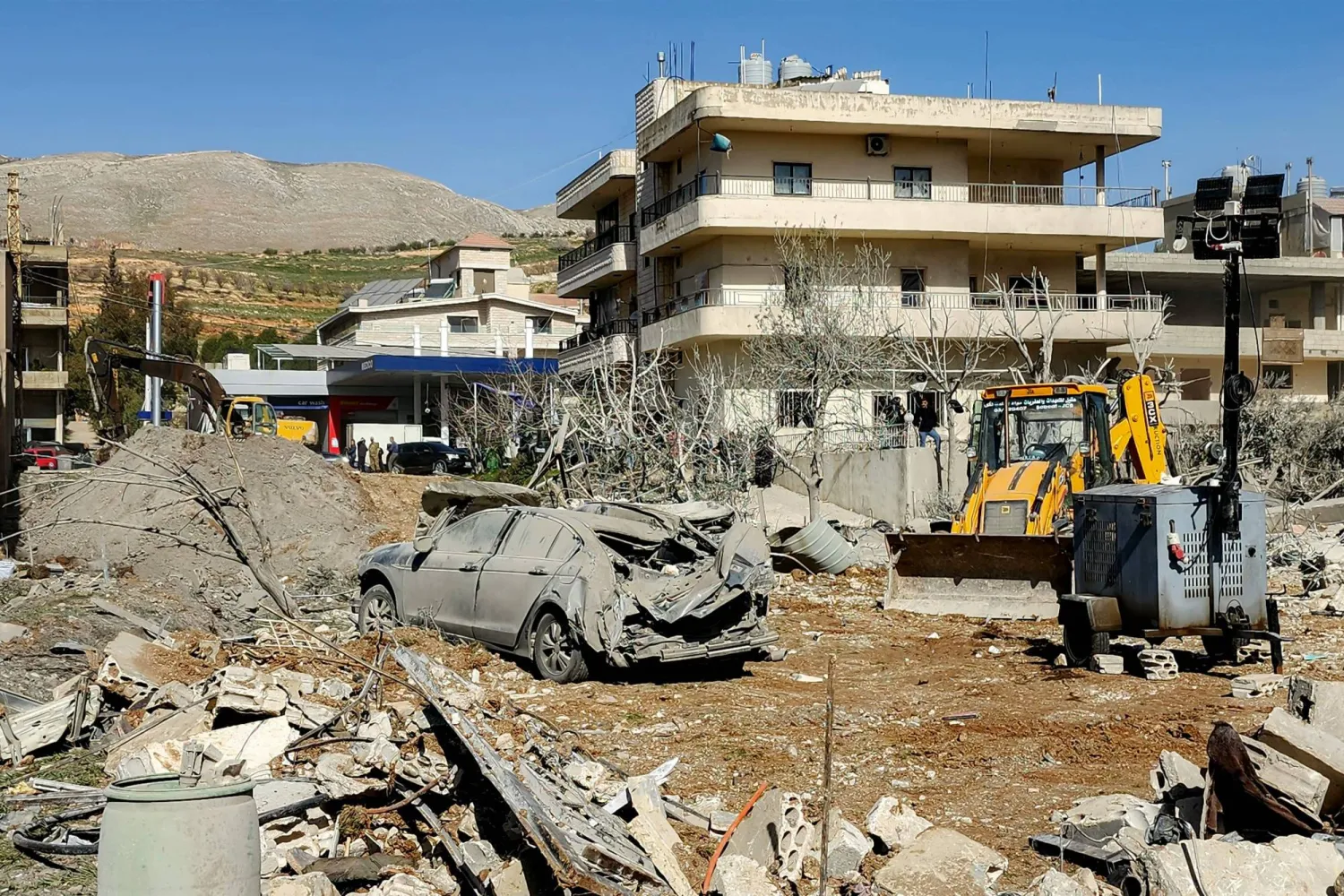


Eight Hezbollah Members Killed in Israel’s Friday Strikes on Lebanon

A bulldozer clears debris near heavily-damaged buildings in the village of Bednayel in Lebanon's eastern Bekaa Valley region on February 21, 2026, following Israeli strikes. (AFP)
TT

Eight Hezbollah Members Killed in Israel’s Friday Strikes on Lebanon

A bulldozer clears debris near heavily-damaged buildings in the village of Bednayel in Lebanon's eastern Bekaa Valley region on February 21, 2026, following Israeli strikes. (AFP)

Attacks carried out by Israel on Friday in eastern Lebanon killed eight members of Hezbollah, an official from the group told AFP on Saturday.

Lebanon's health ministry said Friday that a total of 10 people were killed in strikes that hit the eastern Bekaa region.

The Israeli military said it targeted "several terrorists of Hezbollah's missile array in three different command centers in the Baalbek area".

Lebanon's president on Saturday condemned the attacks, the latest despite a ceasefire with Hezbollah.

In a statement, Joseph Aoun called the attacks "a blatant act of aggression aimed at thwarting diplomatic efforts" by the United States and other nations to establish stability.

A lawmaker from Hezbollah called on Beirut to suspend meetings of a multinational committee tasked with monitoring the truce.

Washington is one of five members on the committee overseeing the ceasefire implemented in November 2024, with the body scheduled to meet again next week.

Israel has repeatedly bombed Lebanon despite the ceasefire, usually saying it is targeting Hezbollah but occasionally also the group's Palestinian ally Hamas.

The Friday attacks on southern and eastern Lebanon killed 12 people, according to the health ministry, 10 of them in the east of the country.

Israel's military said it struck "several terrorists of Hezbollah's missile array in three different command centers in the Baalbek area".

Hezbollah said a commander was killed in the raids. Its lawmaker Rami Abu Hamdan said on Saturday the group "will not accept the authorities acting as mere political analysts, dismissing these as Israeli strikes we have grown accustomed to before every meeting of the committee".

He called on Beirut to "suspend the committee's meetings until the enemy ceases its attacks".

Hezbollah, while weakened following war with Israel, remains a strong political force in Lebanon represented in parliament.

Lebanon's government last year committed to disarming the Iran-backed group, with the army saying last month it had completed the first phase of the plan covering the area near the Israeli border.

Israel, which accuses Hezbollah of rearming since the war, has called the Lebanese army's progress on disarming the group insufficient.


Ramadan’s First Friday Prayers Are Held at Jerusalem’s Al-Aqsa Mosque

Palestinians worshippers gather at Al-Aqsa Mosque compound for the first Friday prayers during the holy month of Ramadan, in the Old City of Jerusalem, 20 February 2026. (EPA)
TT

Ramadan’s First Friday Prayers Are Held at Jerusalem’s Al-Aqsa Mosque

Palestinians worshippers gather at Al-Aqsa Mosque compound for the first Friday prayers during the holy month of Ramadan, in the Old City of Jerusalem, 20 February 2026. (EPA)

Tens of thousands of Palestinians gathered under heavy Israeli restrictions at Jerusalem's Al-Aqsa Mosque compound for the first Friday prayers of the Muslim holy month of Ramadan, including some who were allowed to enter from the occupied West Bank.

The Ramadan prayers at Al-Aqsa took place for the first time since a shaky ceasefire deal between Israel and Hamas went into effect in October. It was the first opportunity many had to leave the West Bank and pray at the site in Jerusalem’s Old City since Ramadan last year.

Israel restricted the number of Palestinians allowed to enter from the West Bank to 10,000 on Friday, and only allowed men over 55 and women over 50 as well as children up to 12. It has imposed similar restrictions in the past, citing security concerns.

The hilltop, which Jews refer to as the Temple Mount, is the holiest site in Judaism and was home to the ancient biblical temples. Muslims call the site the Noble Sanctuary. Today it is home to Al-Aqsa Mosque, the third-holiest site in Islam.

It has frequently been a flashpoint in the Israeli-Palestinian conflict.

Israeli police said more than 3,000 police were deployed across Jerusalem. They said their presence was not meant to show aggression or force but was aimed at providing help in case of an emergency.

Many Palestinians view the heightened Israeli security presence, and increasing visits by religious and nationalist Israeli Jews, as a provocation. They fear that Israel intends to take over or partition the compound. The Israeli government denies having any such plans.

Jerusalem’s Islamic Waqf, the Jordanian religious authority that administers the compound, said there were 80,000 in attendance. In normal times, Ramadan Friday prayers at Al-Aqsa can draw up to 200,000.

Ezaldeen Mustafah, a Palestinian from the West Bank, was among those lamenting the restrictions.

“We need more people than this,” he said.

Some Palestinians from the West Bank on Friday said they were turned away from crossing into Jerusalem even though they had permits. Jihad Bisharat said he was told his permit had been canceled and was sent back. Israel's army didn't immediately respond to a request for comment.

The Old City, home to major religious sites sacred to Jews, Christians and Muslims, is in east Jerusalem, which Israel captured in the 1967 Mideast war, along with the West Bank and the Gaza Strip. The Palestinians want all three territories for a future state with its capital in east Jerusalem. Israel annexed east Jerusalem, a move not recognized by most of the international community, and considers the entire city to be its capital.

Ramadan in Gaza

Many Palestinians said the month’s typically festive spirit is eluding them as they struggle with grief and losses following two years of conflict in Gaza sparked by Hamas' Oct. 7, 2023, attack into Israel.

“All the mosques have been bombed,” said Ramiz Firwana, a Gaza resident who gathered with other worshippers for a Friday sermon and prayers held in schoolyard.

On Thursday evening, families sat amid the rubble and destruction for iftar, the meal held at the end of the daily dawn-to-dusk fast.

“Despite the displacement, the pain and the destruction, we want to rejoice and live,” said Mohammad Kollab, from Khan Younis. “We are not a people destined only for destruction and killing."

Israel’s military offensive has killed more than 72,000 Palestinians, according to Gaza’s Health Ministry, and caused widespread destruction and displaced most of the territory’s residents. Israel launched the offensive after Hamas-led militants killed some 1,200 people, mostly civilians, and took another 251 hostage in the initial attack.

The Oct. 10 US-brokered ceasefire deal has brought an end to major military operations and the release of the remaining hostages. But Palestinians, including many civilians, are still being killed in near-daily strikes that Israel says are aimed at militants who threaten or attack its forces.


Parliamentary Elections Preparations Kick off in Lebanon Despite Doubts They Will Be Held

Head of the Lebanese Forces Samir Geagea announces the launch of its electoral campaign in Bcharre. (National News Agency)
TT

Parliamentary Elections Preparations Kick off in Lebanon Despite Doubts They Will Be Held

Head of the Lebanese Forces Samir Geagea announces the launch of its electoral campaign in Bcharre. (National News Agency)

Political forces in Lebanon have kicked off their preparations for the upcoming parliamentary elections in May despite doubts that they may not be held. No more than ten candidates have so far submitted their nominations as the political powers work on postponing the elections while still preparing to run in them.

Shiite duo

Parliament Speaker Nabih Berri has repeatedly said that the elections will be held on time.

He received on Friday a delegation from Hezbollah’s Loyalty to the Resistance bloc headed by MP Mohammed Raad. Talks focused on political developments and the elections.

Berri’s Amal movement and Hezbollah are allies that form the so-called “Shiite duo”.

Following the meeting, Raad said both sides share the same views and that their alliance still stands.

“Together, they will form national unity against all challenges,” he declared. “We will run in the elections together.”

It remains to be seen what other alliances the Shiite duo will manage to forge.

The Free Patriotic Movement (FPM), headed by MP Jebran Bassil, had previously ended its alliance with Hezbollah, but reports have said the two sides may hold negotiations related to the elections.

Geagea: Elections are critical

Samir Geagea’s Lebanese Forces launched on Friday the party’s electoral campaign from Bcharre, announcing the nomination of MP Setrida Tawk Geagea and former MP Joseph Ishak, who will both run in the province.

More candidates will be announced within a week, leading LF sources told Asharq Al-Awsat.

Samir Geagea described the elections as a “pivotal juncture in reclaiming the state and consolidating its sovereignty,” calling for a large turnout.

Sources from the LF acknowledged that the elections may be postponed, but until that happens, the party will operate as though they are going to be held on time.

The FPM had last week cited “negative” signals that may impede the elections given the ongoing dispute over the voting of expatriates and other differences.

The LF sources told Asharq Al-Awsat that preparations for the elections are taking place “on all levels” and “covering all of their aspects.”

The remaining candidates will be announced within days, they revealed.

“For us, the main question is why and how will the current parliament’s term be extended and who will dare to even suggest it?” they said.

“We are therefore convinced that the elections will be held. We are making our preparations based on the firm conviction that the elections need to be held. There really is no reason to delay them, and we will stand against anyone who tries to do so,” they added.

The Interior Ministry had announced that candidates have between February 10 and March 10 to submit their nominations.
