


Palestinian Detainees Report Israeli Beatings, Mistreatment as West Bank Arrests Surge

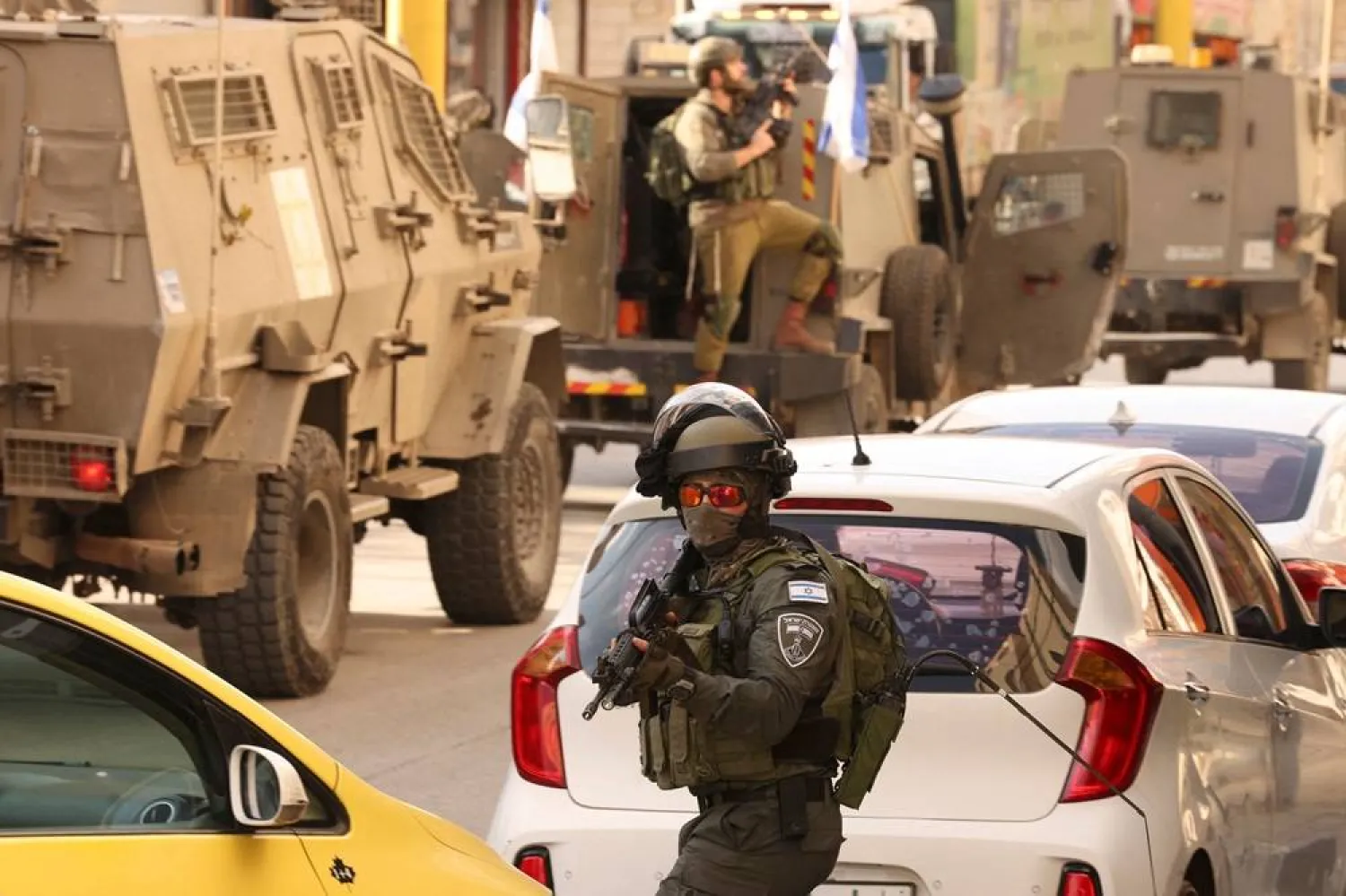
An Israeli security force officer takes position as they surround the area of a Palestinian home, believed to belong to one of the gunmen that attacked an Israel checkpoint on the edge of Jerusalem earlier in the day, during a military operation in the occupied West Bank city of Hebron on November 16, 2023, amid the ongoing battles between Israel and the Palestinian group Hamas. (AFP)
TT

Palestinian Detainees Report Israeli Beatings, Mistreatment as West Bank Arrests Surge

An Israeli security force officer takes position as they surround the area of a Palestinian home, believed to belong to one of the gunmen that attacked an Israel checkpoint on the edge of Jerusalem earlier in the day, during a military operation in the occupied West Bank city of Hebron on November 16, 2023, amid the ongoing battles between Israel and the Palestinian group Hamas. (AFP)

Hamza al-Qawasmi was at home in the occupied West Bank city of Hebron last month when Israeli forces stormed in after midnight and told him he was under arrest.

The 27-year-old coffee seller had taken part in marches against the Gaza war. He had been arrested and detained previously for being a member of the Islamic bloc at Hebron University but he said the treatment this time was the worst.

"They put me in the military jeep. That's when the assault began," he told Reuters.

Qawasmi said his captors blindfolded and handcuffed him, took him away, accused him of being an ISIS member, beat him and at some point removed the blindfold so he could see them point their rifles to his head as they threatened to kill him.

The Israeli military did not respond to requests for comment on Qawasmi's case.

Israeli-Palestinian tensions have flared in the West Bank since Palestinian Hamas gunmen rampaged into southern Israel on Oct. 7 and Israel launched a retaliatory assault on blockaded Gaza, killing more than 12,000 people, according to a Palestinian Health Ministry tally in the Hamas-run enclave.

While Gaza's 2.3 million Palestinians have been in focus the last six weeks, the Israeli-occupied West Bank, home to 3 million Palestinians who live among more than half a million Jewish settlers, has been seething for more than 18 months, drawing growing international concern as violence has escalated.

Palestinian detainees and officials say Israel has conducted mass arrests in the occupied West Bank and East Jerusalem and that prisoners were increasingly facing physical assaults and humiliating treatment in Israeli detention facilities.

"Israel today is in the mood of revenge," Ramallah-based Palestinian Prime Minister Mohammad Shtayyeh told Reuters.

Amnesty International said in a Nov. 8 statement that Israel had dramatically increased its use of administrative detention, a form of incarceration without charge or trial.

The Israeli military has said it operates in the West Bank against suspects involved in militant activity. On Friday, it said most of the 1,750 Palestinians it had caught there in recent weeks were associated with the Hamas.

A statement by the Israel Prison Service said that "as part of the war effort" it was imposing tougher imprisonment conditions for Palestinian political prisoners.

The Palestinian Prisoners Society, representing prisoners held by Israel, said Qawasmi was one of more than 2,700 Palestinians arrested in the West Bank since Oct. 7 when Hamas gunmen breached the fence enclosing Gaza and launched an attack in which Israel says 1,200 people were killed and about 240 people were taken hostage.

The number of Palestinians held by Israel has risen to more than 7,800, including some 300 children and 72 women, said Qadura Fares, head of the Palestinian Authority Commission for Prisoners' Affairs. He said the number did not include prisoners from Gaza, which he said Israel refuses to disclose.

At least four Palestinian prisoners have died in Israeli custody in recent weeks, Fares said. He said autopsies showed they were tortured or medically neglected. Hundreds more prisoners were wounded after being severely beaten, their limbs and ribs broken and their bodies bruised, he added.

An Israeli prisons spokesperson said three Palestinian prisoners had died in three different circumstances over the past six weeks and that the incidents were under investigation.

Qawasmi said he was placed in administrative detention in Ofer Prison, where he said the cells were overcrowded. He said of some 70 prisoners he encountered, most had visible bruises and one prisoner who was beaten until his arm was broken was denied medical attention.

Qawasmi said he was released after being held for two weeks. He said prison guards told him his personal belongings including his clothes, confiscated on his arrival, were tossed in the trash and he was made to leave in his undergarments.

PALESTINIANS ACCUSE ISRAELI FORCES OF ILL TREATMENT

A spokesperson for the Israel Prison Service said they had no knowledge of the event described by Qawasmi but that all prisoners and detainees had the right to file complaints which would be examined by the authorities.

"All prisoners in IPS custody are detained according to the provisions of the law," the spokesperson said.

Heba Morayef, Amnesty's regional director for the Middle East and North Africa, cited testimony and video evidence she said pointed to numerous incidents of torture and other ill-treatment by Israeli forces including beatings and deliberate humiliation of Palestinians detained in dire conditions.

In a Nov. 13 video verified by Reuters, masked Israeli soldiers in Hebron are seen beating a Palestinian man while he livestreamed on TikTok. The soldiers were seen forcibly entering his house, kicking him and beating him with their rifles in front of his family as his daughter screamed in panic. The man, Eyad Banat, was released hours later.

The Israeli military said on Tuesday that soldiers detained Banat for preventing them from searching his apartment building for wanted militants, without elaborating on how he was obstructing their activity while he was in his house or whether any militants were found.

It said a preliminary investigation indicated that an "unreasonable amount of force" was used in Banat's arrest and that disciplinary action will be taken by a military commander as the investigation continues. Banat's cousin, Nizar Banat, who was an outspoken critic of the Palestinian Authority, died in custody of the PA security forces in 2021.

Prisons are overseen by far-right National Security Minister Itamar Ben-Gvir, who has long advocated for a crackdown on Palestinian prisoners.

On Tuesday, Ben-Gvir posted a video from a visit to one of the jails where he said Palestinian militants were held in the strictest conditions and where the Israeli national anthem would play on loudspeakers at all times. He said he hoped a bill supporting the death penalty for militants would soon be advanced beyond a preliminary vote in parliament.



Israel's Netanyahu Says No Reconstruction of Gaza before Demilitarization

Israel’s Prime Minister Benjamin Netanyahu - File Photo/AFP
TT

Israel's Netanyahu Says No Reconstruction of Gaza before Demilitarization

Israel’s Prime Minister Benjamin Netanyahu - File Photo/AFP

Israeli Prime Minister Benjamin Netanyahu said on Thursday there would be no reconstruction of war-shattered Gaza before the disarmament of Hamas, as the "Board of Peace" convened for its inaugural meeting in Washington.

Around two dozen world leaders and senior officials met for the first meeting of the board, which was set up after the United States, Qatar and Egypt negotiated a ceasefire in October to halt two years of war in the Gaza Strip.

"We agreed with our ally the US there will be no reconstruction of Gaza before the demilitarization of Gaza," Netanyahu said during a televised speech at a military ceremony on Thursday, AFP reported.

The meeting in Washington will also look at how to launch the International Stabilization Force (ISF) that will ensure security in Gaza.

One of the most sensitive issues before the board is the future of the Islamist movement Hamas, which fought the war with Israel and still exerts influence in the territory.

Disarmament of the group is a central Israeli demand and a key point in negotiations over the ceasefire's next stage.

US officials including Steve Witkoff, Trump's friend and roving negotiator, have insisted that solid progress is being made and that Hamas is feeling pressure to give up weapons.

Israel has suggested sweeping restrictions including seizing small personal rifles from Hamas.

It remains unclear whether, or how, the Palestinian technocratic committee formed to handle day-to-day governance of Gaza will address the issue of demilitarization.

The 15-member National Committee for the Administration of Gaza (NCAG) will operate under the supervision of the "Board of Peace", and its head, Ali Shaath, is attending the meeting in Washington on Thursday.


Trump Tells First Meeting of Board of Peace that $7 billion Raised for Gaza

US President Donald Trump speaking in Washington - AFP
TT

Trump Tells First Meeting of Board of Peace that $7 billion Raised for Gaza

US President Donald Trump speaking in Washington - AFP

US President Donald Trump told the first meeting of his Board of Peace on Thursday that $7 billion has been contributed to a Gaza reconstruction fund that aims to rebuild the enclave once Hamas disarms, an objective that is far from becoming a reality.

The disarmament of Hamas militants and accompanying withdrawal of Israeli troops, the size of the reconstruction fund and the flow of humanitarian aid to the war-battered populace of Gaza are among the major questions likely to test the effectiveness of the board in the weeks and months ahead.

In a flurry of announcements at the end of a long, winding speech, Trump said the United States will make a contribution of $10 billion to the Board of Peace. He said contributing nations had raised $7 billion as an initial down payment for Gaza reconstruction.

Trump first proposed the board last September when he announced his plan to end Israel's war in Gaza. He later made clear the board's remit would be expanded beyond Gaza to tackle other conflicts worldwide.

Trump also said FIFA will raise $75 million for soccer-related projects in Gaza and that the United Nations will chip in $2 billion for humanitarian assistance.

TRUMP SAYS ANY IRAN DEAL MUST BE MEANINGFUL, PROSPECTS SHOULD BE CLEAR IN 10 DAYS

The Board of Peace includes Israel but not Palestinian representatives and Trump's suggestion that the Board could eventually address challenges beyond Gaza has stirred anxiety that it could undermine the UN's role as the main platform for global diplomacy and conflict resolution.

"We're going to strengthen the United Nations," Trump said, trying to assuage his critics. "It's really very important."

The meeting came as Trump threatens war against Iran and has embarked on a massive military buildup in the region in case Tehran refuses to give up its nuclear program.

Trump said he should know in 10 days whether a deal is possible. "We have to have a meaningful deal," he said.

The event had the feel of a Trump campaign rally, with music blaring from his eclectic playlist from Elvis Presley to the Beach Boys. Red Trump hats were given to participants.

Senior US officials said Trump will also announce that several nations are planning to send thousands of troops to participate in an International Stabilization Force that will help keep the peace in Gaza when it eventually deploys.

Hamas, fearful of Israeli reprisals, has been reluctant to hand over weaponry as part of Trump's 20-point Gaza plan that brought about a fragile ceasefire last October in the two-year Gaza war.

Trump said he hoped use of force to disarm Hamas would not be necessary. He said Hamas had promised to disarm and it "looks like they're going to be doing that, but we'll have to find out."


Few People Left at Syria Camp that Held ISIS Families, Former Director Says

Children, part of a group of detainees, look through a fence at al-Hol camp after the Syrian government took control of it following the withdrawal of Syrian Democratic Forces (SDF), in Hasaka, Syria, January 21, 2026. REUTERS/Khalil Ashawi
TT

Few People Left at Syria Camp that Held ISIS Families, Former Director Says

Children, part of a group of detainees, look through a fence at al-Hol camp after the Syrian government took control of it following the withdrawal of Syrian Democratic Forces (SDF), in Hasaka, Syria, January 21, 2026. REUTERS/Khalil Ashawi

Fewer than 1,000 families remain at a camp where relatives of suspected ISIS militants had been held in Syria's northeast, the camp's former director said on Wednesday, with thousands having fled last month as government forces seized control of the area from Kurdish-led fighters.

Al-Hol, near the Iraqi border, was one of the main detention camps for relatives of suspected ISIS militants who were detained during the US-backed campaign against the terrorist group in Syria.

Control of the camp changed hands last month when government forces under President Ahmed al-Sharaa seized swathes of the northeast from the Kurdish-led Syrian Democratic Forces, including several jails holding ISIS militants. The US military said last week it had completed a mission to transfer 5,700 adult male ISIS detainees to Iraq.

Jihan Hanna, the former director who still coordinates with international agencies and the Syrian government, told Reuters the remaining families were Syrian nationals and were being transferred to a camp in Aleppo. Most of the camp’s foreign nationals had fled, she said.

The Syrian government did not immediately respond to requests for comment.

According to the latest camp data obtained by Reuters, dated January 19 - a day before the government took control of the camp - its population was 6,639 families comprising 23,407 people, mostly Syrians and Iraqis, as well as 6,280 foreigners from more than 40 nationalities.

UNHCR, the UN refugee agency, said it had observed "a significant decrease in the number of residents in al-Hol camp in recent weeks," adding in a statement to Reuters that there were no confirmed figures on the remaining population.

"Over the weekend the camp administration advised UNHCR not to enter the camp due to the unrest and anxiety in the camp," UNHCR added.

The Syrian government accused the SDF of withdrawing from al-Hol on January 20 without any coordination.

The SDF, in a statement that day, said its forces had been "compelled to withdraw from al-Hol camp and redeploy to areas surrounding cities in northern Syria that are facing increasing risks and threats."

A Syrian government security source said most people in the camp fled that day during a five-hour period when it was unguarded, and that some had left with men who came to take their relatives to unknown destinations.

The security source and a source from a non-governmental organization working there said a section of the camp that housed its most dangerous residents, known as the annex, was empty.

The security source said the escapees had spread throughout Syria and that security authorities, working in cooperation with international partners, had established a unit to "follow up on the matter and pursue those who are wanted."

Some have left Syria.

In Lebanon, the army has questioned more than a dozen Lebanese who crossed illegally from Syria after leaving al-Hol, a Lebanese security source said.

The Syrian government’s Directorate of International Cooperation said on Tuesday that hundreds of people, mostly women and children, had been transferred from al-Hol to a newly prepared camp near the town of Akhtarin in northern Aleppo.