


Netanyahu, Hamas Leader Indicate Deal on Gaza Truce and Hostages Is Close

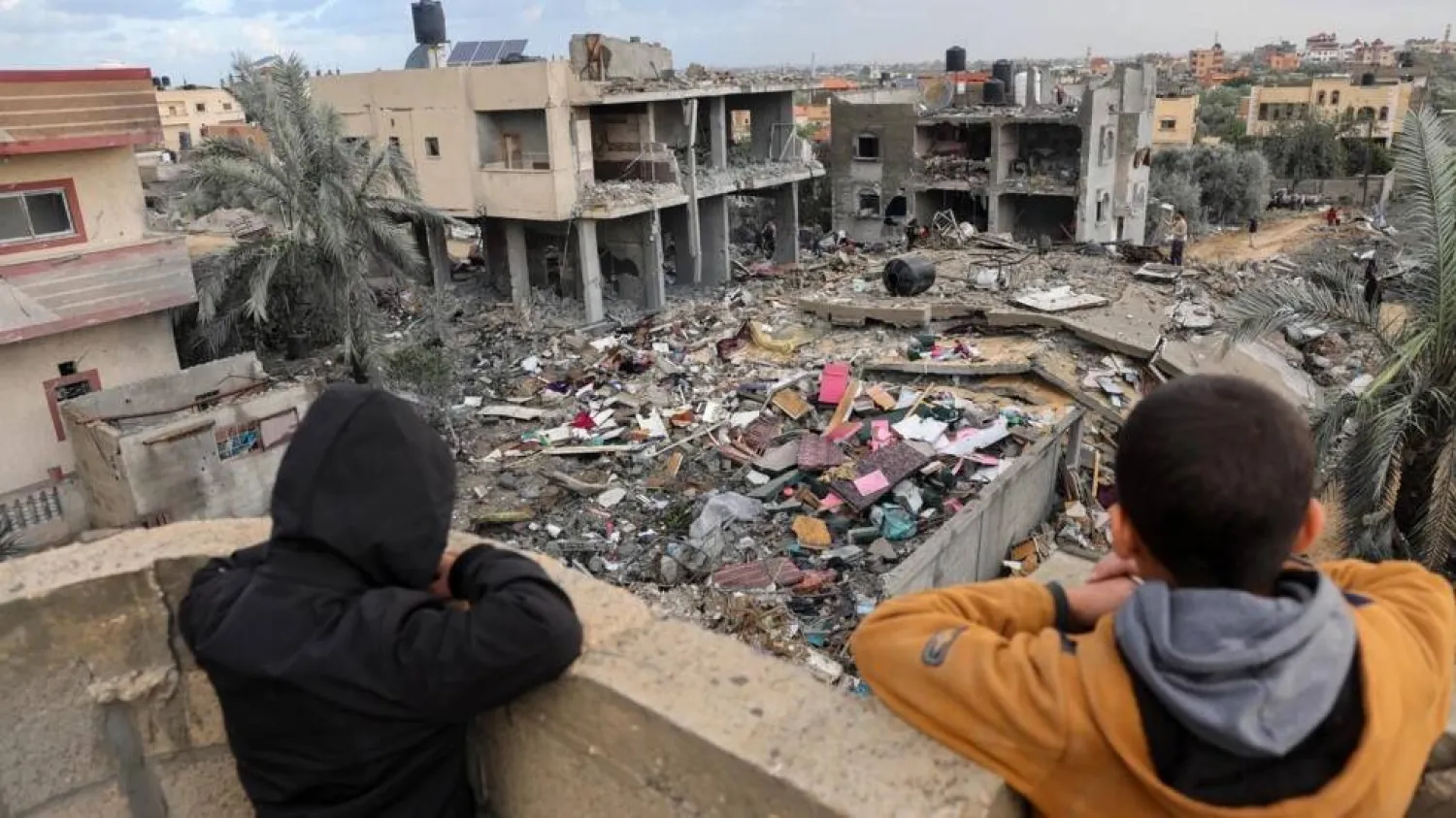
Palestinian children above the rubble of a building destroyed during Israeli strikes on Rafah, in the southern Gaza Strip. Mohammed ABED / AFP
TT

Netanyahu, Hamas Leader Indicate Deal on Gaza Truce and Hostages Is Close

Palestinian children above the rubble of a building destroyed during Israeli strikes on Rafah, in the southern Gaza Strip. Mohammed ABED / AFP

The leader of Hamas said on Tuesday a truce deal with Israel was close and Prime Minister Benjamin Netanyahu said he hoped for good news soon about hostages, the most optimistic signals so far of a deal to pause the war in Gaza and free captives.

Hamas officials were "close to reaching a truce agreement" with Israel and the group had delivered its response to Qatari mediators, Hamas leader Ismail Haniyeh said in a statement sent to Reuters by his aide.

Netanyahu said: "We are making progress. I don't think it's worth saying too much, not at even this moment, but I hope there will be good news soon", according to remarks released by the Israeli prime minister's office.

Later on Tuesday, US President Joe Biden told reporters that an accord to release some of the more than 200 hostages held by Hamas was very near. "My team is in the region shuttling between capitals. We're now very close, very close, to bringing some of these hostages home very soon," he said.

"But I don't want to get into the details because nothing is done until it's done."

Netanyahu summoned his war cabinet amid growing signs of a deal to free a number of the 240 hostages taken by Hamas militants to Gaza after their deadly cross-border raid into Israel on Oct. 7, which triggered the war.

A source familiar with the negotiations said Hamas would free 50 women and children, including some foreigners, while Israel releases 150 Palestinian prisoners, mostly women and minors, during a four-day ceasefire.

A US official briefed on the discussions facilitated by Qatar gave the same figures for releases by each side, saying the 50 hostages to be freed would be mostly women and children, with fighting paused for four or five days.

There is a tentative deal, but it is not final until everything is agreed upon, the official said.

"We believe we are very, very close to having a deal," the official told Reuters. "There is still a lot of work to be done, still approval that has to be achieved. but we believe we are very close."

It would be the first truce of the six-week-old war and the first mass release of those held by both sides.

Hamas' Oct. 7 rampage into Israeli communities near Gaza killed 1,200 people, according to Israeli tallies. In Israel's subsequent aerial blitz and invasion of Gaza, the enclave's Hamas-run government says at least 13,300 Palestinians have been confirmed killed including at least 5,600 children.

A Hamas official told Al Jazeera TV earlier that negotiations were centered on how long the truce would last, arrangements for delivery of aid into Gaza and details of the exchange of captives. Both sides would free women and children, and details would be announced by Qatar, which is mediating in the negotiations, said the official, Issat el Reshiq.

Israel's Channel 12 and Channel 13 TV stations both quoted unidentified officials as saying terms of a deal could be reached "within hours".

Mirjana Spoljaric, president of the International Committee of the Red Cross, met Haniyeh in Qatar on Monday to "advance humanitarian issues" related to the war, the Geneva-based ICRC said in a statement. She also separately met Qatari authorities.

The ICRC said it was not part of hostage negotiations but as a neutral intermediary it was ready "to facilitate any future release that the parties agree to".

RAIN AND COLD WORSEN CONDITIONS

The Hamas incursion on Oct. 7, the deadliest day in Israel's 75-year-old history, prompted Israel to invade Gaza to try to annihilate the militant group that has ruled there since 2007.

Around two-thirds of Gaza's 2.3 million people have since been made homeless, with thousands a day still trekking south on foot with belongings and children in their arms. The central and southern parts of the enclave, where Israel has told them to go, have also regularly come under attack.

A day and a night of rain and cold winter weather worsened the dire conditions in the Gaza Strip for the displaced, many thousands of whom are sleeping rough or in makeshift tents.

Gaza health authorities said on Tuesday at least 20 Palestinians were killed in an Israeli bombing of the Nuseirat refugee camp in central Gaza at midnight. There was no immediate comment from Israel.

The already crowded Nuseirat district, which grew out of a camp for Palestinian refugees from the 1948 Israeli-Arab war, is just south of wetlands that bisect the narrow, coastal strip and has been the arrival point for huge numbers escaping the fighting concentrated in the urbanized north.

Israeli bombing in southern areas leaves Gazans fearing they have no place safe to go. Neighboring Egypt has allowed the evacuation of some wounded and foreign passport holders, but says it will not accept a forced, mass exodus.

Despite an Israeli order to flee, tens of thousands of civilians are believed to remain in north Gaza - wide swathes of which Israel says its forces now control but where Hamas militants, deeply embedded within the population, are waging guerrilla-style war in fiercely contested pockets.

All hospitals in the north have ceased functioning normally, many still housing patients and displaced Gazans. Israel says Hamas uses hospitals as cover for its combatants, which Hamas and the hospitals deny.

The World Health Organization said it was working on plans to evacuate three Northern Gaza hospitals: Al Shifa, Al Ahli and the Indonesian Hospital, lamenting this as a last resort.

Issam Nabhan, head of the nursing department of the Indonesian Hospital, where the WHO and Gaza authorities say 12 people were killed on Monday by Israeli fire, told Al Jazeera on Tuesday there were 60 bodies in the grounds.

"There is no oxygen to supply the patients. All those on artificial respiration have died. We speak out to the free world. The Indonesian hospital has become a cemetery, not a hospital."


7 Killed in Drone Strike on Hospital in Sudan's Kordofan

A Sudanese man rides his decorated bicycle as others (unseen) rally in support of the Sudanese armed forces. (Photo by Ebrahim Hamid / AFP)
TT

7 Killed in Drone Strike on Hospital in Sudan's Kordofan

A Sudanese man rides his decorated bicycle as others (unseen) rally in support of the Sudanese armed forces. (Photo by Ebrahim Hamid / AFP)

A drone strike Sunday on an army hospital in the besieged southern Sudan city of Dilling left "seven civilians dead and 12 injured", a health worker at the facility told AFP.

The victims included patients and their companions, the medic said on condition of anonymity, explaining that the army hospital "serves the residents of the city and its surroundings, in addition to military personnel".

Dilling, in the flashpoint state of South Kordofan, is controlled by the Sudanese army but is besieged by the Rapid Support Forces (RSF).

The greater Kordofan region is currently facing the fiercest fighting in Sudan's war between the army and the RSF, as both seek to wrest control of the massive southern region.

The UN has repeatedly warned the region is in danger of witnessing a repeat of the atrocities that unfolded in North Darfur state capital El-Fasher, including mass killing, abductions and sexual violence.


Iraq's Election Result Ratified by Supreme Federal Court as Premiership Remains up for Grabs

Election workers gather parliamentary election ballots after the polls closed in Baghdad, Iraq, Nov. 11, 2025. (AP Photo/Hadi Mizban, File)
TT

Iraq's Election Result Ratified by Supreme Federal Court as Premiership Remains up for Grabs

Election workers gather parliamentary election ballots after the polls closed in Baghdad, Iraq, Nov. 11, 2025. (AP Photo/Hadi Mizban, File)

The result of last month’s parliamentary elections in Iraq was ratified by the Supreme Federal Court on Sunday, confirming that the party of caretaker prime minister Mohammed Shia al-Sudani won the largest number of seats — but not enough to assure him a second term.

The court confirmed that the voting process met all constitutional and legal requirements and had no irregularities affecting its validity.

The Independent High Electoral Commission submitted the final results of the legislative elections to the Supreme Federal Court on Monday for official certification after resolving 853 complaints submitted regarding the election results, according to The AP news.

Al-Sudani's Reconstruction and Development Coalition won 46 seats in the 329-seat parliament. However, in past elections in Iraq, the bloc taking the largest number of seats has often been unable to impose its preferred candidate.

The coalition led by former Prime Minister Nouri al-Maliki won 29 seats, the Sadiqoun Bloc, which is led by the leader of the Asaib Ahl al-Haq militia, Qais al-Khazali, won 28 seats, and the Kurdistan Democratic Party, led by Masoud Barzani, one of the two main Kurdish parties in the country, won 27 seats.

The Taqaddum (Progress) party of ousted former Parliament Speaker Mohammed al-Halbousi also won 27 seats, setting the stage for a contest over the speaker's role.


Hamas Confirms the Death of a Top Commander in Gaza after Israeli Strike

Destroyed buildings, amid a ceasefire between Israel and Hamas, in Khan Younis in the southern Gaza Strip November 18, 2025. (Reuters)
TT

Hamas Confirms the Death of a Top Commander in Gaza after Israeli Strike

Destroyed buildings, amid a ceasefire between Israel and Hamas, in Khan Younis in the southern Gaza Strip November 18, 2025. (Reuters)

Hamas on Sunday confirmed the death of a top commander in Gaza, a day after Israel said it had killed Raed Saad in a strike outside Gaza City.

The Hamas statement described Saad as the commander of its military manufacturing unit. Israel had described him as an architect of the Oct. 7, 2023, attack that sparked the war in Gaza, and asserted that he had been “engaged in rebuilding the terrorist organization” in a violation of the ceasefire that took effect two months ago, The AP news reported.

Israel said it killed Saad after an explosive device detonated and wounded two soldiers in the territory’s south.

Hamas also said it had named a new commander but did not give details.

Saturday's strike west of Gaza City killed four people, according to an Associated Press journalist who saw their bodies arrive at Shifa Hospital. Another three were wounded, according to Al-Awda hospital. Hamas in its initial statement described the vehicle struck as a civilian one.

Israel and Hamas have repeatedly accused each other of truce violations.

Israeli airstrikes and shootings in Gaza have killed at least 391 Palestinians since the ceasefire took hold, according to Palestinian health officials. Israel has said recent strikes are in retaliation for militant attacks against its soldiers, and that troops have fired on Palestinians who approached the “Yellow Line” between the Israeli-controlled majority of Gaza and the rest of the territory.

Israel has demanded that Palestinian militants return the remains of the final hostage, Ran Gvili, from Gaza and called it a condition of moving to the second and more complicated phase of the ceasefire. That lays out a vision for ending Hamas’ rule and seeing the rebuilding of a demilitarized Gaza under international supervision.

Israel’s two-year campaign in Gaza has killed more than 70,660 Palestinians, roughly half of them women and children, according to the territory’s Health Ministry, which does not distinguish between militants and civilians in its count. The ministry, which operates under the Hamas-run government, is staffed by medical professionals and maintains detailed records viewed as generally reliable by the international community.