
Scores Reported Killed in Gaza as Fighting Shatters Israel-Hamas Truce

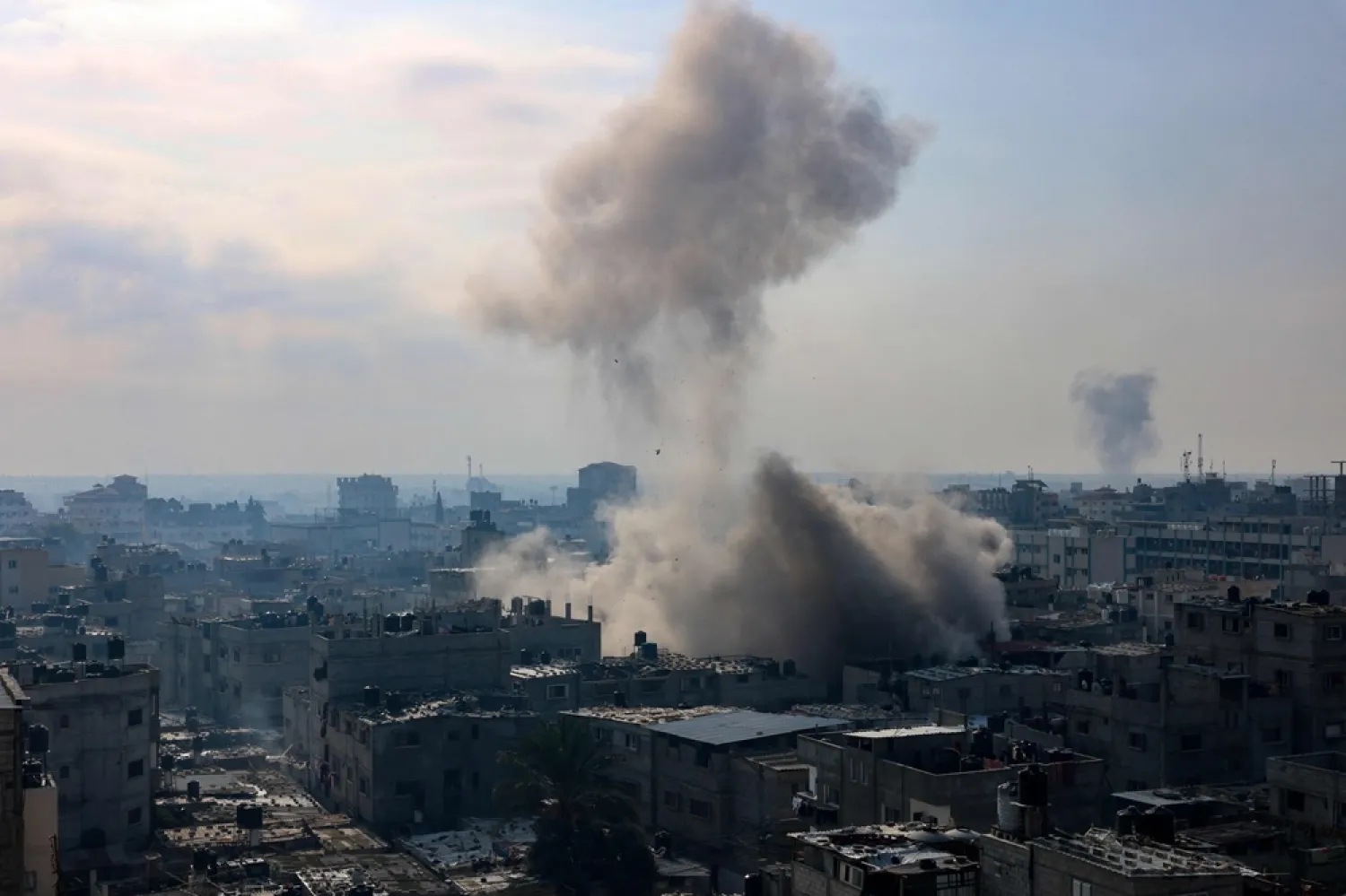
A plume of smoke rises during an Israeli strike on the Rafah refugee camp in the southern Gaza Strip on December 1, 2023, as fighting resumed shortly after the expiration of a seven-day truce between Israel and Hamas militants. (AFP)
TT

Scores Reported Killed in Gaza as Fighting Shatters Israel-Hamas Truce

A plume of smoke rises during an Israeli strike on the Rafah refugee camp in the southern Gaza Strip on December 1, 2023, as fighting resumed shortly after the expiration of a seven-day truce between Israel and Hamas militants. (AFP)

Israel's warplanes pounded Gaza on Friday after talks to extend a week-old truce with Hamas broke down, sending wounded and dead Palestinians into hospitals and others onto the streets to seek safety.

Eastern areas of Khan Younis in southern Gaza came under intensive bombardment as the deadline lapsed shortly after dawn, with columns of smoke rising into the sky, Reuters journalists in the city said. Residents took to the road with belongings heaped up in carts, fleeing for shelter further west.

In the north of the enclave, previously the main war zone, huge plumes of smoke rose above the ruins, seen from across the fence in Israel. The rattle of gunfire and thud of explosions rang out above the sound of barking dogs.

Sirens blared across southern Israel as militants fired rockets from the coastal enclave into towns. On another faultline, Lebanon's Hezbollah group said it had fired at Israeli troops on Israel's northern border to support the Palestinians.

Israel and Hamas accused each other of wrecking the negotiations, though the White House singled out the Palestinian militant group, saying it had failed to produce a new list of hostages to release to enable an extension of the truce.

The UN said the fighting would worsen an extreme humanitarian emergency. "Hell on Earth has returned to Gaza," Jens Laerke, spokesperson for the UN humanitarian office in Geneva, said.

Within hours of the truce expiring, Gaza health officials reported that 109 people had been killed and dozens wounded in air strikes.

Israel's military said its ground, air and naval forces had struck more than 200 of what it called "terror targets" in the enclave since the morning.

"This morning, as promised, we resumed our attack," former defense minister Benny Gantz, who joined Prime Minister Benjamin Netanyahu in an emergency unity government last month, said in a statement.

He said Israel had spent the past week making plans to expand its operations "based on ... the recognition that we must change the reality in the south as well as the in the north".

Medics and witnesses said the bombing was most intense in Khan Younis and Rafah in the southern Gaza Strip, where hundreds of thousands of Gazans have been sheltering from fighting further north. Houses in central and northern areas were also hit.

"Anas, my son!" wailed the mother of Anas Anwar al-Masri, a boy lying on a stretcher with a head injury in the corridor of Nasser hospital in Khan Younis. "I don't have anyone but you!"

‘You have been warned’

Further south in Rafah, residents carried several small children, streaked with blood and covered in dust, out of a house that had been struck. Mohammed Abu-Elneen, whose father owns the house, said it was sheltering people displaced from elsewhere.

At the nearby Abu Yousef al-Najjar hospital, the first wave of wounded were men and boys.

Gazans said they feared that the bombing of southern parts of the enclave could herald an expansion of the war into areas Israel had previously described as safe.

Leaflets dropped on eastern areas of the main southern city Khan Younis ordered residents of four towns to evacuate - not to other areas in Khan Younis as in the past, but further south to the crowded town of Rafah on the Egyptian border.

"You have to evacuate immediately and go to the shelters in the Rafah area. Khan Younis is a dangerous fighting zone. You have been warned," said the leaflets, written in Arabic.

Israel released a link to a map showing Gaza divided into hundreds of districts, which it said would be used in future to communicate which areas were safe.

White House working with mediators

Each of the warring sides blamed the other for causing the collapse by rejecting terms to extend the daily release of hostages held by militants in exchange for Palestinian detainees.

The pause which began on Nov. 24 had been extended twice, and Israel had said it could continue as long as Hamas released 10 hostages each day. But after seven days during which women, children and foreign hostages were freed, mediators failed at the final hour to find a formula to release more, including Israeli soldiers and civilian men.

Israel accused Hamas of refusing to release all the women it held. A Palestinian official said the breakdown occurred over female Israeli soldiers.

Qatar, which has played a central role in mediation efforts, said negotiations were still ongoing with Israelis and Palestinians to restore the truce, but that Israel's renewed bombardment of Gaza had complicated its efforts.

The White House said it continued to work on extending the humanitarian pause in Gaza and that President Joe Biden would remain deeply engaged in efforts to free hostages.

Israel has sworn to annihilate Hamas in response to the Oct. 7 rampage by the militant group, when Israel says gunmen killed 1,200 people and took 240 hostages. Hamas, sworn to Israel's destruction, has ruled Gaza since 2007.

On the streets of the Israeli city of Tel Aviv, passersby placed the blame firmly on Hamas.

"They didn't return all the captives. They didn't reunite the families together. We had no other choice. You know, it's not the war that we choose," said Dvir Feller.

Israel's bombardment and ground invasion have laid waste to much of the territory. Palestinian health authorities deemed reliable by the United Nations say more than 15,000 Gazans have been confirmed killed and thousands more are missing and feared buried under rubble.

The United Nations says as many as 80% of Gaza's 2.3 million people have been driven from their homes, with no way to escape the narrow territory, many sleeping rough in makeshift shelters.

US-Yemen Engagement Seeks to Bolster Partnership, Contain Divisions

Al-Alimi met with US Ambassador Steven Fagin in Riyadh (SABA)
TT

US-Yemen Engagement Seeks to Bolster Partnership, Contain Divisions

Al-Alimi met with US Ambassador Steven Fagin in Riyadh (SABA)

Several meetings held by US Ambassador to Yemen Steven Fagin with the leadership of Yemen’s Presidential Leadership Council (PLC) point to American attempts to reinforce the political and security partnership with the Yemeni government while containing internal divisions within the internationally recognized camp.

The move comes amid a complex domestic environment and growing regional challenges affecting Yemen’s security and stability.

The engagement included talks with PLC President Rashad al-Alimi, a meeting with council member Sheikh Othman Mujalli, and a video call with Major General Sultan al-Aradah.

Discussions focused on bilateral relations, political and military developments, and certain priorities, notably counterterrorism and confronting threats posed by the Iran-backed Houthi militia.

Discussions with al-Alimi reportedly centered on the scope of Yemeni-US partnership and Washington’s role in supporting the Yemeni state, politically in international forums and through counterterrorism cooperation, as well as efforts to curb Iran-linked arms smuggling and financial networks.

Government reforms were also raised, in light of the need for international backing to ease economic and humanitarian pressures.

The talks addressed recent developments in Yemen’s eastern governorates and unilateral measures taken there, alongside regional efforts led by Saudi Arabia and the United Arab Emirates to contain tensions and restore normal conditions.

Yemeni leaders stressed the need to preserve consensus within the framework of legitimacy and prevent internal disputes from undermining unified security and military decision-making.

Yemeni officials also stressed adherence to the key references governing the transitional phase, particularly the Declaration on the Transfer of Power and the Riyadh Agreement, warning that bypassing these frameworks could create security vacuums exploited by the Houthis and terrorist groups.

In a broader assessment during his call with Fagin, al-Aradah described Yemen’s current phase as one in which political, military, and economic challenges intersect, calling for a firmer international stance and practical support to restore state institutions, cut off militia funding, and safeguard UN-led efforts.

In his meeting with Mujalli, Fagin discussed Iran’s role in enhancing Houthi military capabilities and the resulting risks to Yemen, neighboring states, and maritime security in the Red Sea and the Arabian Sea.

According to Yemeni official media, the US ambassador reaffirmed Washington’s support for the country’s unity and territorial integrity, the cohesion of the PLC and government, and continued partnership in counterterrorism, humanitarian relief, and efforts to promote stability and development.


ISIS, in First Comment, Calls Palmyra Attack a Blow to US and Syrian Forces

A police vehicle of the interim Syrian government moves through a street by the Saha Mosque in Palmyra in central Syria on February 7, 2025. (Photo by Omar HAJ KADOUR / AFP)
TT

ISIS, in First Comment, Calls Palmyra Attack a Blow to US and Syrian Forces

A police vehicle of the interim Syrian government moves through a street by the Saha Mosque in Palmyra in central Syria on February 7, 2025. (Photo by Omar HAJ KADOUR / AFP)

The ISIS group said the killing of US Pentagon personnel in Syria's ancient city of Palmyra was a "blow" to US forces and Syrian armed factions opposed to it, in its first public comment on the incident.

Two US Army soldiers and a civilian interpreter were killed on Saturday when an attacker targeted a convoy of American and ‌Syrian forces ‌in Palmyra before ‌being ⁠shot dead, the ‌US military said. Three US soldiers were wounded.

In an article published on its Telegram channel on Thursday, ISIS accused the United States and its Syrian-based allies of forming a single front against it. ⁠It used religious language to frame the assault as ‌a decisive moment intended ‍to dispel doubt among ‍its supporters, but did not explicitly ‍claim responsibility.

US President Donald Trump called the incident "terrible" and vowed retaliation.

Syria's Interior Ministry said on Sunday it had arrested five people suspected of links to the shooting, describing the attacker as a member of the Syrian ⁠security forces suspected of sympathizing with ISIS.

The ministry said security units in Palmyra carried out the arrests in coordination with international coalition forces.

Syria has been cooperating with a US-led coalition against ISIS. The United States has troops stationed in northeastern Syria as part of a decade-long campaign against the group, which controlled large ‌parts of Syria and Iraq from 2014 to 2019.


Syria, Kurdish Forces Race to Save Integration Deal ahead of Deadline

Kurds wave the flags of the SDF and the new Syrian regime during a celebration in the city of Qamishli in northeastern Syria (AFP).
TT

Syria, Kurdish Forces Race to Save Integration Deal ahead of Deadline

Kurds wave the flags of the SDF and the new Syrian regime during a celebration in the city of Qamishli in northeastern Syria (AFP).

Syrian, Kurdish and US officials are scrambling ahead of a year-end deadline to show some progress in a stalled deal to merge Kurdish forces with the Syrian state, according to several people involved in or familiar with the talks.

Discussions have accelerated in recent days despite growing frustrations over delays, according to the Syrian, Kurdish and Western sources who spoke to Reuters, some of whom cautioned that a major breakthrough was unlikely, Reuters said.

The interim Syrian government has sent a proposal to the Kurdish-led Syrian Democratic Forces (SDF) that controls the country's northeast, according to five of the sources.

In it, Damascus expressed openness to the SDF reorganizing its roughly 50,000 fighters into three main divisions and smaller brigades as long as it cedes some chains of command and opens its territory to other Syrian army units, according to one Syrian, one ‌Western and three Kurdish ‌officials.

'SAVE FACE' AND EXTEND TALKS ON INTEGRATION

It was unclear whether the idea would ‌move ⁠forward, and several sources downplayed ‌prospects of a comprehensive eleventh-hour deal, saying more talks are needed. Still, one SDF official said: "We are closer to a deal than ever before".

A second Western official said that any announcement in coming days would be meant in part to "save face", extend the deadline and maintain stability in a nation that remains fragile a year after the fall of former President Bashar al-Assad.

Whatever emerges was expected to fall short of the SDF's full integration into the military and other state institutions by year-end, as was called for in a landmark March 10 agreement between the sides, most of the sources said.

Failure to mend Syria's deepest remaining fracture risks an armed clash that could derail its emergence from 14 years of war, and ⁠potentially draw in neighboring Türkiye that has threatened an incursion against Kurdish fighters it views as terrorists.

Both sides have accused the other of stalling and acting in bad faith. The SDF ‌is reluctant to give up autonomy it won as the main US ally during ‍the war, after which it controlled ISIS prisons and rich ‍oil resources.

The US, which backs Syrian President Ahmed al-Sharaa and has urged global support for his interim government, has relayed messages between ‍the SDF and Damascus, facilitated talks and urged a deal, several sources said.

A US State Department spokesperson said Tom Barrack, the US ambassador to Türkiye and special envoy to Syria, continued to support and facilitate dialogue between the Syrian government and the SDF, saying the aim was to maintain momentum towards integration of the forces.

SDF DOWNPLAYS DEADLINE; TURKIYE SAYS PATIENCE THIN

Since a major round of talks in the summer between the sides failed to produce results, frictions have mounted including frequent skirmishes along several front lines across the north.

The SDF took control of much of northeast Syria, where most of the nation's oil and wheat production is, after defeating ISIS militants in 2019.

It said ⁠it was ending decades of repression against the Kurdish minority but resentment against its rule has grown among the predominantly Arab population, including against compulsory conscription of young men.

A Syrian official said the year-end deadline for integration is firm and only "irreversible steps" by the SDF could bring an extension.

Türkiye’s foreign minister, Hakan Fidan, said on Thursday it does not want to resort to military means but warned that patience with the SDF is "running out".

Kurdish officials have downplayed the deadline and said they are committed to talks toward a just integration.

"The most reliable guarantee for the agreement's continued validity lies in its content, not timeframe," said Sihanouk Dibo, a Syrian autonomous administration official, suggesting it could take until mid-2026 to address all points in the deal.

The SDF had in October floated the idea of reorganizing into three geographical divisions as well as the brigades. It is unclear whether that concession, in the proposal from Damascus in recent days, would be enough to convince it to give up territorial control.

Abdel Karim Omar, representative of the Kurdish-led northeastern administration in Damascus, said the proposal, which has not been made public, included "logistical and administrative details that could cause disagreement and ‌lead to delays".

A senior Syrian official told Reuters the response "has flexibility to facilitate reaching an agreement that implements the March accord".