


US Sanctions Target 3 Former Sudanese Officials

Sudanese warring parties signing the Jeddah Talks agreement (Reuters)
TT

US Sanctions Target 3 Former Sudanese Officials

Sudanese warring parties signing the Jeddah Talks agreement (Reuters)

The US Treasury imposed sanctions on three former Sudanese officials for their role in undermining the country's peace, security, and stability.

The US Department of the Treasury's Office of Foreign Assets Control (OFAC) said the designations support diplomatic efforts by the international community to end the conflict and demonstrate the US commitment to achieve a civilian government and a transition to democracy.

Under Secretary of the Treasury for Terrorism and Financial Intelligence Brian Nelson, the Treasury continues its efforts to "identify and take action against individuals contributing to the instability in Sudan and undermining prospects for a peaceful resolution."

"The United States will not tolerate the continuing exploitation of the Sudanese people by those who seek to extend and deepen the conflict."

The sanctions include Taha Osman Ahmed al-Hussein, a former State Minister and Presidential Office Director to former Sudanese President Omar al-Bashir.

Hussein was pivotal in managing the relationship between the Rapid Support Forces (RSF) and regional actors to advance the RSF's warfighting efforts.

They also include Salah Abdallah Mohamed Salah, a former high-ranking Sudanese government official who left his position following the fall of the al-Bashir regime and, since that time, has undertaken efforts to destabilize Sudan.

The Treasury also included Mohamed Etta Elmoula Abbas, a former Sudanese Ambassador and leader of Sudan's National Intelligence and Security Service under the al-Bashir regime.

Meanwhile, sources revealed new details regarding disputes and mutual accusations between the Sudanese army and the RSF, threatening the second round of negotiations in Jeddah, sponsored by Saudi-US mediation.

The sources explained that negotiations may be resumed later without an official announcement, noting that the army delegation had previously agreed to a proposal submitted by an Intergovernmental Development Organization (IGAD) expert.

The sources reported that the IGAD expert proposed freezing all movements and each force remaining in its area of control, which would be done immediately after signing the cessation of hostilities agreement that both parties approved.

The army later rejected the proposal.

The sources, who asked to remain anonymous, told Asharq Al-Awsat that the army negotiating delegation also rejected another item that called for a comprehensive political dialogue 15 days after agreeing to cease hostilities.

The army also rejected the Joint Center tasked with monitoring the ceasefire. The center includes four countries and is chaired by Saudi Arabia.

The army also insisted on the exit of the RSF from the capital, Khartoum.

- Confidence-building measures

The RSF accused the army of not committing to implementing the "confidence-building" measures agreed upon in the Jeddah Platform.

The Arab World News Agency quoted a source familiar with the course of the negotiations as saying that the Sudanese army's attempts to involve "members of the former regime" were one of the reasons for the failure of the Jeddah talks.

The source, who asked not to be identified, said that the army sought to "fail the negotiating platform" by including two members of the former regime, Ambassador Omar Siddiq and Brigadier General Saleh al-Mubarak.

Both figures were rejected by the RSF, delaying the talks for three days before they agreed to dismiss them and retain them as experts.

- Negotiations suspended without any progress

The source confirmed that the second round of negotiations had faltered, and mediation was suspended without progress, especially in the humanitarian and ceasefire issues.

Last November, the second round of the Jeddah negotiations began with two main items: humanitarian aid and confidence-building measures.

On November 7, the two parties signed commitments to deliver humanitarian aid and confidence-building measures, which included four essential items, namely arresting the Islamists who escaped from prisons.

The source confirmed that the agreement set ten days to arrest the wanted persons.

The Rapid Support delegation handed over a list of wanted persons, and the army delegation requested five days, but it did not implement its pledges even after extending the deadline ten more days.

According to the same source, the army delegation refused to send humanitarian aid to the affected areas in Darfur and other regions around the country.

He also refused to open the airports of Nyala, el-Geneina, and el-Fasher for humanitarian purposes and insisted on delivering aid through Port Sudan airport.

- Controlling the capital

The Rapid Support Forces controlled large areas of the capital, forcing the army to retreat in Darfur and Kordofan.

Last month, the RSF took control of significant army strongholds in Nyala, Zalingei, and el-Geneina in the Darfur region.

The source told the Arab World News Agency that the army delegation asked Doctors Without Borders and the Italian and Norwegian organizations to stop their work in Khartoum, refusing to grant visas to humanitarian and medical workers.

Doctors Without Borders (MSF) in Sudan said on Friday that it was forced to make the difficult decision to reduce the number of employees to the minimum in al-Ban al-Jadeed Hospital.

The organization noted that the measures come from the strict restrictions imposed on employees' movements and the authorities' delay in issuing travel permits.

- Umma Party: Disappointment

The head of the National Umma Party, Fadlallah Burma Nasser, said on Monday that the collapse of the Jeddah negotiations disappointed the Sudanese people.

In a statement, he stated that the National Umma accuses the extremist forces of the negotiations' failure, pointing out that the irresponsible statements and spreading of accusations confirm the lack of national will to reach an agreement.



Syria: SDF’s Mazloum Abdi Says Implementation of Integration Deal May Take Time

People sit outdoors surrounded by nature, with the Tigris river flowing in the background, following a long atmospheric depression, near the Syrian-Turkish border in Derik, Syria, February 16, 2026 REUTERS/Orhan Qereman
TT

Syria: SDF’s Mazloum Abdi Says Implementation of Integration Deal May Take Time

People sit outdoors surrounded by nature, with the Tigris river flowing in the background, following a long atmospheric depression, near the Syrian-Turkish border in Derik, Syria, February 16, 2026 REUTERS/Orhan Qereman

Mazloum Abdi, commander of the Syrian Democratic Forces, said the process of merging the SDF with Syrian government forces “may take some time,” despite expressing confidence in the eventual success of the agreement.

His remarks came after earlier comments in which he acknowledged differences with Damascus over the concept of “decentralization.”

Speaking at a tribal conference in the northeastern city of Hasakah on Tuesday, Abdi said the issue of integration would not be resolved quickly, but stressed that the agreement remains on track.

He said the deal reached last month stipulates that three Syrian army brigades will be created out of the SDF.

Abdi added that all SDF military units have withdrawn to their barracks in an effort to preserve stability and continue implementing the announced integration agreement with the Syrian state.

He also emphasized the need for armed forces to withdraw from the vicinity of the city of Ayn al-Arab (Kobani), to be replaced by security forces tasked with maintaining order.


Israeli Far-Right Minister to Push for ‘Migration’ of West Bank, Gaza Palestinians 

A Palestinian man checks leather belts as people prepare for Ramadan, in the old city of Hebron in the Israeli-occupied West Bank, February 17,2026. (Reuters)
TT

Israeli Far-Right Minister to Push for ‘Migration’ of West Bank, Gaza Palestinians 

A Palestinian man checks leather belts as people prepare for Ramadan, in the old city of Hebron in the Israeli-occupied West Bank, February 17,2026. (Reuters)

Israel's far-right Finance Minister Bezalel Smotrich said he would pursue a policy of "encouraging the migration" of Palestinians from the occupied West Bank and Gaza Strip, Israeli media reported Wednesday.

"We will eliminate the idea of an Arab terror state," said Smotrich, speaking at an event organized by his Religious Zionism Party late on Tuesday.

"We will finally, formally, and in practical terms nullify the cursed Oslo Accords and embark on a path toward sovereignty, while encouraging emigration from both Gaza and Judea and Samaria.

"There is no other long-term solution," added Smotrich, who himself lives in a settlement in the West Bank.

Since last week, Israel has approved a series of measures backed by far-right ministers to tighten control over the West Bank, including in areas administered by the Palestinian Authority under the Oslo Accords, in place since the 1990s.

The measures include a process to register land in the West Bank as "state property" and facilitate direct purchases of land by Jewish Israelis.

The measures have triggered widespread international outrage.

On Tuesday, the UN missions of 85 countries condemned the measures, which critics say amount to de facto annexation of the Palestinian territory.

"We strongly condemn unilateral Israeli decisions and measures aimed at expanding Israel's unlawful presence in the West Bank," they said in a statement.

"Such decisions are contrary to Israel's obligations under international law and must be immediately reversed.

"We underline in this regard our strong opposition to any form of annexation."

UN Secretary-General Antonio Guterres on Monday called on Israel to reverse its land registration policy, calling it "destabilizing" and "unlawful".

The West Bank would form the largest part of any future Palestinian state. Many on Israel's religious right view it as Israeli land.

Israeli NGOs have also raised the alarm over a settlement plan signed by the government which they say would mark the first expansion of Jerusalem's borders into the occupied West Bank since 1967.

The planned development, announced by Israel's Ministry of Construction and Housing, is formally a westward expansion of the Geva Binyamin, or Adam, settlement situated northeast of Jerusalem in the West Bank.

The current Israeli government has fast-tracked settlement expansion, approving a record 52 settlements in 2025.

Excluding Israeli-annexed east Jerusalem, more than 500,000 Israelis live in West Bank settlements and outposts, which are illegal under international law.


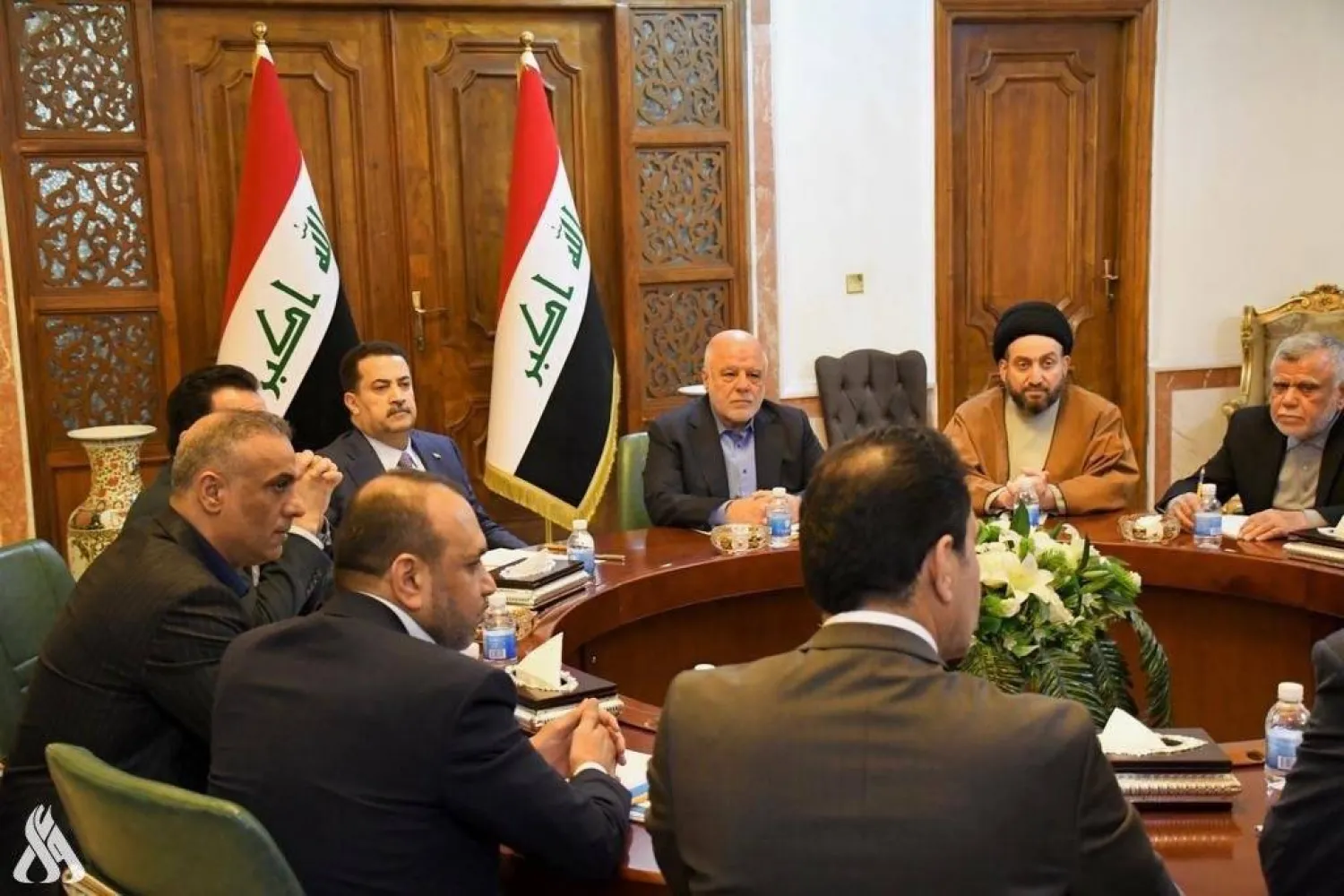
Maliki Can Withdraw as Candidacy as Iraq PM the Easy or Hard Way

Members of the Coordination Framework hold a meeting. (Iraqi News Agency)
TT

Maliki Can Withdraw as Candidacy as Iraq PM the Easy or Hard Way

Members of the Coordination Framework hold a meeting. (Iraqi News Agency)

Iraqi Former Prime Minister Nouri al-Maliki declined at the last minute to attend a meeting of the pro-Iran Coordination Framework on Monday night that was aimed at settling the crisis over his nomination as prime minister.

Instead of declaring that he was pulling out as candidate, as had been expected, Maliki informed his close circle that he is “following through with his nomination to the end,” trusted sources told Asharq Al-Awsat.

Iraq has come under intense pressure from the US to withdraw the nomination. In January, President Donald Trump warned Baghdad against picking Maliki as its PM, saying the United States would no longer help the country.

“Last time Maliki was in power, the Country descended into poverty and total chaos. That should not be allowed to happen again. Because of his insane policies and ideologies, if elected, the United States of America will no longer help Iraq,” Trump wrote on Truth Social.

Maliki also dismissed as “extortion and intimidation” talks of renewed US sanctions on Iraq, added the sources.

However, circles within the Coordination Framework have started to “despair” with the impasse over naming a new prime minister and are weighing the possibility of taking “difficult” choices, they revealed. Maliki has become a prisoner of his own nomination.

The Sunni Progress Party (Takadum) had voiced its reservations over Maliki’s nomination before Trump made his position clear and which has since weighed heavily on Iraq.

‘Indefinitely’

Maliki’s decision to skip the Framework’s meeting on Monday forced the coalition to postpone it “indefinitely”, exposing more differences inside the alliance that have been festering for months. The dispute over the post of prime minister is threatening to evolve into one that threatens the unity of the coalition itself.

Several sources told Asharq Al-Awsat that Maliki had sent the Framework a written message on Monday night informing them that he will not attend the meeting because “he was aware that discussions will seek to pressure him to withdraw his candidacy.”

Maliki was the one to call for the meeting to convene in the first place, they revealed.

Reports have been rife in Iraq that Shiite, Sunni and Kurdish political leaderships have all received warnings that the US would take measure against Iraq if Maliki continued to insist on his nomination.

Former Foreign Minister Hoshyar Zebari told Dijlah TV that “Shiite parties” had received two new American messages reiterating the rejection of Maliki’s nomination.

Necessary choice

Maliki and the Framework are now at an impasse, with the latter hoping the former PM would take it upon himself to withdraw his candidacy in what a leading Shiite figure said would help protect the unity of the coalition.

Leading members of the coalition were hoping to give Maliki enough time to decide himself to withdraw, but as time stretches on, the coalition may take matters into its own hands and take “necessary” choices, said the figure.

Other sources revealed, however, that Maliki refuses to voluntarily withdraw from the race believing that this is a responsibility that should be shouldered by the Framework. This has effectively left the alliance with complex and limited choices to end the crisis.

Sources close to Maliki said he has made light of US threats to impose sanctions, saying that if they were to happen, Iraq will emerge on the other side stronger, citing other countries that came out stronger after enduring years of pressure.

Moreover, he is banking on an American change in position, saying mediators have volunteered to “polish his image before Trump and his team.” Members of Maliki’s State of Law coalition declined to comment on this information.

Sources inside the Framework said the coalition may “ultimately withdraw Maliki’s nomination if he becomes too much of a burden on an already weary alliance.”

Doing so may cost them a strong ally in Maliki and force the Framework to yield to Washington’s will, said the Shiite figure. “Maliki may come off as stubborn and strong, but he is wasting his realistic options at this critical political juncture,” it added.

The Framework is divided between a team that is banking on waiting to see how the US-Iran tensions will play out to resolve the crisis and on Maliki voluntarily withdrawing his nomination. The other team is calling for the coalition to resolve the crisis through an internal vote.

Leading Shiite figures told Asharq Al-Awsat that opponents of Maliki’s nomination in the coalition have no choice but to apply internal pressure inside the Framework, which is on the verge of collapse.