


Maliki Can Withdraw as Candidacy as Iraq PM the Easy or Hard Way

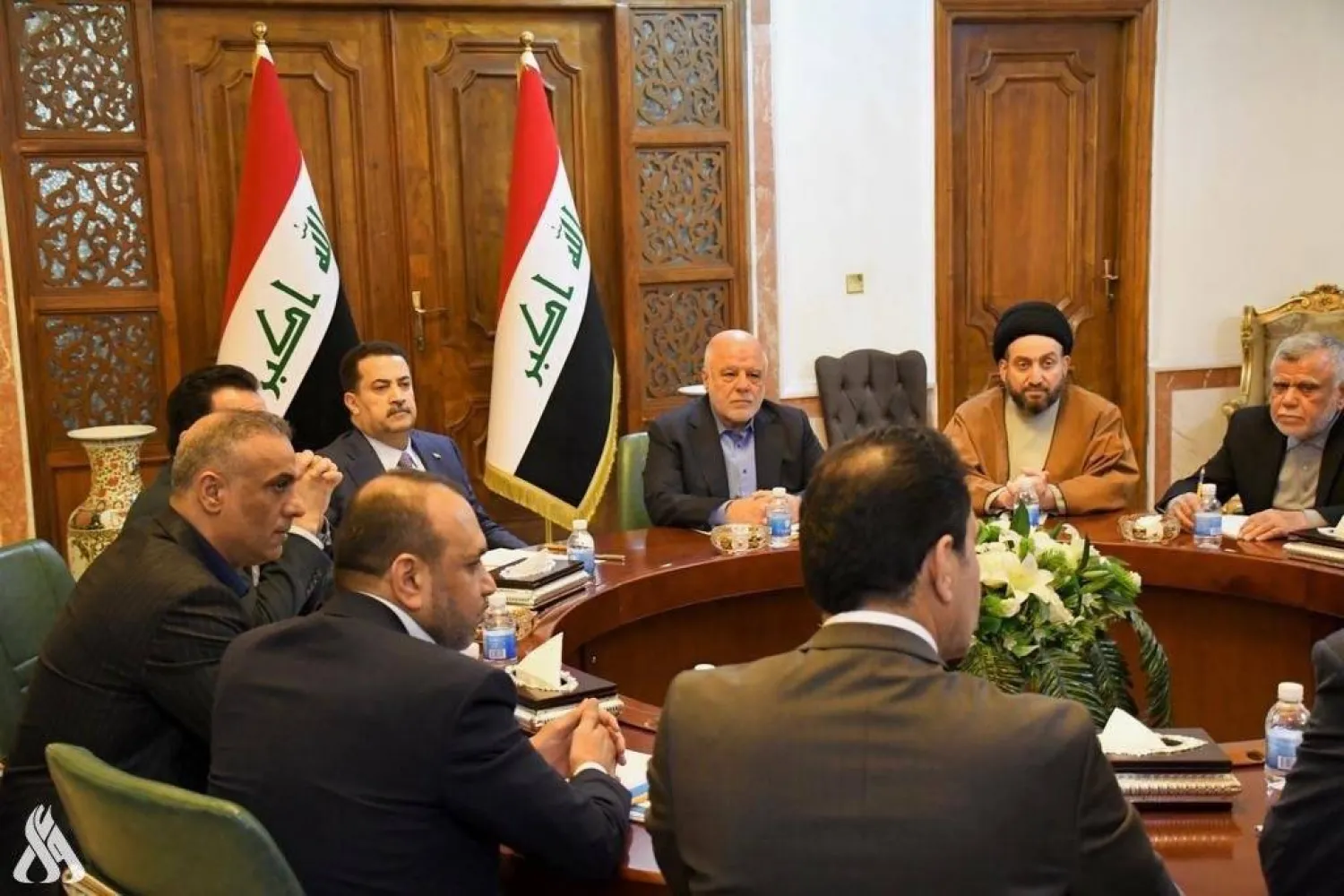
Members of the Coordination Framework hold a meeting. (Iraqi News Agency)
TT

Maliki Can Withdraw as Candidacy as Iraq PM the Easy or Hard Way

Members of the Coordination Framework hold a meeting. (Iraqi News Agency)

Iraqi Former Prime Minister Nouri al-Maliki declined at the last minute to attend a meeting of the pro-Iran Coordination Framework on Monday night that was aimed at settling the crisis over his nomination as prime minister.

Instead of declaring that he was pulling out as candidate, as had been expected, Maliki informed his close circle that he is “following through with his nomination to the end,” trusted sources told Asharq Al-Awsat.

Iraq has come under intense pressure from the US to withdraw the nomination. In January, President Donald Trump warned Baghdad against picking Maliki as its PM, saying the United States would no longer help the country.

“Last time Maliki was in power, the Country descended into poverty and total chaos. That should not be allowed to happen again. Because of his insane policies and ideologies, if elected, the United States of America will no longer help Iraq,” Trump wrote on Truth Social.

Maliki also dismissed as “extortion and intimidation” talks of renewed US sanctions on Iraq, added the sources.

However, circles within the Coordination Framework have started to “despair” with the impasse over naming a new prime minister and are weighing the possibility of taking “difficult” choices, they revealed. Maliki has become a prisoner of his own nomination.

The Sunni Progress Party (Takadum) had voiced its reservations over Maliki’s nomination before Trump made his position clear and which has since weighed heavily on Iraq.

‘Indefinitely’

Maliki’s decision to skip the Framework’s meeting on Monday forced the coalition to postpone it “indefinitely”, exposing more differences inside the alliance that have been festering for months. The dispute over the post of prime minister is threatening to evolve into one that threatens the unity of the coalition itself.

Several sources told Asharq Al-Awsat that Maliki had sent the Framework a written message on Monday night informing them that he will not attend the meeting because “he was aware that discussions will seek to pressure him to withdraw his candidacy.”

Maliki was the one to call for the meeting to convene in the first place, they revealed.

Reports have been rife in Iraq that Shiite, Sunni and Kurdish political leaderships have all received warnings that the US would take measure against Iraq if Maliki continued to insist on his nomination.

Former Foreign Minister Hoshyar Zebari told Dijlah TV that “Shiite parties” had received two new American messages reiterating the rejection of Maliki’s nomination.

Necessary choice

Maliki and the Framework are now at an impasse, with the latter hoping the former PM would take it upon himself to withdraw his candidacy in what a leading Shiite figure said would help protect the unity of the coalition.

Leading members of the coalition were hoping to give Maliki enough time to decide himself to withdraw, but as time stretches on, the coalition may take matters into its own hands and take “necessary” choices, said the figure.

Other sources revealed, however, that Maliki refuses to voluntarily withdraw from the race believing that this is a responsibility that should be shouldered by the Framework. This has effectively left the alliance with complex and limited choices to end the crisis.

Sources close to Maliki said he has made light of US threats to impose sanctions, saying that if they were to happen, Iraq will emerge on the other side stronger, citing other countries that came out stronger after enduring years of pressure.

Moreover, he is banking on an American change in position, saying mediators have volunteered to “polish his image before Trump and his team.” Members of Maliki’s State of Law coalition declined to comment on this information.

Sources inside the Framework said the coalition may “ultimately withdraw Maliki’s nomination if he becomes too much of a burden on an already weary alliance.”

Doing so may cost them a strong ally in Maliki and force the Framework to yield to Washington’s will, said the Shiite figure. “Maliki may come off as stubborn and strong, but he is wasting his realistic options at this critical political juncture,” it added.

The Framework is divided between a team that is banking on waiting to see how the US-Iran tensions will play out to resolve the crisis and on Maliki voluntarily withdrawing his nomination. The other team is calling for the coalition to resolve the crisis through an internal vote.

Leading Shiite figures told Asharq Al-Awsat that opponents of Maliki’s nomination in the coalition have no choice but to apply internal pressure inside the Framework, which is on the verge of collapse.



Arab League, Arab Parliament Condemn Closure of Al-Aqsa Mosque

A view of the Aqsa Mosque is pictured in Old City of Jerusalem on March 6, 2026.  (Photo by AHMAD GHARABLI / AFP)
A view of the Aqsa Mosque is pictured in Old City of Jerusalem on March 6, 2026. (Photo by AHMAD GHARABLI / AFP)
TT

Arab League, Arab Parliament Condemn Closure of Al-Aqsa Mosque

A view of the Aqsa Mosque is pictured in Old City of Jerusalem on March 6, 2026.  (Photo by AHMAD GHARABLI / AFP)
A view of the Aqsa Mosque is pictured in Old City of Jerusalem on March 6, 2026. (Photo by AHMAD GHARABLI / AFP)

The General Secretariat of the Arab League expressed deep concern over the continued measures by the Israeli occupation authorities to close Al-Aqsa Mosque to Muslim worshippers, particularly during the holy month of Ramadan, considering this a violation of freedom of worship and an infringement of the historical and legal status quo of the holy sites in the city of Jerusalem.

In a statement issued Thursday, the General Secretariat stressed that Al-Aqsa Mosque holds a special religious and historical status for Muslims around the world, and that any measures restricting access to it or hindering the performance of religious rituals there could lead to an escalation of tensions and undermine efforts to achieve calm and stability, SPA reported.

The Arab League called on the international community and concerned organizations to assume their responsibilities to protect the holy sites and preserve the historical and legal status quo in Jerusalem, stressing that respect for holy sites and freedom of worship are fundamental to maintaining stability and enhancing prospects for peace in the region.

Also, the speaker of the Arab Parliament Mohammed bin Ahmed Al-Yamahi condemned the Israeli occupation's ongoing measures that close the Al-Aqsa Mosque and the Haram Al-Sharif to Muslim worshippers, particularly during Ramadan. He described these actions as violations of the freedom of worship and an infringement on the historical status quo in occupied Jerusalem.

Al-Yamahi stated that restricting access to Al-Aqsa Mosque is a troubling escalation that provokes Muslims globally and reflects efforts to alter the city's Arab and Islamic identity. He emphasized that the Al-Aqsa Mosque, covering 144 dunams, is exclusively for Muslim worship.

He warned that such restrictions would heighten tensions in the region and expressed concern over violations at the Ibrahimi Mosque in Hebron. He called on the international community, including the United Nations, to protect the holy sites in Jerusalem and ensure respect for the historical status of Islamic and Christian sacred sites.


Iraq to Keep Crude Output at 1.4 million bpd amid Hormuz Tensions, Oil Minister Says

Technicians working at the Majnoon oil field in Basra, Iraq. (Reuters)
TT

Iraq to Keep Crude Output at 1.4 million bpd amid Hormuz Tensions, Oil Minister Says

Technicians working at the Majnoon oil field in Basra, Iraq. (Reuters)

Iraq will keep crude oil production at around 1.4 million barrels per day, Oil Minister Hayan Abdel-Ghani ​was quoted as saying on Thursday, less than a third of the level before the US-Israeli conflict with Iran.

According to the state news agency, the minister said that 200,000 bpd is being transported by truck through Türkiye, Syria, and Jordan ‌and that ‌Iraq has put in ​place ‌a ⁠plan ​to manage ⁠the current disruptions.

Oil production from Iraq's main southern oilfields, where most of its oil is produced and exported, has plunged 70% to just 1.3 million bpd, sources told Reuters on March 8, as the country ⁠is unable to export via the ‌Gulf due to ‌the war.

The drop in ​production and exports ‌is set to strain Iraq's already fragile finances ‌as the state relies on crude sales for nearly all public spending and more than 90% of its income.

Under pressure to mitigate ‌the losses, the oil ministry has asked the Kurdistan Regional Government (KRG) if ⁠it ⁠would pump at least 100,000 bpd from its state-managed Kirkuk oilfields to Türkiye's Ceyhan port, sources told Reuters on Wednesday. The ministry said the KRG has not yet responded to the request.

Abdel-Ghani was quoted as saying on Thursday that Iraq will sign an agreement on exporting oil through the Ceyhan pipeline, but he did not ​give further details. 


51 Crew Rescued, 1 Dead after Attack on Tankers Off Iraq

An oil tanker burns after being hit by an Iranian strike in the ship-to-ship transfer zone at Khor al-Zubair port near Basra, Iraq, late Wednesday, March 11, 2026. (AP Photo)
TT

51 Crew Rescued, 1 Dead after Attack on Tankers Off Iraq

An oil tanker burns after being hit by an Iranian strike in the ship-to-ship transfer zone at Khor al-Zubair port near Basra, Iraq, late Wednesday, March 11, 2026. (AP Photo)

More than 50 crew members were rescued after an attack on two oil tankers in Iraq's territorial waters, Farhan al-Fartousi of the port authorities told AFP.

Fartousi, from Iraq's General Company for Ports, said "all crew members of the two tankers were rescued," adding that the 51 workers were in good condition.

The attack killed at least one crew member, an Indian national.

Iran's Revolutionary Guards said Thursday they had struck a Marshall Islands-flagged ship, which they claimed was US-owned, in the north of the Gulf.

The vessel, Safesea Vishnu, came under attack March 11 while operating near Basra, India’s embassy said.

The remaining 15 Indian crew members were evacuated and are safe, the embassy added.