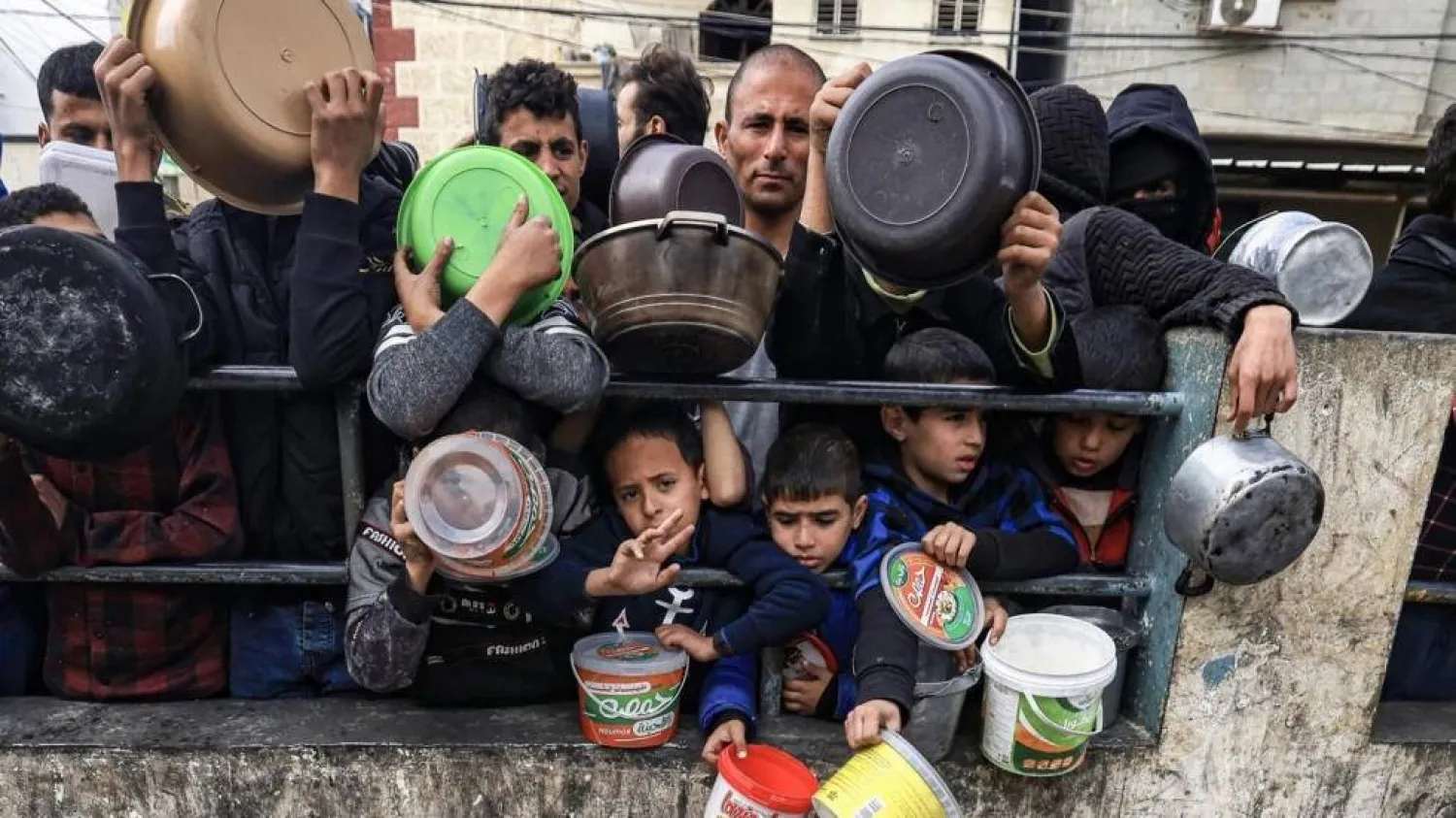
Gripped by Hunger, Gazans Queue for Meagre Food

Many children are among those queueing, desperate for food. Mahmud HAMS / AFP
TT

Gripped by Hunger, Gazans Queue for Meagre Food

Many children are among those queueing, desperate for food. Mahmud HAMS / AFP

When Bakr al-Naji realizes the meals he prepares each day for a charity in the Gaza Strip won't be sufficient to fill the stomachs of the children, his heart sinks.
In Rafah, a city at the southern end of Gaza, thousands of people queue up for a little food at the Tkiyeh center, said Naji.
The 28-year-old was displaced from Gaza City, but volunteers to cook for those facing the same circumstances.
"The most difficult moment, for me, is when I hand out the meals," he told AFP.
"I feel a pang in my heart when there is no more food and the children complain and say they haven't eaten enough," he said.
Faced with those pleas, most volunteers sacrifice their own meals.
According to UN's hunger monitoring system (IPC) by the start of December more than two million Gazans were already facing acute food insecurity, with more than 378,000 experiencing "catastrophic hunger".
The IPC report on Thursday said that there was a risk of famine which was "increasing each day" and warned that within weeks the entire population will face "acute food insecurity" or worse.
Humanitarian aid is only trickling into the besieged coastal territory, which Israel's army has been pounding since October 7.
The relentless ground and air campaign, aimed at destroying Hamas, was triggered by the Islamist groups' unprecedented attack on Israel in which it killed around 1,140 people, mostly civilians, according to an AFP tally of Israeli figures.
Israel's retaliation has killed more than 20,200 people, mostly women and children, according to the health ministry in the Hamas-run territory.
In Rafah, people crowded against a barrier separating the crowd from large, steaming pots of food.
Adults and a large number of children were waiting with plastic bowls and small pots.
"Lentils and bulgur wheat have disappeared from the markets, as well as peas and white beans," said Khaled Sheikh al-Eid, an official at the charity which serves around 10,000 people a day.
His center survives thanks to donations and volunteers and must constantly juggle what few supplies are available.
'Die of hunger'
"A can of beans has gone from one shekel ($ 0.28) to six)," said Naji.
"People were poor before the war, even those who worked had barely enough to feed their children. How can they cope now?" he asked. "I fear that people will die of hunger."
In the morning, Salam Haidar, 36, was queueing outside the food center.
"They told me that it's too early but I want to be sure that I get something," said the mother of three small children.
"My son cries when he sees another child holding a piece of bread. He tried to steal sweets from another child, I had to tell him it was very bad."
Nur Barbakh, five months pregnant and displaced from Khan Yunis, was also waiting hours before the opening of the center in Rafah.
"Sometimes I send my 12-year-old eldest son but he gets beaten up. He comes back crying and empty handed," said Barbakh.
"If it wasn't for this center, we would have nothing at all," she said, holding three tomatoes and two shekels in her hand. "I couldn't find any bread".
"My children have lost a lot of weight, the hunger wakes them up at night," she said, adding that she was considering returning to her home in Khan Yunis, despite it being the center of fighting between Israel and Hamas.
"It's better to die at home as a martyr than to die of hunger," she said.



Syria to Start Currency Swap on January 1st, Central Bank Governor Says

Syrian pounds are pictured inside an exchange currency shop in Azaz, Syria February 3, 2020. Picture taken February 3, 2020. REUTERS/Khalil Ashawi/File Photo
TT

Syria to Start Currency Swap on January 1st, Central Bank Governor Says

Syrian pounds are pictured inside an exchange currency shop in Azaz, Syria February 3, 2020. Picture taken February 3, 2020. REUTERS/Khalil Ashawi/File Photo

Syria will start swapping old banknotes for new ones under a ​plan to replace Assad-era notes starting from January 1, 2026, Central Bank Governor Abdelkader Husrieh said on Thursday.

Husrieh announced the introduction of the new Syrian currency, saying the decree "sets January ‌1, 2026, ‌as the start date ‌for ⁠the ​exchange ‌process". Sources familiar with the matter told Reuters in August that the country will issue new banknotes, removing two zeros from its currency in an attempt to restore ⁠public confidence in the severely devalued pound.

The ‌step is intended ‍to strengthen ‍the Syrian pound after its purchasing ‍power collapsed to record lows following a 14-year conflict that ended with President Bashar al-Assad's ouster in December.

Husrieh ​said the operation will take place through a smooth and orderly ⁠swap - a move bankers hope will ease fears that the new currency could fuel inflation and further erode the purchasing power of Syrians already reeling from high prices.

He added that a press conference will soon outline the exact regulations and mechanisms.


Türkiye Begins Black Box Analysis of Jet Crash That Killed Libyan Military Chief and 7 Others

Libyan national flags fly at half-mast in Tripoli on December 24, 2025, after the head of Libya's armed forces and his four aides died in a plane crash in Türkiye. (AFP)
TT

Türkiye Begins Black Box Analysis of Jet Crash That Killed Libyan Military Chief and 7 Others

Libyan national flags fly at half-mast in Tripoli on December 24, 2025, after the head of Libya's armed forces and his four aides died in a plane crash in Türkiye. (AFP)

The technical analysis of the recovered black boxes from a jet crash that killed eight people, including western Libya’s military chief, began as the investigation proceeded in cooperation with Libyan authorities, the Turkish Ministry of Defense said Thursday.

The private jet with Gen. Muhammad Ali Ahmad al-Haddad, four other military officials and three crew members crashed on Tuesday after taking off from Türkiye’s capital, Ankara, killing everyone on board. Libyan officials said the cause of the crash was a technical malfunction on the plane.

The high-level Libyan delegation was on its way back to Tripoli after holding defense talks in Ankara aimed at boosting military cooperation between the two countries.

The wreckage was scattered across an area covering 3 square kilometers (more than a square mile), complicating recovery efforts, according to the Turkish Interior Minister Ali Yerlikaya.

A 22-person delegation, including five family members, arrived from Libya early on Wednesday to assist in the investigation.


Lebanese President: We are Determined to Hold Parliamentary Elections on Time

President Joseph Aoun between Prime Minister Nawaf Salam and Speaker Nabih Berri (Lebanese Presidency file photo)
TT

Lebanese President: We are Determined to Hold Parliamentary Elections on Time

President Joseph Aoun between Prime Minister Nawaf Salam and Speaker Nabih Berri (Lebanese Presidency file photo)

Lebanese President Joseph Aoun reiterated on Thursday that the country’s parliamentary elections are a constitutional obligation that must be carried out on time.

Lebanon’s state-run National News Agency quoted Aoun as saying that he, alongside Prime Minister Nawaf Salam and Parliament Speaker Nabih Berri, is determined to hold the elections on schedule.

Aoun also emphasized that diplomatic efforts have continued unabated to keep the specter of war at bay, noting that "things are heading in a positive direction".

The agency also cited Berri reaffirming that the elections will take place as planned, with "no delays, no extensions".

The Lebanese parliamentary elections are scheduled for May next year.