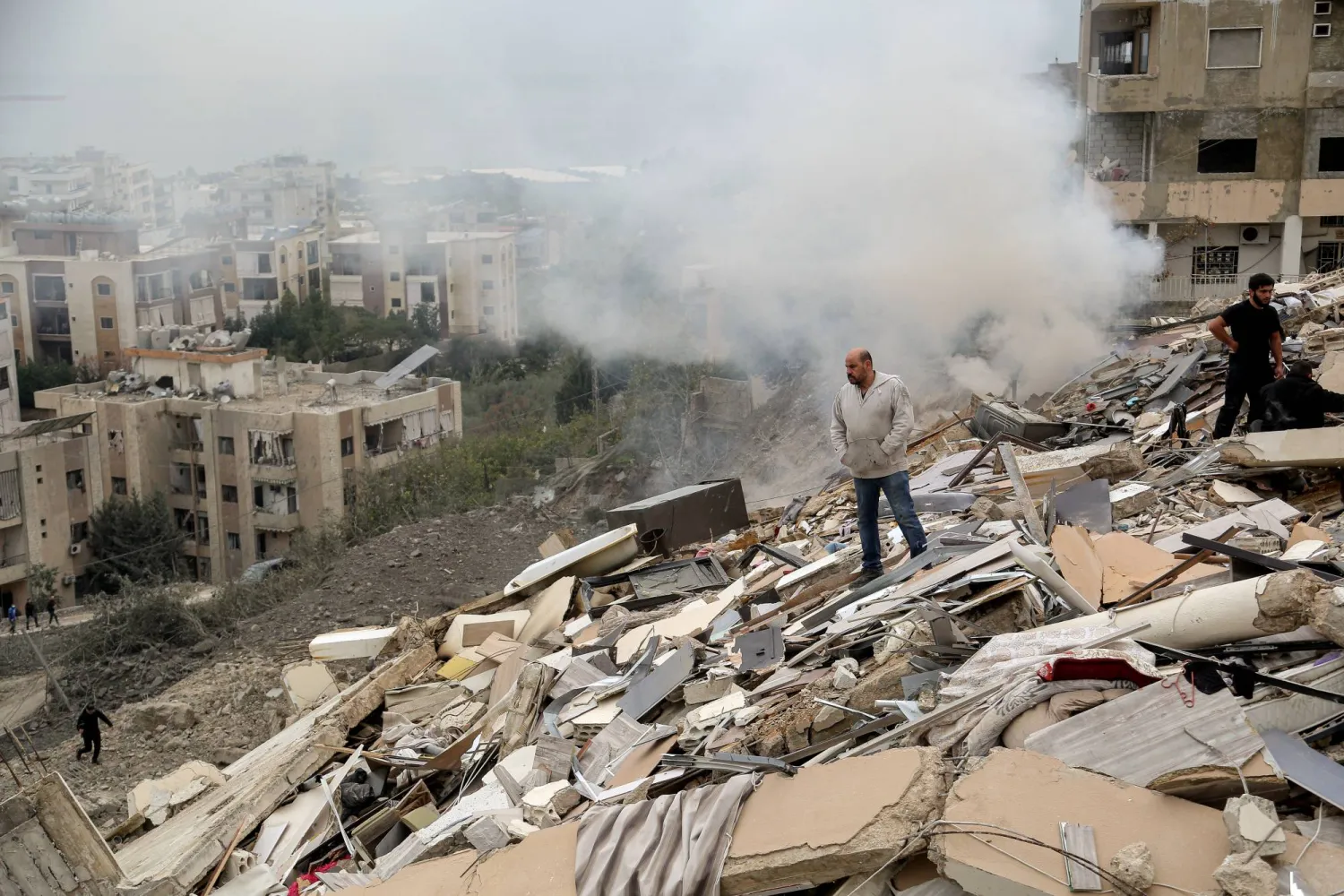
As Gaza War Grinds on, Tensions Soar along Israel's Volatile Northern Border with Lebanon

Smoke and fire rise from a building following an Israeli strike on what the Israeli military says are Hezbollah targets in a location given as Lebanon, amid the ongoing cross-border hostilities between Hezbollah and Israeli forces, in this screengrab taken from an undated handout video released on November 24, 2023.  Israel army/Handout via REUTERS
Smoke and fire rise from a building following an Israeli strike on what the Israeli military says are Hezbollah targets in a location given as Lebanon, amid the ongoing cross-border hostilities between Hezbollah and Israeli forces, in this screengrab taken from an undated handout video released on November 24, 2023. Israel army/Handout via REUTERS
TT

As Gaza War Grinds on, Tensions Soar along Israel's Volatile Northern Border with Lebanon

Smoke and fire rise from a building following an Israeli strike on what the Israeli military says are Hezbollah targets in a location given as Lebanon, amid the ongoing cross-border hostilities between Hezbollah and Israeli forces, in this screengrab taken from an undated handout video released on November 24, 2023.  Israel army/Handout via REUTERS
Smoke and fire rise from a building following an Israeli strike on what the Israeli military says are Hezbollah targets in a location given as Lebanon, amid the ongoing cross-border hostilities between Hezbollah and Israeli forces, in this screengrab taken from an undated handout video released on November 24, 2023. Israel army/Handout via REUTERS

Israeli officials are stepping up threats against the Lebanese militant group Hezbollah, warning that Israel is running out of patience as the two sides continue to trade fire along Israel's volatile northern border.
Benny Gantz, a member of Israel's War Cabinet, said Wednesday that if the international community and the Lebanese government don't restrain Hezbollah, Israel will. Israel’s army chief, Lt. Gen. Herzi Halevi, said the military is in a state of high readiness and has approved plans in case it decides to open a second front in the north.
The fighting along Israel’s northern border broke out when Hezbollah began firing rockets shortly after the Oct. 7 cross-border attack by Hamas triggered the war in Gaza.
While at a lower intensity than the battle in Gaza, the simultaneous fighting has caused destruction, displacement and death on both sides and raised fears of a wider regional war.
Here is a look at the battle between Israel and Hezbollah:
WHAT DOES THE FIGHTING INVOLVE? Hezbollah fighters have been attacking Israeli posts and villages along the border, and the group has launched rockets and drones toward Israeli targets. Israeli tanks, artillery and aircraft have been striking areas on the Lebanese side of the border. The fighting has been mostly brief, but almost daily.
The Israeli military says more than 1,700 rockets have been fired from Lebanon toward Israel, killing 15 Israelis, including nine soldiers, and injuring more than 150 people.
Israel has evacuated about 60,000 people from more than 40 northern communities, including the main city of Kiryat Shemona, which has 22,000 residents. Israeli media outlets have aired footage of battered homes and barren communities, with Israeli soldiers guarding empty streets.
On the Lebanese side, around 74,500 people have been displaced by the fighting, according to the International Organization for Migration.
Nearly 160 people have been killed by Israeli airstrikes and shelling in Lebanon, according to an Associated Press tally. Most of those were fighters with Hezbollah and allied groups, but at least 19 civilians have also been killed, including journalists and children.
Human rights groups and local officials have also accused Israel of hitting Lebanese border areas with shells containing white phosphorus, a controversial incendiary munition. The strikes have burned hundreds of hectares (acres) of farm and woodland and injured civilians. Israel says all its actions conform with international law.
WHY ARE THEY FIGHTING? Israel and Iran-backed Hezbollah are longtime bitter enemies, dating back to Israel's occupation of parts of south Lebanon from 1982 to 2000.
After Hezbollah fighters ambushed an Israeli patrol in 2006 and took two Israeli soldiers hostage, the sides fought a vicious monthlong war that ended in a draw — but not before Israeli bombardment wreaked widespread destruction in southern Lebanon and parts of Beirut.
The border area had largely been quiet since that war, aside from sparse skirmishes and sporadic tensions. Israel estimates that Hezbollah has some 150,000 rockets and missiles in its arsenal, many of which can strike virtually anywhere in Israel, including the economic capital, Tel Aviv.
Hezbollah says its attacks aim to ease pressure on the Gaza Strip, where Israel is fighting an unprecedented ground, air and sea offensive meant to topple Hamas and return some 129 people held captive in the territory.
THE IRAN CONNECTION Although there has been no proof that Iran, Israel's archenemy, ordered the Oct. 7 attack, its fingerprints have been visible throughout the ensuing conflict.
In addition to Iran's support for Hamas and Hezbollah, Iran-backed groups in Yemen, Syria and Iraq have launched attacks on Israel and its allies in support of Hamas.
In the Red Sea, attacks by Houthi rebels in Yemen against ships they believe to be connected to Israel have disrupted trade and prompted the launch of a US-led multinational naval operation to protect shipping routes.
Iran-backed militias in Iraq have also launched dozens of attacks on bases housing US troops in Iraq and Syria, which they have said are in retaliation for Washington’s support of Israel.
And on Monday, Iranian state media blamed Israel for a strike on a Damascus neighborhood that killed a high-ranking Iranian general.
Amos Harel, a military commentator for the daily Haaretz newspaper, wrote Wednesday that the general's killing was a message to Iran that it can no longer enjoy immunity while its proxies attack Israel.
“It also brings us closer to the possibility of a growing escalation against Hezbollah, and even against the Iranians, on the northern front,” he wrote.
WHAT IS HEZBOLLAH'S ROLE? Hezbollah's leader, Hassan Nasrallah, faces a risky balancing act.
Joining Hamas would risk dragging Lebanon — beset by economic calamity and internal political tensions — into a conflict it can ill afford, fueling domestic opposition to the group. The World Bank has already said the clashes are likely to harm Lebanon's economy.
Lebanon is in the fourth year of a crippling economic crisis and is bitterly divided between Hezbollah and its allies and opponents, paralyzing the political system.
But staying entirely on the sidelines as Israeli troops battle in the Gaza Strip could compromise Hezbollah’s credibility, and a Hamas defeat would be a blow to Iran.
Hezbollah has been careful to limit its attacks on Israel, while keeping open the threat of a broader escalation.
“If Israel goes too far, we will retaliate twice as much,” Hezbollah’s deputy leader, Sheikh Naim Kassem, said Thursday. “We will not fear either Israeli or American threats or intimidation.”
A NEW FRONT FOR ISRAEL? With its soldiers bogged down in Gaza, Israel has mostly sought to limit the fighting in its north. Hezbollah’s military capabilities are far superior to those of Hamas.
Still, Israeli officials are increasingly warning that the country is prepared to expand the fighting and that Hezbollah should be prepared to pay a price for the damage it has wrought over the past three months.
Israel already has bolstered forces in the north and could well turn its sights on Hezbollah once it scales down or wraps up the war in Gaza.
Israel's top ally, the US, which has sent military reinforcements to the region, says it prefers to see a negotiated solution to the mounting tensions rather than a second war front.
Israel also wants Hezbollah to abide by a 2006 UN cease-fire agreement that states the border area in southern Lebanon must be “free of any armed personnel, assets and weapons” other than Lebanese government forces and UN peacekeepers. Under the resolution, Hezbollah should not have military presence in the border region.
Lebanon, meanwhile, argues that Israel violates the resolution with its air force’s frequent entry into Lebanese airspace and by its presence in Chebaa Farms, a disputed area along the country’s border with the Golan Heights, an area seized by Israel from Syria in 1967.
Israeli Foreign Minister Eli Cohen said Wednesday that Hezbollah must respect the 2006 cease-fire. Otherwise, he warned, Nasrallah “must understand that he's next.”



Lebanon Says Two Killed in Israeli Strike on Palestinian Refugee Camp

22 January 2026, Lebanon, Qnarit: People inspect the damage of a building that was destroyed by an Israeli air raid on the southern Lebanese village of Qnarit. (dpa)
TT

Lebanon Says Two Killed in Israeli Strike on Palestinian Refugee Camp

22 January 2026, Lebanon, Qnarit: People inspect the damage of a building that was destroyed by an Israeli air raid on the southern Lebanese village of Qnarit. (dpa)

Lebanon said an Israeli strike on the country's largest Palestinian refugee camp killed two people on Friday, with Israel's army saying it had targeted the Palestinian group Hamas. 

The official National News Agency said "an Israeli drone" targeted a neighborhood of the Ain al-Hilweh camp, which is located on the outskirts of the southern city of Sidon. 

Lebanon's health ministry said two people were killed in the raid. The NNA had earlier reported one dead and an unspecified number of wounded. 

An AFP correspondent saw smoke rising from a building in the densely populated camp as ambulances headed to the scene. 

The Israeli army said in a statement that its forces "struck a Hamas command center from which terrorists operated", calling activity there "a violation of the ceasefire understandings between Israel and Lebanon" and a threat to Israel. 

The Israeli military "is operating against the entrenchment" of the Palestinian group in Lebanon and will "continue to act decisively against Hamas terrorists wherever they operate", it added. 

Israel has kept up regular strikes on Lebanon despite a November 2024 ceasefire that sought to halt more than a year of hostilities with Hezbollah. 

Israel has also struck targets belonging to Hezbollah's Palestinian ally Hamas, including in a raid on Ain al-Hilweh last November that killed 13 people. 

The UN rights office had said 11 children were killed in that strike, which Israel said targeted a Hamas training compound, though the group denied it had military installations in Palestinian camps in Lebanon. 

In October 2023, Hezbollah began launching rockets at Israel in support of Hamas at the outset of the Gaza war, triggering hostilities that culminated in two months of all-out war between Israel and the Iran-backed Lebanese group. 

On Sunday, Lebanon said an Israeli strike near the Syrian border in the country's east killed four people, as Israel said it targeted operatives from Palestinian group Islamic Jihad. 


UN Says It Risks Halting Somalia Aid Due to Funding Cuts 

A Somali trader marks watermelons for sale at an open-air grocery market as Muslims start the fasting month of Ramadan, the holiest month in the Islamic calendar, within Bakara market in Mogadishu, Somalia, February 18, 2026. (Reuters)
TT

UN Says It Risks Halting Somalia Aid Due to Funding Cuts 

A Somali trader marks watermelons for sale at an open-air grocery market as Muslims start the fasting month of Ramadan, the holiest month in the Islamic calendar, within Bakara market in Mogadishu, Somalia, February 18, 2026. (Reuters)

The UN's World Food Program (WFP) warned Friday it would have to stop humanitarian assistance in Somalia by April if it did not receive new funding.

The Rome-based agency said it had already been forced to reduce the number of people receiving emergency food assistance from 2.2 million in early 2025 to just over 600,000 today.

"Without immediate funding, WFP will be forced to halt humanitarian assistance by April," it said in a statement.

In early January, the United States suspended aid to Somalia over reports of theft and government interference, following the destruction of a US-funded WFP warehouse in the capital Mogadishu's port.

The US announced a resumption of WFP food distribution on January 29.

However, all UN agencies have warned of serious funding shortfalls since Washington began slashing aid across the world following President Donald Trump's return to the White House last year.

"The situation is deteriorating at an alarming rate," said Ross Smith, WFP Director of Emergency Preparedness and Response, in Friday's statement.

"Families have lost everything, and many are already being pushed to the brink. Without immediate emergency food support, conditions will worsen quickly.

"We are at the cusp of a decisive moment; without urgent action, we may be unable to reach the most vulnerable in time, most of them women and children."

Some 4.4 million people in Somalia are facing crisis-levels of food insecurity, according to the WFP, the largest humanitarian agency in the country.

The Horn of Africa country has been plagued by conflict and also suffered two consecutive failed rainy seasons.


Hamas Says Path for Gaza Must Begin with End to ‘Aggression’ 

Makeshift tents of displaced Palestinian families among the ruins of their homes at sunset during the holy month of Ramadan in Jabaliya northern Gaza Strip on, 19 February 2026. (EPA)
TT

Hamas Says Path for Gaza Must Begin with End to ‘Aggression’ 

Makeshift tents of displaced Palestinian families among the ruins of their homes at sunset during the holy month of Ramadan in Jabaliya northern Gaza Strip on, 19 February 2026. (EPA)

Discussions on Gaza's future must begin with a total halt to Israeli "aggression", the Palestinian movement Hamas said after US President Donald Trump's Board of Peace met for the first time.

"Any political process or any arrangement under discussion concerning the Gaza Strip and the future of our Palestinian people must start with the total halt of aggression, the lifting of the blockade, and the guarantee of our people's legitimate national rights, first and foremost their right to freedom and self-determination," Hamas said in a statement Thursday.

Trump's board met for its inaugural session in Washington on Thursday, with a number of countries pledging money and personnel to rebuild the Palestinian territory, more than four months into a fragile ceasefire between Israel and Hamas.

Israeli Prime Minister Benjamin Netanyahu has insisted however that Hamas must disarm before any reconstruction begins.

"We agreed with our ally the US that there will be no reconstruction of Gaza before the demilitarization of Gaza," Netanyahu said.

The Israeli leader did not attend the Washington meeting but was represented by his foreign minister Gideon Saar.

Trump said several countries had pledged more than seven billion dollars to rebuild the territory.

Muslim-majority Indonesia will take a deputy commander role in a nascent International Stabilization Force, the unit's American chief Major General Jasper Jeffers said.

Trump, whose plan for Gaza was endorsed by the UN Security Council in November, also said five countries had committed to providing troops, including Morocco, Kazakhstan, Kosovo and Albania.