


Diplomacy Is Still the Only Viable Path to Peace in Ukraine, UN Refugee Chief Barham Salih Says

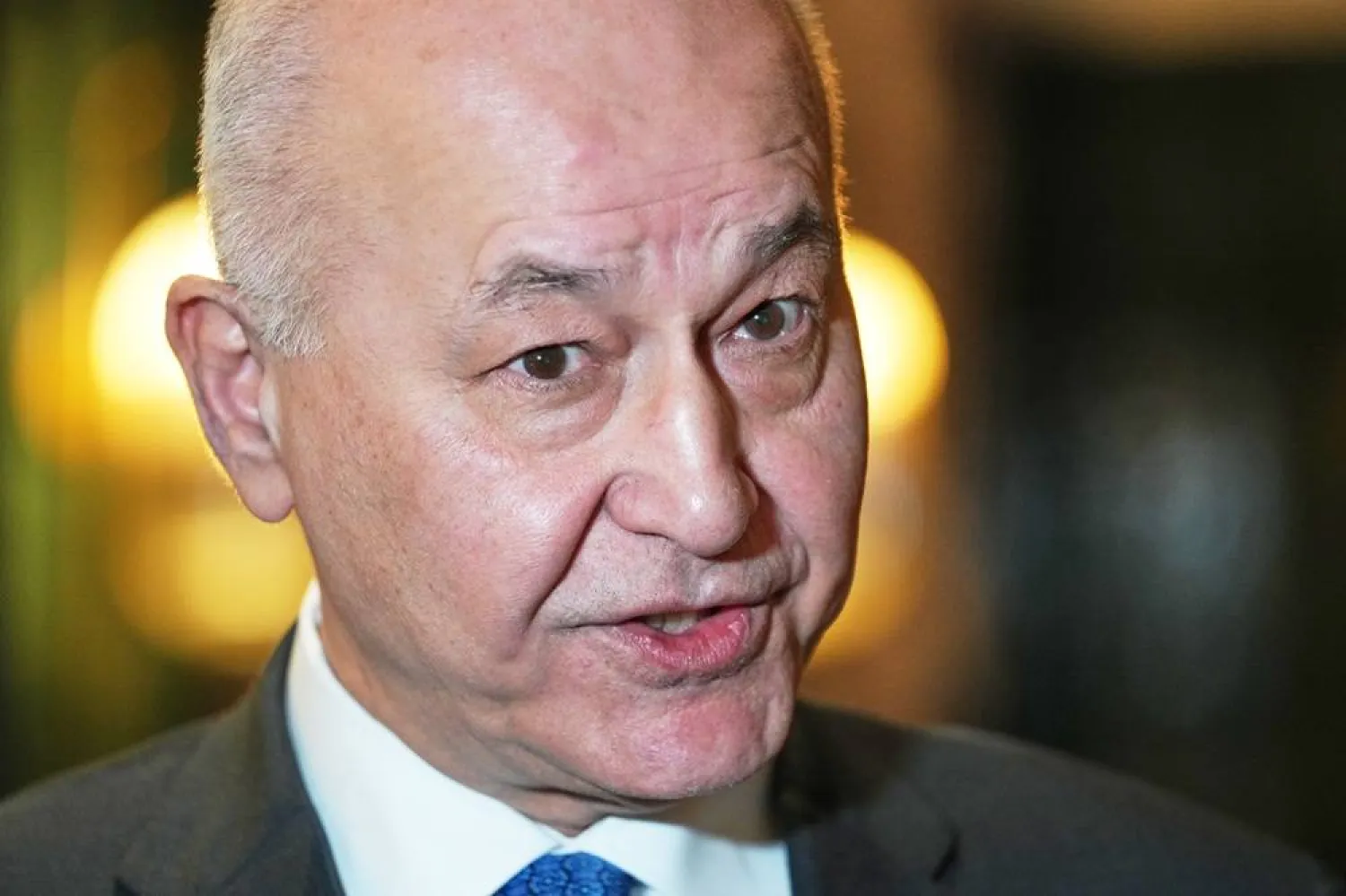
UNCHR High Commissioner Barham Salih talks during an interview with The Associated Press in Kyiv, Ukraine, Friday, Feb. 20, 2026. (AP)
TT

Diplomacy Is Still the Only Viable Path to Peace in Ukraine, UN Refugee Chief Barham Salih Says

UNCHR High Commissioner Barham Salih talks during an interview with The Associated Press in Kyiv, Ukraine, Friday, Feb. 20, 2026. (AP)

There are many obstacles to a peace deal in Ukraine, but a diplomatic solution remains the only viable option, the newly appointed head of the UN refugee agency said Friday, warning that humanitarian operations are increasingly overstretched because of multiple global crises.

Barham Salih, Iraq’s former president who was elected UNHCR high commissioner in December, made his first visit to Ukraine since taking office.

After traveling to Ukraine’s front-line cities, including Kharkiv and Zaporizhzhia, he met with President Volodymyr Zelenskyy and discussed the latest in efforts to secure a peace deal. He also discussed the future of UNHCR operations as Ukraine endures Russian attacks on its energy grid during a harsh winter.

“You have to be hopeful, but I do understand the difficulties in the situation, and it’s clear, of course, there are many, many impediments along the way, but at the end of the day, there is no military solution. There needs to be peace, a durable and just peace so that people can go back to their lives,” he said, speaking to The Associated Press in an interview in Kyiv.

“Things are not necessarily easy, definitely not easy, but let’s redouble the effort to make sure that diplomacy has a chance and really bring about a durable and just peace to this war that has been going on for far too long,” he added.

Of the agency’s $470 million appeal for Ukraine, only $150 million has been pledged. The shortfall reflects deep cuts across the humanitarian sector, making it increasingly difficult to deliver aid across multiple crises.

There are 3.7 million Ukrainians displaced within the country and nearly 6 million Ukrainians outside the country who have become refugees in Europe and elsewhere, he said.

“This tells you the gap between what is needed and what is available,” he said. “My appeal to the international community is, really, this is not the moment to walk away, this is not a moment to look the other way round. These vulnerable populations need support. We should deliver this help to them.”

The UN agency in Ukraine predicts 10.8 million Ukrainians will require humanitarian assistance in 2026, according to a report from the agency. The most critical needs are concentrated along the war’s front lines in the eastern and southern parts of Ukraine, as well as in the northern border region. Intensified hostilities produce fresh waves of displacement.

The agency’s Ukraine appeal competes with large-scale conflicts in Sudan and Gaza. Since his appointment, Salih has spent only one week in his Geneva office, traveling to Kenya, Chad, Türkiye and Jordan before visiting Ukraine.

Drastic cuts to US humanitarian funding under President Donald Trump has accelerated the erosion of global humanitarian infrastructure and severely undermined the ability of organizations to deliver aid.

There are 117 million displaced people worldwide, including at least 42 million refugees, Salih said. Two-thirds face protracted displacement and remain dependent on humanitarian assistance.

Deciding where to prioritize given shrinking resources is “difficult” he said.

“It’s really very difficult to prioritize given the scale of the problem. I was in Kenya and I was in Chad recently and I was in Türkiye and in Jordan talking to refugees from Syria. And of course, now in Ukraine, these are all pressing issues, pressing requirements,” he said.

“We need to be there to help people, but also I have to say we really need to look at durable solutions too as well. It’s not a matter of sustaining dependency or humanitarian assistance,” he added.

In his meeting with Zelenskyy, Salih said they discussed the need to focus on the “recovery phase and sustainable solutions and self reliance as we go forward,” he said.



Türkiye Condemns Closing of 8 Turkish Schools in Greece

View of the island of Halki from a ferry sailing to the island of Rhodes, off the island of Halki, Greece, April 13, 2021. (Reuters)
TT

Türkiye Condemns Closing of 8 Turkish Schools in Greece

View of the island of Halki from a ferry sailing to the island of Rhodes, off the island of Halki, Greece, April 13, 2021. (Reuters)

Türkiye's foreign ministry on Sunday condemned a decision by Greece to close eight schools catering to the country's Turkish-speaking minority, accusing its neighbor of discrimination.

In a communique, the ministry condemned "systematic practices aimed at undermining the right to education of the Turkish minority in Western Thrace".

"We once again call on Greece to act in accordance with its contractual obligations regarding minority rights and fundamental rights," it added.

The number of Turkish-language schools left in the north-east region of Thrace -- near the border between the two countries -- is now 76.

Greek authorities have said they were closing schools, and not solely in Turkish-speaking areas, because of declining numbers of pupils.

According to 2021 statistics, some 120,000 Muslims of Turkish origin live in Thrace, where they enjoy specific rights in regards to religion and education under the Treaty of Lausanne, signed after the First World War.


5.5 Magnitude Earthquake Hits Peru’s Andes Region, Killing at Least 5 People

This handout picture released by Peru's Defense Ministry shows a collapsed house on the outskirts of Huancayo, about 300 km east of Lima, on July 19, 2026, following a 5.5 magnitude quake. (Handout / Peruvian Ministry of Defense / AFP)
TT

5.5 Magnitude Earthquake Hits Peru’s Andes Region, Killing at Least 5 People

This handout picture released by Peru's Defense Ministry shows a collapsed house on the outskirts of Huancayo, about 300 km east of Lima, on July 19, 2026, following a 5.5 magnitude quake. (Handout / Peruvian Ministry of Defense / AFP)

A 5.5 magnitude earthquake shook the Andes region of Peru, killing at least five people, local authorities said on Sunday.

More than 20 people were injured, and 300 have been displaced so far.

The US Geological Survey (USGS) reported the quake struck on Saturday at 9:24 p.m. local time, with its epicenter located 2 kilometers (1.24 miles) west-southwest of the city of Sicaya, in Huancayo province. The incident took place at a depth of 10 kilometers (6.21 miles).

Peru’s National Civil Defense Institute said in a statement the total number of people missing is still unknown.

Several buildings collapsed or suffered structural damage, including the local church and convent.

Images broadcast by local media captured the anguish of victims’ relatives in one of the hardest-hit areas, the agricultural region of Chongo Bajo, where residents huddled under blankets outside severely damaged homes. Animals were also seen under the rubble.

In 2007, a magnitude 7.9 earthquake struck the province of Pisco in the Ica region, leaving nearly 600 people dead.

Earthquakes are frequent in Peru, as the country is located in the so-called Pacific “Ring of Fire.”


UN Watchdog Calls for Restraint as Iran Says US Attacked Unfinished

Iranians walk past an anti-US banner in Tehran on July 19, 2026. (AFP)
TT

UN Watchdog Calls for Restraint as Iran Says US Attacked Unfinished

Iranians walk past an anti-US banner in Tehran on July 19, 2026. (AFP)

The UN's nuclear watchdog called for restraint on Sunday after Iran's Atomic Energy Organization said the United States had attacked an under-construction nuclear power plant in the country's southwest.

The US and Iran have been trading escalating attacks for days, and Washington carried out fresh airstrikes on Sunday to "punish" Iran for the deaths of two US service members in Jordan on Friday -- its first reported losses since the return to open hostilities in the Middle East war.

Tehran's Atomic Energy Organization said US forces "in an aggressive and brutal act contrary to international law, attacked the under-construction Darkhovin nuclear power plant... with a number of projectiles on Sunday", according to a statement carried by state TV.

The UN's International Atomic Energy Agency said it was looking into the reports, noting the plant "is in the very early stages of construction and contained no nuclear material when last visited by the IAEA".

While the incident "is not believed to pose any radiological risk", IAEA director Rafael Grossi reiterated his "call for military restraint in the vicinity of all nuclear-related sites", the agency said, in a post on X.

Iran's nuclear program has long been a major point of contention between it and the West, including in negotiations aimed at ending the current war.

While foreign powers including the US and Israel suspect it of seeking a bomb, Tehran has always maintained its program is peaceful, though it insists on its right to enrich uranium for civilian purposes.