


Ethiopia and Somaliland: Security in Return for Sea Access

Ethiopian Prime Minister Abiy Ahmed and Somaliland leader Muse Bihi Abdi  attend the signing of the Memorandum of Understanding agreement, that allows Ethiopia to use a Somaliland port, in Addis Ababa, Ethiopia, January 1, 2024. (Reuters)
Ethiopian Prime Minister Abiy Ahmed and Somaliland leader Muse Bihi Abdi attend the signing of the Memorandum of Understanding agreement, that allows Ethiopia to use a Somaliland port, in Addis Ababa, Ethiopia, January 1, 2024. (Reuters)
TT

Ethiopia and Somaliland: Security in Return for Sea Access

Ethiopian Prime Minister Abiy Ahmed and Somaliland leader Muse Bihi Abdi  attend the signing of the Memorandum of Understanding agreement, that allows Ethiopia to use a Somaliland port, in Addis Ababa, Ethiopia, January 1, 2024. (Reuters)
Ethiopian Prime Minister Abiy Ahmed and Somaliland leader Muse Bihi Abdi attend the signing of the Memorandum of Understanding agreement, that allows Ethiopia to use a Somaliland port, in Addis Ababa, Ethiopia, January 1, 2024. (Reuters)

Ethiopia’s signing on Monday of a Memorandum of Understanding (MoU) to use the main port of Somalia's breakaway region of Somaliland has sparked a new dispute with its eastern neighbor.

Somalia declared on Tuesday its rejection of the deal and summoned its ambassador from Addis Ababa for consultations.

Landlocked Ethiopia has for years sought access to sea channels to meet its economic ambitions. Currently, it relies on neighboring Djibouti’s port for 95 percent of its marine trade.

Ethiopia has in the past sought to complete agreements with Eritrea, Sudan and Kenya over the use of their seaports. All failed for various reasons, such as war and coups in Sudan.

Mutual interests

The new MoU grants Ethiopia 20-km access to the Red Sea, specifically in the Berbera port, for a 50-year period.

In return, Ethiopia will recognize Somaliland as a republic, announced Muse Bihi Abdi leader of Somaliland, which has not been internationally recognized since it broke away from Somalia in 1991.

Under the MoU, at least 30 percent of Ethiopia’s trade transactions with Djibouti will now be process at Berbera port.

National Security Affairs Advisor to Ethiopian Prime Minister Abiy Ahmed, Redwan Hussein said the MoU will pave the way for his country to carry out marine trade in the region.

It will also grant it access to a leased military base on the Red Sea as part of the agreement, he added.

In other words, Somaliland will achieve security in a turbulent region in return for selling some of its territories to Addis Ababa.

The MoU also stipulates that Somaliland will acquire a stake in the Ethiopian Airlines national carrier.

Expert in Horn of Africa affairs Abdushekur Abdulsamad told Asharq Al-Awsat that the MoU will help Somaliland in modernizing its infrastructure, paving roads and laying railways. It will also benefit from electricity generated by the Grand Ethiopian Renaissance Dam (GERD).

It could gain military support from Ethiopia once the MoU is expanded further, he added.

The agreement “shall pave the way to realize the aspiration of Ethiopia to secure access to the sea and diversify its access to seaport,” PM Abiy’s office posted on X.

“It also strengthens their security, economic and political partnership,” it said.

In a televised speech last October, Abiy declared that his country needed to pursue its right to sea access, raising concerns in the region.

He said Ethiopia “is a nation whose existence was tied to the Red Sea” and that it needed access to a port.

Moreover, he said that “peace” in the region hinged on the “balanced” relations between Ethiopia and its neighbors overlooking the Red Sea, specifically naming Djibouti, Eritrea and Somalia.

Addressing the concerns raised by his statements, he vowed that he will “never pursue his interests through war.”

Partial or full stake?

Even though the MoU did not specify Ethiopia’s exact stake in Berbera port, Abdulsamad said it could be a full stake and the facility could come under Ethiopia’s complete control.

Ethiopian authorities said they will release an official statement with the details of the MoU soon.

In 2018, Ethiopia acquired a 19 percent stake in the Berbera port, according to Dubai-based DP World, which manages the port's operations. The company itself holds a 51 percent stake, while Somaliland has the remaining 30 percent.

Ethiopia was cut off from the coast after Eritrea seceded from the country and declared independence in 1993 following a three-decade war.

Addis Ababa had maintained access to a port in Eritrea until the two countries went to war in 1998-2000, and since then Ethiopia funnels most of its trade through Djibouti.

Somaliland has not gained widespread international recognition, despite declaring autonomy from Somalia in 1991.

Ethiopia, under its former President Meles Zenawi, was the first country to recognize Somaliland’s independence.

It received informal recognition from other countries that set up diplomatic missions there or carried out trade operations.

A European Union delegation had monitored the last elections that were held in Somaliland, congratulating its people, government, electoral commission and political parties for successfully organizing them.

Kenyan and Somaliland officials have exchanged visits over the years. People of Somaliland travel through passports issued in Somaliland.

Somalia stresses that Somaliland is part of its territories. Its state news agency SONNA reported that following mediation from Djibouti, it agreed with Somaliland to resume talks to resolve their disputes.

Strongly worded Somali protest

Somalia summoned its ambassador in Ethiopia in protest against the MoU.

Prime Minister Hamza Abdi Barre convened an emergency cabinet meeting to discuss the MoU, which it described as a “blatant assault on the independence, sovereignty and unity of the Federal Republic of Somalia.” It deemed the agreement null and void.

Barre added that the government was determined to protect Somalia’s sovereignty. “No one can violate a part of Somalia’s territory, whether by sea or air,” he stated.

The government also said it was appealing to the United Nations, African Union, Organization of Islamic Cooperation, Arab League, European Union and regional East African grouping IGAD among others “to stand with the right for Somalia to defend its sovereignty and force Ethiopia to adhere to international laws”.

President Hassan Sheikh Mohamud condemned the MoU, accusing Ethiopia of violating Somalia’s national sovereignty and regional security.

“No one can and no one will be allowed to extract an inch of Somali soil. Somalia belongs to the Somali people,” he declared in a post on the X platform.

The two Horn of Africa neighbors have a history of stormy relations and territorial feuds, fighting two wars in the late 20th century.

Abdulsamad said, however, that the tensions are now “water under the bridge.” Economic interests and policies of openness are now allowing greater rapprochement between these countries.

Eritrea

Eritrean authorities have so far not commented on the MoU, but observers believe that it will not sit well with Asmara, which will not comment on it.

Abdulsamad said Eritrea may have wasted opportunities to strike a lucrative agreement with Ethiopia to allow it access to the Assab port.

Ethiopia will not forget past agreements with Eritrea and Sudan, and it may return to them in the future, because it is working on diversifying its sources of trade operations given its massive population of 120 million people, he explained.



Israeli Far-Right Minister to Push for ‘Migration’ of West Bank, Gaza Palestinians 

A Palestinian man checks leather belts as people prepare for Ramadan, in the old city of Hebron in the Israeli-occupied West Bank, February 17,2026. (Reuters)
TT

Israeli Far-Right Minister to Push for ‘Migration’ of West Bank, Gaza Palestinians 

A Palestinian man checks leather belts as people prepare for Ramadan, in the old city of Hebron in the Israeli-occupied West Bank, February 17,2026. (Reuters)

Israel's far-right Finance Minister Bezalel Smotrich said he would pursue a policy of "encouraging the migration" of Palestinians from the occupied West Bank and Gaza Strip, Israeli media reported Wednesday.

"We will eliminate the idea of an Arab terror state," said Smotrich, speaking at an event organized by his Religious Zionism Party late on Tuesday.

"We will finally, formally, and in practical terms nullify the cursed Oslo Accords and embark on a path toward sovereignty, while encouraging emigration from both Gaza and Judea and Samaria.

"There is no other long-term solution," added Smotrich, who himself lives in a settlement in the West Bank.

Since last week, Israel has approved a series of measures backed by far-right ministers to tighten control over the West Bank, including in areas administered by the Palestinian Authority under the Oslo Accords, in place since the 1990s.

The measures include a process to register land in the West Bank as "state property" and facilitate direct purchases of land by Jewish Israelis.

The measures have triggered widespread international outrage.

On Tuesday, the UN missions of 85 countries condemned the measures, which critics say amount to de facto annexation of the Palestinian territory.

"We strongly condemn unilateral Israeli decisions and measures aimed at expanding Israel's unlawful presence in the West Bank," they said in a statement.

"Such decisions are contrary to Israel's obligations under international law and must be immediately reversed.

"We underline in this regard our strong opposition to any form of annexation."

UN Secretary-General Antonio Guterres on Monday called on Israel to reverse its land registration policy, calling it "destabilizing" and "unlawful".

The West Bank would form the largest part of any future Palestinian state. Many on Israel's religious right view it as Israeli land.

Israeli NGOs have also raised the alarm over a settlement plan signed by the government which they say would mark the first expansion of Jerusalem's borders into the occupied West Bank since 1967.

The planned development, announced by Israel's Ministry of Construction and Housing, is formally a westward expansion of the Geva Binyamin, or Adam, settlement situated northeast of Jerusalem in the West Bank.

The current Israeli government has fast-tracked settlement expansion, approving a record 52 settlements in 2025.

Excluding Israeli-annexed east Jerusalem, more than 500,000 Israelis live in West Bank settlements and outposts, which are illegal under international law.


Maliki Can Withdraw as Candidacy as Iraq PM the Easy or Hard Way

Members of the Coordination Framework hold a meeting. (Iraqi News Agency)
TT

Maliki Can Withdraw as Candidacy as Iraq PM the Easy or Hard Way

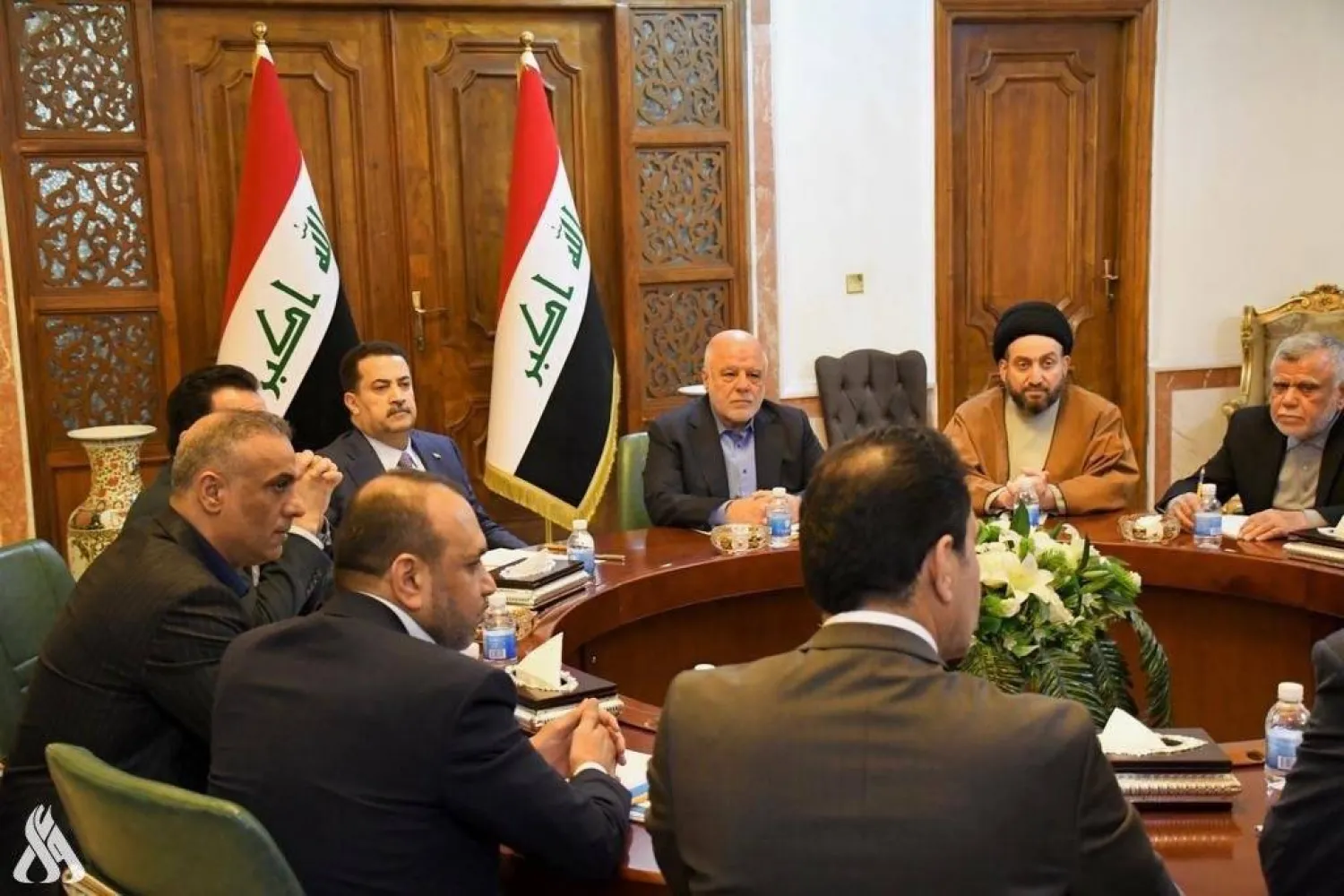
Members of the Coordination Framework hold a meeting. (Iraqi News Agency)

Iraqi Former Prime Minister Nouri al-Maliki declined at the last minute to attend a meeting of the pro-Iran Coordination Framework on Monday night that was aimed at settling the crisis over his nomination as prime minister.

Instead of declaring that he was pulling out as candidate, as had been expected, Maliki informed his close circle that he is “following through with his nomination to the end,” trusted sources told Asharq Al-Awsat.

Iraq has come under intense pressure from the US to withdraw the nomination. In January, President Donald Trump warned Baghdad against picking Maliki as its PM, saying the United States would no longer help the country.

“Last time Maliki was in power, the Country descended into poverty and total chaos. That should not be allowed to happen again. Because of his insane policies and ideologies, if elected, the United States of America will no longer help Iraq,” Trump wrote on Truth Social.

Maliki also dismissed as “extortion and intimidation” talks of renewed US sanctions on Iraq, added the sources.

However, circles within the Coordination Framework have started to “despair” with the impasse over naming a new prime minister and are weighing the possibility of taking “difficult” choices, they revealed. Maliki has become a prisoner of his own nomination.

The Sunni Progress Party (Takadum) had voiced its reservations over Maliki’s nomination before Trump made his position clear and which has since weighed heavily on Iraq.

‘Indefinitely’

Maliki’s decision to skip the Framework’s meeting on Monday forced the coalition to postpone it “indefinitely”, exposing more differences inside the alliance that have been festering for months. The dispute over the post of prime minister is threatening to evolve into one that threatens the unity of the coalition itself.

Several sources told Asharq Al-Awsat that Maliki had sent the Framework a written message on Monday night informing them that he will not attend the meeting because “he was aware that discussions will seek to pressure him to withdraw his candidacy.”

Maliki was the one to call for the meeting to convene in the first place, they revealed.

Reports have been rife in Iraq that Shiite, Sunni and Kurdish political leaderships have all received warnings that the US would take measure against Iraq if Maliki continued to insist on his nomination.

Former Foreign Minister Hoshyar Zebari told Dijlah TV that “Shiite parties” had received two new American messages reiterating the rejection of Maliki’s nomination.

Necessary choice

Maliki and the Framework are now at an impasse, with the latter hoping the former PM would take it upon himself to withdraw his candidacy in what a leading Shiite figure said would help protect the unity of the coalition.

Leading members of the coalition were hoping to give Maliki enough time to decide himself to withdraw, but as time stretches on, the coalition may take matters into its own hands and take “necessary” choices, said the figure.

Other sources revealed, however, that Maliki refuses to voluntarily withdraw from the race believing that this is a responsibility that should be shouldered by the Framework. This has effectively left the alliance with complex and limited choices to end the crisis.

Sources close to Maliki said he has made light of US threats to impose sanctions, saying that if they were to happen, Iraq will emerge on the other side stronger, citing other countries that came out stronger after enduring years of pressure.

Moreover, he is banking on an American change in position, saying mediators have volunteered to “polish his image before Trump and his team.” Members of Maliki’s State of Law coalition declined to comment on this information.

Sources inside the Framework said the coalition may “ultimately withdraw Maliki’s nomination if he becomes too much of a burden on an already weary alliance.”

Doing so may cost them a strong ally in Maliki and force the Framework to yield to Washington’s will, said the Shiite figure. “Maliki may come off as stubborn and strong, but he is wasting his realistic options at this critical political juncture,” it added.

The Framework is divided between a team that is banking on waiting to see how the US-Iran tensions will play out to resolve the crisis and on Maliki voluntarily withdrawing his nomination. The other team is calling for the coalition to resolve the crisis through an internal vote.

Leading Shiite figures told Asharq Al-Awsat that opponents of Maliki’s nomination in the coalition have no choice but to apply internal pressure inside the Framework, which is on the verge of collapse.


Australia Bars Citizen Held in Syria’s Roj Camp from Returning Home

Members of Australian families believed to be linked to ISIS leave Roj camp near Derik, Syria February 16, 2026. REUTERS/Orhan Qereman
TT

Australia Bars Citizen Held in Syria’s Roj Camp from Returning Home

Members of Australian families believed to be linked to ISIS leave Roj camp near Derik, Syria February 16, 2026. REUTERS/Orhan Qereman

Australia has barred one of its citizens from returning home from a Syrian detention camp because of security concerns, the government said Wednesday.

The unidentified person is among a group of 34 Australian women and children at the Roj camp related to suspected members of ISIS.

"I can confirm that one individual in this cohort has been issued a temporary exclusion order, which was made on advice from security agencies," Home Affairs Minister Tony Burke said in a statement sent to AFP.

"At this stage security agencies have not provided advice that other members of the cohort meet the required legal thresholds for temporary exclusion orders."

The minister can make temporary exclusion orders lasting up to two years to prevent terrorist activities or politically motivated violence.

The Australians were released from the camp on Monday but failed to reach the capital Damascus on their way home, a Kurdish official told AFP in Syria.

The official said they were turned back to the detention camp, citing "poor coordination" with the Syrian authorities.

Prime Minister Anthony Albanese underscored his government's refusal to help repatriate the women and children.

"You make your bed, you lie in it," he said, accusing the group of aligning with an ideology that seeks to "undermine and destroy our way of life".

"We are doing nothing to repatriate or to assist these people," he told reporters Wednesday.

"I think it's unfortunate that children are caught up in this. That's not their decision but it's the decision of their parents or their mother."

The humanitarian organization Save the Children Australia filed a lawsuit in 2023 on behalf of 11 women and 20 children in Syria, seeking their repatriation.

But the Federal Court ruled against Save the Children, saying the Australian government did not control their detention in Syria.