Families in Gaza Search Desperately for Food and Water, Wait in Long Lines for Aid

Palestinians queue as they wait to collect drinking water, amid shortages of drinking water, as the conflict between Israel and Hamas continues, in Rafah, in the southern Gaza Strip January 4, 2024.  REUTERS/Saleh Salem
Palestinians queue as they wait to collect drinking water, amid shortages of drinking water, as the conflict between Israel and Hamas continues, in Rafah, in the southern Gaza Strip January 4, 2024. REUTERS/Saleh Salem
TT

Families in Gaza Search Desperately for Food and Water, Wait in Long Lines for Aid

Palestinians queue as they wait to collect drinking water, amid shortages of drinking water, as the conflict between Israel and Hamas continues, in Rafah, in the southern Gaza Strip January 4, 2024.  REUTERS/Saleh Salem
Palestinians queue as they wait to collect drinking water, amid shortages of drinking water, as the conflict between Israel and Hamas continues, in Rafah, in the southern Gaza Strip January 4, 2024. REUTERS/Saleh Salem

Stranded in a corner of southern Gaza, members of the Abu Jarad family are clinging to a strict survival routine.
They fled their comfortable three-bedroom home in northern Gaza after the Israel-Hamas war broke out nearly three months ago. The 10-person family now squeezes into a 16-square meter (172-square foot) tent on a garbage-strewn sandy plot, part of a sprawling encampment of displaced Palestinians, The Associated Press reported on Friday.
Every family member is assigned daily tasks, from collecting twigs to build a fire for cooking, to scouring the city’s markets for vegetables. But their best efforts can’t mask their desperation.
At night “dogs are hovering over the tents,” said Awatif Abu Jarad, an older member of the family. “We are living like dogs!”
Palestinians seeking refuge in southern Gaza say every day has become a struggle to find food, water, medicine and working bathrooms. All the while, they live in fear of Israeli airstrikes and the growing threat of illnesses.
Israel’s bombardment and ground invasion of Gaza, now in its 13th week, have pushed almost all Palestinians toward the southern city of Rafah along the Egyptian border. The area had a prewar population of around 280,000, a figure that has bulged to over 1 million in recent days, according to the UN agency for Palestinian refugees.
Rafah’s apartment blocks are crammed with people, often extended families who have opened their doors to displaced relatives. West of the city, thousands of nylon tents have sprung up. Thousands more people are sleeping in the open, despite the cool and often rainy winter weather.
Most of northern Gaza is now under the control of the Israeli army, which early in the war urged Palestinians to evacuate to the south. As the war progressed, more evacuation orders were issued for areas in the south, forcing Palestinian civilians to crowd into ever smaller spaces, including Rafah and a nearby sliver of land called Muwasi. Even these purportedly safe spaces are often hit by airstrikes and shelling.
The war broke out on Oct. 7 after Hamas militants stormed into southern Israel, killing about 1,200 people and abducting 240 others. The fighting has killed over 22,400 Palestinians, according to the Health Ministry in the Hamas-run territory, which does not differentiate between civilians and combatants.
According to Nouman, Awatif’s brother, the conflict drove the family the entire length of Gaza. They fled their home in the northern border town of Beit Hanoun on the first day of the war and stayed with a relative in the nearby town of Beit Lahia.
Six days later, the intensity of Israeli strikes in the border area sent them south to Al-Quds Hospital in Gaza City. As people started to evacuate the hospital two days later, they traveled to the Nuseirat urban refugee camp in central Gaza, making the 10-kilometer (6-mile) journey on foot.
They stayed in a cramped UN school building in Nuseirat for over two months, but left on Dec. 23 as the Israeli army turned its focus toward Hamas targets in central Gaza refugee camps.
They escaped to Muwasi on Dec. 23, believing it was the safest option. On the first night, they slept out in the open. Then they bought nylon and wood in a Rafah market to build a tent.
Nouman, an accountant, sleeps on the nylon-covered floor with his wife, sister, six daughters and one grandchild. They sleep on their sides to conserve space.
He said the tent cost 1,000 shekels, about $276. “It is completely crazy,” he said. In Rafah's demand-driven war economy, larger pre-built family tents now range from $800 to $1,400.
The family's hardship begins at 5 a.m. Nouman said his first job is to start a small fire to cook breakfast, while his wife and daughters knead dough for flatbread and then wash their utensils and metal cooking griddle.
After eating, their attention turns to fetching water and food, tasks that take up most of the daylight hours.
Nouman said he and several of his younger relatives collect jugs of water from one of the public pipes nearby, water that is exclusively used for washing and not suitable for drinking. Next, they head to one of the dozens of drinking water tankers dotted across the city, where they wait in line for hours.
A gallon of drinking water costs one shekel, or 28 cents. Some, so desperate for cash, wait in line just to sell their space.
After the water is fetched, family members move between several open markets to hunt for vegetables, flour and canned food for that evening's meal. Meanwhile, Nouman busies himself with scouring the ground for twigs and bits of wood to make a fire.
Food prices have soared. Gaza is facing acute food and medicine shortages and is dependent largely on aid and supplies that trickle in through two crossings, one Egyptian and one Israeli, and what has been grown in the recent harvest. More than half a million people in Gaza — roughly a quarter of the population — are starving, the United Nations said in late December.
Dalia Abu Samhadana, a young mother sheltering with her uncle's family in a crowded house of 20 in Rafah, says the only food staples at her local market are tomatoes, onions, eggplants, oranges and flour. All are virtually unaffordable.
A 25-kilogram (55-pound) bag of flour before Oct. 7 cost around $10. Since then it has fluctuated between $40 and $100.
“My money has almost run out,” said Abu Samhadana, unsure of how she will be able to feed her daughter.
Displaced Palestinians in Rafah are entitled to free aid if they register with the UN agency for Palestinian refugees, which hands out flour, blankets, and medical supplies at 14 spots across southern Gaza. They often spend hours in line waiting for the aid to be distributed.
Abu Samhadana, who is originally from the nearby southern town of Khan Younis, said she has tried to register for free aid several times but has been turned away due to the lack of available supplies.
The UN agency is simply overwhelmed and is already providing support to 1.8 million people in Gaza, according to Juliette Touma, its communications director. She said she did not know if the agency had stopped registering new aid seekers.
With few options left, some hungry Palestinians in Rafah have resorted to grabbing packages from aid trucks as they pass by. The UN refugee agency confirmed that some supplies of aid had been snatched from moving trucks but did not provide any details.
Hamas police escorting aid trucks from border crossings to UN warehouses have been seen beating people, mostly teenagers, as they try to grab what they can. In some cases, they have fired shots into the air. In one incident, a 13-year-old boy was killed when Hamas police opened fire.
Meanwhile, health officials warn of the growing spread of diseases, especially among children.
The World Health Organization has reported tens of thousands of cases of upper respiratory infections, diarrhea, lice, scabies, chickenpox, skin rashes and meningitis in UN shelters.
The rapid spread of disease is mainly due to overcrowding and poor hygiene caused by a lack of toilets and water for washing.
The Abu Jarad family dug its own makeshift toilet attached to the tent to avoid communal bathrooms. Still, the family is vulnerable to disease.
“My granddaughter is 10 months old, and since the day we came to this place, she has been suffering from weight loss and diarrhea,” said Majeda, Nouman's wife.
Going to the pharmacy offers little help. "We can't find any (suitable) medicines available,” she said.



Libya’s Ramadan Celebrations Tempered by Economic Woes

A family walks on their way to shop for Ramadan decorations ahead of the holy month of Ramadan in Benghazi, Libya, February 16, 2026. (Reuters)
TT

Libya’s Ramadan Celebrations Tempered by Economic Woes

A family walks on their way to shop for Ramadan decorations ahead of the holy month of Ramadan in Benghazi, Libya, February 16, 2026. (Reuters)

Libyans have been enjoying Ramadan with feasts and fireworks -- but soaring prices, a devalued currency and political divisions have left many with little to celebrate.

Fifteen years on from the fall of longtime leader Moammar al-Gaddafi, the country remains split between east and west, while shortages of goods, including fuel, disrupt daily life, despite Libya sitting atop vast oil and gas reserves.

During the holy month of Ramadan, shoppers stock up on treats, as families gather for lavish meals before and after the daytime fast that stretches from sunrise to sunset.

But this year supermarkets have been rationing their goods, while many petrol stations are short of gas. In the capital Tripoli, most ATMs were out of cash this week.

Firas Zreeg, 37, told AFP while weaving through a crowded supermarket that the economy was deteriorating, blaming currency speculators for the fall in the dinar, "which has negative repercussions on our daily lives".

The price of cooking oil has doubled in recent weeks, while meat and poultry prices rose by half.

Refills of gas cylinders, officially priced at 1.5 dinars ($0.24) but often unavailable through state-run distributors, now sell for 75 dinars ($11.85) on the black market and at times more.

- 'Burden on citizens' -

Libya has struggled to recover from the chaos that erupted following the 2011 uprising that toppled Gaddafi.

It remains divided between the Government of National Unity (GNU) based in Tripoli and an eastern administration backed by Libyan National Army (LNA) commander Khalifa Haftar.

The country has largely been stable in recent years although there have been bouts of deadly violence, including the killing of Gaddafi's son and heir apparent Seif al-Islam this month.

With security holding, many Libyans are more focused on their livelihoods.

Last month, the central bank in the western territory devalued the dinar -- the second time in less than a year -- by nearly 15 percent, "aimed at preserving financial and monetary stability and ensuring the sustainability of public resources".

In an address this week, GNU leader Abdulhamid Dbeibah acknowledged that the devaluation had once again "put the burden on citizens".

Hanna Tetteh, head of the United Nations Support Mission in Libya, warned on Wednesday that "poverty and pressure on society [are] increasing".

"The situation, in addition to the fragile security landscape, should be a matter for concern as such conditions can lead to unexpected political and security challenges," she told the UN Security Council.

Libya's other economic problems included the absence of a unified national budget, in light of its political divide, as well as uncoordinated public spending due to parallel state institutions, Tetteh said.

Revenues from the oil industry were also declining, she added, while the central bank has said public spending is growing at an unsustainable pace.

On Tuesday, Libya marked 15 years since the start of the uprising, with fireworks lighting up the sky in Tripoli, but for many Libyans life remains a struggle.

"Minor improvements in security were made over the past three years," Zreeg told AFP, but Libyans are still faced with huge economic challenges.


Libya PM Undergoes 'Successful' Treatment at Heart Hospital

Head of Libya's Government of National Unity (GNU) Abdulhamid Dbeibah. (GNU)
TT

Libya PM Undergoes 'Successful' Treatment at Heart Hospital

Head of Libya's Government of National Unity (GNU) Abdulhamid Dbeibah. (GNU)

Libya's Prime Minister Abdulhamid Dbeibah has undergone "successful" treatment at a heart hospital, his office said Saturday, but his specific ailment was not disclosed.

"I assure you that I am fine, by God's grace," said a statement posted on social media overnight.

The treatment was carried out at a facility in the northwestern Libyan city of Misrata on an undisclosed date, said AFP.

Dbeibah said he later travelled abroad for "additional medical checkups for reassurance", though this was not the primary reason for his trip.

Italian media outlets previously reported he had been admitted to a leading cardiac facility in Milan on Thursday for a general check-up.

"The matter is simply that I underwent some additional medical checkups for reassurance while I was abroad due to a prior external commitment," he said.

"The results confirmed the success of the treatment I received in Libya, praise be to God."

The prime minister leads a UN-recognized government based in Tripoli that controls western Libya, while the country's east is run by another administration backed by military strongman Khalifa Haftar.

Libya has remained divided since chaos erupted following the 2011 Arab Spring uprising that toppled longtime leader Muammar Gaddafi.


Eight Hezbollah Members Killed in Israel’s Friday Strikes on Lebanon

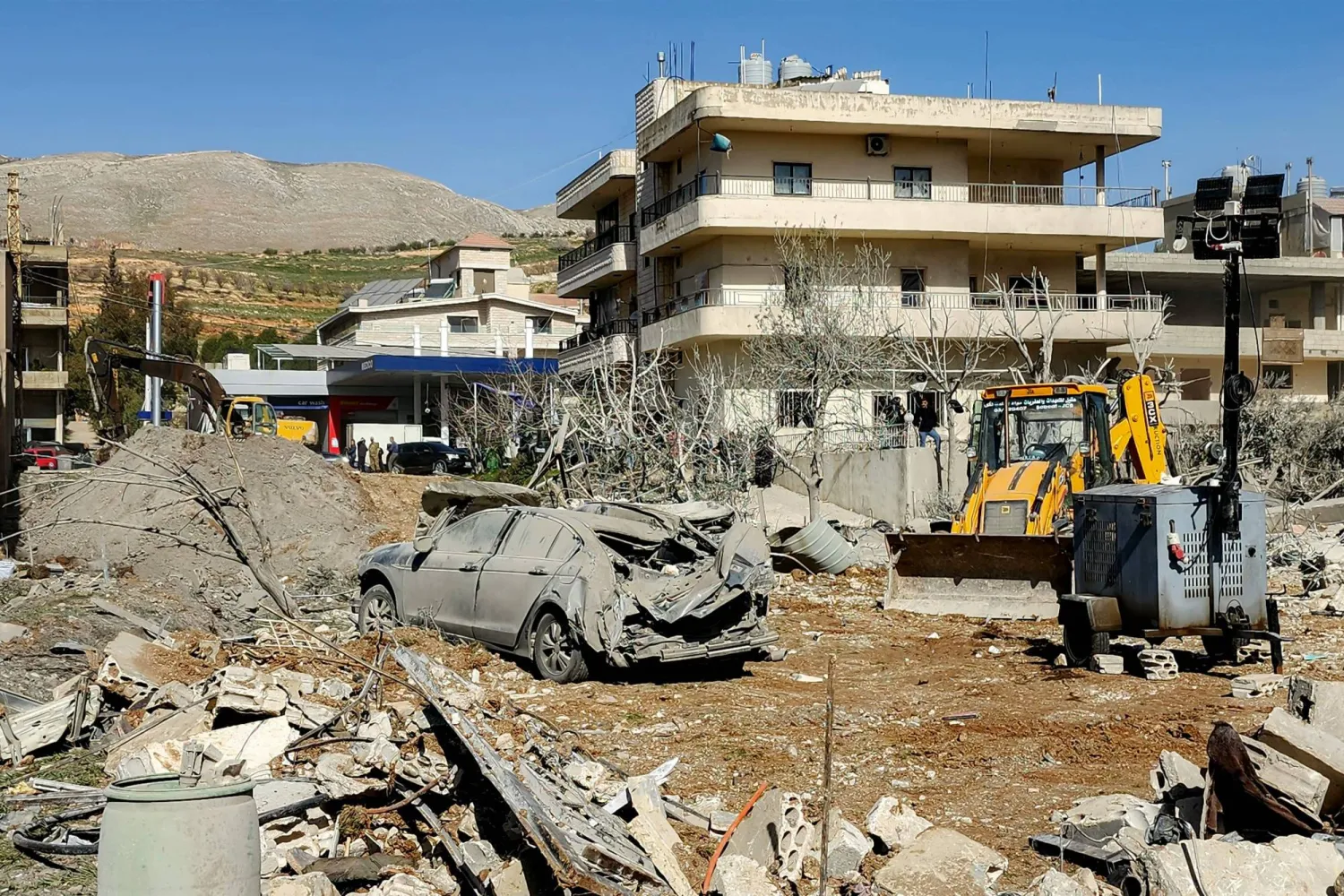
A bulldozer clears debris near heavily-damaged buildings in the village of Bednayel in Lebanon's eastern Bekaa Valley region on February 21, 2026, following Israeli strikes. (AFP)
TT

Eight Hezbollah Members Killed in Israel’s Friday Strikes on Lebanon

A bulldozer clears debris near heavily-damaged buildings in the village of Bednayel in Lebanon's eastern Bekaa Valley region on February 21, 2026, following Israeli strikes. (AFP)

Attacks carried out by Israel on Friday in eastern Lebanon killed eight members of Hezbollah, an official from the group told AFP on Saturday.

Lebanon's health ministry said Friday that a total of 10 people were killed in strikes that hit the eastern Bekaa region.

The Israeli military said it targeted "several terrorists of Hezbollah's missile array in three different command centers in the Baalbek area".

Lebanon's president on Saturday condemned the attacks, the latest despite a ceasefire with Hezbollah.

In a statement, Joseph Aoun called the attacks "a blatant act of aggression aimed at thwarting diplomatic efforts" by the United States and other nations to establish stability.

A lawmaker from Hezbollah called on Beirut to suspend meetings of a multinational committee tasked with monitoring the truce.

Washington is one of five members on the committee overseeing the ceasefire implemented in November 2024, with the body scheduled to meet again next week.

Israel has repeatedly bombed Lebanon despite the ceasefire, usually saying it is targeting Hezbollah but occasionally also the group's Palestinian ally Hamas.

The Friday attacks on southern and eastern Lebanon killed 12 people, according to the health ministry, 10 of them in the east of the country.

Israel's military said it struck "several terrorists of Hezbollah's missile array in three different command centers in the Baalbek area".

Hezbollah said a commander was killed in the raids. Its lawmaker Rami Abu Hamdan said on Saturday the group "will not accept the authorities acting as mere political analysts, dismissing these as Israeli strikes we have grown accustomed to before every meeting of the committee".

He called on Beirut to "suspend the committee's meetings until the enemy ceases its attacks".

Hezbollah, while weakened following war with Israel, remains a strong political force in Lebanon represented in parliament.

Lebanon's government last year committed to disarming the Iran-backed group, with the army saying last month it had completed the first phase of the plan covering the area near the Israeli border.

Israel, which accuses Hezbollah of rearming since the war, has called the Lebanese army's progress on disarming the group insufficient.