


Blinken to Israel: Keep Hope of Palestinian State Alive

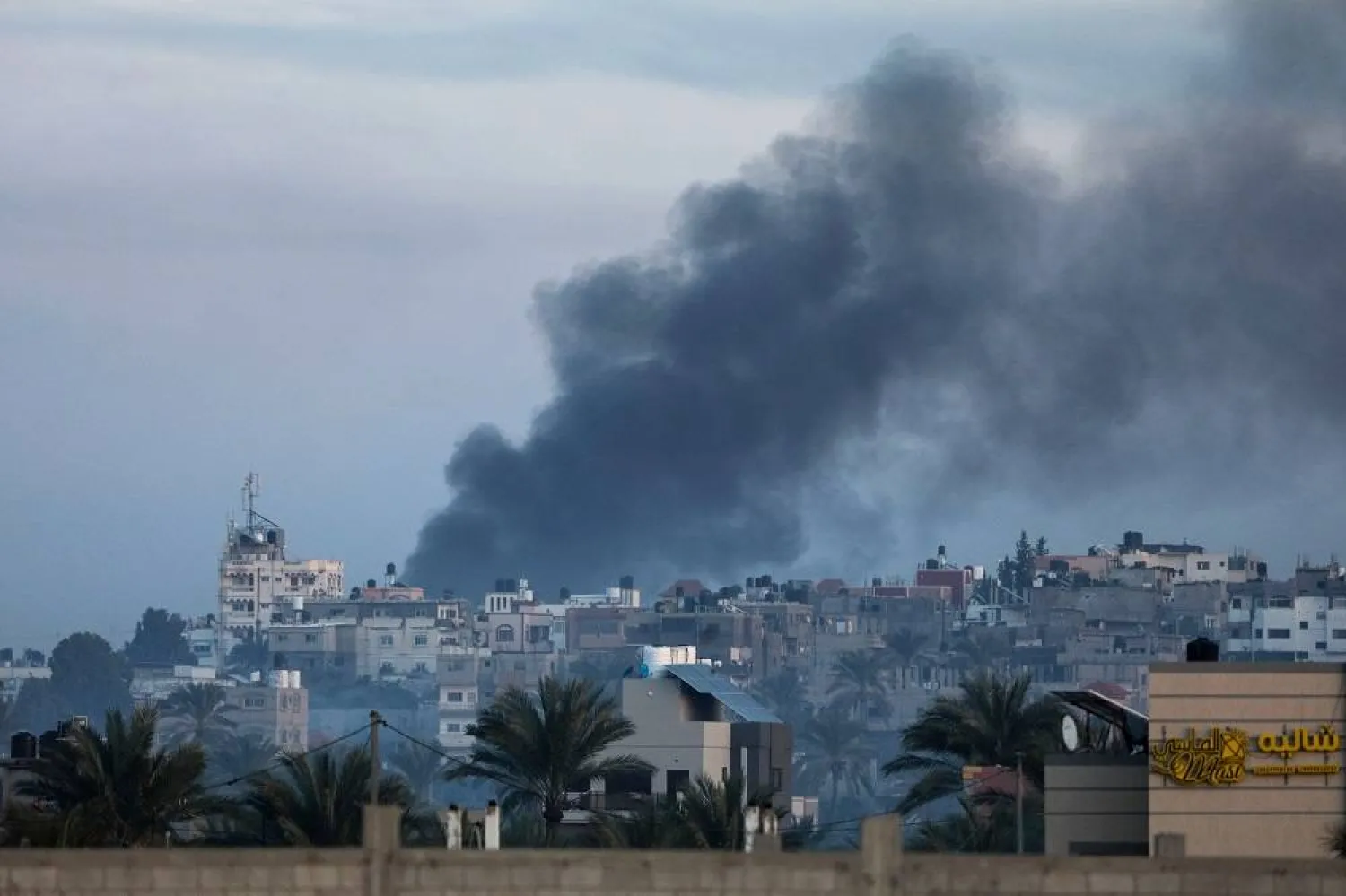
Smoke rises during Israeli military operations in the east of Al Maghazi, Al Bureij and Al Nuseirat refugee camps in the Gaza Strip, 08 January 2024. (EPA)
TT

Blinken to Israel: Keep Hope of Palestinian State Alive

Smoke rises during Israeli military operations in the east of Al Maghazi, Al Bureij and Al Nuseirat refugee camps in the Gaza Strip, 08 January 2024. (EPA)

US Secretary of State Antony Blinken on Tuesday urged Israeli leaders to avoid harming civilians in the war in Gaza and to seek a path towards the creation of Palestinian state as a way to resolve the long-running wider conflict.

Blinken was making his fourth visit to the Middle East since the war between Hamas and Israel erupted in October.

International concern has been growing over the huge Palestinian death toll from the Israeli assault on the enclave as well as a humanitarian crisis enveloping hundreds of thousands of people in Gaza.

The United States and other countries are also anxious to prevent the war from spreading through the wider Middle East.

Blinken met with Israeli Prime Minister Benjamin Netanyahu at Tel Aviv's Kirya military base on Tuesday and then with his war cabinet.

He stressed "the importance of avoiding further civilian harm and protecting civilian infrastructure in Gaza," State Department spokesperson Matthew Miller said in a statement.

Blinken also repeated the Biden administration's support for Israel's right to prevent a repeat of the Oct. 7 attacks by Hamas in southern Israel which killed 1,200 people and triggered the war in Gaza.

The Israeli air and ground assault has now killed more than 23,000 Palestinians, according to Gaza's health ministry, and obliterated large areas of the densely populated enclave.

As well as trying to tamp down regional tensions, Blinken has been discussing plans for the future governance of Gaza once the war is over.

In the meetings with Netanyahu, Blinken "reiterated the need to ensure lasting, sustainable peace for Israel and the region, including by the realization of a Palestinian state," Miller said.

Before arriving in Israel, Blinken held talks in Jordan, Qatar, the United Arab Emirates and Saudi Arabia, which have focused on seeking a longer-term approach to the Israel-Palestinian conflict to help end the Gaza war.

After his meetings with Arab leaders, he said they wanted closer relations with Israel but only if that included a "practical pathway" to a Palestinian state.

"I think there are actually real opportunities," he told his Israeli counterpart Israel Katz on Tuesday. "But we have to ... ensure that October 7 can never happen again and work to build a much different and much better future."

US-brokered talks on a Palestinian state in Israeli-occupied territory collapsed almost a decade ago, and right-wing leaders in Israel's current ruling coalition are outspokenly opposed to Palestinian statehood.

With US support, Israel established diplomatic ties with the United Arab Emirates and Bahrain in 2020.

Heavy fighting in south Gaza

After weeks of US pressure to ease its assault, Israel says it is moving from full-blown to more targeted warfare in northern Gaza, while maintaining intensive combat in southern areas.

It said its troops had killed around 40 Palestinian fighters and raided a militant compound and tunnels since Monday in Khan Younis, the main city in the south.

After a week of comparatively low Israeli losses, Israel said nine of its soldiers had been killed, mostly from engineering units tackling tunnels, in one of their deadliest days of the ground assault.

The health ministry in Gaza said 126 Palestinians had been killed and 241 wounded in the previous 24 hours.

Sean Casey, World Health Organization Emergency Medical Teams coordinator in Gaza, said the health system was fast collapsing, and Israel was denying access to more and more of Gaza for relief trucks.

"Every day we line up our convoys, we wait for clearance, and we don't get it - and then we come back and we do it again the next day."

Medical staff and patients were fleeing for their lives, including an estimated 600 patients from one facility, and 66 health workers were in detention.

Only about a third of Gaza's hospitals, all in southern and central Gaza, are even partially functional. The UN humanitarian office OCHA said three hospitals in central Gaza and Khan Younis were at risk of closure.

Casey said many staff at the main Nasser Hospital in Khan Younis had fled to shelters in the strip's southernmost tip, leaving just one doctor for more than 100 burn victims.

Hezbollah ‘does not want to expand war’

Israel's relentless bombardment and restrictions on aid supplies have prompted South Africa to file a lawsuit in the International Court of Justice, accusing Israel of genocidal actions. Hearings begin on Thursday.

Israeli President Isaac Herzog told Blinken there was "nothing more atrocious and preposterous" than that court case, noting that Hamas is sworn to Israel's destruction.

The conflict has rippled to Lebanon, where Hezbollah has been firing rockets into Israel in support of Hamas. Both groups are supported by Iran, Israel's sworn enemy.

Three members of Hezbollah were killed on Tuesday in a strike in the south of Lebanon, two sources familiar with the group's operations told Reuters, after a top Hezbollah commander was killed in the area on Monday.

Hezbollah said it had launched explosive drones at an army base in northern Israel in response to the killing of senior Hezbollah figure Wissam Tawil, and that of deputy Hamas leader Saleh al-Arouri in Beirut last week.

Hezbollah deputy leader Naim Qassem said in an address that his group did not want to expand the war from Lebanon, "but if Israel expands (it), the response is inevitable to the maximum extent required to deter Israel".

Israel has neither confirmed nor denied responsibility for the assassinations. The army said an unspecified northern base had experienced an aerial attack without damage or casualties.



How Gaza Armed Gangs Recruit New Members

Security personnel guard trucks carrying aid as they arrive in Rafah, amid the ongoing conflict between Israel and the Palestinian Islamist group Hamas, in the southern Gaza Strip January 17, 2024. (Reuters)
TT

How Gaza Armed Gangs Recruit New Members

Security personnel guard trucks carrying aid as they arrive in Rafah, amid the ongoing conflict between Israel and the Palestinian Islamist group Hamas, in the southern Gaza Strip January 17, 2024. (Reuters)

As Hamas moves to strike armed gangs operating in areas of the Gaza Strip under Israeli army control, the groups are responding with defiance, stepping up efforts to recruit young men and expand their ranks.

Videos posted on social media show training exercises and other activities, signaling that the gangs remain active despite pressure from Hamas security services.

Platforms affiliated with Hamas security say some members have recently turned themselves in following mediation by families, clans and community leaders. The gangs have not responded to those statements. Instead, they occasionally broadcast footage announcing new recruits.

Among the most prominent was Hamza Mahra, a Hamas activist who appeared weeks ago in a video released by the Shawqi Abu Nasira gang, which operates north of Khan Younis and east of Deir al-Balah.

Mahra’s appearance has raised questions about how these groups recruit members inside the enclave.

Field sources and others within the security apparatus of a Palestinian armed faction in Gaza told Asharq Al-Awsat that Mahra’s case may be an exception. They described him as a Hamas activist with no major role, despite his grandfather being among the founders of Hamas in Jabalia.

His decision to join the gang was driven by personal reasons linked to a family dispute, they said, not by organizational considerations.

The sources said the gangs exploit severe economic hardship, luring some young men with money, cigarettes and other incentives. Some recruits were heavily indebted and fled to gang-controlled areas to avoid repaying creditors.

Others joined in search of narcotic pills, the sources said, noting that some had previously been detained by Hamas-run security forces on similar charges. Economic hardship and the need for cigarettes and drugs were among the main drivers of recruitment, they added, saying the gangs, with Israeli backing, provide such supplies.

Resentment toward Hamas has also played a role, particularly among those previously arrested on criminal or security grounds and subjected to what the sources described as limited torture during interrogations under established procedures.

According to the sources, some founders or current leaders of the gangs previously served in the Palestinian Authority security services.

They cited Shawqi Abu Nasira, a senior police officer; Hussam al-Astal, an officer in the Preventive Security Service; and Rami Helles and Ashraf al-Mansi, both former officers in the Palestinian Presidential Guard.

These figures, the sources said, approach young men in need and at times succeed in recruiting them by promising help in settling debts and providing cigarettes. They also tell recruits that joining will secure them a future role in security forces that would later govern Gaza.

The sources described the case of a young man who surrendered to Gaza security services last week. He said he had been pressured after a phone call with a woman who threatened to publish the recording unless he joined one of the gangs.

He later received assurances from another contact that he would help repay some of his debts and ultimately agreed to enlist.

During questioning, he said the leader of the gang he joined east of Gaza City repeatedly assured recruits they would be “part of the structure of any Palestinian security force that will rule the sector.”

The young man told investigators he was unconvinced by those assurances, as were dozens of others in the same group.

Investigations of several individuals who surrendered, along with field data, indicate the gangs have carried out armed missions on behalf of the Israeli army, including locating tunnels. That has led to ambushes by Palestinian factions.

In the past week, clashes in the Zaytoun neighborhood south of Gaza City and near al-Masdar east of Deir al-Balah left gang members dead and wounded.

Some investigations also found that the gangs recruited young men previously involved in looting humanitarian aid.


Meta's Zuckerberg Faces Questioning at Youth Addiction Trial

REUTERS/Francis Mascarenhas Purchase Licensing Rights
TT

Meta's Zuckerberg Faces Questioning at Youth Addiction Trial

REUTERS/Francis Mascarenhas Purchase Licensing Rights

Meta Platforms CEO and billionaire Facebook founder Mark Zuckerberg is set to be questioned for the first time in a US court on Wednesday about Instagram's effect on the mental health of young users, as a landmark trial over youth social media addiction continues. While Zuckerberg has previously testified on the subject before Congress, the stakes are higher at the jury trial in Los Angeles, California. Meta may have to pay damages if it loses the case, and the verdict could erode Big Tech's longstanding legal defense against claims of user harm, Reuters reported.

The lawsuit and others like it are part of a global backlash against social media platforms over children's mental health. Australia has prohibited access to social media platforms for users under age 16, and other countries including Spain are considering similar curbs. In the US, Florida has prohibited companies from allowing users under age 14. Tech industry trade groups are challenging the law in court. The case involves a California woman who started using Meta's Instagram and Google's YouTube as a child. She alleges the companies sought to profit by hooking kids on their services despite knowing social media could harm their mental health. She alleges the apps fueled her depression and suicidal thoughts and is seeking to hold the companies liable.

Meta and Google have denied the allegations, and pointed to their work to add features that keep users safe. Meta has often pointed to a National Academies of Sciences finding that research does not show social media changes kids' mental health.

The lawsuit serves as a test case for similar claims in a larger group of cases against Meta, Alphabet's Google, Snap and TikTok. Families, school districts and states have filed thousands of lawsuits in the US accusing the companies of fueling a youth mental health crisis.

Zuckerberg is expected to be questioned on Meta's internal studies and discussions of how Instagram use affects younger users.

Over the years, investigative reporting has unearthed internal Meta documents showing the company was aware of potential harm. Meta researchers found that teens who report that Instagram regularly made them feel bad about their bodies saw significantly more “eating disorder adjacent content” than those who did not,

Reuters reported

in October. Adam Mosseri, head of Instagram, testified last week that he was unaware of a recent Meta study showing no link between parental supervision and teens' attentiveness to their own social media use. Teens with difficult life circumstances more often said they used Instagram habitually or unintentionally, according to the document shown at trial.

Meta's lawyer told jurors at the trial that the woman's health records show her issues stem from a troubled childhood, and that social media was a creative outlet for her.


Israel Permits 10,000 West Bank Palestinians for Friday Prayers at Al Aqsa

Palestinians attend Friday prayers in a mosque following an attack that local Palestinians said was carried out by Israeli settlers, in the village of Deir Istiya near Salfit in the Israeli-occupied West Bank November 14, 2025. REUTERS/Sinan Abu Mayzer
TT

Israel Permits 10,000 West Bank Palestinians for Friday Prayers at Al Aqsa

Palestinians attend Friday prayers in a mosque following an attack that local Palestinians said was carried out by Israeli settlers, in the village of Deir Istiya near Salfit in the Israeli-occupied West Bank November 14, 2025. REUTERS/Sinan Abu Mayzer

Israel announced that it will cap the number of Palestinian worshippers from the occupied West Bank attending weekly Friday prayers at the Al-Aqsa Mosque in east Jerusalem at 10,000 during the holy month of Ramadan, which began Wednesday.

Israeli authorities also imposed age restrictions on West Bank Palestinians, permitting entry only to men aged 55 and older, women aged 50 and older, and children up to age 12.

"Ten thousand Palestinian worshippers will be permitted to enter the Temple Mount for Friday prayers throughout the month of Ramadan, subject to obtaining a dedicated daily permit in advance," COGAT, the Israeli defense ministry agency in charge of civilian matters in the Palestinian territories, said in a statement, AFP reported.

"Entry for men will be permitted from age 55, for women from age 50, and for children up to age 12 when accompanied by a first-degree relative."

COGAT told AFP that the restrictions apply only to Palestinians travelling from the West Bank, which Israel has occupied since the 1967 Arab-Israeli war.

"It is emphasised that all permits are conditional upon prior security approval by the relevant security authorities," COGAT said.

"In addition, residents travelling to prayers at the Temple Mount will be required to undergo digital documentation at the crossings upon their return to the areas of Judea and Samaria at the conclusion of the prayer day," it said, using the Biblical term for the West Bank.

During Ramadan, hundreds of thousands of Palestinians traditionally attend prayers at Al-Aqsa, Islam's third holiest site, located in east Jerusalem, which Israel captured in 1967 and later annexed in a move that is not internationally recognized.

Since the war in Gaza broke out in October 2023, the attendance of worshippers has declined due to security concerns and Israeli restrictions.

The Palestinian Jerusalem Governorate said this week that Israeli authorities had prevented the Islamic Waqf -- the Jordanian-run body that administers the site -- from carrying out routine preparations ahead of Ramadan, including installing shade structures and setting up temporary medical clinics.

A senior imam of the Al-Aqsa Mosque, Sheikh Muhammad al-Abbasi, told AFP that he, too, had been barred from entering the compound.

"I have been barred from the mosque for a week, and the order can be renewed," he said.

Abbasi said he was not informed of the reason for the ban, which came into effect on Monday.

Under longstanding arrangements, Jews may visit the Al-Aqsa compound -- which they revere as the site of the first and second Jewish temples -- but they are not permitted to pray there.

Israel says it is committed to upholding this status quo, though Palestinians fear it is being eroded.

In recent years, a growing number of Jewish ultranationalists have challenged the prayer ban, including far-right politician Itamar Ben Gvir, who prayed at the site while serving as national security minister in 2024 and 2025.