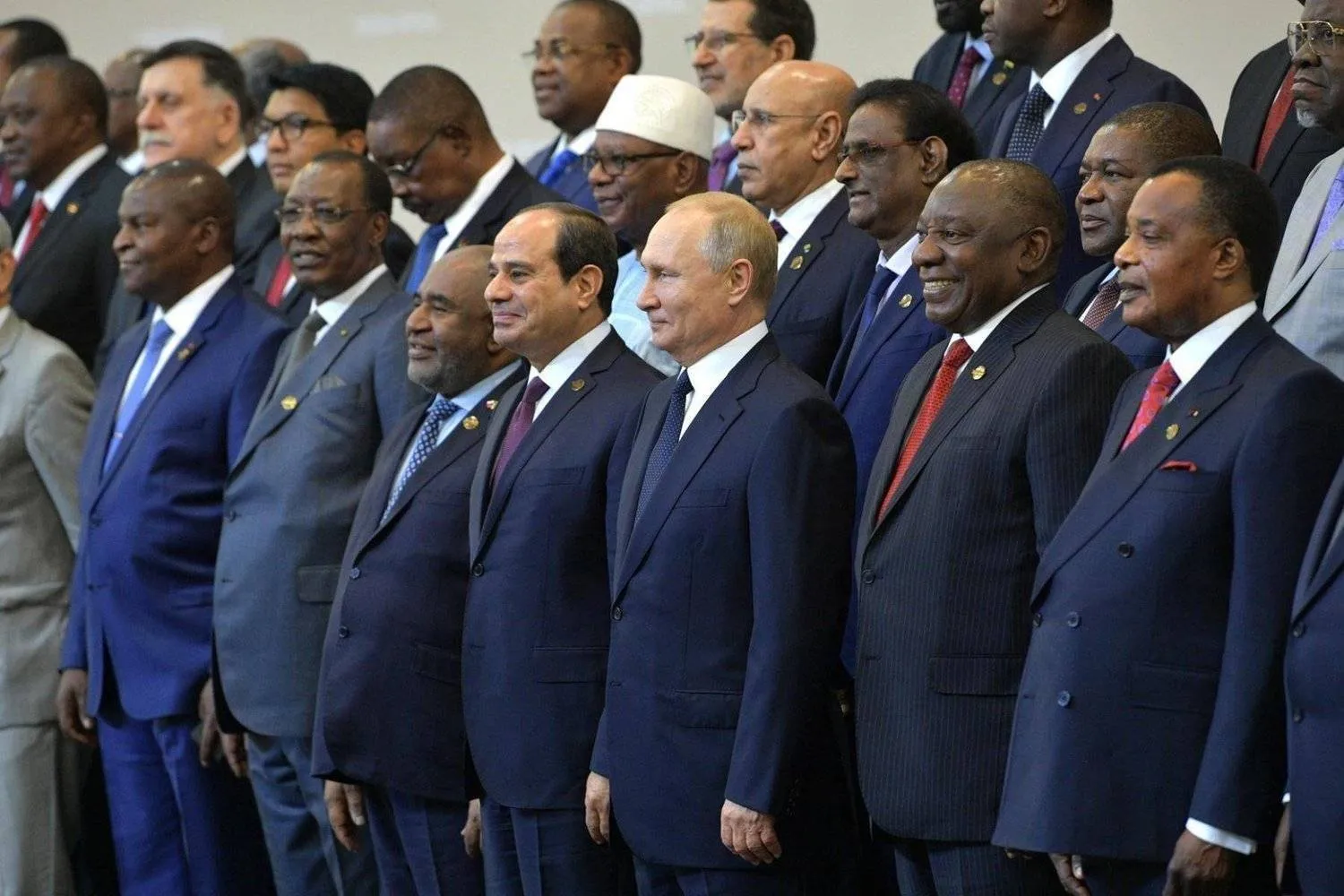

Egyptian President Abdel Fattah al-Sisi and his Russian counterpart Vladimir Putin virtually laid the foundation of el-Dabaa, Egypt's first-ever nuclear power plant (NPP).
The Presidents witnessed the official ceremony for pouring the first concrete into the foundation of power unit 4 at the Nuclear Power Plant (NPP) developed by the Russian State Atomic Energy Corporation (Rosatom).
Experts said the new power plant will bolster cooperation between the two nations, describing it as the "partnership of the century."
At the inauguration ceremony, Sisi said Egypt is "writing a new bright chapter in history by fulfilling the long-held aspiration of all Egyptians of owning a peaceful nuclear plant."
The President said the "great event represents another chapter in the close cooperation between Egypt and Russia."
The Dabaa station is the first nuclear facility in Matrouh Governorate on the coast of the Mediterranean Sea, about 300 kilometers northwest of Cairo.
The Dabaa station will include four "Three +" generation reactors operating with pressurized water, with a total capacity of 4,800 megawatts, 1,200 megawatts each, with the first reactor scheduled to be launched in 2028.
The long-awaited NPP costs $28.75 billion, about 85% of which is financed by Russia and paid by Egypt over a 22-year loan with an annual 3% interest rate as per a bilateral agreement signed back in 2015.
Sisi said that the fourth unit allows Egypt to begin the next phase of building the nuclear reactor.
It "shall contribute to providing safe, cheap, and long-term energy supplies, reducing dependence on fossil fuels and avoiding fluctuations in their prices."
Sisi stressed that introducing nuclear power into the energy mix that Egypt relies on to produce electricity is crucial to meeting the growing demands for electrical energy to fulfill the needs of economic and social development plans.
It contributes to boosting reliance on new and renewable energy, which achieves environmental sustainability and addresses climate change.
Egypt suffers from a shortage of electrical energy, which prompted the Egyptian government to make decisions to reduce loads and cut off electricity in residential neighborhoods.
The President stated that the "great event" of pouring concrete for the fourth unit of the nuclear reactor "reflects the enormous efforts exerted by both sides towards implementing Egypt's national project, with the establishment of El-Dabaa Nuclear Power Plant."
The Egyptian President thanked his Russian counterpart and the project workers from both countries.
The process of pouring the concrete slab that will be used as the basis for the fourth unit of the nuclear power plant is the end of the preparation phase and a transition to begin the primary phase of the project.
Putin stressed that the Dabaa nuclear plant represents the culmination of cooperation between Cairo and Moscow and will contribute to developing the Egyptian economy and promoting modern industries.
He added that trade exchange with Egypt is witnessing significant development, and there is a partnership in many energy and agriculture projects, noting that the Dabaa nuclear station is the most important project between the two countries.
Egypt is Russia's strategic partner, said Putin and invited his Egyptian counterpart to attend the BRICS summit scheduled for next October, according to the Russian TASS news agency.
Recently, Rosatom announced it was opening a representative office in Egypt.
Director of Rosatom's country office in Egypt, Murad Aslanov, said at the time that the company launched a large-scale project initiative to unify the infrastructure of its projects abroad.
The Dabaa station is the company's most significant project in Africa. Located in the Matrouh Governorate, it is Egypt's first nuclear facility.