


Hamas Studies Ceasefire Proposal After Deadly Israeli Hospital Raid in West Bank 

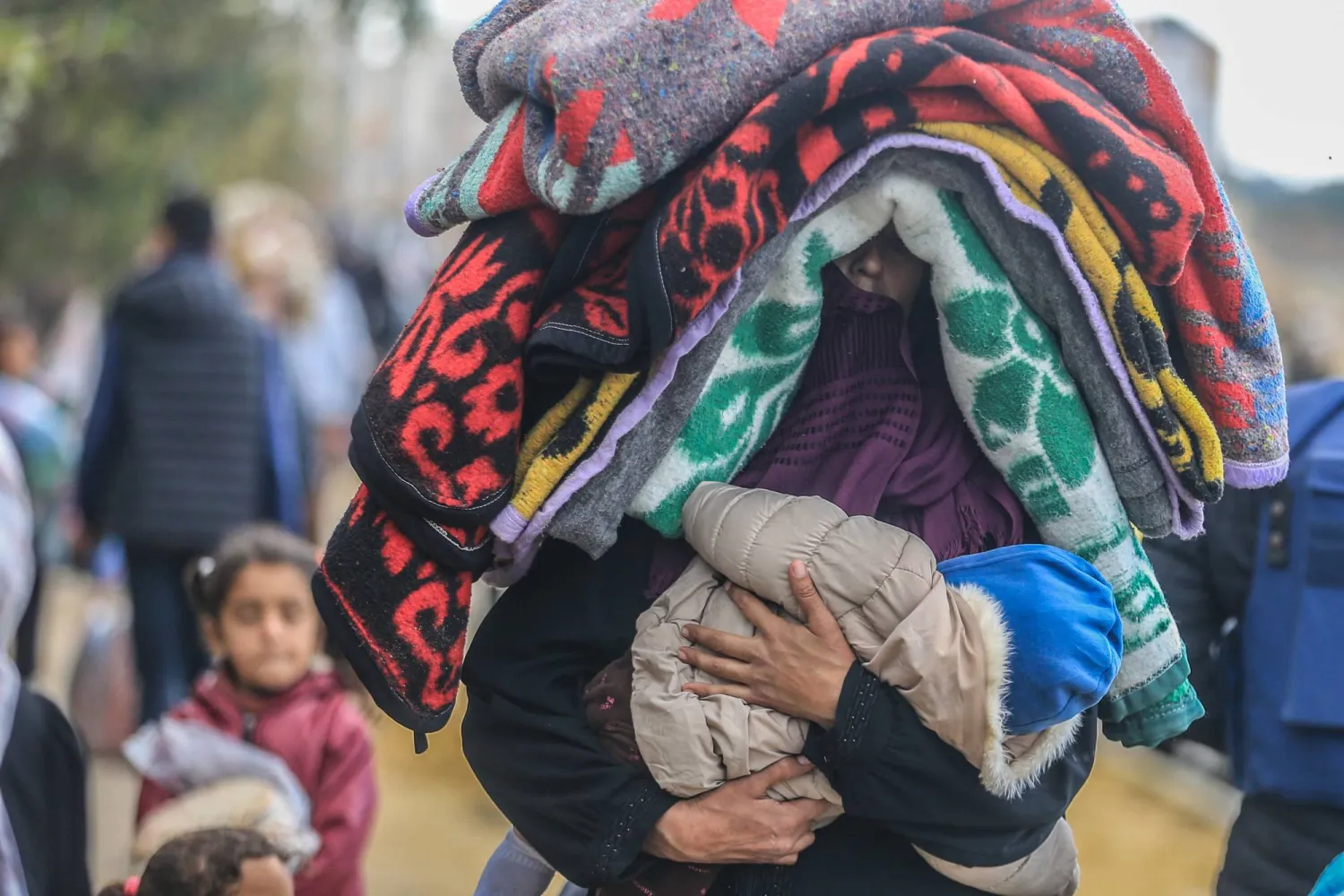
29 January 2024, Palestinian Territories, Khan Younis: Palestinians leave the area of Nasser Hospital and the adjacent schools in Khan Younis in the southern Gaza Strip, after the Israeli army ordered people to immediately evacuate certain parts of the city. Photo: Mohammed Talatene/dpa
TT

Hamas Studies Ceasefire Proposal After Deadly Israeli Hospital Raid in West Bank 

29 January 2024, Palestinian Territories, Khan Younis: Palestinians leave the area of Nasser Hospital and the adjacent schools in Khan Younis in the southern Gaza Strip, after the Israeli army ordered people to immediately evacuate certain parts of the city. Photo: Mohammed Talatene/dpa

Hamas said on Tuesday it would study a new ceasefire proposal in the war with Israel in Gaza, hours after Israeli commandos killed three Palestinian militants in a raid on a hospital in the occupied West Bank. 

The raid underscored the risk of the Gaza war spreading to other fronts, while Israeli forces fought new battles with Hamas fighters in the Palestinian enclave. 

Clashes in northern Gaza forced more Palestinian residents to flee to safer areas, and southern parts of the coastal enclave were hit by Israeli air strikes. 

Hamas leader Ismail Haniyeh said the group had received a ceasefire proposal put forward after talks in Paris. He said he would study the plan and visit Cairo for discussions on it. 

The priority for the Palestinian militant group was to end the Israeli offensive and a full pull-out of Israeli forces from Gaza, he said. 

Haniyeh gave no details of the ceasefire proposal but it followed talks in Paris involving CIA Director William Burns, Qatar's prime minister, the chief of Israel's Mossad intelligence service and the head of Egyptian intelligence. 

While the West Bank - an area that Palestinians envisage as part of a hoped-for independent state - had seen increased violence even before the outbreak of the Gaza war in October, the hospital raid could fuel a more intense phase of unrest. 

CCTV footage appeared to show about a dozen troops, including three in women's garb and two dressed as Palestinian medical staff, pacing through a corridor in Ibn Sina hospital in the city of Jenin with rifles. 

Hamas said one of the dead was a member of the militant group. The allied faction "Islamic Jihad" said the other two killed were brothers who belonged to it. Ibn Sina said one of the brothers had been receiving treatment for an injury that paralyzed his legs. 

The Israeli military said one of those killed had a pistol, and that the incident showed militants were using civilian areas and hospitals as shelters and "human shields". Hamas has previously denied such allegations. 

Palestinian sources said the three were not engaged in any fighting. They said one, Basel Al-Ghazzawi, was wheelchair-bound after being wounded in his back this month, and was in the hospital for treatment. His brother Mohammad was staying there to help him, and the third man was a friend, the sources said. 

The Israeli undercover squad broke into the hospital, headed to the third floor and killed them using silenced pistols, hospital sources said. 

Palestinian Health Minister Mai Alkaila called the incident a war crime and urged the United Nations and international rights groups to put an end to such actions. Israel has previously denied committing war crimes. 

The Israeli military identified one of the slain men as Mohammed Jalamneh, 27, from Jenin, who it said had contacts with Hamas headquarters abroad and was planning an attack inspired by the Hamas rampage in southern Israel on Oct. 7. 

GAZA DEATH TOLL RISES 

Israel unleashed its assault on Gaza in response to that attack in which 1,200 Israelis were killed and 253 taken hostage. More than 100 hostages remain captive in Gaza. 

Since then, 26,751 Palestinians have been killed and 65,636 wounded by Israeli actions in Gaza, the Gaza health ministry said. Some 114 Palestinians were killed and 249 injured in the past 24 hours, it said. 

Israel says its forces have killed around 9,000 Palestinian combatants in Gaza, and that 221 of its soldiers have been killed in the fighting. 

The war has created a humanitarian crisis, with wide areas of Gaza flattened, hundreds of thousands of people left destitute, and supplies of food, water and medicines almost exhausted. 

The World Health Organization said the population of Gaza was on the verge of famine. 

"It's getting worse by the day," WHO spokesperson Christian Lindmeier told a briefing in Geneva. 

She said one convoy tried to reach the Nasser Hospital on Tuesday morning, but people helped themselves to supplies before they could be distributed. 

TANKS IN ACTION 

Israel mounted a new push in northern Gaza after earlier reporting successes against Palestinian militants there. The militants' presence in the area suggests Israel's campaign to eradicate Hamas is not going to plan. 

Hamas appears to have been able to regroup in Gaza City as the war drags on and international concern over the plight of civilians mounts. 

Much of Tuesday's action in Gaza was focused on the Beach refugee camp and near the Al Shifa hospital, residents said. Israeli tanks broke into one shelter site and soldiers rounded up dozens of men. 

Residents and health officials also said an Israeli tank opened fire against dozens of Palestinians near Al-Kuwaiti Square on the southern edge of Gaza City where aid trucks unload their shipments, killing two people and wounding others. 

The fighting caused more people to flee within Gaza City and to the south towards Deir Al-Balah in the center. Heavy bombing also hit western and southern suburbs of Gaza. 

In the south, Israeli forces kept up pressure in Khan Younis, maintaining their encirclement of the city's two main hospitals. 

Palestinian health officials said at least 10 Palestinians were killed in two separate Israeli air strikes in Khan Younis and in Deir Al-Balah. 

The Israeli military said in a summary of overnight operations that action continued in the western part of Khan Younis, where militants were killed and many arms seized. In northern and central Gaza, soldiers killed "numerous" militants, including a rocket-propelled grenade squad. 


Türkiye Sees Deal between Syria, Kurdish Forces as ‘Historic Turning Point’

A group of civilians smash a statue of a Syrian Democratic Forces fighter in the city of Tabqa after the Syrian army took control of it, in Tabqa, Syria, January 18, 2026. REUTERS/Karam al-Masri TPX IMAGES OF THE DAY
TT

Türkiye Sees Deal between Syria, Kurdish Forces as ‘Historic Turning Point’

A group of civilians smash a statue of a Syrian Democratic Forces fighter in the city of Tabqa after the Syrian army took control of it, in Tabqa, Syria, January 18, 2026. REUTERS/Karam al-Masri TPX IMAGES OF THE DAY

Türkiye sees an integration deal between Syria's government and Kurdish forces there as an "historic turning point", ahead of which the Turkish intelligence agency played an intensive role to ensure restraint by parties involved, Turkish security sources said on Monday.

Türkiye, a strong supporter of Syrian President Ahmed al-Sharaa, sees the deal ‌as critical ‌to restoring state authority across ‌Syria ⁠and to ‌its own goal of eliminating terrorism at home, including advancing its long-running efforts toward securing peace with the outlawed Kurdistan Workers Party (PKK), the sources said.

Ankara is the strongest foreign backer of the administration in neighboring Damascus ⁠and had threatened its own military operation against the ‌Syrian Kurdish Democratic Forces (SDF) in the ‍north if the ‍group did not agree to come under ‍central government control, Reuters said.

On Sunday, Syria and the SDF struck a wide-ranging deal to integrate the Kurdish civilian and military authorities, ending days of fighting in which Syrian troops captured territory including key oil fields.

The Turkish security ⁠sources said the fight against ISIS group in Syria would continue uninterrupted despite the agreement.

Türkiye's intelligence agency MIT had been in dialogue with the United States - which mediated the Sunday agreement - and the Syrian government ahead of the deal, the sources said. MIT also maintained intensive contacts to ensure restraint among parties, including protecting civilians and critical infrastructure, in ‌Syria in the run-up to the deal, they added.


Syrian Army Deploys in Deir Ezzor Province After Kurdish Withdrawal

A military vehicle of the Syrian army is parked on the highway near Tabqa, after the Syrian army took control of it, Syria, January 19, 2026. (Reuters)
TT

Syrian Army Deploys in Deir Ezzor Province After Kurdish Withdrawal

A military vehicle of the Syrian army is parked on the highway near Tabqa, after the Syrian army took control of it, Syria, January 19, 2026. (Reuters)

Syria's army on Monday deployed its forces in parts of the eastern Deir Ezzor province formerly controlled by Kurdish forces following their withdrawal from the area.

After two days of rapid gains in Kurdish-controlled territory, Syrian President Ahmed al-Sharaa announced on Sunday a deal with their leader Mazloum Abdi that includes a ceasefire and the integration of the Kurdish administration and forces into the central state.

The government push captured Arab-majority areas that came under Kurdish control during the fight against the ISIS group.

In Deir Ezzor, an AFP correspondent saw dozens of military vehicles heading to the east of the Euphrates river, which once separated Damascus-controlled areas to the west from the US-backed, Kurdish-led Syrian Democratic Forces to the east.

Lines of cars, trucks and motorcycles formed in front of a small bridge leading to the eastern bank.

Some people were also heading there on foot.

"Our joy over liberation is indescribable," Mohammed Khalil, a 50-year-old driver in Deir Ezzor, told AFP.

"We hope things will be better than before. There was... no freedom under the SDF."

Safia Keddo, a 49-year-old teacher, told AFP "the past few years, but today we must turn the page".

"We want children to return to school without fear, and for electricity, water, and bread to be restored. We're not asking for a miracle; we just want stability and a normal life."

The Syrian army said in a statement that it "started the deployment" into the eastern Jazira region "to secure it under the agreement between the Syrian state and the SDF".

The agreement calls for the immediate handover of the provinces of the Arab-majority Raqqa and Deir Ezzor provinces.

The SDF had announced on Sunday that it was withdrawing from areas under its control in the eastern Deir Ezzor countryside, including the Al-Omar and Tanak oil fields.

The SDF had taken control of part of Deir Ezzor after defeating the ISIS group with the support of an international coalition led by the United States.


Qassem's Threat of Civil War Widely Condemned in Lebanon

Hezbollah's then deputy leader Sheikh Naim Qassem speaks during an interview with The Associated Press in Beirut's southern suburbs, Lebanon, July 2, 2024. (AP)
TT

Qassem's Threat of Civil War Widely Condemned in Lebanon

Hezbollah's then deputy leader Sheikh Naim Qassem speaks during an interview with The Associated Press in Beirut's southern suburbs, Lebanon, July 2, 2024. (AP)

Hezbollah Secretary-General Sheikh Naim Qassem's continued refusal to lay down his party's weapons in defiance of the state have sparked outrage in Lebanon.

In a televised address on Saturday, Qassem declared that Hezbollah "will not surrender", accusing Foreign Minister Youssef Raggi of "undermining civil peace and inciting strife." He also called on the government to replace the minister.

Ministerial sources close to the presidency told Asharq Al-Awsat that some of Qassem's remarks were viewed as a response to President Joseph Aoun's recent statements in which he indirectly called on the Iran-backed party to "return to reason and the state and hand over its weapons that have become a burden on its community and Lebanon."

The sources told Asharq Al-Awsat that official "decisions were taken to be implemented. Nothing will change the president's convictions."

Qassem escalated his rhetoric to save face in front of Hezbollah supporters, they added, ruling out the possibility that the party would take its objections to the streets.

The process of imposing state monopoly over arms is on the right path, they stressed.

Meanwhile, officials expressed their outrage over Qassem's remarks.

In a post on the X platform, Justice Minister Adel Nassar said: "Those threatening civil war to preserve their weapons must cease giving lectures about patriotism to a minister in government."

Lebanese Forces MP Razi al-Hajj slammed Hezbollah as a "calamity" on Lebanon. In a post on X, he said: "Naim Qassem is working outside the state, manipulating civil peace, inciting strife and standing against the presidency, government and will of the Lebanese people."

"He refuses to hand over Hezbollah's weapons and makes threats of civil war. Day and night he attacks the Lebanese state's official positions and works against them. Hezbollah is Lebanon's real calamity," he remarked.

LF MP Ghayath Yazbeck slammed Qassem for "verbally" and "morally" assaulting LF ministers, "in complete disregard of ethical principles".

He warned that Qassem’s remarks may be a prelude to the assassination of the ministers and "the assassination of the Lebanese state."

"Our ministers represent dignity, sovereignty and the state," he stressed. Indirectly addressing Qassem, he said: "Act smart. Your predecessors made these mistakes and ended up in history’s trash bin. Haven’t you learned anything?"

Responding to Qassem, Kataeb MP Nadim Gemayel said: "The foreign minister's stance is based on the humiliating agreement that you signed after the 'support war'. Lebanon officially agreed to the deal that effectively embodies the president's swearing in oath and government's policy statement in terms of imposing state monopoly over arms across the country."

In a post on X, he hoped the president and prime minister would issue a clear stance in support of FM Raggi.

Addressing Qassem, LF MP Elias Hankach said on X: "By continuing to rebel against state decisions and threaten the Lebanese people, you have become an outlaw gang."

"Just as the army imposed state monopoly over arms south of the Litani River, it will soon do so to its north," he said.

MP Waddah Sadek slammed Qassem, saying on X: "He himself does not believe what he is saying... He is living in a parallel world while the state continues to firmly reclaim its institutions regardless of the critics."

"The only thing Qassem got right was that Lebanon has indeed entered a new phase," he noted. Addressing the Hezbollah leader, he added: "Your weapons are a burden and no longer serve a purpose."

"For years, we have listened to your speeches and endured defeats and destruction that you brought onto the country. Yours is just another speech that won't make a difference," he stated.

MP Fuad Makhzoumi expressed his rejection of Qassem's statements, saying he is "detached from reality" and posing a "frank challenge to the state and its institutions."

In a post on X, he wrote: "You are part of the government, so how can you object to decisions you were a partner to? Whoever objects to government decisions must resign, not defy the state from the inside."

He urged Hezbollah to commit to the ceasefire, United Nations Security Council resolution 1701, and hand over its weapons, otherwise face the responsibility of violating state decisions.

"No one is above the law in Lebanon and threats have only led to destruction that the Lebanese people alone have paid the price of," he added.
