


Biden Says He’s Decided on Response to Killing of 3 US Troops 

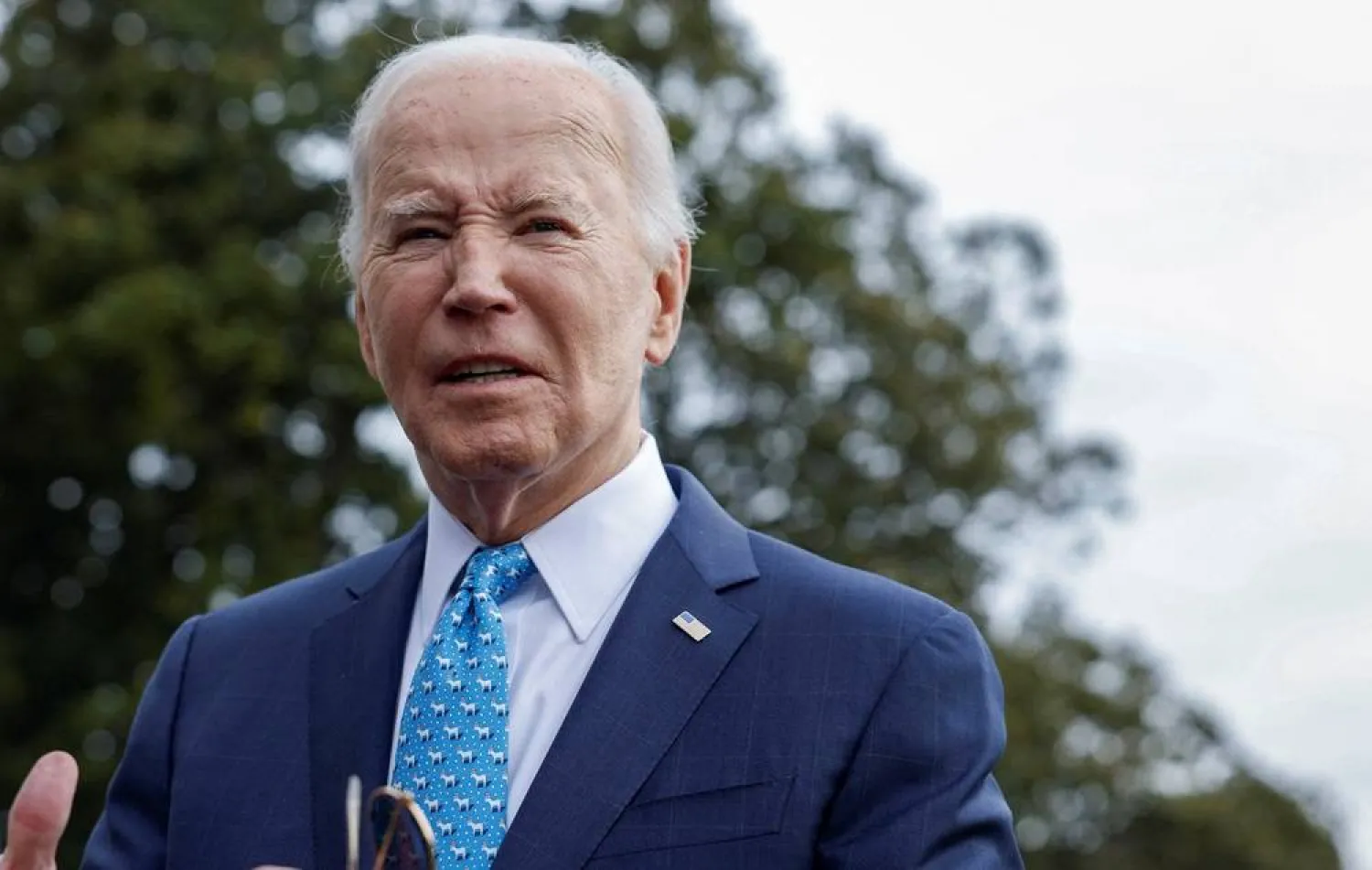
US President Joe Biden looks on as he speaks to the media, before departing the White House for Florida, in Washington, US, January 30, 2024. (Reuters)
TT

Biden Says He’s Decided on Response to Killing of 3 US Troops 

US President Joe Biden looks on as he speaks to the media, before departing the White House for Florida, in Washington, US, January 30, 2024. (Reuters)

President Joe Biden on Tuesday indicated he had decided how to respond after the killing of three American service members Sunday in a drone attack in Jordan that his administration has pinned on Iran-backed militia groups, saying he does not want to expand the war in the Middle East but demurring on specifics. 

US officials said they are still determining which of several Iran-backed groups was responsible for the first killing of American troops in a wave of attacks against US forces in the region since the Oct. 7 Hamas assault on Israel.  

Biden plans to attend the dignified transfer to mark the fallen troops' return to American soil on Friday and answered in the affirmative when asked by reporters if he'd decided on a response, as he indicated he was aiming to prevent further escalation. 

“I don’t think we need a wider war in the Middle East," Biden said at the White House before departing for a fundraising trip to Florida. “That’s not what I’m looking for.” 

It was not immediately clear whether Biden meant he had decided on a specific retaliatory plan. A US official told The Associated Press that the Pentagon is still assessing options to respond to the attack. 

National Security Council spokesman John Kirby told reporters traveling with Biden aboard Air Force One that he would not preview the US response, but indicated it would come in phases. 

“It’s very possible that what you’ll see is a tiered approach here, not just a single action, but potentially multiple actions over a period of time," he said. 

Meanwhile, the Iranian-backed Iraqi militia Kataib Hezbollah, one of several groups eyed by US officials, announced Tuesday in a statement “the suspension of military and security operations against the occupation forces in order to prevent embarrassment to the Iraqi government.” 

The attacks on US forces by Iraqi militias over the past four months have placed the government of Iraqi Prime Minister Mohammed Shia al-Sudani in an awkward position. Sudani was brought to power by Iranian-allied factions but has also attempted to stay in Washington’s good graces and has condemned the attacks on US forces serving in Iraq as part of an international commission to fight the ISIS. Iraqi and US officials on Saturday opened talks aimed at winding down the commission’s presence. 

Kirby said that Biden spoke with the soldiers' families Tuesday morning and extended his condolences, pledging full assistance to the families as they grieve. 

In separate calls with the families, Biden also gauged their feelings about his attendance at Friday's dignified transfer of the fallen service members' remains at Dover Air Force Base in Delaware on Friday, and “all of them supported his presence there,” Kirby said. 

“He was grateful for their time. He expressed to them how proud we all are of their service," Kirby said of Biden's calls with the families. “How we mourn and feel sorrow over their loss.” 

Kirby added: “The president will be going to the dignified transfer on Friday.” 

The solemn ceremony marks the return of fallen service members to American soil as they journey to their final resting place, with silent honor guards carrying flag-draped transfer cases holding the remains from transport aircraft to military vehicles. 

The Pentagon identified those killed in the attack as Sgt. William Jerome Rivers, 46, of Carrollton, Georgia; Spc. Kennedy Ladon Sanders, 24, of Waycross, Georgia; and Spc. Breonna Alexsondria Moffett, 23, of Savannah, Georgia. The Army Reserve announced on Tuesday that it had posthumously promoted Sanders and Moffett to the rank of sergeant. 

There have been a total of 166 attacks on US military installations since Oct. 18, including 67 in Iraq, 98 in Syria and now one in Jordan, a US military official said. On Tuesday, Al-Asad Air Base in Western Iraq was targeted again by a single rocket, but there was no damage and no injuries in that attack, a US military official said.  

The three soldiers killed in the Jordan strike were the first US military fatalities in the Middle East since the war between Israel and Hamas broke out. One contractor has also died as the result of a heart attack after a strike on Al-Asad in December. 

In 2021, Biden attended the dignified transfer of the remains of 13 troops killed in a suicide attack during the US withdrawal from Afghanistan. 

Separately, Landstuhl Regional Medical Center in Germany said it expected to receive three US service members who were injured in the drone attack, including one listed in critical, but stable, condition. The Pentagon has said at least 40 troops were injured alongside the three killed in action. 


Jordan Sentences 3 Men to Death over Karak Church Attack

Mourners carry the bodies of those who were killed in the attack that took place two days earlier at the Greek Orthodox Church during their funeral in the village of Hamoud in Jordan's Karak governorate on October 25, 2026. (Photo by Ahmad SHOURA / AFP)
TT

Jordan Sentences 3 Men to Death over Karak Church Attack

Mourners carry the bodies of those who were killed in the attack that took place two days earlier at the Greek Orthodox Church during their funeral in the village of Hamoud in Jordan's Karak governorate on October 25, 2026. (Photo by Ahmad SHOURA / AFP)

A Jordanian court on Sunday sentenced three men to death by hanging for carrying out last month's deadly gun attack on a church in the kingdom's south.

Gunmen killed nine people and wounded 25 others when they stormed a funeral at a Greek Orthodox church in Hamoud village, in Jordan's Karak governorate on October 23.

Authorities said three men, two Jordanian brothers and their relative by marriage, had fled after the attack and were arrested three days later.

In a statement Sunday, the Jordanian military said the "State Security Court issued its ruling sentencing to death the three criminals who carried out the terrorist attack" at the church.

The court found them guilty of "committing terrorist attacks" resulting in death, as well as weapons offences, "conspiracy to commit terrorist acts" and "promoting the ideas of a terrorist organization.”


France Reaffirms Support for Morocco's Position on Western Sahara

Moroccan Foreign Minister Nasser Bourita receives French Minister for Europe and Foreign Affairs Jean-Noël Barrot in Essaouira (Moroccan Foreign Ministry)
TT

France Reaffirms Support for Morocco's Position on Western Sahara

Moroccan Foreign Minister Nasser Bourita receives French Minister for Europe and Foreign Affairs Jean-Noël Barrot in Essaouira (Moroccan Foreign Ministry)

French Foreign Minister Jean-Noël Barrot reaffirmed France's unwavering support for Moroccan sovereignty over Western Sahara on Friday, declaring that the territory's "present and future fall exclusively within the framework of Moroccan sovereignty."

Speaking during talks with his Moroccan counterpart, Nasser Bourita, in the coastal city of Essaouira, Barrot reiterated Paris' full backing for Morocco's autonomy plan as the sole basis for a final political settlement to the regional dispute.

His remarks echoed France's longstanding position, reaffirmed at a UN Security Council meeting on Oct. 30.

Morocco's Foreign Ministry said the talks were part of efforts to put into practice the "Reinforced Exceptional Partnership" signed by King Mohammed VI and French President Emmanuel Macron on Oct. 28, 2024, a framework designed to strengthen bilateral ties and expand cooperation across multiple sectors.

The ministers welcomed the growing momentum in relations between Rabat and Paris, praising their strong ties of friendship and cooperation as a reflection of both leaders' determination to deepen their strategic partnership and make it more effective.

They reviewed cooperation in politics, trade, culture and humanitarian affairs, exploring ways to broaden ties in line with both countries' aspirations.

Turning to regional and international affairs, Barrot and Bourita welcomed their shared positions on key issues, particularly developments in the Middle East and prospects for implementing a two-state solution.

Both countries renewed their commitment to pursuing a just, comprehensive and lasting peace, while maintaining close coordination to advance security, stability and development across the Maghreb, the Sahel and the Mediterranean.

Barrot traveled to Morocco to attend a high-level session of the 2026 World Forum of Women for Peace, organized by the association Les Guerrières de la Paix in Essaouira.

His visit also included talks with senior Moroccan officials, visits to French cultural and educational institutions in the city and a meeting with representatives of the French community.


Damascus Moves to Reconnect Aleppo Countryside, End a Decade of Territorial Division

Preparations for the launch of the second phase of the “Echo of Resilience 2” project in Manbij (Ministry of Emergency and Disaster Management)
TT

Damascus Moves to Reconnect Aleppo Countryside, End a Decade of Territorial Division

Preparations for the launch of the second phase of the “Echo of Resilience 2” project in Manbij (Ministry of Emergency and Disaster Management)

A convoy of Syrian army heavy machinery headed to Manbij in northern Syria on Saturday to help tear down wartime earthen barriers and fill trenches stretching 841 kilometers across 255 cities and villages, in a drive to erase former frontlines and reunite areas divided by years of conflict.

The operation, in eastern Aleppo province, aims to consolidate state authority and reintegrate the affected areas administratively and economically.

Syria's Ministry of Emergency and Disaster Management, which oversees the "Echo of Resilience" project in cooperation with Aleppo governorate, said the campaign would dismantle military fortifications, clear their remnants, rehabilitate damaged areas and reopen roads between towns and villages.

The ministry said the work would improve public services and help restore normal life and stability in the affected areas.

The project's second phase began on Thursday in Manbij and its surrounding countryside and is expected to last seven months. It aims to make the area safer by clearing landmines and other remnants of war, allowing displaced residents to return home and farmers to reclaim access to their fields and resume cultivation.

The new phase follows an initial operation launched in early July around Azaz in northern Aleppo province, seven kilometers from the Turkish border.

That phase concluded on Nov. 12 after crews cleared 202 kilometers of earthen barriers and trenches, reconnecting about 33 towns and villages and easing civilian movement.

Manbij's Divided Past

The work in Manbij carries particular political and geographical weight. Before the fall of the former government, the city and its surroundings were a volatile meeting point for three rival military forces.

The Syrian Democratic Forces (SDF) and the Manbij Military Council controlled the city and surrounding areas, while Turkish-backed Syrian National Army factions held positions to the north and west. Forces of the former government, backed by Russia and Iran, were stationed to the south.

The rival deployments left hundreds of kilometers of trenches, double-layered earthen barriers and minefields along four main fronts.

The fortifications stretched from the Sajur River toward Jarablus in the north, through the area around Arima toward al-Bab in the west, and from Abu Kahf toward Deir Hafir in the south to the vicinity of Tishrin Dam and Qara Qozak Bridge on the Euphrates River's western bank in the east.

Removing those defenses is intended to reopen vital transport and trade routes linking eastern and northern Aleppo and restore access to farmland that had been isolated or off-limits for years.

From Military Frontlines to State Control

The two phases of the "Echo of Resilience" project coincide with efforts to implement a Jan. 29, 2026, agreement between the Syrian government and the SDF.

The agreement seeks to end territorial divisions, integrate the affected areas administratively and economically, extend state control across Syria and ensure the return of forcibly displaced people and other residents once suitable conditions are in place.

Around Azaz, once a flashpoint along the frontlines facing Tal Rifaat and Afrin, the removal of earthen barriers marked a practical step toward dismantling former lines of confrontation and reconnecting Syrian territory, officials overseeing the project told the Syrian Arab News Agency (SANA).

Observers of Syrian affairs say the dismantling of military fortifications by Syrian army units in a strategic area such as Manbij sends a clear political message: the state is consolidating control on the ground while reducing the military presence in residential and agricultural areas.

They say the shift could also strengthen border security and revive regional trade.
