


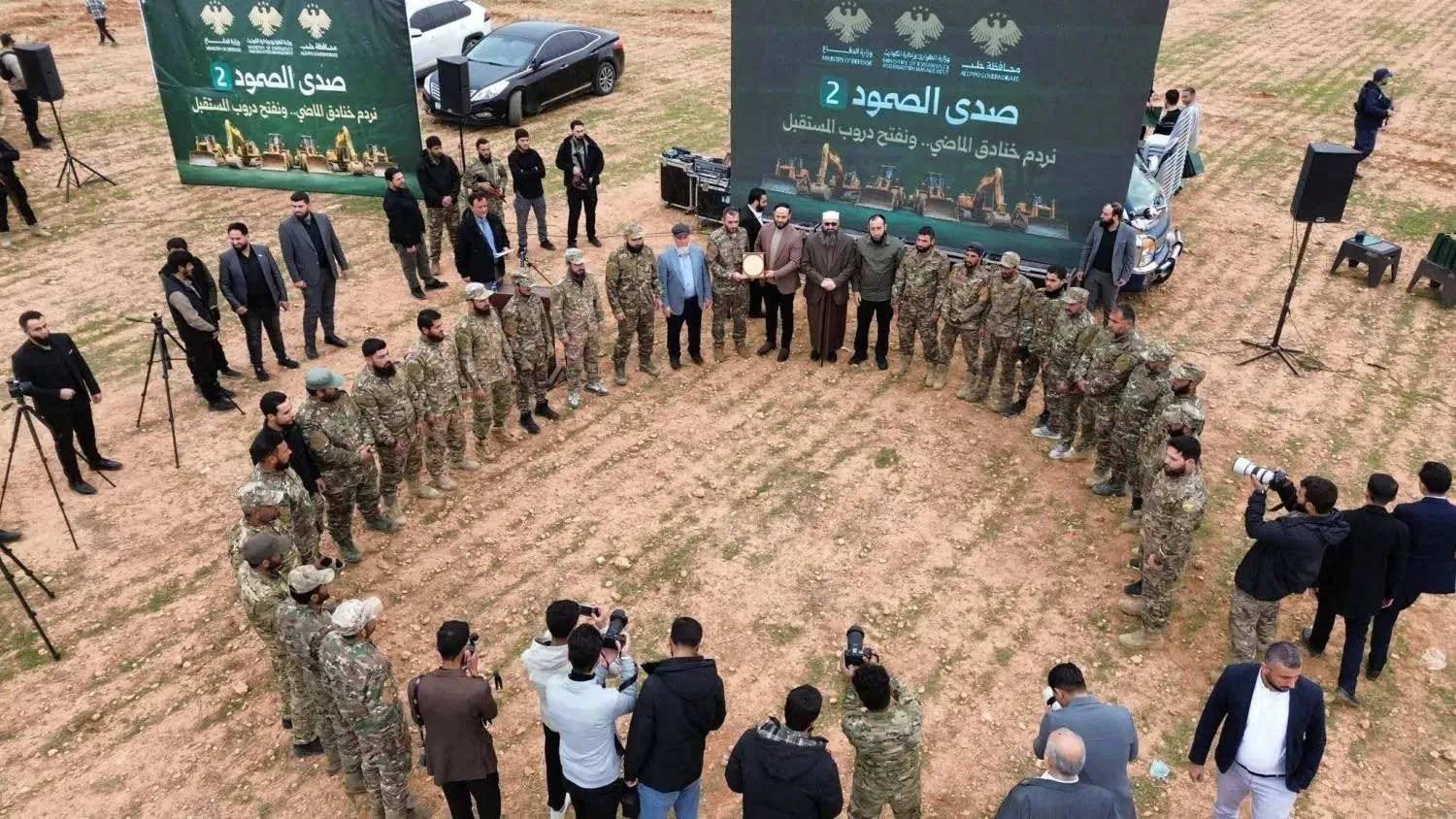

A convoy of Syrian army heavy machinery headed to Manbij in northern Syria on Saturday to help tear down wartime earthen barriers and fill trenches stretching 841 kilometers across 255 cities and villages, in a drive to erase former frontlines and reunite areas divided by years of conflict.
The operation, in eastern Aleppo province, aims to consolidate state authority and reintegrate the affected areas administratively and economically.
Syria's Ministry of Emergency and Disaster Management, which oversees the "Echo of Resilience" project in cooperation with Aleppo governorate, said the campaign would dismantle military fortifications, clear their remnants, rehabilitate damaged areas and reopen roads between towns and villages.
The ministry said the work would improve public services and help restore normal life and stability in the affected areas.
The project's second phase began on Thursday in Manbij and its surrounding countryside and is expected to last seven months. It aims to make the area safer by clearing landmines and other remnants of war, allowing displaced residents to return home and farmers to reclaim access to their fields and resume cultivation.
The new phase follows an initial operation launched in early July around Azaz in northern Aleppo province, seven kilometers from the Turkish border.
That phase concluded on Nov. 12 after crews cleared 202 kilometers of earthen barriers and trenches, reconnecting about 33 towns and villages and easing civilian movement.
Manbij's Divided Past
The work in Manbij carries particular political and geographical weight. Before the fall of the former government, the city and its surroundings were a volatile meeting point for three rival military forces.
The Syrian Democratic Forces (SDF) and the Manbij Military Council controlled the city and surrounding areas, while Turkish-backed Syrian National Army factions held positions to the north and west. Forces of the former government, backed by Russia and Iran, were stationed to the south.
The rival deployments left hundreds of kilometers of trenches, double-layered earthen barriers and minefields along four main fronts.
The fortifications stretched from the Sajur River toward Jarablus in the north, through the area around Arima toward al-Bab in the west, and from Abu Kahf toward Deir Hafir in the south to the vicinity of Tishrin Dam and Qara Qozak Bridge on the Euphrates River's western bank in the east.
Removing those defenses is intended to reopen vital transport and trade routes linking eastern and northern Aleppo and restore access to farmland that had been isolated or off-limits for years.
From Military Frontlines to State Control
The two phases of the "Echo of Resilience" project coincide with efforts to implement a Jan. 29, 2026, agreement between the Syrian government and the SDF.
The agreement seeks to end territorial divisions, integrate the affected areas administratively and economically, extend state control across Syria and ensure the return of forcibly displaced people and other residents once suitable conditions are in place.
Around Azaz, once a flashpoint along the frontlines facing Tal Rifaat and Afrin, the removal of earthen barriers marked a practical step toward dismantling former lines of confrontation and reconnecting Syrian territory, officials overseeing the project told the Syrian Arab News Agency (SANA).
Observers of Syrian affairs say the dismantling of military fortifications by Syrian army units in a strategic area such as Manbij sends a clear political message: the state is consolidating control on the ground while reducing the military presence in residential and agricultural areas.
They say the shift could also strengthen border security and revive regional trade.


