


Israel Is Holding up Food for 1.1 Million Palestinians in Gaza, Says UN Agency

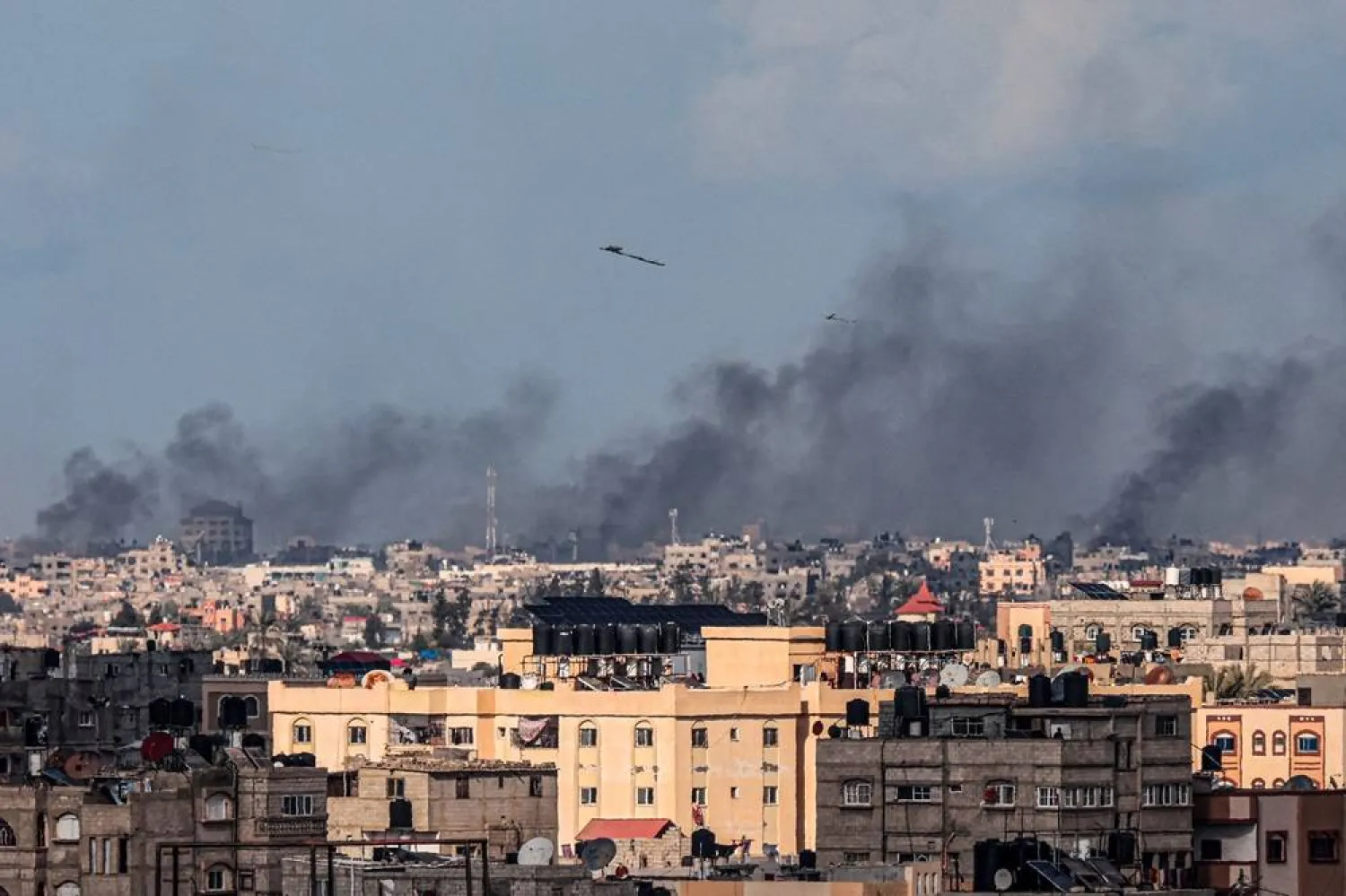
 Kites are flown over Rafah as smoke billows during Israeli bombardment over Khan Younis in the southern Gaza Strip on February 9, 2024, amid continuing battles between Israel and the Palestinian militant group Hamas. (AFP)
Kites are flown over Rafah as smoke billows during Israeli bombardment over Khan Younis in the southern Gaza Strip on February 9, 2024, amid continuing battles between Israel and the Palestinian militant group Hamas. (AFP)
TT

Israel Is Holding up Food for 1.1 Million Palestinians in Gaza, Says UN Agency

 Kites are flown over Rafah as smoke billows during Israeli bombardment over Khan Younis in the southern Gaza Strip on February 9, 2024, amid continuing battles between Israel and the Palestinian militant group Hamas. (AFP)
Kites are flown over Rafah as smoke billows during Israeli bombardment over Khan Younis in the southern Gaza Strip on February 9, 2024, amid continuing battles between Israel and the Palestinian militant group Hamas. (AFP)

Israel has imposed financial restrictions on the main UN agency providing aid in the Gaza Strip, a measure which prevented a shipment of food for 1.1 million Palestinians from reaching the war-battered enclave, the agency's director said Friday.

The restrictions deepened a crisis between Israel and UNRWA, whose operations have been threatened following Israeli accusations that some of its workers participated in the Oct. 7 attack that triggered Israel's war in Gaza. Those accusations have led major donor nations, including the US, to suspend funding to the UN organization and left its future in question.

UNRWA's director, Philippe Lazzarini, said Friday that that a convoy of food donated by Türkiye has been sitting for weeks in the Israeli port city of Ashdod. The agency said that the Israeli contractor they work with received a call from Israeli customs authorities “ordering them not to process any UNRWA goods.”

That stoppage means 1,049 shipping containers of rice, flour, chickpeas, sugar and cooking oil — enough to feed 1.1 million people for one month — are stuck, even as an estimated 25% of families in Gaza face catastrophic hunger.

The World Food Program warned Friday that Gaza could be plunged into famine as early as May. The UN food agency defines a famine as when 30% of children are malnourished, one-fifth of households face acute food shortages and two of every 10,000 people are dying from hunger or malnutrition.

Israel declared war and imposed a siege on Gaza in response to the Oct. 7 Hamas attack, which killed 1,200 people and took 250 others hostage. The war has led to a humanitarian crisis in Gaza, with only a trickle of humanitarian aid entering the territory each day.

Israel has long railed against UNRWA, accusing it of tolerating or even collaborating with Hamas and perpetuating the 76-year-old Palestinian refugee crisis. UNRWA, which serves about 6 million Palestinians whose families were displaced during the war surrounding Israel's creation in 1948, denies the charges. But the tensions have only intensified following the latest allegations by Israel.

Juliette Touma, communications director for the agency, said that UNWRA's bank account with Bank Leumi, which the agency has held for decades, was also frozen this week. In addition, Touma said that Israeli customs authorities notified the agency that UNRWA will no longer be granted tax exemptions.

Israel's finance minister, Bezalel Smotrich, tweeted on Thursday that “the state of Israel will not give tax benefits to terrorist aides.”

Smotrich, a far-right ally of Prime Minister Benjamin Netanyahu, didn't respond to a request for comment.

The agency has been able to reroute other aid shipments through Port Said in Egypt, but Lazzarini warned Friday that the holdup means further difficulties in the already challenging task of aid distribution to Gaza. About 80% of Gaza's 2.3 million people have been displaced by the war.

UNWRA is the main provider of aid to Palestinians in Gaza, but Israeli bombardment and combat between Israel and Hamas has made much of the territory too dangerous for aid convoys to cross. The agency has been unable to deliver aid to around 300,000 Palestinians estimated to still be in the northern half of Gaza, where the World Food Program says food insecurity is the worst.

Lazzarini said efforts have instead focused on the 1.3 million displaced Palestinians sheltering in the makeshift tent camps of Rafah, a city on the border with Egypt where the agency relies on local police to escort aid convoys to distribution points to prevent theft. But that has also grown increasingly challenging, as Israeli warplanes bomb targets in the city.

Airstrikes there killed eight police officers in the city over the last four days, Lazzarini said, making police reluctant to continue helping the agency. Three strikes have taken place near an UNWRA clinic, Lazzarini said. Israeli media have portrayed the police escorts as an attempt by Hamas to seize aid shipments for its own use.

Lazzarini said that the police the agency works with weren't affiliated with militant groups. Juliette Touma, agency spokesperson, said the police escort was necessary to prevent people from throwing stones at the convoy and attempting to steal aid from them.

Israel alleged last month that 12 employees of the aid agency participated in the Oct. 7 Hamas attacks in southern Israel. Several countries suspended funding worth about $440 million, almost half of the agency’s annual budget.

Two UN investigations are underway, including an independent review announced this week. The review, headed by a former French foreign minister, is supposed to focus on the way the agency ensures that it remains neutral and responds to allegations that it failed to do so. Colonna’s team plans to look at whether the system works and how it might be improved.

Lazzarini said Friday that he immediately fired the 10 workers, rather than suspending them, without first investigating the evidence against them. Two others had been killed by the time the allegations surfaced. Lazzarini said there was too much pressure on the organization — and current conditions make investigating the workers difficult — to do anything else.

“Knowing that the organization is under fierce and ugly attacks,” he said, “I could not take the risk ... I could have suspended them, but I fired them.”



Yemen's PLC Imposes No Fly-Zone, Sea and Ground Blockade on All Ports and Crossings

Chairman of Yemen's Presidential Leadership Council Dr. Rashad al-Alimi. (Saba)
TT

Yemen's PLC Imposes No Fly-Zone, Sea and Ground Blockade on All Ports and Crossings

Chairman of Yemen's Presidential Leadership Council Dr. Rashad al-Alimi. (Saba)

Chairman of Yemen's Presidential Leadership Council Dr. Rashad al-Alimi declared on Tuesday a state of emergency throughout the country in wake of the "internal strife caused by the military rebellion in eastern provinces aimed at dividing the republic."

He called for all military formations and forces in the Hadhramaut and Al-Mahra governorates to coordinate completely with the Coalition to Restore Legitimacy in Yemen, represented by Saudi Arabia, and to immediately return to their original positions without a fight. They should cede their positions in the two governorates to the National Shield forces.

Al-Alimi said the state of emergency will last 90 days, which can be extended. He also imposed a no fly-zone, sea and ground blockade on all ports and crossings for 72 hours.

The move also stems from "the commitment to the unity of Yemen, its sovereignty, independence, and territorial integrity and the need to confront the Houthi coup that has been ongoing since 2014," he stressed.

Moreover, al-Alimi called on "all United Arab Emirates forces to leave the country within 24 hours."

"We will firmly deal with any rebellion against state institutions," he warned.

He called on the Southern Transitional Council to "return to reason and quickly and unconditionally withdraw its forces from Hadhramaut and Al-Mahra."

Al-Alimi announced the state of emergency shortly after the Saudi-led Arab coalition carried out a "limited" airstrike targeting a military shipment that had arrived in Yemen's Al-Mukalla port.

In a statement, coalition spokesman Major General Turki al-Malki said the forces detected on Saturday and Sunday the arrival of two vessels from the Port of Fujairah to Mukalla without obtaining any permits from the Joint Forces Command.

Saudi Arabia expressed on Tuesday its disappointment in the United Arab Emirates for pressuring the STC to carry out military operations on the Kingdom's southern borders in Hadhramaut and Al-Mahra.

A Saudi Foreign Ministry statement said: "The steps taken by the UAE are considered highly dangerous, inconsistent with the principles upon which the Coalition to Restore Legitimacy in Yemen was established, and do not serve the coalition's purpose of achieving security and stability for Yemen."

"The Kingdom stresses that any threat to its national security is a red line, and the Kingdom will not hesitate to take all necessary steps and measures to confront and neutralize any such threat," it declared.


STC Accused of Committing Hundreds of Violations in Yemen's Hadhramaut 

A person waves a South Yemen flag during a rally in the southern port city of Aden, Yemen, 25 December 2025. (EPA)
TT

STC Accused of Committing Hundreds of Violations in Yemen's Hadhramaut 

A person waves a South Yemen flag during a rally in the southern port city of Aden, Yemen, 25 December 2025. (EPA)

Yemeni Defense Minister Mohsen Mohammed al-Daeri welcomed on Monday Saudi Defense Minister Prince Khalid bin Salman's message to the Yemeni people in which he called on the Southern Transitional Council (STC) to withdraw its forced from the Hadhramaut and al-Mahra governorates.

He said the message underscores "Saudi Arabia's firm support to Yemen and its legitimate authorities and its constant keenness on backing its unity."

The Kingdom has backed Yemen's efforts to restore state institutions, liberate all of its territories and achieve the goals of the Arab coalition and therefore bolster security and stability in Yemen and the region, he added in a post on Facebook.

He expressed his "absolute trust in the Saudi leadership and its ability to overcome and resolve any differences to help guide both northern and southern Yemen to safety."

He hailed the "Saudi sacrifices and its continuous generous support" to Yemen in all fields, voicing his pride "in this strategic partnership that will remain a cornerstone to completing the liberation and building a secure and prosperous future."

Hundreds of violations

Separately, as the STC continues its unilateral military escalation, reports have emerged of hundreds of violations it has committed in Hadhramaut.

The Yemeni Network for Rights and Freedoms (YNRF) documented 614 violations in the governorate between December 2 and 25. It spoke of a "systematic" targeting of civilians and social infrastructure that has displaced some 5,000 families.

In a report on Monday, it said that the "extent of the violations reflects a systematic pattern of practices that cannot be described as incidental. Rather, they are part of a methodical policy that threatens social peace and undermines the rule of law in one of Yemen's most relatively stable governorates."

The violations include murder, extrajudicial killings, arbitrary arrests, forced disappearances and displacement, and looting of private and public property. It documented the killing of 35 members of the army and 12 civilians, and the injury of 56 others, in Hadhramaut.

It documented seven cases of extrajudicial killings of prisoners and 316 cases of arbitrary arrest against civilians. It reported 216 cases of forced disappearances in Hadhramaut, Raymah, Hajjah, Taiz, Dhumar, Abyan, Ibb and other provinces.

The network noted the looting of 112 homes and 56 commercial establishments.

It said that it has received dozens of notices about the detention and forced disappearance of civilians. It revealed that hundreds of military personnel have been reported missing in grave violation of national law and international standards.

The network said the STC violations are a flagrant violation of international humanitarian law and commitments that have been made in Yemen. Some of the violations can also amount to war crimes and crimes against humanity.

It warned of the "catastrophic" humanitarian consequences of the violations, such as the breakup of the social fabric, greater internal displacement, and collapse of the local economy.

It demanded clear international condemnation of the violations in Hadhramaut, urging an immediate and unconditional end to them. It called for the immediate release of all arbitrarily held detainees and that looted property be returned to their owners. It also demanded that those responsible be held to account.

The developments in Hadhramaut "were not an isolated incident, but part of a systematic pattern that undermines the opportunities for stability and peace in Yemen," it warned.


Syria Reveals New Post-Assad Banknotes

Syria's President Ahmed al-Sharaa (L) and Syria's Central bank chief Abdul Qadir al-Hasriya (R) hold one of the country's new revamped currency notes at the Conference Palace in the Syrian capital Damascus on December 29, 2025. (AFP)
TT

Syria Reveals New Post-Assad Banknotes

Syria's President Ahmed al-Sharaa (L) and Syria's Central bank chief Abdul Qadir al-Hasriya (R) hold one of the country's new revamped currency notes at the Conference Palace in the Syrian capital Damascus on December 29, 2025. (AFP)

Syrian leader Ahmed al-Sharaa unveiled on Monday new banknotes replacing those showing ousted ruler Bashar al-Assad and his family, hoping the Syrian pound can regain some of the value lost to over a decade of war.

Improving the standing of the Syrian pound is among the greatest challenges for Syria's new authorities, who will remove two zeros, in a process known as redenomination.

The new bills, which range from 10 to 500 Syrian pounds, will enter circulation on January 1. They show images of roses, wheat, olives, oranges and other agricultural symbols for which Syria is famous.

After unveiling the banknotes, Sharaa said the new currency marks "the end of a previous, unlamented phase and the beginning of a new phase that the Syrian people... aspire to".

"The new currency design is an expression of the new national identity and a move away from the veneration of individuals."

Since the start of Syria's civil war in 2011, the pound has plunged from 50 to around 11,000 against the greenback, and Syrians are forced to carry huge wads of banknotes even for basic needs like grocery shopping.

The removal of the zeros, which does not impact the currency's value, was done to make transactions easier and restore trust in the Syrian pound.

"If someone wants to buy something simple, they need to carry bags in order to trade, so people go for dollars," Sharaa said, adding that the currency revamp will boost "the national currency within the country and strengthen trust".

"Syria deserves a strong economy and a stable currency."

Syria's old banknotes were printed in Russia, Assad's former backer.

When asked by journalists, Syrian central bank chief Abdul Qadir al-Hasriya did not specify where the new currency will be printed.