Airstrike from Israeli Hostage Rescue Wipes Out Entire Palestinian Family in Gaza Border Town

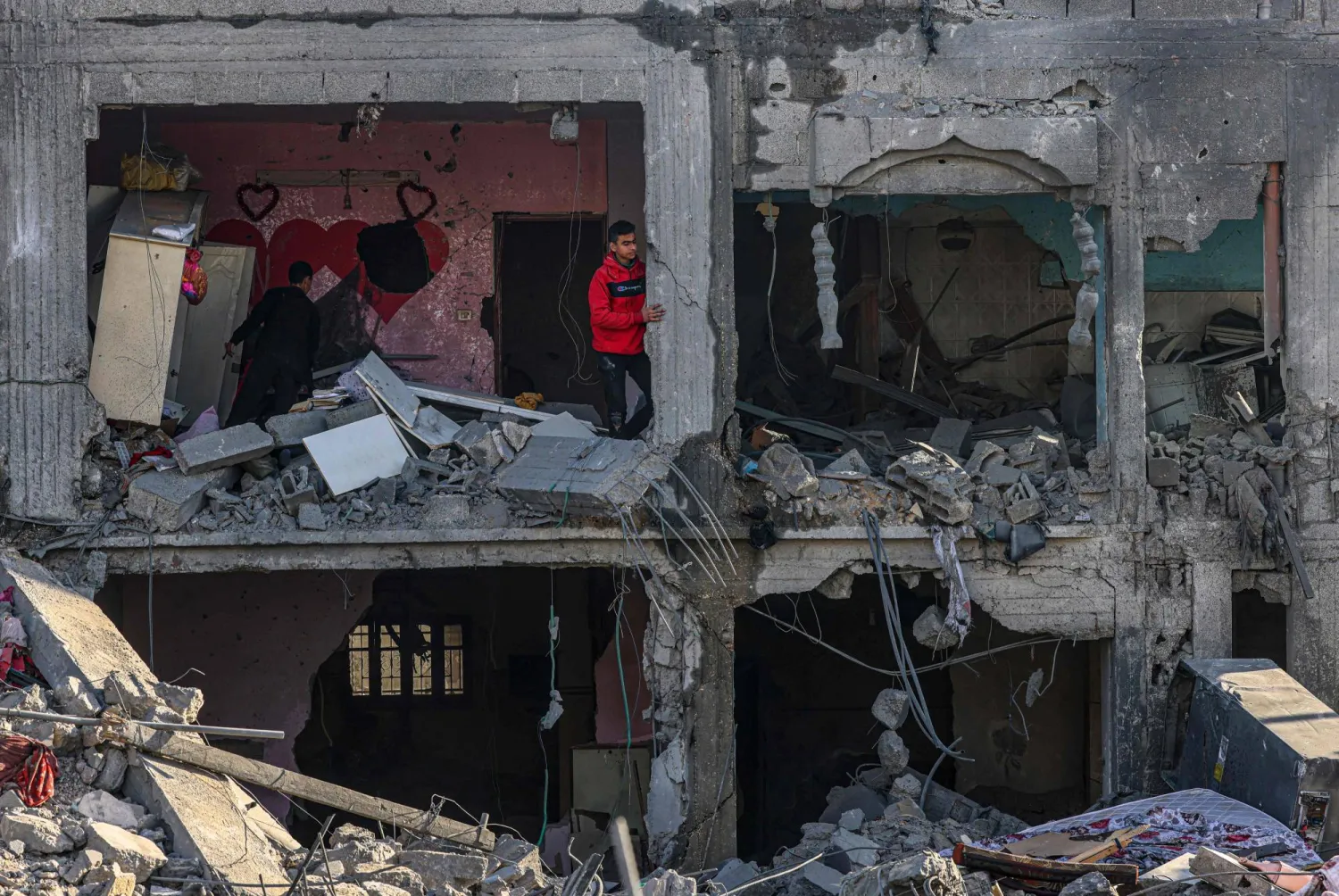
Palestinians inspect the damage in the rubble of a building where two hostages were reportedly held before being rescued during an operation by Israeli security forces in Rafah, on the southern Gaza Strip on February 12, 2024, amid ongoing battles between Israel and the group Hamas. (Photo by SAID KHATIB / AFP)
TT

Airstrike from Israeli Hostage Rescue Wipes Out Entire Palestinian Family in Gaza Border Town

Palestinians inspect the damage in the rubble of a building where two hostages were reportedly held before being rescued during an operation by Israeli security forces in Rafah, on the southern Gaza Strip on February 12, 2024, amid ongoing battles between Israel and the group Hamas. (Photo by SAID KHATIB / AFP)

Ibrahim Hasouna trudged over the rubble of the destroyed house, pointing out where family moments had taken place — where his mother and sister-in-law used to sleep, where he played with his 5-year-old nieces, where he helped his 1-year-old nephew take his first steps.
His entire family was now dead — his parents, his two brothers, and the wife and three children of one of those brothers. The house was reduced to rubble on top of them in the barrage of airstrikes that Israeli warplanes inflicted across Rafah before dawn Monday as cover for troops rescuing two hostages elsewhere in the city on the southern Gaza border.
At least 74 Palestinians were killed in the bombardment, which flattened large swaths of buildings and tents sheltering families who had fled to Rafah from across Gaza, The Associated Press said.
Among the dead were 27 children and 22 women, according to the Palestinian Center for Human Rights, whose researchers compiled the list from Rafah hospitals. The Israeli offensive has taken a heavy toll on women and children, with more than 12,300 Palestinian children and young teens killed in the conflict, the Gaza Health Ministry said Monday.
The 30-year-old Ibrahim, his parents and his brothers arrived in Rafah a month earlier, the latest of their multiple moves to escape fighting after fleeing their homes in northern Gaza. They rented a small, one-story house on the east side of Rafah.
“I was close to them,” Ibrahim said of his older brother Karam’s children. In the house, he would play cards or hide-and-seek with them to distract them from the war, he said. The twin girls, Suzan and Sedra, often asked if they would go to kindergarten and if their teacher from kindergarten back home was alive or dead, he said.
The strikes came at a moment of joy. The families had just obtained three chickens — the first they would have to eat since the war started more than four months ago.
“The children were thrilled,” Ibrahim said. The family was sick of canned food, which was the main thing they were able to get under an Israeli siege that has allowed only a trickle of humanitarian aid into Gaza.
They planned to eat the chicken Sunday night. But during the day, Ibrahim went to visit a friend on the other side of Rafah, who convinced him to stay the night. Ibrahim called home, and they decided to put off the treasured meal so he wouldn’t miss it. Ibrahim’s mother, Suzan, put the chickens in the neighbor’s fridge.
Just after 2 a.m. Monday, Ibrahim began getting calls from friends telling him strikes had hit in the neighborhood where his family was staying. Unable to reach them by phone, he walked and hitched a motorcycle ride back home. He found massive destruction, he said.
The first thing he saw was a woman’s arm that had been hurled across the street to the door of a neighboring mosque. It was his mother’s. He dug through the rubble, pulling out body parts.
Later he went to the Youssef Najjar Hospital and identified the bodies of his mother and his father, Fawzi, an engineer. The body of his younger brother Mohammed had no head, but he recognized the clothes.
In a bag that staff brought him were parts of his brother Karam and his family. He recognized pieces of his niece Suzan from her earrings and a bracelet, one she used to fight over all the time with her sister, Ibrahim said.
He spoke to The Associated Press on Tuesday as he walked around the rubble of the home. He recalled how the children’s noise in the morning would wake him up, but “their noises were comforting for me.”
He pointed to part of the wreckage. There, he said he would sit with his nephew Malek “to bask in the sun and to walk him for a little bit. To walk a little bit and have a sense of life.”
Israel said the bombardment was to cover its troops as they extracted two Israeli hostages from an apartment and made their way back out of Gaza. The military has not commented on why specific sites across Rafah were targeted in the barrage, but Israeli officials have blamed Hamas for causing civilian casualties by operating in the heart of residential areas.
The extent of the bloodshed from the raid has increased fears of what could happen if Israel follows through with vows to attack Rafah in its campaign to destroy Hamas. The city and its surroundings now shelter more than half of the Gaza Strip’s entire population of 2.3 million after hundreds of thousands took refuge there.
Already, Israel's campaign in Gaza has killed more than 28,000 Palestinians, more than 70% of them women and children, according to the Gaza Health Ministry. The count does not distinguish between civilians and combatants.
Israel has vowed to uproot Hamas from Gaza and win the return of more than 100 hostages still in the group's hands after the Oct. 7 attacks in which Hamas killed some 1,200 people, mostly civilians.



Will Lebanon Be the Biggest Loser After the Ceasefire?

Smoke rises after an Iranian missile is intercepted over the Sahel Alma area in Mount Lebanon. (Reuters)
TT

Will Lebanon Be the Biggest Loser After the Ceasefire?

Smoke rises after an Iranian missile is intercepted over the Sahel Alma area in Mount Lebanon. (Reuters)

Political sources in Beirut warned Lebanon could emerge as the biggest loser when the current regional war ends, outlining their concerns to Asharq Al-Awsat.

Lebanon is heading toward a severe internal crisis, the sharpest in its modern history with the dispute centering on Hezbollah’s weapons.

The majority of Shiites in the country insists on keeping them, while most other segments say Lebanon’s survival depends on implementing government decisions to limit arms to the state, in line with Lebanese, Arab, and international positions.

The sources noted that Hezbollah has again entered a regional war it cannot influence, risking burdens Lebanon cannot bear.

Hefty price

The war is proving costly for those involved and for countries hit by its spillover.

A ceasefire would likely show Iran suffered heavy damage to its defense, industrial sectors, and infrastructure, potentially setting it back decades. But its size, energy resources, and experience with economic hardship may help it manage the aftermath, unless losses destabilize the system.

Iranian missiles are expected to have caused damage to Israeli institutions and infrastructure, despite a high interception rate. The cost of interception is steep, but Israel appears ready to absorb it, calling the conflict an existential war and relying on strong US support.

Lebanon will struggle the most. Its economy is already near collapse. The country faces a catastrophic situation, with about one million displaced and heavy destruction along the border with Israel.

Israel has said it intends to establish a “buffer zone” inside Lebanese territory, signaling a return of occupation to parts of the country “pending guarantees for the safety of Galilee residents.”

The most dangerous scenario is that Israel’s campaign on the Lebanese front continues even if a ceasefire is reached between the US and Israel on one side and Iran on the other.

The fallout is worsened by a deepening rift among Lebanon’s components, raising the risk of internal conflict.

The role of parliament Speaker Nabih Berri appears diminished as the conflict widens. The current crisis over the expulsion of the Iranian ambassador reflects a deeper divide between the Shiite camp and others over weapons, the war, and Lebanon’s regional role.

Hezbollah described the expulsion as a “sin”, demanding that the government reverse it.

‘Impossible to coexist’

Voices are rising in Lebanon, warning that it was “impossible to coexist” between a “quasi-state” and a “Hezbollah’s statelet.”

Countries that once backed Lebanon’s reconstruction, especially in the Gulf, are now focused on their own losses from Iranian attacks. They have also made clear that they will not help unless the Lebanese state takes full control over decisions of war and peace.

The sources reiterated their warning that Lebanon risks being the biggest loser, especially if Israel expands its ground offensive and internal divisions deepen to the point of questioning the country’s very formula of coexistence.


Netanyahu Says Israel Is Expanding ‘Buffer Zone’ in Lebanon

Smoke billows from an Israeli strike on Marjeyoun in southern Lebanon on Wednesday. (AFP)
TT

Netanyahu Says Israel Is Expanding ‘Buffer Zone’ in Lebanon

Smoke billows from an Israeli strike on Marjeyoun in southern Lebanon on Wednesday. (AFP)

Israeli Prime Minister Benjamin Netanyahu said on Wednesday that his country's forces were expanding a "buffer zone" in southern Lebanon as the military pressed ahead with its campaign against Hezbollah.

"We have created a genuine security zone preventing any infiltration toward the Galilee and the northern border," Netanyahu said in a video statement.

"We are expanding this zone to push the threat from anti-tank missiles further away and to establish a broader buffer zone."

Netanyahu said that dismantling Hezbollah "remains central" to Israel's objectives in Lebanon.

"It is connected to the broader confrontation with Iran," he said.

"We are determined to profoundly transform the situation in Lebanon," he added.

Lebanon was pulled into the Middle East war when Iran-backed Hezbollah began firing rockets into Israel on March 2 to avenge the killing of Iran's supreme leader Ali Khamenei.


Strike on Western Iraq Kills Seven Security Personnel

Members of Iraq's PMF carry the coffin of the PMF operations commander for Al-Anbar, Saad Dawai alongside others during a mass funeral in Baghdad on March 24, 2026. (AFP)
TT

Strike on Western Iraq Kills Seven Security Personnel

Members of Iraq's PMF carry the coffin of the PMF operations commander for Al-Anbar, Saad Dawai alongside others during a mass funeral in Baghdad on March 24, 2026. (AFP)

A strike on a base in western Iraq killed seven security personnel, the defense ministry said Wednesday, a day after an attack on the same base targeted the Popular Mobilization Forces.

"This resulted in the death of seven of our heroic fighters and the injury of 13 others," the ministry said of the strike in Anbar province, saying it specifically targeted the base's military healthcare clinic.

Rescue operations were ongoing, it added.

The base hosts Iraqi police, soldiers from the regular army and PMF, a security official told AFP.

It was hit by a deadly strike on Tuesday that the former paramilitaries blamed on the United States.

Iraq said late on Tuesday it would summon the US charge d'affaires and the Iranian ambassador after deadly strikes blamed on their countries, as Iraqi authorities granted the targeted groups the "right to respond".

Iraq has been pulled into the war sparked by US and Israeli strikes on Iran on February 28, and which has since engulfed much of the region.

Iraq has long been a proxy battleground for the United States and Iran, and has struggled to balance diplomatic ties with both countries.

Since the war began, pro-Iran armed groups have claimed responsibility for attacks on US interests in Iraq and across the region, while strikes have also targeted these groups, including state-linked positions.

In the statement from the prime minister's office, however, Iraq granted former paramilitaries within the official armed forces the right to "respond to military attacks" by drones and aircraft that targeted their headquarters.